


Class in Session: A History in Classification
July 24, 2017
By Rob Kaminski
MHSAA benchmarks editor
This is the first part in a series on MHSAA tournament classification, past and present, that will be published over the next two weeks. This series originally ran in this spring's edition of MHSAA benchmarks.
Conversation and discussion at the March 2017 MHSAA Representative Council Meeting leaned heavily toward the subject of 8-Player Football and how to properly balance its tournament with the growing number of schools sponsoring the sport.
While the proposal to split the tournament into two divisions beginning with the 2017 school year was adopted, the MHSAA then faced questions such as when to set the divisions, how to determine qualifiers and where to host the championship games.
The topic continues to create a buzz in Class D schools across both peninsulas, and likely will do into the start of school this fall.
Likewise, the lone holdouts still conducting tournaments by class – MHSAA Boys and Girls Basketball and Girls Volleyball – took center stage at the May Council discussion, and following the 2017-18 school year, class is out for good. Both genders of basketball, and girls volleyball, will move to divisional formats thereafter.
There is much to be decided to be sure; but as those in education are well aware, history is the best teacher.
Fortunately for the sports in flux and for all sports under the governance of the MHSAA, the Association more or less wrote the book on the subject of sport classification. Following is a history lesson, with a little advanced division thrown in.
Class structure
Credited with being the first state with multiple tournament classifications, Michigan’s attention to trends and shifts in philosophy aimed at fair play and equal tournament opportunity can be traced from 80 years ago to the present.
In the earliest years of the MHSAA, there were four classifications for elections and tournaments – Classes A, B, C and D. Classes C and D had far more schools than Classes A and B. For example, 80 years ago (1937), there were only 58 schools in Class A, 94 schools in Class B, 297 schools in Class C and 253 schools in Class D.
Gradually through the years, as Michigan’s major cities spawned suburbs, there was a shift in the other direction to the point 30 years ago (1987) when school size became more balanced: 173 Class A schools, 178 Class B schools, 179 Class C schools and 182 Class D schools.
Up until 1987, the MHSAA published the dividing line between each classification, after which schools submitted their enrollments. Then, for 1988 and thereafter, the MHSAA adopted the plan of gathering all enrollments first and then placing 25 percent of the schools in each of four classes. This completed the equalization of the number of schools in each class for elections.
However, the change for 1988 did nothing to equalize the number of teams actually entered by each class in each sport. And unlike the early years of the Association when there were many more Class C and D teams than A and B teams, there were more Class A and B teams than C and D teams entering MHSAA tournaments decades later.
Moreover, the difference in number of teams entered in the different classifications for a sport continued to increase as many small schools, the fastest growing portion of the MHSAA's membership, sponsor only a few sports, or they sponsor no sports at all but enter into cooperative programs with other schools.
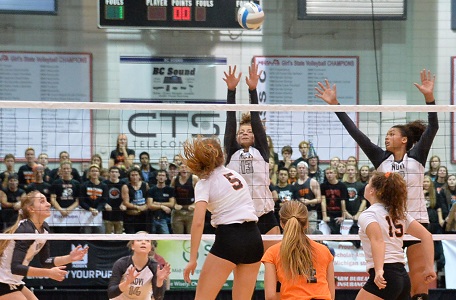 Because of these differences, Class A or B schools sometimes had to win twice as many games as Class C or D schools to reach the MHSAA Finals in a sport. At times, the larger classifications had District Tournaments, even rat-tail games, and/or a Quarterfinal game, and the smaller classifications did not. Most Class D Districts have had four teams (some only three), while Class A Districts often had seven or eight teams. In Regional levels of individual sports, the number of entries in the larger classification once greatly outnumbered those in the smaller classifications of the tournament for the same sport.
Over the years, these dividing lines between classes escalated gradually, as did the differences in enrollments of largest and small schools in each class. In 1937 the dividing lines were 700, 300 and 100 between Class A and B, B and C, and C and D, respectively. By 1987, the dividing lines were 1,129, 571 and 298, respectively, leading to the current method of collecting enrollments and then setting the classification.
With the pendulum swinging well past center by the late 1980s, coaches associations, MHSAA sport committees, tournament managers and school administrators began discussion and offered proposals to correct what many believed had become a flawed system of MHSAA tournament classification.
At the 1996 MHSAA Update Meetings, ¾ of 858 respondents to that year’s annual survey indicated they favored a system that would divide schools which actually sponsor each sport into two, three or four nearly equal divisions.
Problem solving
At its meeting May 4-6, 1997, the Representative Council defeated a motion that would have adopted in one action a coordinated plan of reclassification for all sports to equalize the number of schools in each tournament for each respective sport. Instead, the Council discussed and voted on each proposal that had been presented from sport committees.
This resulted in the Representative Council adopting four equal divisions for baseball and softball, four equal divisions for boys and girls tennis, four equal divisions for boys soccer and three equal divisions for girls soccer, effective with the 1997-98 school year. Helping in the decision was the success of the 1995-96 MHSAA Wrestling season, which saw the sport move to four divisions for its tournament structure
The Council delayed action on similar proposals for football and boys golf at that time to glean additional input. The same decision was made with respect to a proposal from the Ice Hockey Committee that would have split the Class A schools in two divisions and left the Class B/C/D Tournament unchanged.
“The gist of the move from classes to divisions was to equalize the path to championships for students of all schools, regardless of the size of those schools,” said MHSAA Executive Director Jack Roberts.
While the restructuring accomplished that goal for the majority of competitors, opposition exists now as it did then. The primary argument in opposition to the changes is that, in some sports, it increases the range between largest and smallest schools in the division for smallest schools, even as the range is usually reduced for other divisions.
Larger schools offered a counterpoint.
“The larger schools suggested that while they may have more students, they also attempt to sponsor more sports than the smaller schools, in some cases spreading the enrollment as thin as a much smaller school with fewer sports,” Roberts said.
“Even today, the idea of four equal divisions can be unpopular among some Class D schools which feel especially burdened by the equal division concept,” Roberts said. “There was enough opposition in 1997 that equal divisions were rejected for boys and girls basketball and girls volleyball, and some of that opposition remains.”
The numbers of schools sponsoring each MHSAA tournament are still close to the totals today, with the exception of soccer in both genders, which has enjoyed substantial increases. This spring, 466 girls teams were scheduled to compete in the MHSAA Soccer Tournament, while 473 boys teams will suit up this fall.
Since the beginning of MHSAA divisions in 1996 with wrestling, 147 additional team champions have been crowned and countless individuals have known the thrill of victory due to an extra level of Finals in various sports. Girls soccer has seen the most growth in opportunity, moving from two classes in 1987 to three divisions the following year, and then four divisions in 2000. Boys soccer had enjoyed four classes for two years prior to the new four-division format, and it was the sport of soccer that helped to create a caveat in the nearly equal division movement.
Lower Peninsula boys and girls swimming & diving expanded from two to three divisions in 2008, while boys and girls bowling are the most recent sports to enjoy increased tournament opportunity, adding a fourth division in 2010.
“Fairness is in the eye of the beholder. While having the same number of schools in each division is one kind of fairness, holding in check the enrollment range between the largest and smallest schools in Division 4 is another kind of fairness that is dear to a great number of people,” Roberts said. “Because more schools sponsor basketball and volleyball than other sports, Class D schools would have been least affected by the equal divisions concept in those sports; but that, and ‘tradition,’ did not dissuade the opponents in the 1990s.”
The shift to divisions not only paved the way for student-athletes, but also assisted administrators and schools hosting tournaments. MHSAA tournament mangers looked to equal divisions to more closely equalize the number of schools in District or Regional Tournaments and to better equalize the length of day required for these rounds of tournaments, both for management and participating teams and individuals.
Pinning down an answer
Wrestling became the first MHSAA Tournament to be conducted in nearly equal divisions when team and individual champions were crowned in Divisions 1, 2, 3 and 4 rather than Classes A, B, C/D for the 1996 winter championships.
The movement was well received, as schools saw more opportunity for success: four champions where there once were three at the District, Regional and Final levels, and a smaller range of enrollment between the smallest and largest school in all four tournaments, leading to the impetus for the Fall 1996 Update Meeting Survey of schools regarding similar movement in other sports.
Team champions that year were Holt (D1), Petoskey (D2), Middleville Thornapple Kellogg (D3) and Dundee (D4).
Getting their kicks
When the "equal divisions" concept was approved by the Representative Council for most MHSAA Tournaments for the 1997-98 school year, there was opposition from the smallest schools which, under the equal divisions, are forced to play against larger schools than reside in Class D. Compelling arguments were made – and still are – that an enrollment difference between schools with smaller enrollments (e.g., Class D) is more difficult to overcome in athletic competition than an even larger enrollment difference between schools with larger enrollments (e.g., Class A).
The opposition was most intense in soccer because of the number of students needed to field a team and the physical nature of the sport. As a result, from 2000-01 through 2010-11, soccer operated with a “20-percent modification.” This placed 20 percent of all schools that actually sponsored soccer in Division 4, and the remaining 80 percent were placed equally in Divisions 1, 2 and 3.
At the time the 20 percent modification was adopted, it was also established that soccer would return to four equal divisions when the largest Division 4 soccer school had an enrollment equal to or smaller than the mid point for Class C schools. That occurred in 2010.
Last class on the schedule
In the same volume of “history being the best teacher,” one can also find the adage, “times change.” While the division format was a welcome change in some sports, others were left to hold class without change.
 In the sports of boys and girls basketball, and girls volleyball, the number of schools sponsoring the sports were so close to the overall membership of the MHSAA that divisions were not necessary; the enrollment breakdowns themselves were enough to delineate equal opportunity for tournament success.
That is no longer the case, according to MHSAA membership. The last move from classes to divisions occurred for the 2006-07 school year following Council action. Before this May, that is. Action at the most recent Representative Council meeting, May 2017, called for the shift to divisions for MHSAA Boys and Girls Basketball, and Girls Volleyball, beginning with the 2018-19 season.
“Because the MHSAA Volleyball Committee had requested this change several times a number of years ago, and because the Council felt the change inevitable, there should not be further delay,” Roberts said. “It is an important detail that the Class D maximum has dropped 50 students over the past decade so the objection that much larger schools would be competing in Division 4 isn’t very strong now.”
Using the 2017-18 enrollment figures, just eight Class C schools would be competing in Division 4 for boys basketball, 11 for girls basketball and 14 for girls volleyball.
Good things came of the previous most-recent switches in 2006-07. Competitive Cheer was re-classified from Class A, B and C-D into four equal divisions assisting in the rapid growth of sponsoring schools (approximately 80 schools per division). Alpine skiing was changed from Class A and B-C D to two equal divisions.
At that time, the MHSAA Basketball Committee had recommended to the Council the study of increased classifications, but status quo remained.
Back on the grid
As such, MHSAA Basketball and Volleyball remained the only holdovers of the MHSAA class structure. Discussion resurfaced periodically during the last two decades to bring those tournaments in line with the other MHSAA sports.
Regular-season football-playing schools are separated by class, then are reshuffled by divisions for the playoffs. Football, as we know, underwent a significant postseason facelift in the late 1990s.
While MHSAA Football also remained a class sport through 1998, it had expanded from four to eight classes from 1990-98, becoming the first MHSAA sport to crown more than four team champions. Member schools were asked to consider a pair of options in November of 1997. One called for eight equal divisions, and the second would leave Class D by itself as division 8, and split Class A, B and C schools into seven nearly equal divisions.
After much discussion, retooling, and crunching of formulas, the MHSAA unveiled its revised Football Playoff model that continues to roll today, nearly 20 years later. It was determined that 256 teams would qualify for the tournament based first on a minimum of six wins, then by Playoff Points determined by formula. From there, the field would be divided into eight divisions, with the field being filled out by a nearly equal number of five-win teams in each division as needed to reach 256.
Eight championships would indeed be enough, until football sponsorship among the MHSAA’s smallest schools – some with rich football traditions – began to trend downward. The MHSAA again went to the drawing board, examining the viability of 8-player football. After an experimental year in 2010 without a tournament, the 8-player game was playoff-ready for 2011, with a field of 16 qualifiers embarking on a four-week tournament.
Not only did the 8-player option restore recently canceled programs, but it also created teams in schools which previously had none, and convinced some 11-player schools that this new division was the best path to take.
What did this do for the Class D holdovers staying in the traditional 11-player game? Well, a couple of things, positive and negative. As two and three dozen Class D schools opted for the 8-player game, the remaining 11-player Class D schools at times found themselves in disrupted leagues and had to travel further to complete schedules. They also competed against larger teams in Division 8 of the 11-player MHSAA Football Playoffs.
However, the growth of the 8-player game among the smallest schools also resulted in more Class D schools qualifying for the MHSAA Football Playoffs than ever before. In 2012, an all-time high 44 percent of Class D schools sponsoring football qualified for either the 8-player tournament or Division 8 of the 11-player tournament. That compared to 42.2 percent of Class C schools, 44.9 percent of Class B schools and 41.6 percent of Class A schools which qualified for the 2012 playoffs.
Much is to be determined in the most recent chapter of MHSAA Tournament expansion as the 8-Player Football Playoffs welcome a second division. As the past illustrates, there will be pluses and minuses. History also shows that the MHSAA has received maximum input from its constituents, researched all possibilities, and will find solutions to questions still in the balance before an additional group of athletes hoists a new trophy in November.
Through the Years
A chronology of when which sports moved from Class to Division in the MHSAA.
1995-96: LP Wrestling
1997-98: Baseball, Boys Soccer, Girls Soccer, Softball, LP Girls Tennis, LP Boys Tennis
1998-99: LP Boys Golf, LP Girls Golf
1999-2000: Ice Hockey, LP Boys Track & Field, LP Girls Track & Field
2000-01: LP Boys Cross Country, LP Girls Cross Country, UP Boys Cross Country, UP Girls Cross Country, UP Boys Golf, UP Girls Golf, UP Boys Tennis, UP Girls Tennis, UP Boys Track & Field, UP Girls Track & Field
2002-03: LP Girls Swimming & Diving, LP Boys Swimming & Diving
2005-06: Boys Bowling, Girls Bowling
2006-07: Girls Competitive Cheer, Boys Skiing, Girls Skiing
2018-19: Boys Basketball, Girls Basketball, Girls Volleyball
Note: Boys and Girls Lacrosse has been a divisional sport since it began in during the 2004-05 school year.
Ratings, Polls & Birth of State's 'Top Ten'
September 30, 2020
By Ron Pesch
Special for Second Half
By December, with the annual announcement of Michigan’s All-State football team, the intense pressure of the 1951 season had disappeared for two of the state’s finest high school coaches.
The football season had started with an exceptional honor for Muskegon’s Harry Potter, one of the mentors.
“Six leading Michigan school-boy coaches, representing separate geographical areas of the state, again will write daily stories for Free Press readers heralding the outstanding All State candidates from week to week,” noted prep sportswriter Hal Schram.
Potter worked with Joe Rosbeck of Hamtramck, Bob Waldorf from Battle Creek Central, Willard Anderson of Stambaugh, Herb Korf of Saginaw High School and Hiram Becker of Cadillac High on the board.
“At the close of the 1951 campaign these six veterans in Michigan’s prep coaching ranks will be brought to Detroit by the Free Press to select Michigan’s official All-State team.” It was the third straight season the Detroit paper had done such.
Potter had joined the Muskegon staff as reserve coach in 1927, serving as an assistant to head varsity coach C. Leo Redmond. In 1947, when the successful Redmond resigned to take a position as a principal within the district, Potter took charge of the varsity.
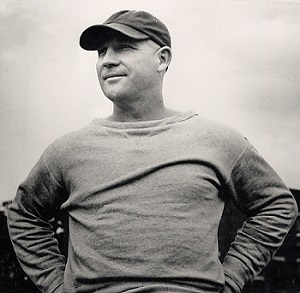
Ted Sowle could relate to the pressure no doubt felt by Potter. Schram, the Free Press’ high school sports editor, had really started his full-court press on prep coverage in 1949. For a nickel daily, readers could keep tabs on the state’s top teams and players. The head coach at Grand Rapids Catholic Central had been honored in 1950 to occupy one of those half-dozen cherished seats on the Free Press All-State board. Sowle (who had also replaced a successful and cherished coach in Edward Killoran at Catholic) joined a panel that featured well over 100 years of coaching experience, including future University of Nebraska coaching legend Bob Devaney, then guiding Alpena High School, and Howard Auer, who had led Flint Central since 1939. Bill Kelly, Saginaw Arthur Hill’s mentor, with 19 seasons, and Oscar E. ‘Okie’ Johnson of Muskegon Heights – Michigan’s Dean of Coaches with 24 campaigns under his belt – were among the six that sat on Schram’s first All-State board.
 All of the state’s high school gridiron coaches could assist the panel representatives by mail weekly, with material for their columns. “Postcards, addressed to their Board representative, are in the hands of all state schoolboy coaches for the ‘feeding’ process,” stated Schram explaining the procedure to readers. At season’s end, having received ballots from those coaches, game officials and sports reporters, the board named the Free Press’ All-State squad.
During the 1951 season, the six board members penned 42 by-lined stories for the paper. Potter’s updates appeared on Fridays in the Free Press.
On Friday, November 30th, five of the six All-State Board members gathered at Detroit’s Hotel Shelby, then spent seven hours on Saturday compiling, correlating, then distilling down “recommendations of more than 400 other Michigan coaches… which climaxed a season long search.” Herb Korf of Saginaw, “confined to his bed with the flu” had been unable to attend. His choices and material, however, had been sent to Detroit to be weighed with the others.”
Because of the method of involvement, Schram referred to the Detroit Free Press All-State squad as “Michigan’s OFFICIAL All-State” team. Released on Wednesday, December 5th after masterful pomp and circumstance by the advertising staff of the Detroit paper over the weeks previous, the 1951 team, like several before it, featured the names of nearly 400 prep players. The first, second and third teams each included 11 names that came from, but were not limited to, schools with the largest enrollment, labeled Class A in Michigan. An additional 22 players, 11 each from Class B and Class C enrollment-sized schools, were also accorded top honors. Finally, more than 300 other players were recognized on the extensive honorable mention list by the paper.
As challenging and rewarding as the work had been to Potter, it was not what had brought the majority of stress to the coach during the 1951 season.
Rivals
Located 40 miles apart, the cities of Muskegon and Grand Rapids had been longtime rivals, economically and athletically, since the turn of the century. The Big Reds had faced Catholic Central on the gridiron off and on since 1918. The teams had met to uncap the season in both 1949 and 1950. The Cougars had won both games, but Muskegon still led the 10-game series between the schools with seven wins against three defeats. With the end of their home-and-home contract, they would not play each other in 1951. Grand Rapids Press sportswriter Lendy Davis wrote the Big Reds were dodging Catholic, expected to be a strong squad.
So, it was a bit of a surprise when Potter and Sowle, rivals on the gridiron, united over issue with another aspect of the newspaper industry’s battle for readers – the weekly rating of high school football teams to identify a state champion.
Almost from the day football became a sport in Michigan, the battle for supremacy – local, state or national – has been part of the game. Claims on Michigan’s state prep title date back to at least 1894. Today, the Michigan High School Athletic Association awards 10 gridiron championship trophies – eight across Divisions in 11-player football and two across Divisions in 8-player football – via a structured playoff. However, the MHSAA’s first postseason football tournament didn’t arrive until 1975. That season, the Association awarded championships in four enrollment groupings – Class A, B, C and D.
Postseason basketball tournaments sponsored by the Association and its predecessors had produced annual champions in Michigan dating back to at least 1918. State Track and Field meets had named champions even before that time. But in football, operating without a postseason since its start before the turn of the 20th century, naming champions was left in the hands of the media and the schools prior to 1975. Without structured head-to-head competition to sort the results of the state’s nine-game season, titles were based on observation, opinion, guesswork or proclamation. Hence the term ‘mythical’ is applied to state titles proclaimed prior to 1975 in the Great Lakes State.
Rankings and the evolution of the 'Top Ten'
Initiated by a suggestion from Charles Sumner ‘Cy’ Sherman, a Lincoln, Nebraska sportswriter, The Associated Press (AP) launched college football’s Top Ten weekly rankings in 1936 with a national poll of a hundred sportswriters. In 1943, in the final weeks of the season, Watson Spoelstra of the AP in Michigan used late-season lists to relay the win-loss marks of the state’s undefeated and once defeated high school football teams with the largest enrollment numbers. Those lists were sorted, first by victories, then by points scored. (‘Waddy’ Spoelstra would later become a sportswriter for the Detroit News, a correspondent for The Sporting News and the founder of the Baseball Chapel, an international ministry responsible for the appointment of team chapel leaders, recognized by Major League Baseball.)
The Detroit Free Press writer Truman Stacey can be credited with the creation of Michigan’s weekly poll, starting with his arrival in Detroit in 1944. He brought the idea with him from his previous job as a sportswriter in Oklahoma. In 1943 at the Daily Oklahoman, published in Oklahoma City, Stacey’s byline regularly appeared with the ranking of the Sooner State’s “Top Ten” high school football teams. The concept, at least in Oklahoma, was initiated by his predecessor, sports editor Arthur Edson, in 1941. (Edson started at the Oklahoman in 1936, and later would become a longtime newsman for the Washington D.C. bureau of The Associated Press, and political writer for U.S. News and World Report).
In Michigan, Stacey’s “ratings proved so popular that both news services and other newspapers picked them up later,” wrote Schram at the dawn of the MHSAA Playoffs in 1975. “After all, a good thing is a good thing, even if someone else thinks of it first.”
Within weeks, Stacey quickly proved the impact and popularity of the polls with fans. His first top-ranked team was Jackson High School: “By reason of three decisive victories over strong foes, Jackson stands at the top of the list as the State’s finest football team.”
In Week 6, Jackson squared off with Muskegon, the state’s second-ranked team according to the rankings. In his weekly Tuesday column, Stacey relayed the result to readers in dramatic fashion:
“Jackson’s fancy Vikings, for five straight weeks the kingpins of high school football in Michigan, fell from their pinnacle this week as the list of the state’s top ten teams underwent its most drastic revision.
“Muskegon, by virtue of the completeness of its 19-0 victory over the former leaders, fell heir to Jackson’s scepter as the state’s schoolboy ruler.
“The two leaders clashed for the top in a game that created so much excitement in Muskegon Friday night the school officials were forced to close the gates of the stadium 15 minutes before the kickoff, after 10,000 fans had jammed their way inside.”
Blueprint for the future
The theatrics and playfulness that inspires chroniclers of the weekly polls today was present in 1944.
Muskegon stayed at the top of Stacey’s list as the year rolled on, with Grand Rapids South and Saginaw nipping at its heels.
With two games left to play in the season, Stacey’s column in the Friday paper leading up to Week 8’s games focused on a call he had received from Federal Judge Frank Picard. A Saginaw High and University of Michigan alum and devout Trojans football fan, Picard was questioning the writer’s smarts as the season headed for a conclusion.
“Fierce blue sparks darted from the telephone when I listened to him speaking in what, for want of a better description, I shall call his six-gun voice,” Stacey wrote.
 “’I see you haven’t yet learned that crime does not pay, Stacey,’ he said. ‘You still have Muskegon up there in first place ahead of Saginaw, which is a mere third in your rankings …’”
Emphasizing that he felt the Trojans had played a stronger schedule, Picard asked, “By just what process of reasoning do you consider Muskegon a better team than Saginaw?’
…’Well, your honor, I just used my own judgement, and ---‘
“’I’d send a man to jail for less! You are a menace to American jurisprudence.”
Picard must have been annoyed when Stacey’s Week 8 poll arrived, showing Saginaw had slipped past Grand Rapids South for second place, but still trailed the Big Reds for the top spot. He must have been overjoyed when Stacey finally saw the light.
“The 1944 race to decide Michigan’s mythical state high school grid champion blazed to the tape in a photo finish. … It was one of the ironic quirks of the schedules that the three powers did not meet – a circumstance which caused many fans and coaches to bemoan the lack of a method of deciding a champion similar to that employed during the basketball season.
“By reason of a 13-6 decision over Arthur Hill in their final start on Thanksgiving Day, the Trojans of Coach Carl Nordberg won a narrow decision over Muskegon and South for the top spot among the state’s elect.
“The victory gave the Trojans their first perfect season since 1907, when another mythical state champion was produced.”
Incidentally, the quarterback of that 1907 Saginaw team was Frank Picard. A tie in a season-ending game with, ironically, Muskegon that year had allowed Saginaw to proclaim itself “mythical” state champion.
A good thing – or is it?
In late September 1945, Stacey announced he had accepted a position as public relations director for the University of Detroit. During his stay at the university, he earned his bachelor and master’s degrees.
Hal Schram, previously a prep writer for the Lansing State Journal, stepped into Stacey’s role on the Free Press sports staff. Over his 42-year career, he would expand and enhance what Stacey started and ultimately define the role of a beloved prep writer.
In 1945, Muskegon Heights unseated top-ranked Muskegon in the final week of the season to earn the Free Press title. The Big Reds, riding a 16-game win streak before the loss, had been Schram’s top-ranked team for the previous three weeks. The Tigers laid claim to the crown with a 7 to 6 triumph played out before 13,500 fans. Two Class B schools made Schram’s final top 10. (In the coming years, the top 10 lists would eventually expand to separate and rank all four enrollment classes in Michigan.)
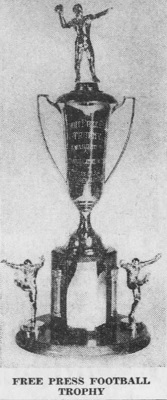
In 1946, Lansing Sexton slipped past undefeated Muskegon Heights in the Week 9 poll for the Free Press championship. With the 1947 season, Schram and the Free Press publicized use of a statistical championship system to rank the state’s Class A teams and announced plans to award a 30-inch high trophy to symbolize the achievement of ending the season as the top-ranked football team. (A limited number of copies, describing the system, were available to those interested by sending a self-addressed stamped envelope to Schram at the Free Press). Flint Central emerged as titleholders with Port Huron finishing second. Despite running its consecutive win streak to 27, Muskegon Heights ended the season fifth in the Free Press final standings.
The Associated Press chose to jump into the fray of ranking teams in 1947 with a poll of Class A schools by the state’s sportswriters. George Maskin, prep writer at the Detroit Times, opted to rank teams too. They both named Flint Central as tops in the state, with Muskegon Heights ending the year in second. Port Huron landed in third place in the AP poll and fourth in the Times rankings.
While the Free Press and Times awarded the state’s No. 1 ranking to Grand Rapids Union in 1948, the AP did not rank squads, opting instead for a season-ending compilation of undefeated teams, supplied by “Dick Kishpaugh, Kalamazoo statistician and newsman.” When announcing its All-State squads in December, the AP did note that Union was “generally considered the No. 1 team in the state.”
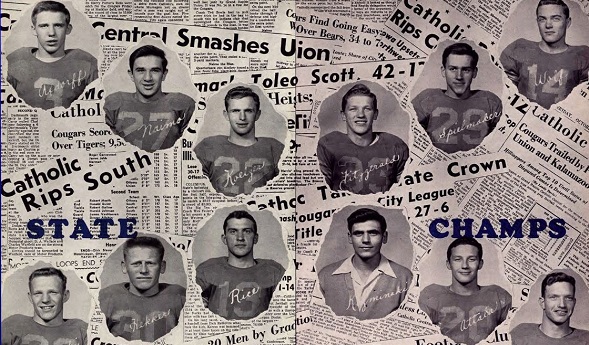
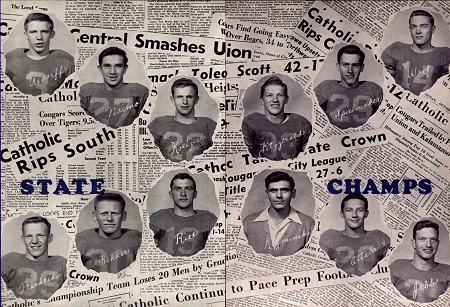
Grand Rapids showcased its second-straight Free Press trophy as the Cougars of Catholic Central, led by Coach Sowle, grabbed the 1949 crown. The Cougars downed Muskegon, Muskegon Heights, Toledo Scott and Grand Rapids Union to start the season, never relinquishing their hold on the No. 1 spot in Schram’s Top Ten. The Times concurred.
In 1950, United Press International (UPI) entered the ratings game. At season’s end, the Free Press, the Times and UPI all awarded the mythical crown to Flint Northern. The Associated Press remained on the sidelines. However, when naming Northern’s backfield trio of Duncan MacDonald, Ellis Duckett and Leroy Bolden to its annual Class A All-State squad, the AP did indicate that the three backs were “the big reason why Flint Northern smashed its way to nine straight wins this season to make it a standout for honors as the state championship eleven.”
Madness
The Free Press, Detroit Times, Grand Rapids Press, AP, and UPI all took to rating statewide teams in 1951. According to Schram, a total of 69 Class A and B teams, “whose schedule sends their teams against at least three Class A opponents” were eligible for the Free Press trophy, now in its fifth year of presentation.
Sowle’s Grand Rapids Catholic Central Cougars immediately grabbed control of the top spot in the rankings. With the exception of the Free Press ratings, Muskegon quickly emerged as the second-ranked team in the polls.
With two weeks remaining on schedules, Muskegon and Catholic were tied for the top spot in the Associated Press poll. The Big Reds overtook Catholic Central for the top spot in the AP Top Ten in Week 8, following a 33-0 win over Southwestern Conference rival Kalamazoo Central. (AP sports editor for Michigan, Harry Stapler, had made a surprise visit to the press box at Muskegon to check out the action). That victory was also enough for the Big Reds to slip by Owosso for second place in the Free Press rankings. Earlier in the year, Birmingham (now Birmingham Seaholm), a Class B school playing a slate composed of primarily Class A competition, had a lock on No. 2 in Schram’s statistical championship system.
In their season-ending contest, hosted at Houseman Field in Grand Rapids, the Cougars squared off with twice-beaten Detroit Catholic Central. Muskegon would face crosstown rival Muskegon Heights in its finale. Catholic and Muskegon had met only one like opponent on the year – Holland. The Cougars downed the Dutchmen, 32-12 in Week 4. Muskegon overpowered Holland 48-0 in Week 5.
Ted Olewinski and Roman Zobro, a pair of breakaway backs, powered the GRCC attack. Led by senior quarterback Earl Morrall, who later played 21 seasons in the NFL, the Big Reds had scored 290 points on the year – tops in the state entering the game. According to Schram, both teams were favored by two touchdowns.
Only hours after their contests, both Coach Sowle and Coach Potter publicly criticized the football polls as putting too much pressure on teams and players and creating overemphasis on high school football.
Who won?
Both teams emerged victorious. The Free Press, United Press International and the Grand Rapids Press each named Grand Rapids Catholic as state champion. The Associated Press poll selected Muskegon in a tight vote of sportswriters.
“Man for man, perhaps, the Cougars might boast an edge on Muskegon,” said George Maskin of the Detroit Times. “But Muskegon’s ace quarterback, Earl Morrall … certainly balanced the books.” The teams finished the season as co-champions according to Maskin’s Times rankings.
“For the first time in my career – with a winning club – I was booed from the stands this season when I substituted at a point where we could have continued to score,” said Sowle, speaking out at a Knights of Columbus dinner honoring the Catholic Central team the day after the Cougars’ season-ending victory over the Shamrocks.
“My first string, gunning for state honors, begged me to keep them in the game … in order to win a decisive victory and enhance the state championship possibilities. They wanted to demonstrate their scoring potential for reasons created by the rating system.”
“When we piled up that big score Saturday night, we were battling the polls, and not Detroit.”
 “Coach Ted Sowle of the G.R.C.C. kept his regulars in action until only 30 seconds remained in the game,” wrote Maskin, who made the trip to Grand Rapids for the game. “They had a hand in all eight Cougar scores.”
The Cougars defeated DCC 51-0 before a crowd of 6,100.
Heavy snow had been removed from the stands of Hackley Stadium by students and from the field by city plows in Muskegon in preparation for the Saturday game with the Heights. With temperatures in the 40s, the Big Reds downed the Tigers, 26-6, in front of 11,000 fans.
Potter said that during the season, “he had been open to criticism because he removed his regulars in several games and did not ‘pile it on’ to the last touchdown.”
“It has been like trying to hold in thoroughbred horses. The boys themselves feel the poll rivalry keenly and want to go all out.”
The comments received statewide coverage.
“Such blasts have been heard consistently in the college ranks this season,” stated a United Press article.
Schram fights back
Schram came out swinging at the criticism.
“In Michigan there are two generally-accepted state-wide high school rating systems,” stated the Detroit writer. “One is a ‘popularity poll’ in which voters are influenced, to some extent, by the size of scores. The other, conducted by the Free Press for seven seasons, award points for winning and tieing games. It takes into account the quality of opposition – but does not give a bonus for increasing the point spread.”
Potter emphasized to the Free Press he was against all ratings of high school teams. Sowle backtracked a bit in conversation with Schram, stating “his critical remarks were not directed at the Free Press system,” and agreed with the writer that the paper’s system was “the ‘fairest possible approach.’”
“We feel that this feature creates interest,” continued the journalist. “We think it’s a lot of harmless fun. Rating systems have been used in many states for the past 10 years and have proved very popular with readers, coaches and players alike. In the absence of an official high school playoff toward state championships, such as (those) in Texas, Oklahoma and other states, the Free Press believes a rating system is the best possible way for fans, players and coaches to evaluate teams.”
Schram concluded with a final statement.
“The Free Press system operates in such a fashion that it is free from any such charges. The Free Press will continue to rate high school teams in football and basketball.”
Battle Raged
“Proponents of the polls claimed they increased interest in high school athletics, raised the standard of play, brought in funds at the gate that helped support minor sports and were demanded by readers,” noted the AP as it weighed the issue. The AP also observed that others felt polls were a detriment to sportsmanship, created unnecessary rivalry between schools, encouraged teams to run up scores and curbed substitutions even though the game was in hand. Some felt that the polls encouraged betting.
Charles E. Forsythe, state director for the MHSAA, was asked for comment.
“We can’t do anything to stop the rating systems of course. We wouldn’t think of attempting to. But the association may decide whether or not to make a statement on its stand,” he said.
At the end of November, the MHSAA’s Representative Council unanimously did adopt a motion denouncing such polls. A spokesman for the Council said the only issue at stake in the voice vote was: “’Do the polls do any good?’ He said the discussion was brief, as no one spoke in favor of the polls.”
In June of 1952, the managing editors of Associated Press-affiliated newspapers responded. In a 12-11 decision, they voted to discontinue the weekly polls. The Free Press and Times, UPI and other organizations pushed on unabated.
Schram reminded readers that point spreads were not a factor in the Free Press system. The Associated Press returned to running Kishpaugh’s lists of undefeated squads. After three years away, they returned to posting weekly gridiron polls in the fall of 1955. There appears to have been little if any objection.
Since then, as sure as the leaves start to fall come football season, Michigan’s media outlets hype the coming prep season and rank the state’s prep teams.
 Ron Pesch has taken an active role in researching the history of MHSAA events since 1985 and began writing for MHSAA Finals programs in 1986, adding additional features and "flashbacks" in 1992. He inherited the title of MHSAA historian from the late Dick Kishpaugh following the 1993-94 school year, and resides in Muskegon. Contact him at [email protected] with ideas for historical articles.
PHOTOS: (Top/4) Grand Rapids Catholic Central was celebrated as the 1949 "mythical state champion." (2) Muskegon football coach Harry Potter. (3) GRCC received the Detroit Free Press trophy as the top team in 1951. (4) GRCC coach Ted Sowle. (Photos gathered by Ron Pesch.)