


Classes Still Create Hoosier Hysteria
July 27, 2017
By Rob Kaminski
MHSAA benchmarks editor
This is the fourth part in a series on MHSAA tournament classification, past and present, that will be published over the next two weeks. This series originally ran in this spring's edition of MHSAA benchmarks.
Twenty years ago, Bloomington North High School won the Indiana High School Athletic Association boys basketball championship, defeating Delta 75-54 at the RCA Dome in Indianapolis.
The date, March 22, 1997, is at the same time revered and disdained by traditionalists in the state who saw it as the last schoolboy championship game the state would ever host.
That’s how devout the game of basketball, particularly interscholastic basketball, had become in the Hoosier state during the 87 years a state champion – one state champion, to be precise – was crowned.
Following that 1997 season, the IHSAA moved to a four-class system for its roundball tournaments, like so many of its state association counterparts had done years earlier.
It would be shocking to find more than a small percentage of current high school basketball players around the country unfamiliar with the iconic movie Hoosiers, even though the film is now more than 30 years old.
And, the storyline for that blockbuster unfolded more than 30 years prior to its release, when small-town, undermanned Milan High School defeated Muncie Central High School 32-30 in the 1954 IHSAA title game.
Perhaps it’s because of the David vs Goliath notion, or the fame of the movie that replaced Milan with the fictional Hickory and real-life star Bobby Plump with Hollywood hero Jimmy Chitwood, or the simple fact that Indiana had something other states didn’t.
Whatever the reason, plenty of opposition remains to this day to basketball classification in the state.
The fact is, the small rural schools were regularly being beaten handily by the much larger suburban and city schools as the tournament progressed each season.
Small schools also were closing at a rapid rate following the state’s School Reorganization Act in 1959, as students converged on larger, centralized county schools. From 1960 to 2000, the number of schools entering the tournament dropped from 694 to 381, and in 1997 a total of 382 schools and 4,584 athletes began competition at the Sectional level (the first level of the IHSAA Basketball Tournament).
It was at the entry level of the tournament where school administrators felt the pain of the new class system, but not necessarily for the same nostalgic reasons as the fans who either attended or boycotted the tournament.
At the Sectional round of the tournament, the IHSAA was culling just 2 percent of the revenue, with the participating schools splitting the balance. So, when Sectional attendance dropped by 14 percent in that first year of class basketball, many schools realized a financial loss. It was money they had grown to count on in prior years to help fund various aspects of the department.
Schools cumulatively received more than $900,000 from Sectional competition in 1998, but that total was down from more than $1 million in the last year of the single-class tournament.
Yet, the current format provides a great deal more opportunity and realistic chances at championship runs for schools of all enrollments.
To date, 60 additional teams have championship or runner-up trophies on display in school trophy cases around Indiana.
That was the mission in front of then-IHSAA commissioner Bob Gardner (now National Federation executive director) once the board made its decision: to give thousands more student-athletes the opportunity for once-in-a-lifetime experiences.
As any statistician knows, figures can be manipulated to tell any side of a story. Declining attendance in year one of class basketball is such a number.
The truth is tournament attendance had been on a steady downward spiral since its peak of just over 1.5 million in 1962. By the last single-class event in 1997, the total attendance was half that.
The challenge then and today, as it is for all state associations, is to find that delicate balance for those holding onto tradition, those holding onto trophies, and the number of trophies to hand out.
Editor’s Note: Stories from the Fort Wayne Journal Gazette in 1998 and from a 2007 issue of Indianapolis Monthly provided facts in this article.
Breslin Bound: 2024-25 Boys District Preview
By
Geoff Kimmerly
MHSAA.com senior editor
February 24, 2025
March is finally on the horizon, our state finally seems to be thawing out from a long, snowy winter – and all signs point to East Lansing as Districts tip off the MHSAA Boys Basketball Tournament tonight for more than 700 teams.

We always switch up our “Breslin Bound” format once the MHSAA Tournament starts, as last week’s most intriguing results below are followed this time by glances at three District brackets of note in each division. Host sites are bolded, and teams playing in those brackets are listed by seed as determined by Michigan Power Ratings (MPR).
Everything you could want to know this week about tickets, brackets and more can be found on the Boys Basketball page. To watch any of several games online, visit the NFHS Network.
“Breslin Bound” is powered by MI Student Aid based on results and schedules posted for each school at MHSAA.com.
Week in Review
The countdown of last week’s five most intriguing results:
1. Orchard Lake St. Mary’s 76, Detroit Renaissance 73 Catholic High School League champion St. Mary’s (15-6) claimed its second-straight Operation Friendship victory, in a close one this time over the Detroit Public School League-winning Phoenix (14-8).
2. Novi 66, Wayne Memorial 64 After edging Northville by two points four days earlier to clinch the Kensington Lakes Activities Association West title outright, Novi (18-4) moved past East winner Wayne (19-3) for the overall league championship.
3. Flint Kearsley 75, Goodrich 73 Kearsley (16-6) jumped from third in the Flint Metro League Stripes last season to a three-way tie for first this winter, then edged Lake Fenton by three and Goodrich (17-5) by a bucket to claim the overall league title.
4. Kingsford 72, Marquette 60 The Flivvers (17-3) avenged a 58-53 loss to Marquette (19-3) from Jan. 3 to pull even with the Sentinels and share the Great Northern Conference championship.
5. Hartford 61, Centreville 50 The Huskies (19-2) avenged their lone league defeat, 59-50 on Jan. 27, to pull even with Centreville (18-3) and share the Southwest 10 Conference title.
Districts at a Glance
These could be among our most competitive brackets. Host sites are in bold, and teams are listed by seed:
DIVISION 1
Auburn Hills Avondale
1. Waterford Mott (19-3), 2. Auburn Hills Avondale (15-7), 3. Clarkston (15-7), 4. Lake Orion (15-7), 5. Waterford Kettering (1-21).
Clarkston would be the favorite most seasons but enters after finishing fourth in the Oakland Activities Association Blue and having been swept by its Wednesday opponent, league runner-up and District host Avondale (15-7). On the other side, Mott was the co-champion from the Lakes Valley Conference and fell just a pair of overtime losses from a perfect league run. Lake Orion was runner-up in the OAA White and fell to Clarkston 49-38 on Dec. 4 – a few months ago but sure to be mentioned if they meet again Friday.
Grosse Pointe South
1. Detroit Martin Luther King (17-4), 2. Detroit Cass Tech (19-3), 3. Grosse Pointe North (18-4), 4. Grosse Pointe South (7-14), 5. Detroit East English (9-10), 6. Detroit Western (2-15).
King/Cass Round 3 is likely the expected Friday title matchup. They’ve met in District play the last three seasons and split their meetings this season with Cass winning 54-42 on Dec. 17 and King taking the rematch in the Detroit Public School League Tournament 58-52. Grosse Pointe North will do its best to crash the party coming off a Macomb Area Conference Blue championship and riding an 11-game winning streak that’s included a 58-43 win over Adrian (18-4).
Muskegon Reeths-Puffer
1. Rockford (20-2), 2. Muskegon (19-2), 3. Greenville (21-1), 4. Muskegon Mona Shores (10-12), 5. Cedar Springs (9-13), 6. Muskegon Reeths-Puffer (6-16).
A potential championship matchup of Ottawa-Kent Conference Red champion Rockford and O-K Green title winner Muskegon is what most will anticipate, and that makes sense – all four of their combined losses came to teams ranked among the top seven in statewide Division 1 or MPR, and traditionally they are two of the strongest West Michigan programs in any division. But River Cities Alliance champion Greenville definitely gives this bracket an intriguing wild card – its only loss came to Allendale (16-6), and 17 of the Yellow Jackets’ wins were by double digits.
DIVISION 2
Adrian
1. Onsted (20-1), 2. Adrian (18-4), 3. Adrian Madison (18-3), 4. Tecumseh (16-6), 5. Milan (5-17).
The top two teams from the Lenawee County Athletic Association and Southeastern Conference White top this bracket, as Onsted and Madison shared the LCAA title and Adrian High was first and Tecumseh second in the SEC White. Onsted and Madison split, with Madison winning the second meeting Jan. 30, and that may become notable if they meet one more time as that was Onsted’s only loss. Adrian defeated Tecumseh by 11 and 19 and also Madison by 16 on Dec. 16 – but the Maples are coming off a 73-60 loss to Brooklyn Columbia Central (18-4).
Grand Rapids Catholic Central
1. Grand Rapids Covenant Christian (19-3), 2. Hudsonville Unity Christian (20-2), 3. Grand Rapids Catholic Central (15-7), 4. Allendale (16-6), 5. Grand Rapids West Catholic (9-12), 6. Wyoming Lee (8-14).
Covenant Christian moved into Division 2 this season after reaching the Division 3 Quarterfinals a year ago, and the Chargers loaded their schedule with several Division 1 and 2 teams and contenders from Divisions 3 and 4 – notably handing North Muskegon its only loss but also falling to Unity 46-39 on Dec. 3. That was some time ago but will provide some familiarity if Covenant and the O-K Black champion Crusaders meet again. Don’t count that as a sure thing, however. Unity saw potential Wednesday opponent GRCC at Calvin University on Dec. 14, winning but in overtime 53-49. And Covenant saw its potential Wednesday opponent Allendale on Dec. 20, winning 58-52 in another close matchup.
Otsego
1. South Haven (17-3), 2. Paw Paw (19-3), 3. Parchment (19-3), 4. Plainwell (14-6), 5. Allegan (9-11), 6. Otsego (5-15).
The top four-seeded teams in this bracket either won or finished runners-up in their respective leagues – Parchment winning the Southwestern Athletic Conference Valley, Paw Paw winning the Wolverine Conference, Plainwell placing second in the Wolverine and South Haven second in the SAC Lakeshore but still earning the top seed this week. South Haven did defeat Parchment 57-45 at Kalamazoo College on Nov. 30, and also has notable wins over Galesburg-Augusta (18-4) and Berrien Springs (17-4). Parchment has won 17 of its last 18 games, falling only to Battle Creek Pennfield (18-4) by three during that time.
DIVISION 3
Bark River Harris or Higher Seed (non-traditional)
1. Iron Mountain (19-3), 2. Munising (19-2), 3. Menominee (11-11), 4. Gwinn (9-13), 5. Bark River-Harris (7-15), 6. Manistique (4-18).
Western Peninsula Athletic Conference East champion Iron Mountain has pairs of wins over Gwinn and Manistique and a 16-point victory Feb. 3 over Menominee, which knocked the Mountaineers out of the District a year ago. Munising won the large schools division of the Skyline Central Conference and also has a pair of wins over Manistique and one over Gwinn – and may have to defeat Menominee in the District Semifinal to reach Friday’s championship game. Bark River-Harris is the named host for this non-traditional bracket and will host all games it plays; otherwise the highest seed in each game will host that contest.
Hanover-Horton
1. Jackson Lumen Christi (19-3), 2. Grass Lake (21-1), 3. Hanover-Horton (14-8), 4. East Jackson (11-11), 5. Napoleon (9-13), 6. Vandercook Lake (4-18).
Lumen Christi has emerged as a basketball contender the last two seasons, reaching the Quarterfinals a year ago and finishing CHSL AA runner-up this season to another Division 3 contender in Riverview Gabriel Richard. Grass Lake has made a jump too after finishing 11-13 a year ago, winning the Cascades Conference East and overall championships with its only loss last week to Clinton, 42-40. Grass Lake has a Dec. 3 53-48 win over Hanover-Horton, a possible Wednesday opponent and the runner-up from the Cascades Conference West. East Jackson finished fourth in the Cascades East, also enjoying a nice bump after going 8-15 a season ago.
Quincy
1. Schoolcraft (16-6), 2. Centreville (18-3), 3. Union City (14-8), 4. Bronson (11-11), 5. Quincy (11-10), 6. Homer (5-17).
This could be one of the most evenly-matched brackets in any division. Schoolcraft was the SAC Valley runner-up but defeated Centreville 62-54 on Feb. 5. Centreville shared the Southwest 10 Conference title. Union City was one of three runners-up in the Big 8 Conference (where Bronson finished fifth and Quincy sixth), sweeping Bronson but winning the second meeting only 63-61 and splitting with Quincy losing the second meeting 58-48 just last week – although those two are on Schoolcraft’s side of the bracket and Union City must instead defeat Homer and Centreville to get to Friday. Schoolcraft reached the Regional Final a year ago before falling to eventual Division 3 champion Niles Brandywine.
DIVISION 4
Crystal Falls Forest Park or Higher Seed (non-traditional)
11. Crystal Falls Forest Park (20-2), 2. Norway (17-5), 3. Powers North Central (10-11), 4. Stephenson (15-7), 5. Hannahville Nah Tah Wahsh (15-7), 6. Carney-Nadeau (6-16).
Skyline Central Conference small-schools division champion Forest Park swept third-place Powers North Central and also has a pair of wins over Norway and one over Stephenson as the Trojans seek to match and surpass last season’s run to the Quarterfinals. Their only losses were to Great Northern Conference co-champions Marquette and Kingsford. Norway finished second to Munising in the SCC large-schools division, with four of its five losses to teams with at least 19 wins. North Central has won only three of its last 11 games, but two straight including last week over Hannahville Nah Tah Wahsh 68-63. Stephenson also has a win over Nah Tah Wahsh and split with North Central – avenging a 34-point loss with a 12-point win a month later.
Saginaw Michigan Lutheran Seminary
11. Mount Pleasant Sacred Heart (18-3), 2. Saginaw Nouvel Catholic Central (13-8), 3. Coleman (13-9), 4. Saginaw Michigan Lutheran Seminary (13-9), 5. Merrill (5-17), 6. Midland Calvary Baptist (5-16).
Mid-State Activities Conference champion Sacred Heart is seeking to return to the Division 4 championship game after finishing second last season, and went 2-2 in nonleague play this winter stacking the schedule with Beal City, Marine City Cardinal Mooney, Maple City Glen Lake and Jackson Lumen Christi. Nouvel finished second in the Tri-Valley Conference Blue but played Ithaca (17-4) last week for a share of the title and loaded its nonleague schedule as well. Among potential stoppers, Coleman is enjoying its first winning season since 2019-20, and MLS its first since 2020-21 and with a split with Nouvel – although the Panthers avenged losing the first game by seven points by winning the second by 15.
Vestaburg
1. Fowler (19-3), 2. Fulton (17-5), 3. Portland St. Patrick (14-7), 4. Vestaburg (12-8), 5. Breckenridge (10-11), 6. Ashley (1-21).
While Fowler may be the favorite – the Eagles finished second in the Central Michigan Athletic Conference to Division 3 Pewamo-Westphalia (19-3) and have double-digit wins over Fulton and St. Patrick – there are opportunities to shake things up. Fowler did win its one matchup with Fulton 62-32, but the Pirates went on to finish second in the MSAC and downed Sacred Heart 70-62 last week. St. Patrick finished third in the CMAC and cut its deficit against Fowler from 22 to 13 between their first and second meetings. Vestaburg was fourth in the MSAC, losing the second meeting to Fulton by 11 but winning the first by six, and Breckenridge took Fulton to overtime in their second game.
MHSAA.com's weekly “Breslin Bound” previews and reviews are powered by MI Student Aid, a division within the Department of Lifelong Education, Advancement, and Potential (MiLEAP). MI Student Aid encourages students to pursue postsecondary education by providing access to student financial resources and information. MI Student Aid administers the state’s scholarship and grant programs that help make college Accessible, Affordable and Attainable for you. Connect with MI Student Aid at www.michigan.gov/mistudentaid and find more information on Facebook and Twitter @mistudentaid.
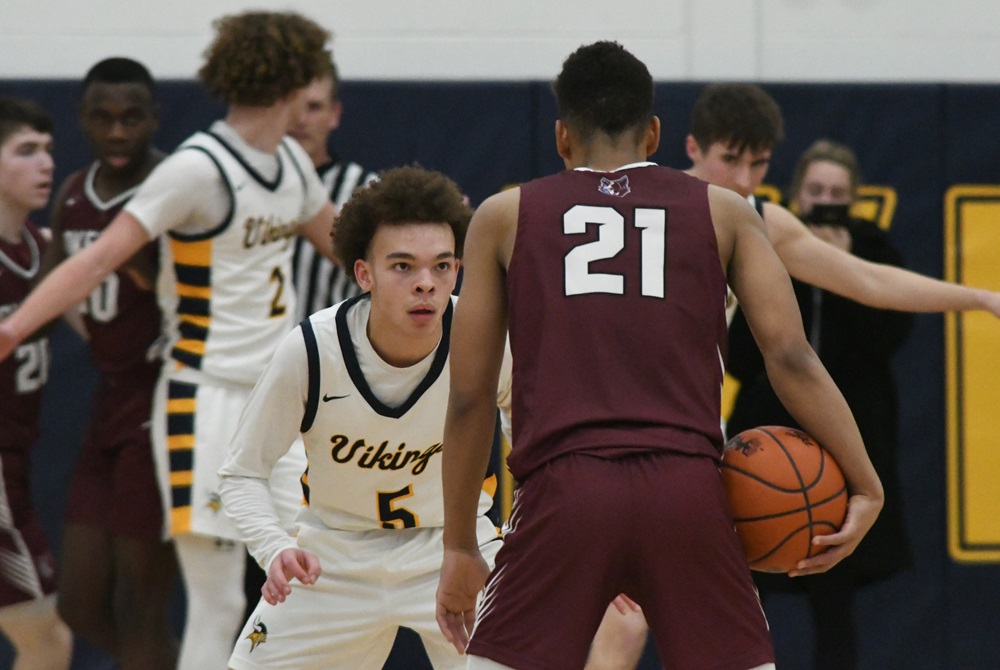
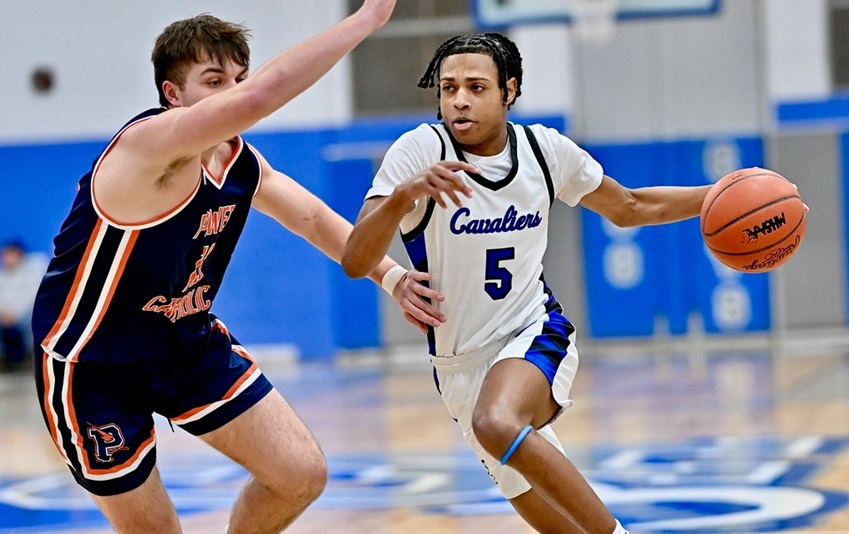
PHOTOS (Top) Haslett's Wardrell Wicker (5) gets in defensive position as Okemos' Branden Pruitt (21) considers his options during a 58-48 win Feb. 3. (Middle) Flint Carman-Ainsworth's Jaden Green (5) drives to the basket during his team's 90-88 triple-overtime win over Flint Powers Catholic on Tuesday. (Haslett/Okemos photo by John Johnson. Carman-Ainsworth photo by Terry Lyons.)