


Classes Still Create Hoosier Hysteria
July 27, 2017
By Rob Kaminski
MHSAA benchmarks editor
This is the fourth part in a series on MHSAA tournament classification, past and present, that will be published over the next two weeks. This series originally ran in this spring's edition of MHSAA benchmarks.
Twenty years ago, Bloomington North High School won the Indiana High School Athletic Association boys basketball championship, defeating Delta 75-54 at the RCA Dome in Indianapolis.
The date, March 22, 1997, is at the same time revered and disdained by traditionalists in the state who saw it as the last schoolboy championship game the state would ever host.
That’s how devout the game of basketball, particularly interscholastic basketball, had become in the Hoosier state during the 87 years a state champion – one state champion, to be precise – was crowned.
Following that 1997 season, the IHSAA moved to a four-class system for its roundball tournaments, like so many of its state association counterparts had done years earlier.
It would be shocking to find more than a small percentage of current high school basketball players around the country unfamiliar with the iconic movie Hoosiers, even though the film is now more than 30 years old.
And, the storyline for that blockbuster unfolded more than 30 years prior to its release, when small-town, undermanned Milan High School defeated Muncie Central High School 32-30 in the 1954 IHSAA title game.
Perhaps it’s because of the David vs Goliath notion, or the fame of the movie that replaced Milan with the fictional Hickory and real-life star Bobby Plump with Hollywood hero Jimmy Chitwood, or the simple fact that Indiana had something other states didn’t.
Whatever the reason, plenty of opposition remains to this day to basketball classification in the state.
The fact is, the small rural schools were regularly being beaten handily by the much larger suburban and city schools as the tournament progressed each season.
Small schools also were closing at a rapid rate following the state’s School Reorganization Act in 1959, as students converged on larger, centralized county schools. From 1960 to 2000, the number of schools entering the tournament dropped from 694 to 381, and in 1997 a total of 382 schools and 4,584 athletes began competition at the Sectional level (the first level of the IHSAA Basketball Tournament).
It was at the entry level of the tournament where school administrators felt the pain of the new class system, but not necessarily for the same nostalgic reasons as the fans who either attended or boycotted the tournament.
At the Sectional round of the tournament, the IHSAA was culling just 2 percent of the revenue, with the participating schools splitting the balance. So, when Sectional attendance dropped by 14 percent in that first year of class basketball, many schools realized a financial loss. It was money they had grown to count on in prior years to help fund various aspects of the department.
Schools cumulatively received more than $900,000 from Sectional competition in 1998, but that total was down from more than $1 million in the last year of the single-class tournament.
Yet, the current format provides a great deal more opportunity and realistic chances at championship runs for schools of all enrollments.
To date, 60 additional teams have championship or runner-up trophies on display in school trophy cases around Indiana.
That was the mission in front of then-IHSAA commissioner Bob Gardner (now National Federation executive director) once the board made its decision: to give thousands more student-athletes the opportunity for once-in-a-lifetime experiences.
As any statistician knows, figures can be manipulated to tell any side of a story. Declining attendance in year one of class basketball is such a number.
The truth is tournament attendance had been on a steady downward spiral since its peak of just over 1.5 million in 1962. By the last single-class event in 1997, the total attendance was half that.
The challenge then and today, as it is for all state associations, is to find that delicate balance for those holding onto tradition, those holding onto trophies, and the number of trophies to hand out.
Editor’s Note: Stories from the Fort Wayne Journal Gazette in 1998 and from a 2007 issue of Indianapolis Monthly provided facts in this article.
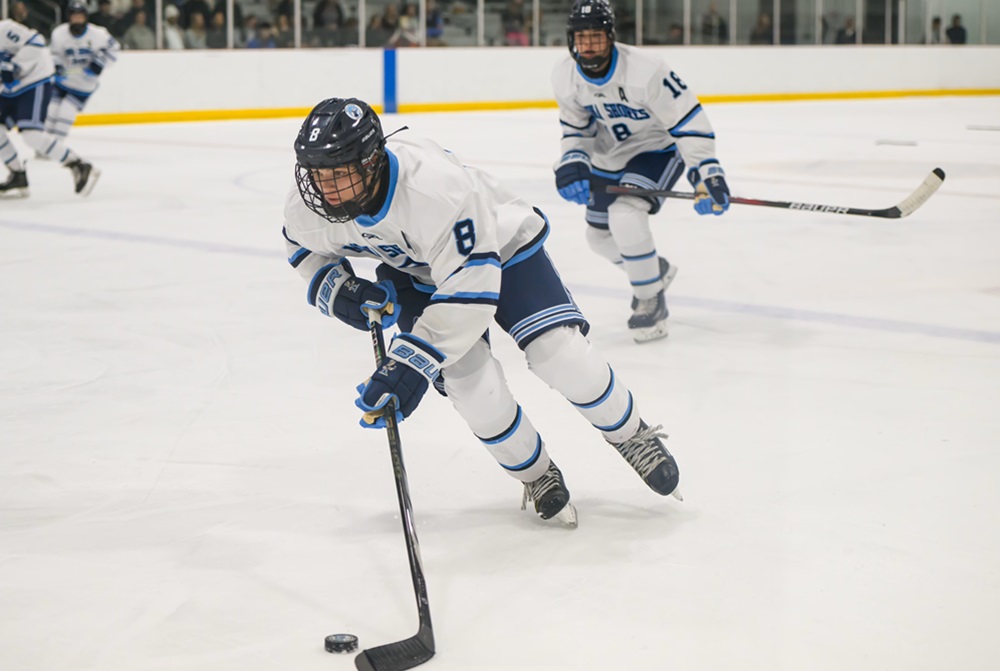
Always Better Together, 'Tilden Boys' Bring Special Bond to Shores Hockey
By
Tom Kendra
Special for MHSAA.com
December 13, 2024
Nathan and Brady Tilden realized a long time ago that they are better together than apart.
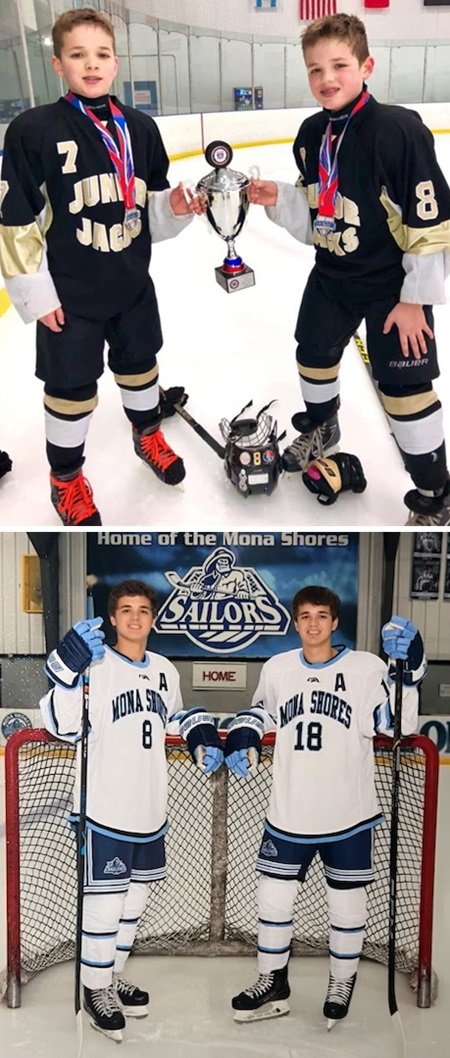
 The “Tilden Boys,” as they are known to almost everybody in the Muskegon Mona Shores school community, came into the world on the same day 18 years ago as identical twins and have made a conscious decision to spend almost all of their waking moments since together.
“The way we look at it, God made us twins for a reason,” explained Nathan, who is 18 and one minute older than his brother.
“There is no way that I would be where I am today, in hockey or in school or really anything, if Brady wasn’t with me. He is my best friend, and we do everything together.”
They have pushed each other to great heights in the classroom, taking the same demanding classes and both maintaining a GPA of better than 4.1.
They hold each other accountable to go to church every Sunday and take care of every detail at school, where they have emerged as leaders and role models.
But perhaps the place where their special twin chemistry really manifests itself is on the ice, as senior assistant captains and standouts on the Mona Shores hockey team which is off to a 4-1 start heading into games this weekend at Wyandotte Roosevelt and Allen Park.
Nathan has been on a tear with a team-high seven goals and five assists for 12 points, while Brady leads the team with eight assists plus has scored two goals for 10 points. Throw in junior center Eli Habetler (team-high 13 points) and you have one of the top lines in West Michigan.
“We just know where each other is going to be,” said Brady. “Eli is almost like our third twin. Our goal on every shift is to get a goal, and we don’t care who gets it.”
Special connection
Mona Shores sixth-year hockey coach Chris Benedict said the team’s coaches and players often just sit back and marvel at the way the Tilden boys work together.
“It’s like they literally cloned a hockey player,” said Benedict. “They always know exactly what the other one is going to do, which is a huge advantage in hockey. It’s so much fun to watch them go to work.”
 The Tildens, who are both in their third year on the Shores varsity team, were at it again in their first conference game Wednesday night on their home ice at Lakeshore Sports Centre. Nathan scored a goal and added an assist, while Brady chipped in a pair of assists in a 5-2 win over visiting Holland West Ottawa.
But Nathan and Brady, who also happen to be the team’s two best penalty-killers, were most excited Wednesday that other players got involved in the scoring – which they know is necessary if the team wants to achieve its major goal of winning the Ottawa-Kent Conference Fischer title and then making a postseason run. Quinn Addicott had a first-period goal off an assist from Vaire VanderWalle, and Cooper Nellis scored a nifty, sharp-angle goal in the third period with an assist from Cullen Conrad.
Another reason for Shores’ hot start is the play of senior goaltender Joey Griffes-Castonia, one of six players the team added in its first year of a cooperative agreement with Whitehall. He had 46 saves in a game last month.
The Sailors opened the season with a loss to Plymouth but have since reeled off four consecutive wins.
Included in that streak were a pair of tight victories in Traverse City over Thanksgiving weekend. Brady Tilden scored the lone shootout goal in a 3-2 win over TC Central, and he and Nathan both had a goal and two assists in a 5-4 overtime win over TC West the next day.
“They have a motor that doesn’t quit,” said Benedict. “They are fast and in-your-face and do an incredible job in the offensive zone. You throw in Eli, and I would put that line up against any in the state.”
Fittingly, their career stats in three years on the Shores varsity are nearly identical. Nathan has 24 goals and 32 assists for 56 points, while Brady has 20 goals and 35 assists for 55 points.
Second set of twins
The odds of having identical twins are 1 in every 250 births.
But Nathan and Brady are not even the only set of identical twins in their family. There are also the “Tilden Girls” – 23-year-old identical twins Emma and Lily – which put the odds of Bob and Colleen Tilden having a second set of identical twins at 1 in 110,000.
“I’ll never forget I went to what I thought was just a regular doctor’s visit,” recalled Colleen. “A few minutes later, I was calling Bob and telling him: ‘You are not going to believe this, but we’re having twins again.’”
Fast forward 18 years, and neither Bob nor Colleen can imagine their lives without their twin boys.
“They were against the odds, but now we know that they were meant to be here,” said Colleen, fighting back tears. “They are very special boys. They are such a blessing.”
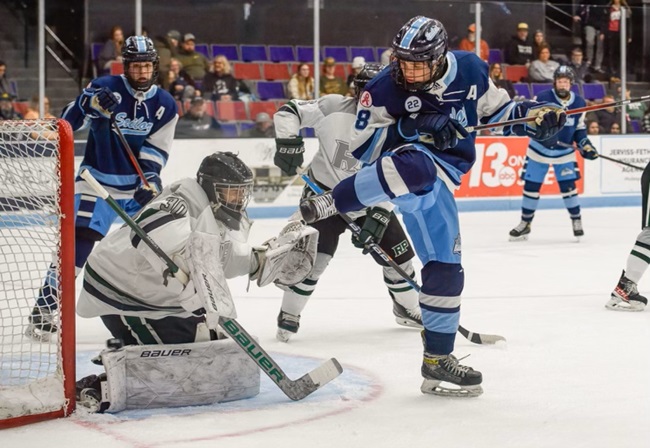 Bob marvels at their dedication and self-discipline, watching them wake up at 4:30 a.m. every Monday and Friday to go get an extra skate in or figuring out a way to get to church every weekend, even with their often-crazy hockey and school schedules.
“They are able to accomplish everything they do because of each other,” said Bob. “Brady is very focused and a good planner. Nathan is the one checking the details and making sure his brother has everything that he needs. They work together on everything, every single day.”
The final piece of the Tilden puzzle is oldest sibling Zach, 26, the only non-twin of the family’s five kids.
Zach was a standout hockey player for Shores, and both Nathan and Brady immediately name him as one of their biggest role models in hockey and life in general.
“What made me love hockey was going to all of Zach’s games and watching him play,” said Brady.
Sticking together
Even though their older sisters went in different directions after high school, Nathan and Brady are sticking together.
The boys will live together at Michigan Tech, where they both plan to major in mechanical engineering.
“There’s no reason for us to go to different colleges,” said Nathan, who pointed out the longest they have ever been apart was two days, when he was sick in 10th grade and had to stay home while Brady went and played in the Brighton Showcase hockey tournament.
“Tech is a hard school and mechanical engineering is a tough major, but together I know we can do it.”
They also know that, eventually, jobs or marriage will separate them physically. But in the meantime, they are determined to continue to work their twin magic and make the most of their final high school hockey season.
They both also play a spring sport, but while Brady continues to play baseball, Nathan switched to golf his sophomore year. That change is one of the only tangible differences between their high school resumes, and even they struggle (often comically) to come up with other differences.
“How are we different? That’s a good question,” said Brady, taking a long pause and several deep breaths, thinking about it. “I mean, I like Subway and he doesn’t like Subway. We don’t drink pop very much, but if we do, he’ll get a root beer and I’ll get a Dr. Pepper.
“There’s gotta be some other differences. Sorry, but I can’t really think of anything else right now.”
 Tom Kendra worked 23 years at The Muskegon Chronicle, including five as assistant sports editor and the final six as sports editor through 2011. E-mail him at [email protected] with story ideas for Muskegon, Oceana, Mason, Lake, Oceola, Mecosta and Newaygo counties.
PHOTOS (Top) Mona Shores’ Nathan Tilden (8) makes his way up the ice with the puck as twin brother Brady Tilden (18) trails the play. (Middle) The Tildens show off a trophy early in their youth hockey careers, and then take a photo together during the team’s media day this season. (Below) Nathan Tilden raises his leg to allow linemate Eli Habetler's shot past and into the goal against Muskegon Reeths-Puffer last season. Twin brother Brady Tilden looks in on the play. (Action photos by Eric Sturr; posed photos courtesy of the Tilden family.)