


Classes Still Create Hoosier Hysteria
July 27, 2017
By Rob Kaminski
MHSAA benchmarks editor
This is the fourth part in a series on MHSAA tournament classification, past and present, that will be published over the next two weeks. This series originally ran in this spring's edition of MHSAA benchmarks.
Twenty years ago, Bloomington North High School won the Indiana High School Athletic Association boys basketball championship, defeating Delta 75-54 at the RCA Dome in Indianapolis.
The date, March 22, 1997, is at the same time revered and disdained by traditionalists in the state who saw it as the last schoolboy championship game the state would ever host.
That’s how devout the game of basketball, particularly interscholastic basketball, had become in the Hoosier state during the 87 years a state champion – one state champion, to be precise – was crowned.
Following that 1997 season, the IHSAA moved to a four-class system for its roundball tournaments, like so many of its state association counterparts had done years earlier.
It would be shocking to find more than a small percentage of current high school basketball players around the country unfamiliar with the iconic movie Hoosiers, even though the film is now more than 30 years old.
And, the storyline for that blockbuster unfolded more than 30 years prior to its release, when small-town, undermanned Milan High School defeated Muncie Central High School 32-30 in the 1954 IHSAA title game.
Perhaps it’s because of the David vs Goliath notion, or the fame of the movie that replaced Milan with the fictional Hickory and real-life star Bobby Plump with Hollywood hero Jimmy Chitwood, or the simple fact that Indiana had something other states didn’t.
Whatever the reason, plenty of opposition remains to this day to basketball classification in the state.
The fact is, the small rural schools were regularly being beaten handily by the much larger suburban and city schools as the tournament progressed each season.
Small schools also were closing at a rapid rate following the state’s School Reorganization Act in 1959, as students converged on larger, centralized county schools. From 1960 to 2000, the number of schools entering the tournament dropped from 694 to 381, and in 1997 a total of 382 schools and 4,584 athletes began competition at the Sectional level (the first level of the IHSAA Basketball Tournament).
It was at the entry level of the tournament where school administrators felt the pain of the new class system, but not necessarily for the same nostalgic reasons as the fans who either attended or boycotted the tournament.
At the Sectional round of the tournament, the IHSAA was culling just 2 percent of the revenue, with the participating schools splitting the balance. So, when Sectional attendance dropped by 14 percent in that first year of class basketball, many schools realized a financial loss. It was money they had grown to count on in prior years to help fund various aspects of the department.
Schools cumulatively received more than $900,000 from Sectional competition in 1998, but that total was down from more than $1 million in the last year of the single-class tournament.
Yet, the current format provides a great deal more opportunity and realistic chances at championship runs for schools of all enrollments.
To date, 60 additional teams have championship or runner-up trophies on display in school trophy cases around Indiana.
That was the mission in front of then-IHSAA commissioner Bob Gardner (now National Federation executive director) once the board made its decision: to give thousands more student-athletes the opportunity for once-in-a-lifetime experiences.
As any statistician knows, figures can be manipulated to tell any side of a story. Declining attendance in year one of class basketball is such a number.
The truth is tournament attendance had been on a steady downward spiral since its peak of just over 1.5 million in 1962. By the last single-class event in 1997, the total attendance was half that.
The challenge then and today, as it is for all state associations, is to find that delicate balance for those holding onto tradition, those holding onto trophies, and the number of trophies to hand out.
Editor’s Note: Stories from the Fort Wayne Journal Gazette in 1998 and from a 2007 issue of Indianapolis Monthly provided facts in this article.
Baldwin Hopes to Set Example for Aspiring Saginaw Wrestlers with Rapid Rise
By
Paul Costanzo
Special for MHSAA.com
December 11, 2024
When Michael Baldwin began his wrestling career as a freshman at Saginaw Arthur Hill, coach Angel Rodriguez recognized he had a special talent on his hands almost immediately.
 Almost.
“I didn’t think I’d be back in that room after a week, to be honest,” Baldwin said. “My first practice, I threw up and passed out, so I thought that was going to be my last time in a wrestling room. So, I definitely didn’t think I’d make it this far.”
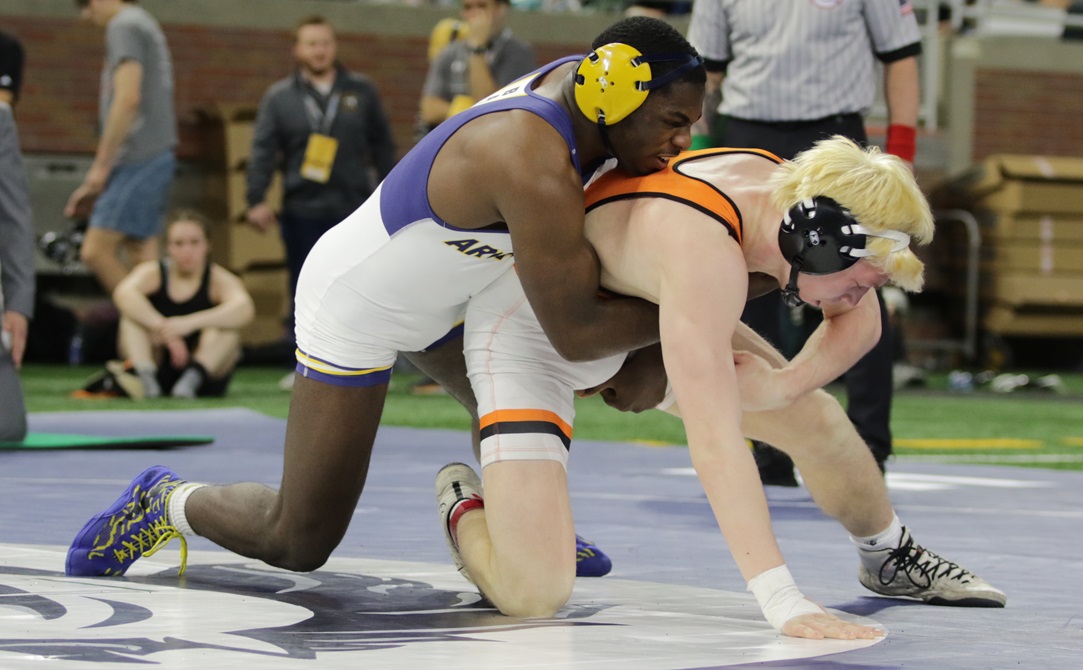
Baldwin bounced back nicely from that first day and has turned himself into one of the best wrestlers in the state as he begins his senior season. The now-Saginaw United wrestler is coming off a third-place finish at the 2024 Individual Finals and is ranked No. 1 at 175 pounds in Division 1 by Michigan Grappler.
It’s a quick rise, but one that Rodriguez has seen as possible all along, despite that rough start.
“You could see it his freshman year,” Rodriguez said. “You could see him wanting to be better and better and better, trying to get better at every situation. His sophomore year, he went straight into wrestling again. You could see it, it’s just that you don’t know how special it’s going to become.”
Baldwin already has put himself among the best wrestlers to ever come through the city. His third-place finish at 165 pounds is tied for the best at Arthur Hill, with his brother Lionel’s third place in 2023.
Saginaw High, which joined with Arthur Hill to form Saginaw United this fall, had produced a pair of Finals champions – Quinton Moore in 2010 and Yohanas Moore in 1987. Baldwin knows what it would mean to join them representing United’s first-year program.
“It would be huge, and after that, I would really hope that people in our city and our community would start to look at wrestling a little bit more,” Baldwin said. “To be completely honest, it’s all football and basketball here. Those sports are great, and they’re cool and they’re mainstream, and they definitely make the most money if you become the best in the world at it. A sport like wrestling is just so life-changing, that it’s almost like a gift to share it with other people. I’m forever grateful to my brother for introducing me to the sport. So, if I could win states and really put it out there that there’s somebody from Saginaw who’s the best wrestler in the state of Michigan, I feel like then maybe parents would start to encourage their kids to wrestle.”
Baldwin knows that with wrestling seeing is believing, as it’s what flipped the switch for him. It wasn’t until he watched his brother qualify for the 2022 Finals tournament that he really started to believe he could make some noise in the sport.
 “When I think about it, I think, ‘What can I do for other people that my brother’s done for me?’ Which is why I go to all these national tournaments and why I try to perform at such a high level,” Baldwin said. “All it took for me was my brother showing me it was possible to go to states, because I didn’t think stuff like that was possible. I never thought about making it to the state Finals as a football team, or for any other sport, I never thought about being the best in the state, at all. Seeing my brother be one of the best wrestlers in the state, it just showed me how possible that stuff was. At this point, four years into my career, I think anything is possible.”
Winning a Finals title is the immediate goal for Baldwin, and he’s off to a good start. He placed third this past weekend at the Grappler Gold Invitational, with his one loss coming to eventual champion Kole Katschor of Dundee, who is a returning Finals champion. Katschor defeated three-time Finals champion Sebastian Martinez of Riverview Gabriel Richard in the final of a stacked GGI 175-pound bracket.
Over the summer, Baldwin wrestled in several national tournaments, and placed fifth at the Grappler Fall Classic, with his only losses coming against nationally-ranked Max Harmon from Tennessee. He’s also been one match away from placing at the nationals in Fargo, N.D., the most illustrious tournament in the country for high schoolers.
Colleges have begun to notice, as he’s had talks with several from the NAIA level all the way up to Division I.
That’s despite the fact it’s not well-known he’s only been wrestling since his freshman year. Combined with his being ranked No. 1 academically in his class, that makes him a remarkably attractive prospect.
“I’m sure when I tell them that, they start to see the potential,” Baldwin said. “I have so much to learn and so much to get better at.”
The ultimate goal is to be a world champion, and Baldwin spends his offseason wrestling in freestyle and Greco Roman tournaments to make that a reality.
It’s a lofty goal, for sure, but after seeing what Baldwin has been able to accomplish during his short time with the sport, it does feel as though anything is possible.
“It’s surreal,” Rodriguez said. “Because, you see the talent in the city. You see the talent in the school. You see the type of kids that have the ability to be great, or fantastic, or do something that someone’s never done. To have it be one of my athletes, one of my wrestlers and a kid in my room, it’s surreal. It’s crazy.
“At one point in time, when I started coaching, I couldn’t get a kid past Regionals. … Seeing these kids wear an Arthur Hill singlet, or a Saginaw United singlet, being from the city area and doing what he’s doing – I don’t know, it’s unreal. You would never expect it, because we’re not a school known for wrestling. We’re not an area known for wrestling. But to have one of the top-level kids in your area, in your room, and have the ability to coach him, it’s probably one of the coolest things as a coach that I’ve been able to do.”
 Paul Costanzo served as a sportswriter at The Port Huron Times Herald from 2006-15, including three years as lead sportswriter, and prior to that as sports editor at the Hillsdale Daily News from 2005-06. He can be reached at [email protected] with story ideas for Genesee, Lapeer, St. Clair, Sanilac, Huron, Tuscola, Saginaw, Bay, Arenac, Midland and Gladwin counties.
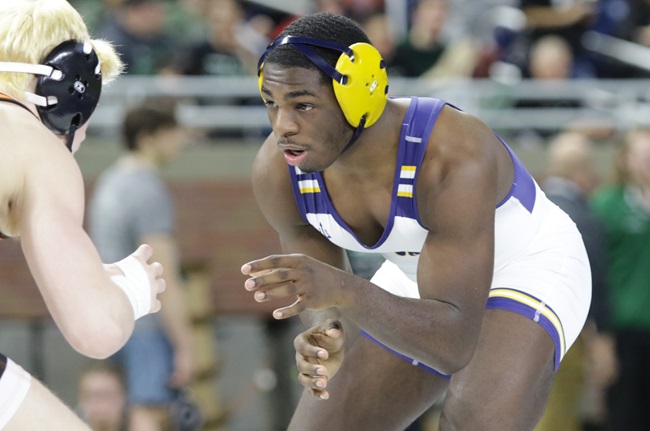
PHOTOS (Top) Saginaw Arthur Hill’s Michael Baldwin (left) wrestles Byron Center’s Blake Ottow during a third-place match at last season’s Individual Finals. (Middle) Baldwin looks to make his move. (Click for more from High School Sports Scene.)