


Classes Still Create Hoosier Hysteria
July 27, 2017
By Rob Kaminski
MHSAA benchmarks editor
This is the fourth part in a series on MHSAA tournament classification, past and present, that will be published over the next two weeks. This series originally ran in this spring's edition of MHSAA benchmarks.
Twenty years ago, Bloomington North High School won the Indiana High School Athletic Association boys basketball championship, defeating Delta 75-54 at the RCA Dome in Indianapolis.
The date, March 22, 1997, is at the same time revered and disdained by traditionalists in the state who saw it as the last schoolboy championship game the state would ever host.
That’s how devout the game of basketball, particularly interscholastic basketball, had become in the Hoosier state during the 87 years a state champion – one state champion, to be precise – was crowned.
Following that 1997 season, the IHSAA moved to a four-class system for its roundball tournaments, like so many of its state association counterparts had done years earlier.
It would be shocking to find more than a small percentage of current high school basketball players around the country unfamiliar with the iconic movie Hoosiers, even though the film is now more than 30 years old.
And, the storyline for that blockbuster unfolded more than 30 years prior to its release, when small-town, undermanned Milan High School defeated Muncie Central High School 32-30 in the 1954 IHSAA title game.
Perhaps it’s because of the David vs Goliath notion, or the fame of the movie that replaced Milan with the fictional Hickory and real-life star Bobby Plump with Hollywood hero Jimmy Chitwood, or the simple fact that Indiana had something other states didn’t.
Whatever the reason, plenty of opposition remains to this day to basketball classification in the state.
The fact is, the small rural schools were regularly being beaten handily by the much larger suburban and city schools as the tournament progressed each season.
Small schools also were closing at a rapid rate following the state’s School Reorganization Act in 1959, as students converged on larger, centralized county schools. From 1960 to 2000, the number of schools entering the tournament dropped from 694 to 381, and in 1997 a total of 382 schools and 4,584 athletes began competition at the Sectional level (the first level of the IHSAA Basketball Tournament).
It was at the entry level of the tournament where school administrators felt the pain of the new class system, but not necessarily for the same nostalgic reasons as the fans who either attended or boycotted the tournament.
At the Sectional round of the tournament, the IHSAA was culling just 2 percent of the revenue, with the participating schools splitting the balance. So, when Sectional attendance dropped by 14 percent in that first year of class basketball, many schools realized a financial loss. It was money they had grown to count on in prior years to help fund various aspects of the department.
Schools cumulatively received more than $900,000 from Sectional competition in 1998, but that total was down from more than $1 million in the last year of the single-class tournament.
Yet, the current format provides a great deal more opportunity and realistic chances at championship runs for schools of all enrollments.
To date, 60 additional teams have championship or runner-up trophies on display in school trophy cases around Indiana.
That was the mission in front of then-IHSAA commissioner Bob Gardner (now National Federation executive director) once the board made its decision: to give thousands more student-athletes the opportunity for once-in-a-lifetime experiences.
As any statistician knows, figures can be manipulated to tell any side of a story. Declining attendance in year one of class basketball is such a number.
The truth is tournament attendance had been on a steady downward spiral since its peak of just over 1.5 million in 1962. By the last single-class event in 1997, the total attendance was half that.
The challenge then and today, as it is for all state associations, is to find that delicate balance for those holding onto tradition, those holding onto trophies, and the number of trophies to hand out.
Editor’s Note: Stories from the Fort Wayne Journal Gazette in 1998 and from a 2007 issue of Indianapolis Monthly provided facts in this article.
Breslin Bound: 2024-25 Boys Report Weeks 1 & 2
By
Geoff Kimmerly
MHSAA.com senior editor
December 9, 2024
A late Thanksgiving this year led to the first week of boys basketball games this 2024-25 season being played during the short week, and even a few days before the final football championship games of the fall.
 But with that rare crossover out of the way, we’re on track and moving forward on another four-month trip that for 16 teams will end at Michigan State University’s Breslin Center in March.
We’ll catch up with several of the highlights from the last two weeks as we debut this winter’s “Breslin Bound” reports with our traditional look back at some key results, teams on the move and games to go see during the week to come.
“Breslin Bound” is powered by MI Student Aid and based on results and schedules posted for each school at MHSAA.com.
Week in Review
The countdown of last week’s five most intriguing results:
1. Warren Lincoln 56, Ann Arbor Huron 51 Reigning Division 2 champion Lincoln (2-0) is off to another impressive start with this Horatio Williams Tip-Off Classic win over Huron (0-1), which made the Division 1 Semifinals last season.
2. Grand Rapids Christian 72, Grand Rapids South Christian 55 Grand Rapids Christian (2-0) – last season’s Division 2 runner-up – put much more distance between itself and the Sailors (1-1) this time compared to last year’s three-point District Final win.
3. Alcona 54, Hillman 44 Both are reigning league champions (different divisions) in the North Star League, and Hillman (1-1) also had finished 22-3 last season while Alcona (2-1) is looking to build off an 18-6 run.
5. Detroit Catholic Central 69, Saginaw United 55 The Shamrocks (4-0) spoiled the program debut for United (0-2), which formed from the previous Saginaw High and Arthur Hill.
5. Detroit Martin Luther King 53, East Kentwood 46 This was another Williams Tip-Off Classic matchup as King (3-0) earned a notable early win against another Division 1 team with tons of potential in the Falcons (1-1).
Watch List
With an eye toward March, here are two teams in each division making sparks:
DIVISION 1
Livonia Churchill (3-0) A 68-64 win over Gibraltar Carlson on Friday kept Churchill undefeated under first-year coach Cameron Scott – and it’s been an incredible turnaround already. The Chargers didn’t win a game last season, with their only victory over the last two coming by forfeit, and this is guaranteed to finish as their first season with at least three victories since 2017-18. Churchill opened with an 84-46 win over Dearborn Heights Annapolis and also has a 64-54 victory over Garden City.
Oxford (4-0) Jake Champagne became the program’s all-time leading scorer at 1,146 points with 26 in a 46-32 win over Grosse Pointe North at Sunday’s D Zone Rising Team Tip Off, and all four of the Wildcats’ victories have come by double digits – including as well a notable 64-39 victory over Davison last week. Oxford is in the Oakland Activities Association White this winter after finishing second in the Blue and 14-9 overall last season.
DIVISION 2
Cheboygan (3-0) Coming off a 9-13 run last season – which concluded with a 10-point District-opening loss to Kalkaska – Cheboygan is off to a fast start capped Friday by a 66-60 victory over the Blazers. That also was the league opener for the new Northern Shores Conference, which Cheboygan joined after previously playing in the Straits Area Conference. A 76-63 season-opening win over Rudyard also avenged a pair of defeats from last season.
Marshall (3-0) A 62-60 victory over Hanover-Horton at the Carl Lee Invitational at Albion College gave Marshall its first three all by six points or fewer, to go with a 53-49 win over Battle Creek Lakeview and 48-42 victory over Battle Creek Harper Creek. Those had to generate plenty of excitement as the Lakeview win avenged a loss from last season – when Marshall finished 9-14 – and Hanover-Horton was a league and District champ last winter.
DIVISION 3
Ithaca (3-0) The Yellowjackets also picked up a couple of close wins last week – 54-52 over Standish-Sterling and then 49-43 over Saginaw Michigan Lutheran Seminary – as they began building on last season’s 16-9 campaign that included a second-place finish in the Tri-Valley Conference White and District championship. Ithaca had started 2-4 a year ago and will get a chance to avenge one of those losses, to Beal City, next week.
North Muskegon (3-0) The Norsemen traveled to Benzie Central over the weekend and won the Will Lynch Season Tip Off with a 49-37 victory over Menominee – a Division 3 quarterfinalist last winter – followed by a 52-34 win over Division 1 Lapeer. North Muskegon is coming off a 24-1 run last winter, when its only loss came in overtime, 43-40, to Pewamo-Westphalia in a Regional Semifinal.
DIVISION 4
Dollar Bay (4-0) The Blue Bolts are coming off three straight sub-.500 finishes, including 10-14 last season. But they are quickly making those distant memories with this start that’s included wins over Chassell, Painesdale Jeffers, Houghton and Hancock. The Houghton win was by just four points in overtime, but the other three were all by 18 or more – more impressive as Dollar Bay went a combined 0-5 against Chassell, Jeffers and Houghton last season, losing to Jeffers by more than 30 points twice and Houghton by 28.
Traverse City Christian (4-0) The Sabres averaged nearly 16 wins per season over the last three, finishing 16-7 last winter, and could take another step if this start is an indication – all four wins came by at least 14 points. A 45-26 victory over Mio gave Traverse City Christian the Battle of the Bridge championship at Mackinaw City, after it had defeated Cedarville 66-42 to advance.
Can’t-Miss Contests
Be on the lookout for results of these games coming up:
Tuesday – Niles Brandywine (2-1) at Schoolcraft (2-0) – This is a rematch of a Regional Final from last season won by Brandywine 41-32 on the way to claiming the Division 3 championship.
Saturday – East Lansing (2-0) vs. Warren Lincoln (2-0) at Lansing's Don Johnson Fieldhouse – The Moneyball Tip-Off Classic features this matchup of the reigning Division 2 champion Lincoln against an East Lansing team that reached the Division 1 Quarterfinals last season.
Saturday – Grand Rapids Catholic Central (2-1) vs. Hudsonville Unity Christian (2-0) at Calvin University – These two are annually two of the best in West Michigan and will meet in The Invite in the second of the day’s four games.
Saturday – Rockford (2-0) vs. Grand Rapids Northview (2-0) at Calvin University – These two also will meet at The Invite, capping off the evening.
Saturday – Detroit Catholic Central (4-0) at Hudsonville (2-0) – This matchup at the Hudsonville Showcase should provide a nice indication of potential for both promising teams.
MHSAA.com's weekly “Breslin Bound” previews and reviews are powered by MI Student Aid, a division within the Department of Lifelong Education, Advancement, and Potential (MiLEAP). MI Student Aid encourages students to pursue postsecondary education by providing access to student financial resources and information. MI Student Aid administers the state’s scholarship and grant programs that help make college Accessible, Affordable and Attainable for you. Connect with MI Student Aid at www.michigan.gov/mistudentaid and find more information on Facebook and Twitter @mistudentaid.
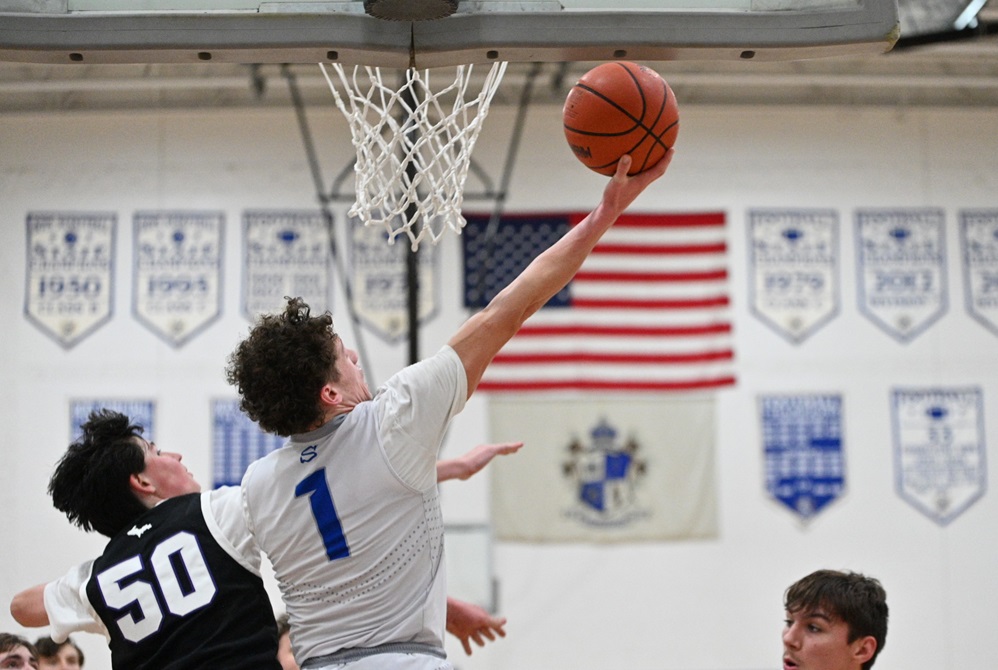
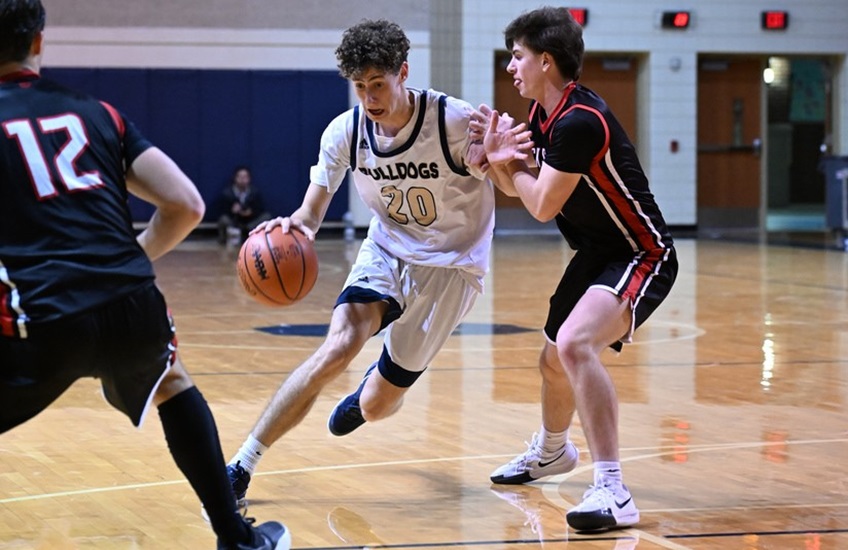
PHOTOS (Top) Ishpeming's Caden Luoma (1) scoops in a shot for two points, but the Hematites lost 67-59 to Gladstone on Dec. 2. (Middle) An Otsego player attempts to get to the lane while defended during a 72-54 season-opening loss to Vicksburg. (Top photo by Cara Kamps. Otsego/Vicksburg photo by Gary Shook.)