


Classes Still Create Hoosier Hysteria
July 27, 2017
By Rob Kaminski
MHSAA benchmarks editor
This is the fourth part in a series on MHSAA tournament classification, past and present, that will be published over the next two weeks. This series originally ran in this spring's edition of MHSAA benchmarks.
Twenty years ago, Bloomington North High School won the Indiana High School Athletic Association boys basketball championship, defeating Delta 75-54 at the RCA Dome in Indianapolis.
The date, March 22, 1997, is at the same time revered and disdained by traditionalists in the state who saw it as the last schoolboy championship game the state would ever host.
That’s how devout the game of basketball, particularly interscholastic basketball, had become in the Hoosier state during the 87 years a state champion – one state champion, to be precise – was crowned.
Following that 1997 season, the IHSAA moved to a four-class system for its roundball tournaments, like so many of its state association counterparts had done years earlier.
It would be shocking to find more than a small percentage of current high school basketball players around the country unfamiliar with the iconic movie Hoosiers, even though the film is now more than 30 years old.
And, the storyline for that blockbuster unfolded more than 30 years prior to its release, when small-town, undermanned Milan High School defeated Muncie Central High School 32-30 in the 1954 IHSAA title game.
Perhaps it’s because of the David vs Goliath notion, or the fame of the movie that replaced Milan with the fictional Hickory and real-life star Bobby Plump with Hollywood hero Jimmy Chitwood, or the simple fact that Indiana had something other states didn’t.
Whatever the reason, plenty of opposition remains to this day to basketball classification in the state.
The fact is, the small rural schools were regularly being beaten handily by the much larger suburban and city schools as the tournament progressed each season.
Small schools also were closing at a rapid rate following the state’s School Reorganization Act in 1959, as students converged on larger, centralized county schools. From 1960 to 2000, the number of schools entering the tournament dropped from 694 to 381, and in 1997 a total of 382 schools and 4,584 athletes began competition at the Sectional level (the first level of the IHSAA Basketball Tournament).
It was at the entry level of the tournament where school administrators felt the pain of the new class system, but not necessarily for the same nostalgic reasons as the fans who either attended or boycotted the tournament.
At the Sectional round of the tournament, the IHSAA was culling just 2 percent of the revenue, with the participating schools splitting the balance. So, when Sectional attendance dropped by 14 percent in that first year of class basketball, many schools realized a financial loss. It was money they had grown to count on in prior years to help fund various aspects of the department.
Schools cumulatively received more than $900,000 from Sectional competition in 1998, but that total was down from more than $1 million in the last year of the single-class tournament.
Yet, the current format provides a great deal more opportunity and realistic chances at championship runs for schools of all enrollments.
To date, 60 additional teams have championship or runner-up trophies on display in school trophy cases around Indiana.
That was the mission in front of then-IHSAA commissioner Bob Gardner (now National Federation executive director) once the board made its decision: to give thousands more student-athletes the opportunity for once-in-a-lifetime experiences.
As any statistician knows, figures can be manipulated to tell any side of a story. Declining attendance in year one of class basketball is such a number.
The truth is tournament attendance had been on a steady downward spiral since its peak of just over 1.5 million in 1962. By the last single-class event in 1997, the total attendance was half that.
The challenge then and today, as it is for all state associations, is to find that delicate balance for those holding onto tradition, those holding onto trophies, and the number of trophies to hand out.
Editor’s Note: Stories from the Fort Wayne Journal Gazette in 1998 and from a 2007 issue of Indianapolis Monthly provided facts in this article.
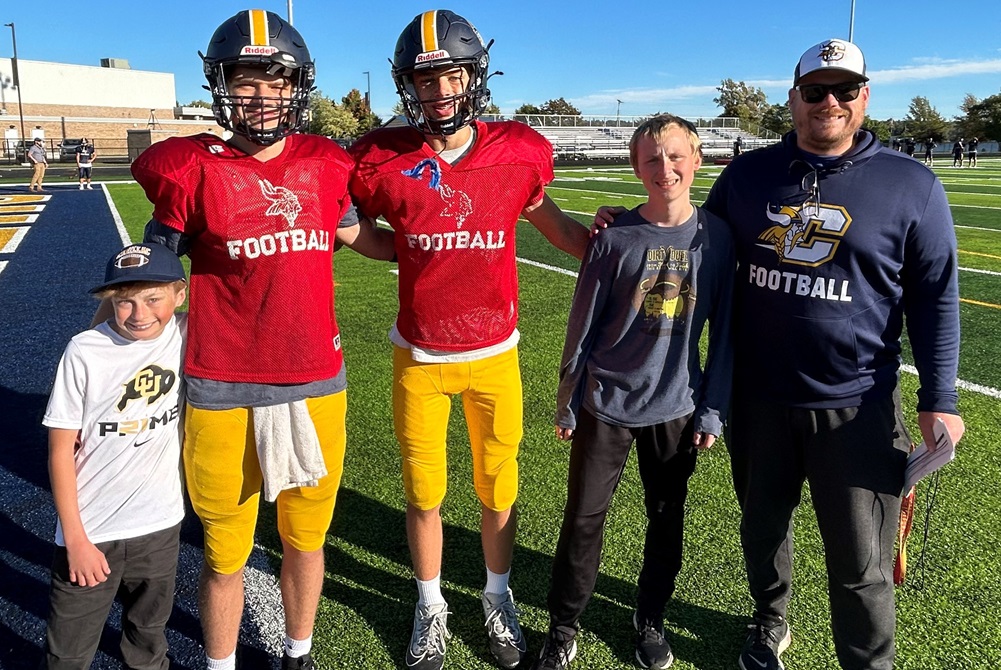
Cadillac Freshmen Wing, Westinghouse Become Wingmen for Each Other
By
Tom Spencer
Special for MHSAA.com
October 18, 2024
Lawson Westinghouse has a wingman.
 He really has several, but arguably no one closer than Dominic Wing, the 6-foot-5 freshman starting quarterback at Cadillac High School.
Westinghouse is also a freshman at Cadillac. A couple of other freshman, lineman Tanner Johnson and wide receiver/linebacker Will Howell, also are standing ready and willing to support.
Westinghouse, an avid long distance runner, likely will never play a down on the football field for the Vikings. But he’s usually helping the quarterbacks with drills at practice and looks like a member of the coaching staff on the sidelines during games.
He’s taken all road trips with the Vikings, sitting right next to Wing on the bus. Unfortunately, the road trip string is likely to end tonight when the Vikings head to Marquette for a matchup with league and playoff implications. Cadillac goes into the game 4-3 overall with a 3-2 Big North Conference record. Marquette is 5-2, 4-1.
Westinghouse can’t make the trip because he’s battling sickness complications from chemotherapy. He was diagnosed with a rare bone cancer called Ewing Sarcoma a few years back.
He got good news earlier this season indicating he was cancer free, but had to return to chemo this week.
Wing, Johnson and Howell spend time daily with Westinghouse reading. Westinghouse had goals of reading the book “The Twin Thieves” by the end of the school year and trying to stay in school every day.
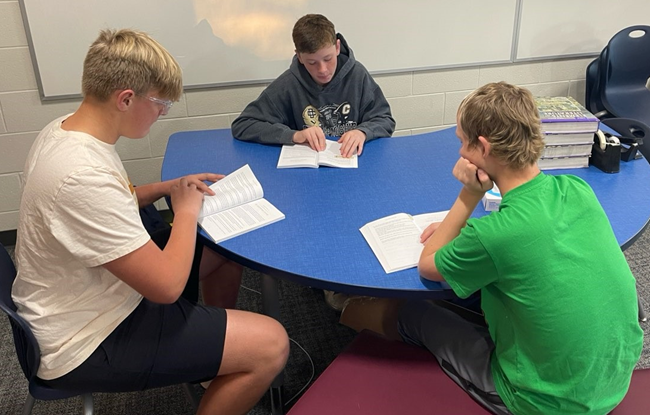 The boys try to get Westinghouse through a few pages every day. Wing is his primary reading partner, having developed a close bond with Westinghouse since transferring to Cadillac from Morley Stanwood this fall.
They first met at a basketball game last winter at Cadillac. They reconnected on the first day of school this fall and sat side by side during road trips to Midland, Gaylord, Sault Ste. Marie and Greenville as Cadillac recovered from an 0-2 start winning four of its last five games heading into tonight’s contest.
“I had a bunch of friends (at Cadillac), so I came up for a game,” Wing recollected. “(Lawson) saw me there, and he came up and introduced himself.
The friendship started to really take off with the first day of school, the two freshmen said. “(Lawson) wanted to be on the field, and we started reading in the mornings, which was really nice,” Wing recalled.
The special bond has led to a looser game warm-up and become a key to Wing’s mental preparations. It may be even more critical than Wing’s off-field opportunities to consult with a former NFL quarterback, John Wolford.
“We both talk the whole time on the bus rides,” Westinghouse said.
Wing treasures the conversation.
“We connect on the bus,” Wing said. “Once we get off the bus, he’ll get my warm-up ball and he’ll come over and watch me warm up, and I think it is pretty cool.”
Second-year coach Nick Winkler, who also serves as a special education teacher for Cadillac, loves how the new quarterback has connected with Westinghouse, who may rank as the most popular kid in school.
“Dom does a really good job of looking out for opportunities to take some time with Lawson during games and practice,” said Winkler. “Playing quarterback is hard enough as it is, so to intentionally do that speaks a lot to Lawson and a lot of people in the program.”
Westinghouse said he loves football and running. He recently asked his parents to buy him a football, and he’s been secretly practicing away from the football field. He also has run the Mackinac Bridge Labor Day event both ways every year.
 One of the most memorable moments for Winkler, Wing, Howell, Tanner and Westinghouse is far from the best one though. Lawson found himself sick on the way back from the Sault victory, and the boys had an opportunity to comfort him and practice a little caregiving.
“It was a late-night bus trip back, and Lawson gets sick,” Winkler said. “Those guys really helped him out — I think that speaks to their character.”
Another freshman, Ty Pettit, cannot play football due to a health condition, but also has been welcomed to the team. He participates in quarterback drills and serves as an equipment manger. He also serves as the resident prankster on the team, according to Winkler.
“I mostly hang out with the team and encourage them to do their best,” Pettit said of his role.
Without Westinghouse tonight, Wing will rely more on his consultation with Wolford, who first connected with Winkler in Green Bay. Wing is coming off completing 14 of 18 attempts for 200 yards in last week’s win. He has one touchdown pass and no interceptions.
Wolford played for the Los Angeles Rams from 2019-2022 and then during then during the 2023 season with the Tampa Bay Buccaneers. His first NFL start was in place of injured Jared Goff in the 2020 regular-season finale, and he led the Rams back into the playoffs with a 10-6 victory. He became the first quarterback to pass for more than 200 yards and rush for more than 50 in his NFL debut. He also backed up Matthew Stafford as the Rams won the 2021 Super Bowl.
‘‘Dominic’s grooming as a quarterback has not been normal,” said Winkler. “He has the opportunity to talk with an NFL quarterback every week if he wants to, and I would say that relationship would come second to what he and Lawson have developed.”
Wing will miss Westinghouse every time the offense comes off the field tonight.
‘I usually like to look for him and we give each other a little fist bump when I come off,” Wing said.
 Tom Spencer is a longtime MHSAA-registered basketball and soccer official, and former softball and baseball official, and he also has coached in the northern Lower Peninsula area. He previously has written for the Saginaw News, Bay County Sports Page and Midland Daily News. He can be reached at [email protected] with story ideas for Manistee, Wexford, Missaukee, Roscommon, Ogemaw, Iosco, Alcona, Oscoda, Crawford, Kalkaska, Grand Traverse, Benzie, Leelanau, Antrim, Otsego, Montmorency, Alpena, Presque Isle, Cheboygan, Charlevoix and Emmet counties.
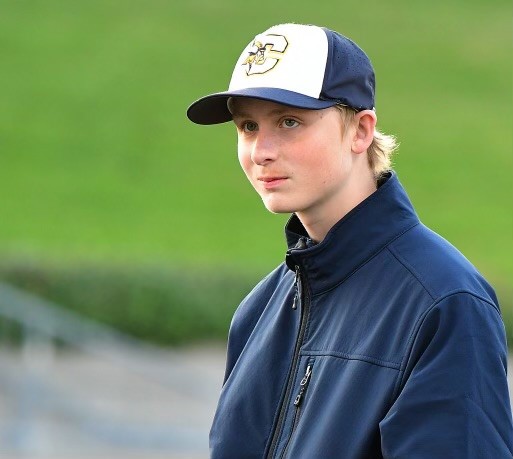
PHOTOS (Top) From left, Ty Pettit, quarterbacks KaLenn Harsh and Dominic Wing, Lawson Westinghouse and Cadillac football coach Nick Winkler take a moment for a photograph during a recent practice. (Middle) Tanner Johnson, Will Howell and Westinghouse read “The Twin Thieves” together. (Below) Westinghouse keeps an eye on the action. (Practice photos by Tom Spencer; reading photo courtesy of the Cadillac athletic department.)