


Classes Still Create Hoosier Hysteria
July 27, 2017
By Rob Kaminski
MHSAA benchmarks editor
This is the fourth part in a series on MHSAA tournament classification, past and present, that will be published over the next two weeks. This series originally ran in this spring's edition of MHSAA benchmarks.
Twenty years ago, Bloomington North High School won the Indiana High School Athletic Association boys basketball championship, defeating Delta 75-54 at the RCA Dome in Indianapolis.
The date, March 22, 1997, is at the same time revered and disdained by traditionalists in the state who saw it as the last schoolboy championship game the state would ever host.
That’s how devout the game of basketball, particularly interscholastic basketball, had become in the Hoosier state during the 87 years a state champion – one state champion, to be precise – was crowned.
Following that 1997 season, the IHSAA moved to a four-class system for its roundball tournaments, like so many of its state association counterparts had done years earlier.
It would be shocking to find more than a small percentage of current high school basketball players around the country unfamiliar with the iconic movie Hoosiers, even though the film is now more than 30 years old.
And, the storyline for that blockbuster unfolded more than 30 years prior to its release, when small-town, undermanned Milan High School defeated Muncie Central High School 32-30 in the 1954 IHSAA title game.
Perhaps it’s because of the David vs Goliath notion, or the fame of the movie that replaced Milan with the fictional Hickory and real-life star Bobby Plump with Hollywood hero Jimmy Chitwood, or the simple fact that Indiana had something other states didn’t.
Whatever the reason, plenty of opposition remains to this day to basketball classification in the state.
The fact is, the small rural schools were regularly being beaten handily by the much larger suburban and city schools as the tournament progressed each season.
Small schools also were closing at a rapid rate following the state’s School Reorganization Act in 1959, as students converged on larger, centralized county schools. From 1960 to 2000, the number of schools entering the tournament dropped from 694 to 381, and in 1997 a total of 382 schools and 4,584 athletes began competition at the Sectional level (the first level of the IHSAA Basketball Tournament).
It was at the entry level of the tournament where school administrators felt the pain of the new class system, but not necessarily for the same nostalgic reasons as the fans who either attended or boycotted the tournament.
At the Sectional round of the tournament, the IHSAA was culling just 2 percent of the revenue, with the participating schools splitting the balance. So, when Sectional attendance dropped by 14 percent in that first year of class basketball, many schools realized a financial loss. It was money they had grown to count on in prior years to help fund various aspects of the department.
Schools cumulatively received more than $900,000 from Sectional competition in 1998, but that total was down from more than $1 million in the last year of the single-class tournament.
Yet, the current format provides a great deal more opportunity and realistic chances at championship runs for schools of all enrollments.
To date, 60 additional teams have championship or runner-up trophies on display in school trophy cases around Indiana.
That was the mission in front of then-IHSAA commissioner Bob Gardner (now National Federation executive director) once the board made its decision: to give thousands more student-athletes the opportunity for once-in-a-lifetime experiences.
As any statistician knows, figures can be manipulated to tell any side of a story. Declining attendance in year one of class basketball is such a number.
The truth is tournament attendance had been on a steady downward spiral since its peak of just over 1.5 million in 1962. By the last single-class event in 1997, the total attendance was half that.
The challenge then and today, as it is for all state associations, is to find that delicate balance for those holding onto tradition, those holding onto trophies, and the number of trophies to hand out.
Editor’s Note: Stories from the Fort Wayne Journal Gazette in 1998 and from a 2007 issue of Indianapolis Monthly provided facts in this article.
Hanover-Horton Off to Record-Setting Start, with More Program 1sts Possible
By
Doug Donnelly
Special for MHSAA.com
October 15, 2024
Hanover-Horton’s football team is in uncharted territory.
 The Comets had never won a playoff game, never won an overall Cascades Conference championship and never started the season with seven straight victories before this fall.
One of those milestones was reached Friday when Hanover-Horton shut out Addison 42-0 for its seventh consecutive victory. The other two are still possible.
“There are a lot of firsts for everybody here,” third-year Comets head coach David Messer said. “Our plan is to just keep it one play at a time.”
Hanover-Horton’s best previous start to a season was 4-0.
“When we got to 5-0, the kids celebrated that,” Messer said. “We talked about getting to 5-0. But I told them we are only going to celebrate over the weekend because Monday we had to get back to work.”
Hanover-Horton went 2-7 last season and 3-6 the year before. The last time the school won seven games in a season was 2014 when they went 8-2, setting a school record for victories that the Comets can equal against Brooklyn Columbia Central on Senior Night this Friday.
“We aren’t looking past that game,” Messer said.
The Addison win also clinched a share of the league's West division title, which the Comets can claim outright Friday. The West and East divisions winners will play for the overall Cascades Conference championship in Week 9.
The Hanover-Horton seniors are on cloud nine about this football season, guaranteed to be the first winning one for the Comets since that 2014 campaign.
“They are on top of the world, but they are not strutting down the hallways or anything,” Messer said. “They are keeping everything in perspective.”
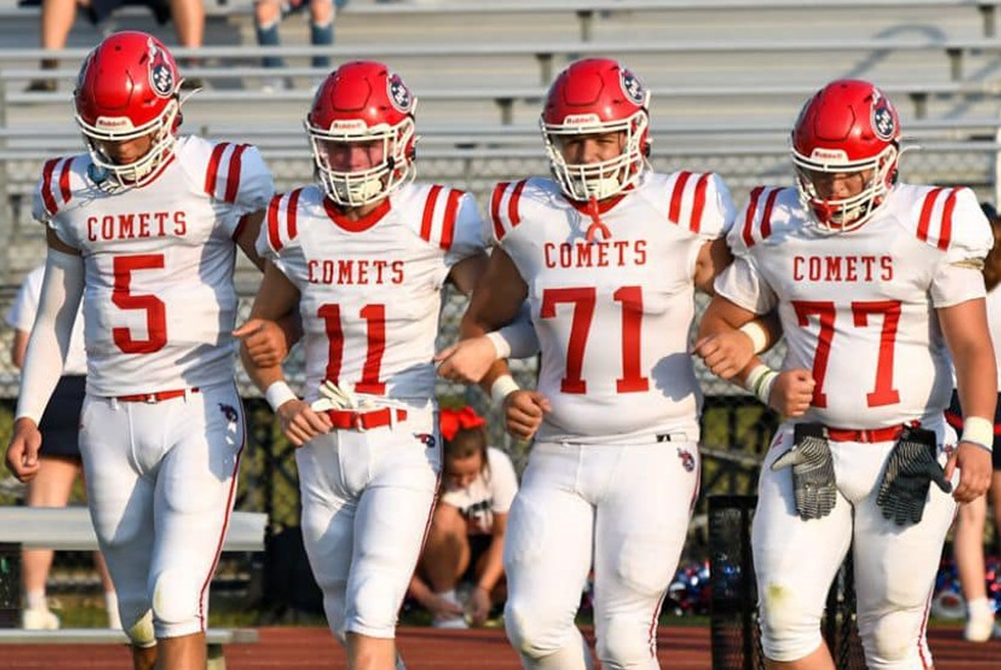
Hanover-Horton has eight seniors. Luke Soper is the quarterback and a two-way starter. Gavin Berkeypile is a physical player who has a nose for the ball. Center Bryant Hamisfar is a captain and makes the calls for the offensive line. Jackson Johnson and Jack Wooster are split ends on offense who have turned into excellent blockers, and Wyatt Ashworth has developed into a solid two-way starter.
The Comets defense is led by junior Adam Ley, a third-year starter despite being only a junior.
“We brought him up as a freshman out of necessity,” Messer said. “He’s really become a great football player. The play of our defensive front has been so strong, it has helped Adam be able to make a lot of tackles from his linebacker spot. Last year he had offensive linemen in his face every play. This year, he’s able to fill the gaps and make plays.”
Ley made 19 tackles last week against Addison during Hanover-Horton’s third consecutive shutout and fourth of the season, also a school record.
On offense, the Comets already have set the single-season school scoring record. Soper directs an offense that has been heavy on the run through the first seven games with multiple backs, including freshman Austyn Hocter.
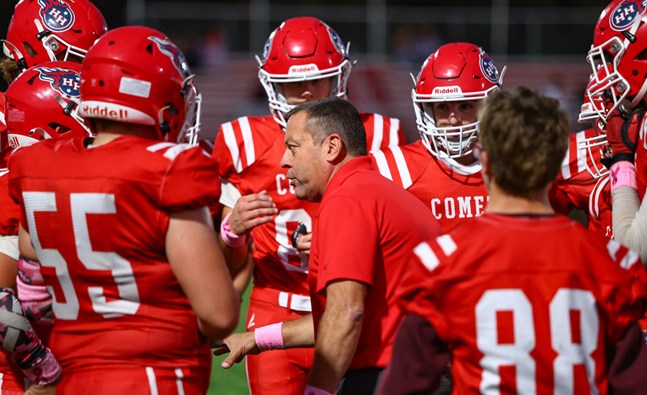 “We are still finding our way on offense,” Messer said. “We try to be a little more balanced. Luke is a heck of a quarterback who has a really good arm. We want to find ways to be more balanced.”
The offense is averaging 43 points a game, while the defense is allowing just 8.4.
“I don’t really look at how many points we score or give up,” Messer said. “I will look at those kinds of things after the season when we have a chance to sit down and assess how things went. We are really focused on the next play, next play.”
Messer comes from a football background rooted in success.
“I’m a Hudson guy through and through,” Messer said. “I was born in Hudson, played football at Hudson and coached for 15 years at Hudson.”
He coached for several years under Hall of Fame coach Chris Luma, and coached defense with current Hudson head coach Dan Rogers.
“Every step of the way, I’ve had some great coaches to help me,” Messer said. “Chris was a tremendous mentor. I know I can still pick up the phone at any time and give him a call.”
One of the first things Messer did at Hanover-Horton was work on the physical strength of the team.
“When I first got here, it was obvious to me that we weren’t a very physical football team,” he said. “The weight room part of it did not come quickly. I’ve had old-timers here tell me they’ve never had so many kids in the weight room. That was one of the things we needed to turn around.”
There already have been several big wins this season for the Comets, but close ones over Michigan Center (21-20) and Jonesville (21-18) made Messer particularly proud.
“We’ve had some moments this year where we reverted to the Hanover-Horton of old, but I’m so proud of the guys to overcome that and stay focused,” Messer said. “That third quarter against Jonesville things weren’t going our way, but we held on. Our goal is to just keep it one play, one drive at a time and make this a historic season.”
 Doug Donnelly has served as a sports and news reporter and city editor over 25 years, writing for the Daily Chief-Union in Upper Sandusky, Ohio from 1992-1995, the Monroe Evening News from 1995-2012 and the Adrian Daily Telegram since 2013. He's also written a book on high school basketball in Monroe County and compiles record books for various schools in southeast Michigan. E-mail him at [email protected] with story ideas for Jackson, Washtenaw, Hillsdale, Lenawee and Monroe counties.
PHOTOS (Top) From left, Hanover-Horton’s Luke Soper (5), Jack Wooster (11), Braden Cogan (71) and Bryan Hamisfar (77) take the field together arm-in-arm. (Middle) Comets coach David Messer talks things over with his players. (Top photo courtesy of the Hanover-Horton athletic department; middle photo courtesy of Karson Durocher/JTV.)