


Classes Still Create Hoosier Hysteria
July 27, 2017
By Rob Kaminski
MHSAA benchmarks editor
This is the fourth part in a series on MHSAA tournament classification, past and present, that will be published over the next two weeks. This series originally ran in this spring's edition of MHSAA benchmarks.
Twenty years ago, Bloomington North High School won the Indiana High School Athletic Association boys basketball championship, defeating Delta 75-54 at the RCA Dome in Indianapolis.
The date, March 22, 1997, is at the same time revered and disdained by traditionalists in the state who saw it as the last schoolboy championship game the state would ever host.
That’s how devout the game of basketball, particularly interscholastic basketball, had become in the Hoosier state during the 87 years a state champion – one state champion, to be precise – was crowned.
Following that 1997 season, the IHSAA moved to a four-class system for its roundball tournaments, like so many of its state association counterparts had done years earlier.
It would be shocking to find more than a small percentage of current high school basketball players around the country unfamiliar with the iconic movie Hoosiers, even though the film is now more than 30 years old.
And, the storyline for that blockbuster unfolded more than 30 years prior to its release, when small-town, undermanned Milan High School defeated Muncie Central High School 32-30 in the 1954 IHSAA title game.
Perhaps it’s because of the David vs Goliath notion, or the fame of the movie that replaced Milan with the fictional Hickory and real-life star Bobby Plump with Hollywood hero Jimmy Chitwood, or the simple fact that Indiana had something other states didn’t.
Whatever the reason, plenty of opposition remains to this day to basketball classification in the state.
The fact is, the small rural schools were regularly being beaten handily by the much larger suburban and city schools as the tournament progressed each season.
Small schools also were closing at a rapid rate following the state’s School Reorganization Act in 1959, as students converged on larger, centralized county schools. From 1960 to 2000, the number of schools entering the tournament dropped from 694 to 381, and in 1997 a total of 382 schools and 4,584 athletes began competition at the Sectional level (the first level of the IHSAA Basketball Tournament).
It was at the entry level of the tournament where school administrators felt the pain of the new class system, but not necessarily for the same nostalgic reasons as the fans who either attended or boycotted the tournament.
At the Sectional round of the tournament, the IHSAA was culling just 2 percent of the revenue, with the participating schools splitting the balance. So, when Sectional attendance dropped by 14 percent in that first year of class basketball, many schools realized a financial loss. It was money they had grown to count on in prior years to help fund various aspects of the department.
Schools cumulatively received more than $900,000 from Sectional competition in 1998, but that total was down from more than $1 million in the last year of the single-class tournament.
Yet, the current format provides a great deal more opportunity and realistic chances at championship runs for schools of all enrollments.
To date, 60 additional teams have championship or runner-up trophies on display in school trophy cases around Indiana.
That was the mission in front of then-IHSAA commissioner Bob Gardner (now National Federation executive director) once the board made its decision: to give thousands more student-athletes the opportunity for once-in-a-lifetime experiences.
As any statistician knows, figures can be manipulated to tell any side of a story. Declining attendance in year one of class basketball is such a number.
The truth is tournament attendance had been on a steady downward spiral since its peak of just over 1.5 million in 1962. By the last single-class event in 1997, the total attendance was half that.
The challenge then and today, as it is for all state associations, is to find that delicate balance for those holding onto tradition, those holding onto trophies, and the number of trophies to hand out.
Editor’s Note: Stories from the Fort Wayne Journal Gazette in 1998 and from a 2007 issue of Indianapolis Monthly provided facts in this article.
1st & Goal: 2024 Week 7 Preview
By
Geoff Kimmerly
MHSAA.com senior editor
October 11, 2024

There are only three weeks left in the 2024 football regular season. But there's still plenty of time to shake things up.
Several newly-crowned league champions could celebrate tonight or Saturday – but as we detail below, scenarios exist in a number of leagues where one, two or three teams are still in the title mix.
And as we look farther toward the MHSAA Playoffs, there's good news as well (or bad, depending on how your favorite team is sitting). Of last year's field of 288 playoff teams, 27 were not among the top 32 (11-player) or 16 (8-player) in their respective divisions heading into Week 7. That number was consistent with 2022, when 25 eventual playoff teams were outside the field with three weeks to play.
There were 17 games Thursday night, including a matchup for first in the Lakes Valley Conference between co-leaders Milford and Walled Lake Western (which Western won 37-0) and a decider in the Oakland Activities Association Red (where Oxford claimed a title share with a 38-14 win over West Bloomfield). All games listed below are tonight unless noted, with results posting as they are reported all weekend on the MHSAA Scores page. Updated standings also are available by clicking the schools on the score list, and every division’s playoff points summary updates as well as scores are received.
Bay & Thumb
Fenton (6-0) at Flushing (5-1) WATCH
Fenton will be playing to finish off a sixth-straight Flint Metro League divisional championship after clinching a share of the Stripes title last week. Rival Flushing has a chance to claim a piece of a championship for the first time since sharing the formerly one-division Metro title in 2018 – a season which also featured its most recent win over the Tigers. The Raiders’ only loss this fall was to Linden, by a point in Week 4, and Linden also is tied for second place, would gain a title share with a Flushing win, and fell to Fenton by just three points last week.
Keep an eye on these FRIDAY North Branch (5-1) at Armada (5-1) WATCH, Harbor Beach (6-0) at Reese (4-2) WATCH, Marysville (5-1) at St. Clair (5-1), Elkton-Pigeon-Bay Port Laker (4-2) at Millington (5-0) WATCH.
Greater Detroit
Macomb Dakota (6-0) at Utica Eisenhower (5-1) WATCH
Clinton Township Chippewa Valley’s stunning win last week over Eisenhower may have blunted some of the buzz that would have come with this matchup – but could also fire up the Eagles even more. They’ll claim a share of the Macomb Area Conference Red title with a win after Dakota guaranteed a share last week thanks to that Eisenhower loss. The Eagles won last year’s meeting with the Cougars 31-0, but Dakota has given up only 52 points total over six games this fall.
Keep an eye on these FRIDAY Macomb Lutheran North (5-1) at Riverview Gabriel Richard (6-0) WATCH, Port Huron Northern (4-2) at Warren Mott (5-1), Howell (6-0) at Novi (5-1) WATCH. SATURDAY Romulus Summit Academy North (5-0) at Warren Michigan Collegiate (5-1)
Mid-Michigan
Saginaw Nouvel Catholic Central (6-0) at Ithaca (6-0) WATCH
Nouvel is enjoying its best start since finishing Division 8 runner-up in 2017 and already has surpassed last season’s four wins. Tonight provides an opportunity to take another step as the Panthers have lost all five matchups with Ithaca since joining the Tri-Valley Conference in 2018. The winner of this one clinches the TVC Blue title outright – and the Yellowjackets have a pair of impressive streaks on the line as well. They’ve won 19 straight league games going back to 2020 and 15 consecutive league championships.
Keep an eye on these FRIDAY DeWitt (6-0) at Grand Ledge (4-2) WATCH, Chesaning (6-0) at Ovid-Elsie (6-0) WATCH, Ionia (4-2) at Lansing Catholic (4-2), East Lansing (3-3) at Lansing Everett (5-1) WATCH.
Northern Lower Peninsula
Marquette (5-1) at Petoskey (6-0) WATCH
The winner earns a share of the Big North Conference title. Petoskey is seeking its first since 2011, and a victory tonight also would guarantee its best record since 2015. Marquette, meanwhile, is in its second season in the BNC and finished second a year ago. Last season’s pair of games against Marquette may have set the stage for this Petoskey run; the Northmen lost 21-20 in Week 8 but claimed the rematch 26-7 in a playoff opener. Scoring could be limited this time; aside from a Week 4 loss to Lowell, the Sentinels have given up seven points total this fall, while Petoskey is allowing just 9.2 per game.
Keep an eye on these FRIDAY Evart (4-2) at McBain (6-0), Cheboygan (3-3) at Kingsley (4-2) WATCH, Charlevoix (4-2) at Mancelona (3-3), Mount Pleasant (4-2) at Traverse City West (3-3) WATCH.
Southeast & Border
Union City (6-0) at Springport (6-0) WATCH
The winner claims a share of the Big 8 Conference title, which for Springport would be a first since 2016 and for Union City its third straight. The Chargers have won 17 consecutive league games, in fact, and defeated Springport in four straight including 41-0 last fall. But the Spartans are enjoying their best season since 2018 and after going 0-9 only two years ago. They’ve already avenged 2023 losses to Sand Creek, Stockbridge and Quincy and have scored nearly as many points this fall as the last two years combined.
Keep an eye on these FRIDAY Ida (5-1) at Adrian Madison (4-2) WATCH, Flat Rock (5-1) at Monroe St. Mary Catholic Central (6-0), Chelsea (5-1) at Jackson (4-2) WATCH, Traverse City St. Francis (5-1) at Jackson Lumen Christi (5-1) WATCH.
Southwest Corridor
Hastings (6-0) at Battle Creek Harper Creek (5-1)
Save for an upset over the next two weeks, this matchup likely will decide the Interstate 8 Athletic Conference title. These two have some history with that; Hastings, Harper Creek and Jackson Lumen Christi shared the championship in 2021, and since the Saxons have won the last three and 20 straight league games. The Beavers will hope a much-improved offense averaging 40 points per game can continue surging against a Hastings defense that gave up only 11.5 ppg in league play in 2023 – and has lowered that to 7.3 ppg over four league games this fall.
Keep an eye on these FRIDAY Dowagiac (5-1) at Berrien Springs (3-3) WATCH, Parchment (5-1) at Constantine (5-1), Niles (5-1) at Edwardsburg (4-2) WATCH, Saugatuck (5-1) at Schoolcraft (5-1) WATCH, Portage Central (4-2) at Portage Northern (4-2) WATCH.
Upper Peninsula
Menominee (6-0) at Negaunee (5-1) WATCH
Menominee is set up for its toughest tests over its final three games of the regular season, as Negaunee, Week 8 opponent Kingsford and Week 9’s Bark River-Harris are a combined 15-3. Negaunee welcomed the Maroons to the Western Peninsula Athletic Conference last year with a 47-20 win and need a repeat performance to have any hope of a West-PAC Copper shared title after losing to Kingsford in Week 4. Menominee’s only losses last season were to Negaunee and Kingsford before reaching the Division 7 championship game, so there’s extra incentive there as well.
Keep an eye on these FRIDAY Bark River-Harris (4-2) at Iron Mountain (6-0) WATCH, Ishpeming Westwood (2-4) at Kingsford (6-0) WATCH, Calumet (3-3) at Hancock (1-5). SATURDAY Manistique (3-3) at Gwinn (2-4).
West Michigan
Grand Rapids Northview (6-0) at Grand Rapids Catholic Central (5-1)
Northview’s best season since 2018 would have its best highlight yet with a win tonight that would not only clinch a share of the Ottawa-Kent Conference Black championship but deliver Grand Rapids Catholic Central a rare loss. Catholic Central is facing a second-straight undefeated opponent and handed Holland Christian its first loss last week, 42-18; the Cougars have lost only one league game over the last eight seasons.
Keep an eye on these FRIDAY Grand Rapids South Christian (4-2) at Hudsonville Unity Christian (6-0), Big Rapids (5-1) at Newaygo (5-1), Ravenna (4-2) at North Muskegon (5-1) WATCH, Grand Rapids West Catholic (4-2) at Ada Forest Hills Eastern (5-1) WATCH.
8-Player
Gobles (6-0) at Martin (5-0) WATCH
This also is a winner-take-all, for the Southwest Michigan 8-Man Football League Red championship, and with a nice rivalry brewing after Gobles won last season’s regular-season meeting 53-16 but the Clippers won the Regional Final rematch 28-6. Martin is coming off scoring a season-high 70 points and has topped 50 three of the last four games, while Gobles has held its last three opponents (and four total) to single digits and posted its second shutout of the season last week.
Keep an eye on these FRIDAY Au Gres-Sims (5-1) at Atlanta (5-1) WATCH, Kingston (5-1) at Deckerville (6-0) WATCH, Portland St. Patrick (6-0) at Fulton (5-1) WATCH, Powers North Central (5-1) at Ontonagon (4-2).
MHSAA.com's weekly “1st & Goal” previews and reviews are powered by MI Student Aid, a division within the Department of Lifelong Education, Advancement, and Potential (MiLEAP). MI Student Aid encourages students to pursue postsecondary education by providing access to student financial resources and information. MI Student Aid administers the state’s scholarship and grant programs that help make college Accessible, Affordable and Attainable for you. Click to connect with MI Student Aid and find more information on Facebook and Twitter @mistudentaid.
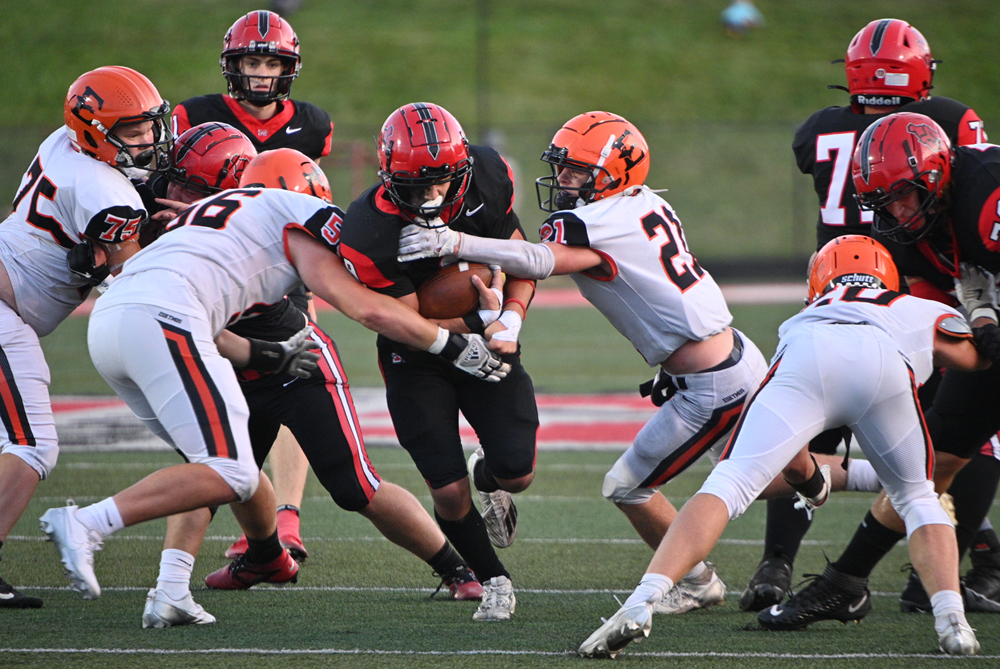
PHOTO Escanaba's Alex Morgan (56) and Keagan Braun (21) converge on Marquette's Chase Niemi (9) as he gets closer to the end zone during the Sentinels' Week 6 win. (Photo by Cara Kamps.)