


Classes Still Create Hoosier Hysteria
July 27, 2017
By Rob Kaminski
MHSAA benchmarks editor
This is the fourth part in a series on MHSAA tournament classification, past and present, that will be published over the next two weeks. This series originally ran in this spring's edition of MHSAA benchmarks.
Twenty years ago, Bloomington North High School won the Indiana High School Athletic Association boys basketball championship, defeating Delta 75-54 at the RCA Dome in Indianapolis.
The date, March 22, 1997, is at the same time revered and disdained by traditionalists in the state who saw it as the last schoolboy championship game the state would ever host.
That’s how devout the game of basketball, particularly interscholastic basketball, had become in the Hoosier state during the 87 years a state champion – one state champion, to be precise – was crowned.
Following that 1997 season, the IHSAA moved to a four-class system for its roundball tournaments, like so many of its state association counterparts had done years earlier.
It would be shocking to find more than a small percentage of current high school basketball players around the country unfamiliar with the iconic movie Hoosiers, even though the film is now more than 30 years old.
And, the storyline for that blockbuster unfolded more than 30 years prior to its release, when small-town, undermanned Milan High School defeated Muncie Central High School 32-30 in the 1954 IHSAA title game.
Perhaps it’s because of the David vs Goliath notion, or the fame of the movie that replaced Milan with the fictional Hickory and real-life star Bobby Plump with Hollywood hero Jimmy Chitwood, or the simple fact that Indiana had something other states didn’t.
Whatever the reason, plenty of opposition remains to this day to basketball classification in the state.
The fact is, the small rural schools were regularly being beaten handily by the much larger suburban and city schools as the tournament progressed each season.
Small schools also were closing at a rapid rate following the state’s School Reorganization Act in 1959, as students converged on larger, centralized county schools. From 1960 to 2000, the number of schools entering the tournament dropped from 694 to 381, and in 1997 a total of 382 schools and 4,584 athletes began competition at the Sectional level (the first level of the IHSAA Basketball Tournament).
It was at the entry level of the tournament where school administrators felt the pain of the new class system, but not necessarily for the same nostalgic reasons as the fans who either attended or boycotted the tournament.
At the Sectional round of the tournament, the IHSAA was culling just 2 percent of the revenue, with the participating schools splitting the balance. So, when Sectional attendance dropped by 14 percent in that first year of class basketball, many schools realized a financial loss. It was money they had grown to count on in prior years to help fund various aspects of the department.
Schools cumulatively received more than $900,000 from Sectional competition in 1998, but that total was down from more than $1 million in the last year of the single-class tournament.
Yet, the current format provides a great deal more opportunity and realistic chances at championship runs for schools of all enrollments.
To date, 60 additional teams have championship or runner-up trophies on display in school trophy cases around Indiana.
That was the mission in front of then-IHSAA commissioner Bob Gardner (now National Federation executive director) once the board made its decision: to give thousands more student-athletes the opportunity for once-in-a-lifetime experiences.
As any statistician knows, figures can be manipulated to tell any side of a story. Declining attendance in year one of class basketball is such a number.
The truth is tournament attendance had been on a steady downward spiral since its peak of just over 1.5 million in 1962. By the last single-class event in 1997, the total attendance was half that.
The challenge then and today, as it is for all state associations, is to find that delicate balance for those holding onto tradition, those holding onto trophies, and the number of trophies to hand out.
Editor’s Note: Stories from the Fort Wayne Journal Gazette in 1998 and from a 2007 issue of Indianapolis Monthly provided facts in this article.
Lumen Christi Shows Resolve, Ermatinger Shines in History-Making Clincher
By
Perry A. Farrell
Special for MHSAA.com
June 14, 2024
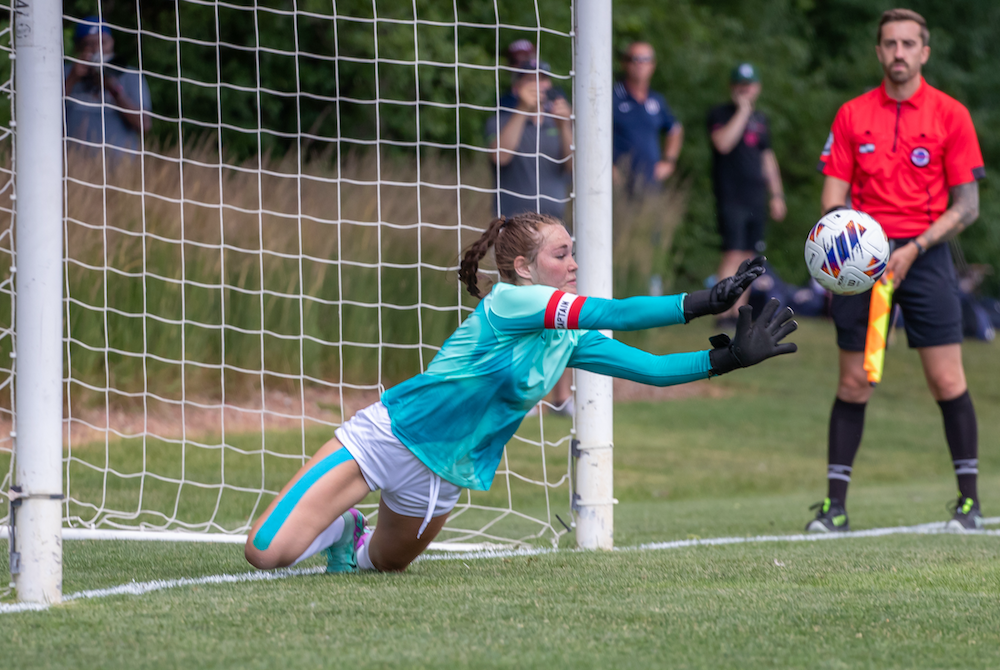
EAST LANSING – Jackson Lumen Christi keeper Izzy Ermatinger stepped up to kick first as the Titans began a Division 4 championship-deciding shootout Kalamazoo Christian on Friday.
She scored, then was brilliant in net stopping all but one of the Comets’ shots to clinch the Titans’ first Finals title in this sport with a 2-1 victory at DeMartin Stadium.
Lumen won the shootout 3-1, as Paige Lefere and Paityn Petitto also buried shots in the deciding portion following 100 minutes of regulation and overtime.
“I always kick left when we are doing PKs (penalty kicks). That’s what I normally do, and I got it,” Ermatinger said.
“We’ve been practicing PKs all through the season in case something like this came up. Every day at practice we shoot PKs,” added Codi Ruge, who scored Lumen’s regulation goal. “Izzy was fantastic. She’s a great goalie and we’re going to miss her.”
Lumen Christi had played in a championship match one other time, in 2000, and finished the season 14-7 after going 2-6 and placing eighth in the Catholic High School League AA.
The Titans gave up only two goals over seven tournament games during this run. Lumen Christi endured Friday's marathon while subbing only once, making the performance even more impressive.
 Kalamazoo Christian also showed its mettle after experiencing an unusual journey to the championship match. The team bus broke down just outside of Battle Creek. Family and friends had to pitch in and get the players to East Lansing. They arrived about 45 minutes before game time, with the MHSAA pushing back the start by five minutes.
The Titans struck first when Petitto sent a 40-yard pass to Ruge, who took the ball in stride and blasted a shot into the net just under four minutes into the match. It was the sophomore’s 17th goal of the season, and Petitto’s 10thassist.
“Every game in the huddle we come out and say first five (minutes), let’s score,’’ said Ruge. “That’s what we did. We wanted to get an early goal to get some momentum. It was a very good pass by (Petitto). We’ve been playing the same people most of the season, so that helped us.”
The Titans kept the offensive pressure on, keeping the ball in the Comets’ half for the first 20 minutes.
Kalamazoo Christian (18-5-2) was unable to take advantage of Lumen Christi’s lack of depth, and struggled to find offensive consistency. Still, the Comets had a great chance to tie the game late in the first half, but a shot sailed over the top of the net.
They wasted no time scoring to start the second half, as Ari Allen capitalized on a Lumen Christi miscue on a pass and scored from the left side on a Phoebe Zeyl assist to tie the score 1-1.
Both goalies – the Comets’ Elizabeth Netz, and Ermatinger – were excellent in goal, making four and seven saves, respectively.
The championship capped a run that also included Lumen Christi’s first Regional title since 2007.
“This means a lot to us,’’ Ruge said. “It has never happened before, and it’s something we’ll never forget.’’
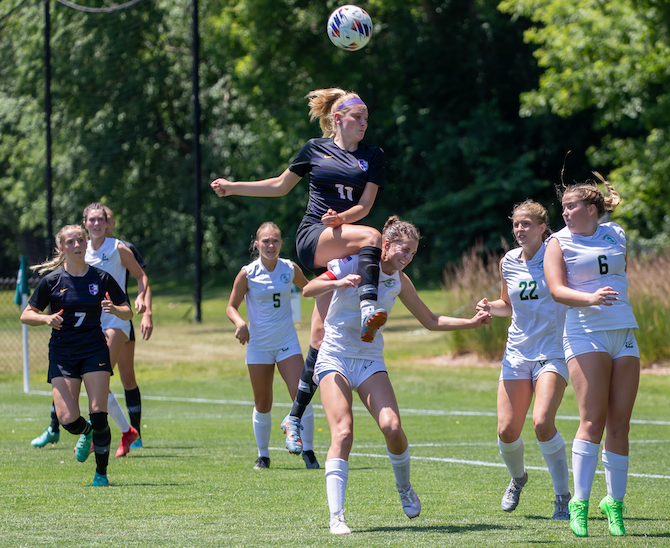
PHOTOS (Top) Lumen Christi keeper Izzy Ermatinger makes the title-clinching save during a shootout that decided the Division 4 title Friday. (Middle) Kalamazoo Christian’s Jordyn Bonnema (11) elevates to get to the ball.