


Classes Still Create Hoosier Hysteria
July 27, 2017
By Rob Kaminski
MHSAA benchmarks editor
This is the fourth part in a series on MHSAA tournament classification, past and present, that will be published over the next two weeks. This series originally ran in this spring's edition of MHSAA benchmarks.
Twenty years ago, Bloomington North High School won the Indiana High School Athletic Association boys basketball championship, defeating Delta 75-54 at the RCA Dome in Indianapolis.
The date, March 22, 1997, is at the same time revered and disdained by traditionalists in the state who saw it as the last schoolboy championship game the state would ever host.
That’s how devout the game of basketball, particularly interscholastic basketball, had become in the Hoosier state during the 87 years a state champion – one state champion, to be precise – was crowned.
Following that 1997 season, the IHSAA moved to a four-class system for its roundball tournaments, like so many of its state association counterparts had done years earlier.
It would be shocking to find more than a small percentage of current high school basketball players around the country unfamiliar with the iconic movie Hoosiers, even though the film is now more than 30 years old.
And, the storyline for that blockbuster unfolded more than 30 years prior to its release, when small-town, undermanned Milan High School defeated Muncie Central High School 32-30 in the 1954 IHSAA title game.
Perhaps it’s because of the David vs Goliath notion, or the fame of the movie that replaced Milan with the fictional Hickory and real-life star Bobby Plump with Hollywood hero Jimmy Chitwood, or the simple fact that Indiana had something other states didn’t.
Whatever the reason, plenty of opposition remains to this day to basketball classification in the state.
The fact is, the small rural schools were regularly being beaten handily by the much larger suburban and city schools as the tournament progressed each season.
Small schools also were closing at a rapid rate following the state’s School Reorganization Act in 1959, as students converged on larger, centralized county schools. From 1960 to 2000, the number of schools entering the tournament dropped from 694 to 381, and in 1997 a total of 382 schools and 4,584 athletes began competition at the Sectional level (the first level of the IHSAA Basketball Tournament).
It was at the entry level of the tournament where school administrators felt the pain of the new class system, but not necessarily for the same nostalgic reasons as the fans who either attended or boycotted the tournament.
At the Sectional round of the tournament, the IHSAA was culling just 2 percent of the revenue, with the participating schools splitting the balance. So, when Sectional attendance dropped by 14 percent in that first year of class basketball, many schools realized a financial loss. It was money they had grown to count on in prior years to help fund various aspects of the department.
Schools cumulatively received more than $900,000 from Sectional competition in 1998, but that total was down from more than $1 million in the last year of the single-class tournament.
Yet, the current format provides a great deal more opportunity and realistic chances at championship runs for schools of all enrollments.
To date, 60 additional teams have championship or runner-up trophies on display in school trophy cases around Indiana.
That was the mission in front of then-IHSAA commissioner Bob Gardner (now National Federation executive director) once the board made its decision: to give thousands more student-athletes the opportunity for once-in-a-lifetime experiences.
As any statistician knows, figures can be manipulated to tell any side of a story. Declining attendance in year one of class basketball is such a number.
The truth is tournament attendance had been on a steady downward spiral since its peak of just over 1.5 million in 1962. By the last single-class event in 1997, the total attendance was half that.
The challenge then and today, as it is for all state associations, is to find that delicate balance for those holding onto tradition, those holding onto trophies, and the number of trophies to hand out.
Editor’s Note: Stories from the Fort Wayne Journal Gazette in 1998 and from a 2007 issue of Indianapolis Monthly provided facts in this article.
Preview: Championship Opportunities Await for Historic Contenders, Rising Aces
By
Geoff Kimmerly
MHSAA.com senior editor
June 5, 2024
This weekend’s Lower Peninsula Boys Golf Finals are guaranteed to produce at least one new team champion and three first-time individual medalists.
The pursuit for the Division 3 title might be the widest open and won’t include 2023 winner Grand Rapids Catholic Central, which played in Division 2 this spring. On the individual side, only Rochester Adams senior Peter Roehl is back from last year’s medalists.
Conversely, Grand Rapids Christian in Division 2 returns its full lineup after claiming last year’s team title. And the Division 2 and 4 individual standings could see plenty of movement all weekend with six top-10 finishers from last season back – including Division 4 runner-up Parker Stalcup from Clarkston Everest Collegiate and 2023 Division 3 runner-up Will Preston from GRCC, who will take on the Division 2 field this time.
Play begins both Friday and Saturday at 9 a.m. See below for more on a number of teams and individuals who could be in contention, and check out the Boys Golf page for full lineups and more.
Division 1 at Battle Creek’s Bedford Valley
Going back five seasons (and not counting COVID-canceled 2020), this division has crowned five different champions, and all five were from Metro Detroit/Ann Arbor. The last four runners-up also have represented that area of the state. Northville was first and Rochester Adams second in 2023, separated by just two strokes and with Brighton finishing third and only four strokes off the lead. Northville just made the Finals this season, finishing third and edging Brighton by a stroke for the final qualifying spot at Pine View in Ypsilanti.
Ann Arbor Skyline: The 2021 champion and 2022 runner-up finished fifth last season and graduated three from its Finals lineup. The Eagles return this weekend with five seniors on the card including 2023 starters Nikash Bhagat and Ethan Stange. Senior Vibhav Alokam tied for sixth at the Final as a sophomore and missed the top 10 standings by a stroke as a freshman on the title-winning team, and also is back. Skyline shot a 302 to win the Regional at Pine View, with Bhagat tied for second individually and Alokam, Stange and senior Chalie Eggleston all tied for fifth.
Detroit Catholic Central: The Shamrocks won their Regional at Twin Lakes in Rochester Hills with a 289, 10 strokes ahead of the field and paced by senior medalist Julian Menser at 66. He missed the individual top 10 standings by a stroke as the lowest scorer on last year’s fourth-place Finals team, and he’s joined again by sophomore David Krusinski, who finished fifth at the Regional last week.
Rochester Adams: Last season’s runner-up is seeking its first Finals championship since 1978 and is paced by the reigning medalist, senior Peter Roehl. He won the Regional at Fieldstone last week in a tie-breaker, leading Adams to the team victory as well. Junior teammate Daniel Lee also was in that first-place mix, and senior Cole Zavadil tied for seventh as the Highlanders shot a 304. Lee and Zavadil also were part of last season’s Finals lineup.
Individuals: Mattawan senior Matthew Novak and Lake Orion junior Connor Fox are the only others back from last season’s top 10, Novak having finished fourth and Fox tied for eighth. Fox also was part of that first-place tie-breaker at Fieldstone last week. Joining Roehl and Mesner as Regional champions were Portage Central senior Jake Longman, Howell junior Derek Kantola, South Lyon East senior Ryan Kruschka and Warren De La Salle Collegiate sophomore Troy Nguyen.
Division 2 at Michigan State’s Forest Akers West
Grand Rapids Christian broke Bloomfield Hills Brother Rice’s two-year hold on the title last spring, with Rice finishing runner-up and just two strokes back. No other team came within 33 of the lead. Nine teams did shoot 305 or lower at last week’s Regionals, which may be an indication of some surprise movement to come this weekend.
Bloomfield Hills Brother Rice: The Warriors finished only third at last week’s Regional at Huron Meadows in Brighton and have only one golfer back from last season’s Finals runner-up finish. But they did shoot a 302 at Huron Meadows, and that one returnee is junior Leandro Pinili, who tied for ninth individually at the Finals as a freshman in 2022. The team’s Regional finish this time was led by sophomore Joseph Karoutsos tying for fourth, and Rice’s lineup will be comprised of three juniors and two sophomores.
Bloomfield Hills Cranbrook Kingswood: The Cranes didn’t make the Finals last year as a team, but did send three individual qualifiers – and sophomore Henry Delzer and junior Ryan Li are back this season and helped the team to a division-low 287 Regional score to win last week at Huron Meadows. Cranbrook finished 10 strokes ahead of Orchard Lake St. Mary’s and 15 fewer than Brother Rice, with sophomore Andrew Chang winning a playoff against Delzer to claim first individually, and Li tying for fourth.
Grand Rapids Christian: All five golfers will return this weekend from the team that made up 10 strokes after last year’s first round to win the program’s first Finals championship since 2013. Senior Dylan Clark was fifth individually last year and sophomore Cooper Reitsma and junior John Cassiday tied for sixth. The Eagles shot 296 last week to win by seven at Quail Ridge in Ada, with Cassiday the medalist, Clark the runner-up, Reitsma tying for sixth and sophomore Sawyer O’Grady (tied for 12th) and senior Maxwell O’Grady (tied for 16th) rounding out an impressive team performance.
Individuals: The Grand Rapids Christian trio are the highest-placing individual finishers returning from last season, and they’re joined by Ada Forest Hills Eastern junior James Seymour and Trenton senior Will Barrett, who tied for ninth in 2023. Chang and Cassiday were joined among Regional champions last week by Grand Rapids Catholic Central senior Will Preston, Richland Gull Lake sophomore Maxwell Vandermolen, St. Johns senior Grant Rustad and Tecumseh junior Grant Simpson. Preston was the runner-up in Division 3 last season.
Division 3 at Katke at Ferris State
Grand Rapids Catholic Central finished first, second and first the last three seasons, respectively, but played this season in Division 2. That’s potentially opened this tournament way up, with Grand Rapids Covenant Christian coming in with the low Regional score last week at 301 and the next four carding 315 (Traverse City St. Francis and Grand Rapids West Catholic) or 316 (Jackson Lumen Christi and Essexville Garber) at their events.
Grand Rapids Covenant Christian: After finishing 15th at last season’s Final but without a senior in the lineup, Covenant is seeking its first top-two finish and won last week’s Regional at Old Channel Trail in Montague by 14 strokes ahead of West Catholic. Four of last season’s top five are back, led by senior Michael DeVries, who finished 14th individually last year. He was the runner-up at Old Channel Trail, with senior Kodie Klamer tied for third, junior Caleb Dykstra fifth and junior Aidan Pipe tied for eighth.
Grand Rapids West Catholic: The Falcons finished runner-up to Covenant at their Regional but with one of the lowest scores across the division, with sophomore Owen Kotowski finishing first at Old Channel Trail and sophomore Alexander Bartish and seniors Zach Parzych and Sam Stellini all tying for 10th. Kotowski also tied for 14th at last season’s Final, with Parzych and senior Samuel Myers both part of the lineup as well that tied for 10th.
Jackson Lumen Christi: The Titans tied for seventh last season without an individual finisher among the top 10, and they will pursue a first team championship since 2017 with two of those golfers back plus some solid reinforcements. Junior Charlie Saunders tied for 22nd at last year’s Final and finished fifth during last week’s Regional win at Cascades in Jackson – solidly in the middle of an impressive team performance that saw freshman Brandon Kulka second, junior Anthony Kulka third, senior Jack Swihart tie for sixth and junior Adam Fuller tie for 10th.
Individuals: With Preston and 2023 medalist Matthew Sokorai from Grand Rapids Catholic Central playing in Division 2 this season, Ann Arbor Greenhills senior Max Schulman is the lone returning top-10 placer from a year ago – when he tied for third. As noted, Kotowski was a Regional champ last week, and Schulman tied for second behind Grosse Pointe Woods University Liggett’s Steve McMahon at Washtenaw Golf Club in Ypsilanti. Grosse Ile sophomore Nicholas Joly-Naso, Essexville Garber senior Owen Halstead, South Haven senior Parker Williamson and Alma junior Cooper Couch also won Regional titles – Couch after a playoff with Benzie Central junior Christien Westcott.
Division 4 at The Meadows at Grand Valley State
Clarkston Everest Collegiate ascended from runner-up in 2022 to champion in 2023 and might be the favorite again this weekend. Grandville Calvin Christian was the only other team to break 330 at last week’s Regional, although 2023 Finals runner-up Hillsdale Academy had the third-lowest Regional score last week at 331 and Charlevoix at 332 should also make some noise. Calvin Christian last won a Finals in 1989, and Hillsdale Academy and Charlevoix are seeking a first team title.
Clarkston Everest Collegiate: Two-time Finals medalist Remy Stalcup graduated last spring, but younger brother Parker – now a junior – tied for 15th individually as a freshman and moved up to runner-up last season. There are four juniors and one sophomore in this year’s lineup, and Stalcup finished runner-up at last week’s Regional at Holly Meadows in Capac to junior teammate Will Pennanen, while junior Mark Cross tied for sixth and sophomore Nolan Alban tied for ninth as the team shot 312 to win by 30 strokes. Pennanen was 22nd at the Final as a freshman and tied for seventh last season.
Grand Calvin Christian: The Squires moved up from ninth at the 2022 Final to seventh last season, and they shot a 315 at Stonegate in Twin Lake last week to win that Regional by 20 strokes. Junior Josh VanderWal was the medalist, with sophomore Will Orme fourth and senior Braden VanderWal and junior Mason Schroeder tied for fifth. Braden VanderWal finished 10th at last season’s Final, when these four were the team’s low four scorers as well.
Hillsdale Academy: Last season’s Final runner-up returns four of last season’s top five, led by juniors Rykert Frisinger and Ridley Fast after they tied for third and placed fifth, respectively, in the individual standings. Junior Kahle Welden and freshman Lincoln Knirk also are back from the program’s highest-finishing team, and that foursome placed second, third, 11th and 18th respectively in winning their Regional at Coldwater Golf Club by four strokes ahead of 2021 Finals champion Kalamazoo Hackett Catholic Prep.
Individuals: In addition to Stalcup, Frisinger, Fast and Pennanen, Maple City Glen Lake junior Michael Houtteman has dominated his area this spring after also tying for seventh at last year’s championship tournament. Houtteman also tied for fifth and Frisinger tied for eighth in 2022. Joining Josh VanderWal and Pennanen in winning Regional championships last week were Breckenridge senior Zane Schmitz, Adrian Lenawee Christian senior Connor Parisien, Kalamazoo Christian junior Ian Tuin and Harbor Springs Harbor Light Christian junior Vaughn Henagan.
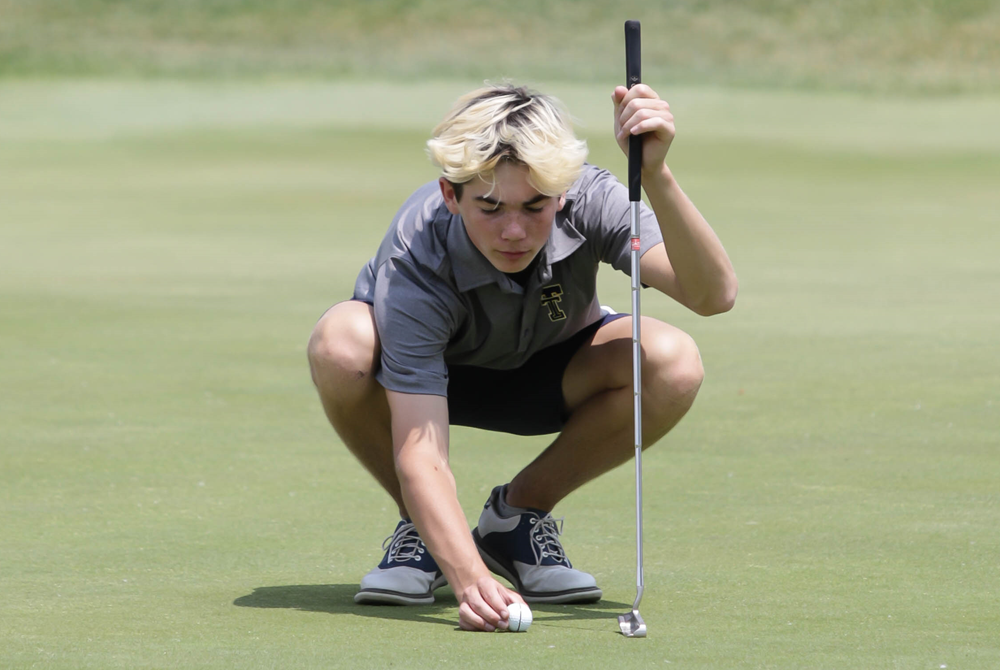
PHOTO Trenton's Will Barrett lines up a putt during last season's Lower Peninsula Division 2 Finals. (Click for more from High School Sports Scene.)