


Classes Still Create Hoosier Hysteria
July 27, 2017
By Rob Kaminski
MHSAA benchmarks editor
This is the fourth part in a series on MHSAA tournament classification, past and present, that will be published over the next two weeks. This series originally ran in this spring's edition of MHSAA benchmarks.
Twenty years ago, Bloomington North High School won the Indiana High School Athletic Association boys basketball championship, defeating Delta 75-54 at the RCA Dome in Indianapolis.
The date, March 22, 1997, is at the same time revered and disdained by traditionalists in the state who saw it as the last schoolboy championship game the state would ever host.
That’s how devout the game of basketball, particularly interscholastic basketball, had become in the Hoosier state during the 87 years a state champion – one state champion, to be precise – was crowned.
Following that 1997 season, the IHSAA moved to a four-class system for its roundball tournaments, like so many of its state association counterparts had done years earlier.
It would be shocking to find more than a small percentage of current high school basketball players around the country unfamiliar with the iconic movie Hoosiers, even though the film is now more than 30 years old.
And, the storyline for that blockbuster unfolded more than 30 years prior to its release, when small-town, undermanned Milan High School defeated Muncie Central High School 32-30 in the 1954 IHSAA title game.
Perhaps it’s because of the David vs Goliath notion, or the fame of the movie that replaced Milan with the fictional Hickory and real-life star Bobby Plump with Hollywood hero Jimmy Chitwood, or the simple fact that Indiana had something other states didn’t.
Whatever the reason, plenty of opposition remains to this day to basketball classification in the state.
The fact is, the small rural schools were regularly being beaten handily by the much larger suburban and city schools as the tournament progressed each season.
Small schools also were closing at a rapid rate following the state’s School Reorganization Act in 1959, as students converged on larger, centralized county schools. From 1960 to 2000, the number of schools entering the tournament dropped from 694 to 381, and in 1997 a total of 382 schools and 4,584 athletes began competition at the Sectional level (the first level of the IHSAA Basketball Tournament).
It was at the entry level of the tournament where school administrators felt the pain of the new class system, but not necessarily for the same nostalgic reasons as the fans who either attended or boycotted the tournament.
At the Sectional round of the tournament, the IHSAA was culling just 2 percent of the revenue, with the participating schools splitting the balance. So, when Sectional attendance dropped by 14 percent in that first year of class basketball, many schools realized a financial loss. It was money they had grown to count on in prior years to help fund various aspects of the department.
Schools cumulatively received more than $900,000 from Sectional competition in 1998, but that total was down from more than $1 million in the last year of the single-class tournament.
Yet, the current format provides a great deal more opportunity and realistic chances at championship runs for schools of all enrollments.
To date, 60 additional teams have championship or runner-up trophies on display in school trophy cases around Indiana.
That was the mission in front of then-IHSAA commissioner Bob Gardner (now National Federation executive director) once the board made its decision: to give thousands more student-athletes the opportunity for once-in-a-lifetime experiences.
As any statistician knows, figures can be manipulated to tell any side of a story. Declining attendance in year one of class basketball is such a number.
The truth is tournament attendance had been on a steady downward spiral since its peak of just over 1.5 million in 1962. By the last single-class event in 1997, the total attendance was half that.
The challenge then and today, as it is for all state associations, is to find that delicate balance for those holding onto tradition, those holding onto trophies, and the number of trophies to hand out.
Editor’s Note: Stories from the Fort Wayne Journal Gazette in 1998 and from a 2007 issue of Indianapolis Monthly provided facts in this article.
Preview: Memorable Finishes Guaranteed at LP Boys Track & Field Finals
By
Geoff Kimmerly
MHSAA.com senior editor
May 30, 2024
A few storylines immediately jump off the page when glancing at this weekend’s Lower Peninsula Boys Track & Field Finals lineups:
- All four of the fall’s Lower Peninsula cross country individual champions are stacking up as favorites in one or more distance races across their respective divisions, three as reigning champions on the track as well.
- Another set of magnificent seniors will be finishing their high school careers, led by three-time individual champion Shamar Heard of Clinton Township Chippewa Valley.
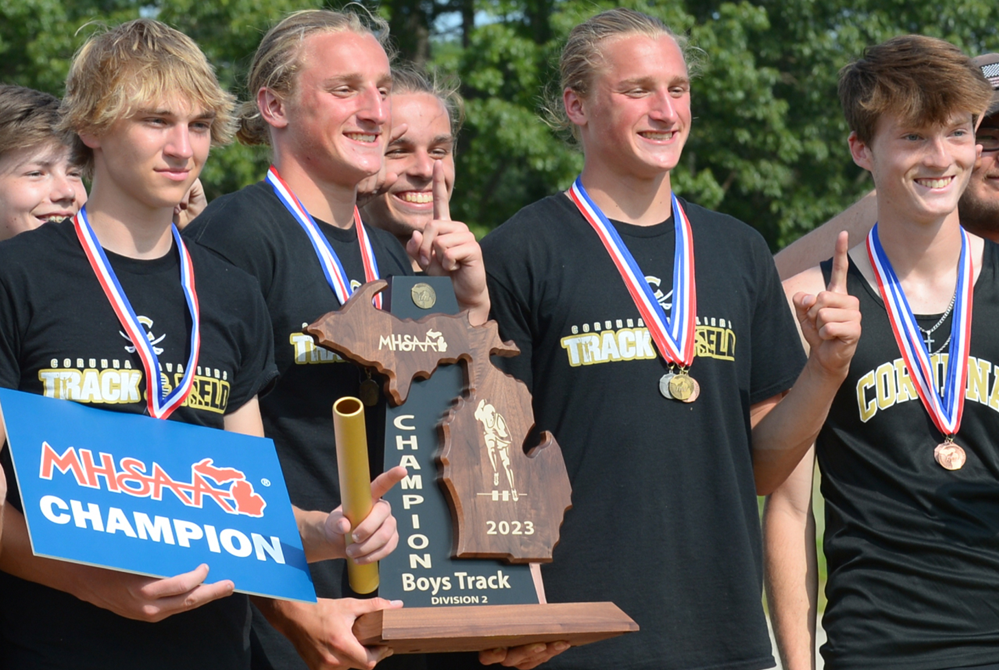
- And the Division 2 team championship pursuit could be another classic as last season’s top finishers contend again.
All four LP Finals will be contested at Grand Rapids-area schools, with pole vault and long jump beginning at 9 a.m., race semifinals and the 3,200 relay at 10 a.m. and the rest of the running finals starting at noon. Tickets cost $11 and are available digitally only via GoFan.
MHSAA.tv will live-stream all four meets beginning at 10 a.m., viewable with subscription. Check out the Boys Track & Field page for meet information for all four sites and lists of all qualifiers. Those described as "seeded" below have received those seeds based on Regional performances.
Below is a glance at team contenders and individuals to watch in all four divisions:
LP Division 1 at East Kentwood
Team forecast: Belleville may be in line to claim its first Finals team title in boys track & field with potential contenders in at least four races, with opportunities to place three in both hurdles championships and contend in the 800 relay. Annual contender Rockford has all four relays running – with three seeded among the top four in their respective races – plus a contender in the long jump among other events. Northville’s distance strength – and presence in all four relays as well plus four field events – could put it in position also to claim a team title for the first time.
Andrew Harding, Ann Arbor Huron senior – Last season’s high jump champion at 6-7 edged 2022 winner Nathan Levine from Canton by an inch and likely will have to outlast him one more time. Harding’s LPD1 Regional-best 6-8 this season was two inches higher than Levine and four others’ Regional jumps.
Shamar Heard, Clinton Township Chippewa Valley senior – He owns four Finals championships having won the 100 and 200 as a sophomore and the 400 and as part of the 800 relay last year. He’ll run the 200, 400 and on the 800 and 1,600 relays this time, and his 200 (21.49), 400 (46.80) and 1,600 relay (3:16.88) times ranked fastest for all LPD1 Regionals.
Brandon Herger, Northville senior – He anchored the all-Finals record-setting 3,200 last season, finished second in the 800 and also anchored the fifth-place 1,600 relay. He’ll run on the same relays this weekend, and his 800 (1:52.47) and 1,600 (4:12.86) times are top-seeded.
Quincy Isaac, Canton senior – The reigning LPD1 long jump champion had the best Regional jump in this division by more than a foot at 24-3¼ and also will high jump and run the 200 and on the 400 relay.
Seth Norder, Grand Haven senior – Last season’s 3,200 champion and last fall’s LPD1 cross country winner (and the runner-up in the 1,600 in 2022) is set to run the 800, 1,600 and on the 3,200 relay. He defeated Herger in the Elite Mile at the Romeo Barnyard Invitational with a 1,600 time of 4:04.81.
Will Jaiden Smith, Belleville junior – He finished sixth in the 200 and eighth in the 400 last season, but enters this weekend with the second-seeded 200 (21.61), fifth-seeded 110 hurdles (14.27) and top-seeded 300 hurdles (38.03) times and running on the fourth-seeded 800 relay.
LP Division 2 at Hamilton
Team forecast: Familiar star power will be everywhere this weekend. The Bower twins will try to lead Corunna to a repeat championship after combining to contribute to 36 of the Cavaliers’ 41 points last season. Mason has a similar one-two punch and tied for second a year ago. Whitehall last won in 1996 and is back after finishing fourth in 2023, bringing top seeds in two individual races and the 1,600 relay. Wayland is seeking its first team title since the first Track & Field Finals in 1925 and has a top hurdler and contenders in multiple field events.
Trannon Aylor, Whitehall senior – The reigning champion in the 400 was also eighth in the 200 in 2023, and among his four events this weekend he has the top-seeded 400 (48.49) and will run on the top-seeded 1,600 relay (3:25.36).
Tyler Baker, Mason senior – He won the 110 hurdles, was second in the long jump, third in the high jump and ran the 300 hurdles last season, and he’ll compete in all four again with his 110 hurdles time of 14.71 second-seeded.
Tarick Bower, Corunna senior – He ran on the winning 400 relay, runner-up 800 relay and was third in long jump last season, and enters this weekend second-seeded in the 100 (10.78), top-seeded in the long jump (22-7½) and running on two second-seeded relays.
Wyatt Bower, Corunna senior – He ran on the same relays as his brother last year, won the long jump and was seventh in the 100, and enters this weekend again on the same relays as Tarick, second-seeded in the long jump (22–¼) and second-seeded in the 200 (21.93).
Jacoby Dunlap, Alma senior – The returning high jump champion will compete in that event again and run on two relays.
TJ Hansen, Freeland junior – The reigning 3,200 champion is another fall cross country champion, and he’s set to run the 1,600 and 3,200 after posting the top LPD2 Regional time in the former (4:15.33).
Jake Machiniak, Berrien Springs senior – He’s the reigning 100 champ and ran on the first-place 800 relay last season as well, and he’s top-seeded in the 100 (10.56) this weekend, third-seeded in the 200 (21.99) and running on the sixth-seeded 800 relay and top-seeded 400 relay (42.40).
AJ Martel, Mason senior – The Bulldogs swept hurdles last season with Martel winning the 300, and he’s seeking a repeat while also running on the 400 and 1,600 relays.
Sam Vesperman, Grosse Ile junior – The reigning pole vault champion posted the best vault of LPD2 Regionals this season by seven inches with a 14-6 after winning last year’s Final by a foot.
LP Division 3 at Kent City
Team forecast: Hillsdale strung together three straight runner-up finishes from 2015-17, but may emerge this weekend with its first team title. The Hornets have potential point scorers in nearly every race and two second-seeded relays, plus contenders in both jumps. Detroit Edison is another hopeful seeking a first team championship, featuring contenders in the 200 and 400 and the top-seeded 800 relay. Reigning runner-up Pewamo-Westphalia has three top seeds and entries all over the meet as it seeks its first team since 2008 in Division 4.
Collin Farmer, Pewamo-Westphalia senior – He finished eighth in the 1,600 and 3,200 last season, but won the LPD3 cross country title in the fall and enters this weekend seeded first in both distance races at 4:25.56 and 9:37.80, respectively.
Sawyer Moloy, Sanford Meridian senior – The reigning high jump champion is seeded first at 6-7 and will also long jump and run on two relays.
Gavin Nurenberg, Pewamo-Westphalia senior – He’s the reigning champion in shot put and runner-up in discus and is seeded first in shot (60-0) and third in disc (169-3).
Tryce Tokar, Ovid-Elsie junior – The two-time champion in the pole vault has the top seed (14-6) and also will run on three relays.
Holden Van Poppel, Napoleon senior – He’s another returning champion, seeking to repeat in the 110 hurdles and seeded sixth (15.36).
Jerry Wiegers, North Muskegon senior – After winning the 200 and 400 last season, he’s seeded first in the 400 (48.24), second in the 200 (22.01) and will also run the 100 and on the third-seeded 1,600 relay.
LP Division 4 at Hudsonville Baldwin
Team forecast: Kalamazoo Hackett Catholic Prep has won the last two team championships but will face strong challengers again in its three-peat pursuit. The Irish do have the top-seeded 3,200 runner and 3,200 relay, entries in the other three relays and contenders in at least two more individual races. But Reading, last season’s team runner-up finishing six points back, has all four relays running and three seeded fourth or higher with multiple individual contenders as well as it seeks its first team title since 1991. Fowler is seeking its first team championship since 1988 and like Reading is strong in sprints and hurdles (with junior Brady Feldpausch seeded first in both hurdles races), but also with top-seeded 800 and 1,600 relays and competitors in all five field events.
Landon Bennett, Athens senior – He’s seeking a repeat in the 300 hurdles and also finished third in the 110s last season; he has the second seed in the 300 (39.93) and third in the 110 (15.14) this time.
Tayshawn Bester, Reading senior – He’s the reigning 110 hurdles champion and is second-seeded in that race (15.08) while running as well on two top-four seeded relays.
Nathan Feltner, Caseville senior – The reigning 400 champion and fifth-place finisher in the 200 will run those races plus the 100 and as part of the 400 relay.
Tyler Lenn, Marine City Cardinal Mooney senior – Another cross country champion from the fall, Lenn also is the reigning LPD4 title winner in the 1,600 and seeded second in that race (4:21.92) while also running the 800 and on the fifth-seeded 3,200 relay.
Owen Patton, Vestaburg senior – After winning the 800 by nearly four seconds last season, Patton is the top seed in that race (1:58:09) and also the fifth seed in the 1,600 and running on the 3,200 relay.
Bradley Richards, Fruitport Calvary Christian junior – The reigning high jump champion missed the meet record last year by half an inch at 6-10. He should approach that again – with 2022 champion Braden Prielipp from Marion also making a push – and also will long jump.
PHOTO Corunna, including twins Tarick and Wyatt Bower, celebrates its LPD2 team championship last season. (Photo by Dave McCauley/RunMichigan.com.)