


Classes Still Create Hoosier Hysteria
July 27, 2017
By Rob Kaminski
MHSAA benchmarks editor
This is the fourth part in a series on MHSAA tournament classification, past and present, that will be published over the next two weeks. This series originally ran in this spring's edition of MHSAA benchmarks.
Twenty years ago, Bloomington North High School won the Indiana High School Athletic Association boys basketball championship, defeating Delta 75-54 at the RCA Dome in Indianapolis.
The date, March 22, 1997, is at the same time revered and disdained by traditionalists in the state who saw it as the last schoolboy championship game the state would ever host.
That’s how devout the game of basketball, particularly interscholastic basketball, had become in the Hoosier state during the 87 years a state champion – one state champion, to be precise – was crowned.
Following that 1997 season, the IHSAA moved to a four-class system for its roundball tournaments, like so many of its state association counterparts had done years earlier.
It would be shocking to find more than a small percentage of current high school basketball players around the country unfamiliar with the iconic movie Hoosiers, even though the film is now more than 30 years old.
And, the storyline for that blockbuster unfolded more than 30 years prior to its release, when small-town, undermanned Milan High School defeated Muncie Central High School 32-30 in the 1954 IHSAA title game.
Perhaps it’s because of the David vs Goliath notion, or the fame of the movie that replaced Milan with the fictional Hickory and real-life star Bobby Plump with Hollywood hero Jimmy Chitwood, or the simple fact that Indiana had something other states didn’t.
Whatever the reason, plenty of opposition remains to this day to basketball classification in the state.
The fact is, the small rural schools were regularly being beaten handily by the much larger suburban and city schools as the tournament progressed each season.
Small schools also were closing at a rapid rate following the state’s School Reorganization Act in 1959, as students converged on larger, centralized county schools. From 1960 to 2000, the number of schools entering the tournament dropped from 694 to 381, and in 1997 a total of 382 schools and 4,584 athletes began competition at the Sectional level (the first level of the IHSAA Basketball Tournament).
It was at the entry level of the tournament where school administrators felt the pain of the new class system, but not necessarily for the same nostalgic reasons as the fans who either attended or boycotted the tournament.
At the Sectional round of the tournament, the IHSAA was culling just 2 percent of the revenue, with the participating schools splitting the balance. So, when Sectional attendance dropped by 14 percent in that first year of class basketball, many schools realized a financial loss. It was money they had grown to count on in prior years to help fund various aspects of the department.
Schools cumulatively received more than $900,000 from Sectional competition in 1998, but that total was down from more than $1 million in the last year of the single-class tournament.
Yet, the current format provides a great deal more opportunity and realistic chances at championship runs for schools of all enrollments.
To date, 60 additional teams have championship or runner-up trophies on display in school trophy cases around Indiana.
That was the mission in front of then-IHSAA commissioner Bob Gardner (now National Federation executive director) once the board made its decision: to give thousands more student-athletes the opportunity for once-in-a-lifetime experiences.
As any statistician knows, figures can be manipulated to tell any side of a story. Declining attendance in year one of class basketball is such a number.
The truth is tournament attendance had been on a steady downward spiral since its peak of just over 1.5 million in 1962. By the last single-class event in 1997, the total attendance was half that.
The challenge then and today, as it is for all state associations, is to find that delicate balance for those holding onto tradition, those holding onto trophies, and the number of trophies to hand out.
Editor’s Note: Stories from the Fort Wayne Journal Gazette in 1998 and from a 2007 issue of Indianapolis Monthly provided facts in this article.
Marcellus Baseball Making History with 1st League Title, Perfect Regular-Season Record
By
Scott Hassinger
Special for MHSAA.com
May 28, 2024
MARCELLUS – Crowds have grown so big at Marcellus baseball games this spring that Don Price, the school's athletic director, had to hire extra gate help and make sure the athletic boosters had the concession stand well-stocked.
 The Wildcats have put together a memorable baseball season for this community of just more than 1,000 residents located in Cass County.
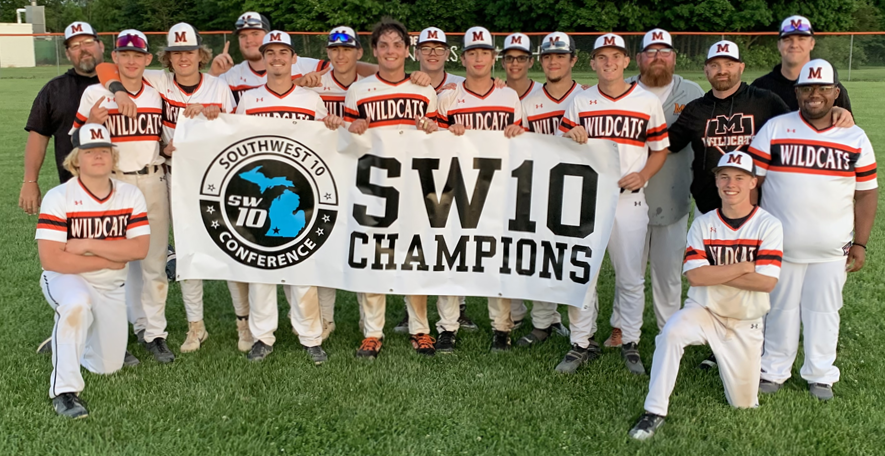
Marcellus, ranked No. 8 in Division 4, ended its regular season last week at 27-0, which included capturing first place in the Southwest 10 Conference title with a 19-0 mark.
It was the first unbeaten regular season and conference title in the history of Marcellus' baseball program.
With all of that behind the team now, coach Christian Hutson is busily preparing his ballclub for Saturday's noon District Semifinal clash against Burr Oak. Marcellus, just 13-19 a year ago, features a roster that includes four seniors, a pair of juniors, one sophomore and seven freshmen.
"We're hoping to make a run, but first we have to get through a tough District at Centreville. We have to approach it one game at a time. Any team can beat you on any given day," Hutson said.
"Our seniors have gone through lots of growing pains. They've all been asked to play a huge role for us from a young age,” Hutson added. “Now it's all come to life and they are playing real baseball, making plays and picking one another up. Everything has finally come together for these kids.”
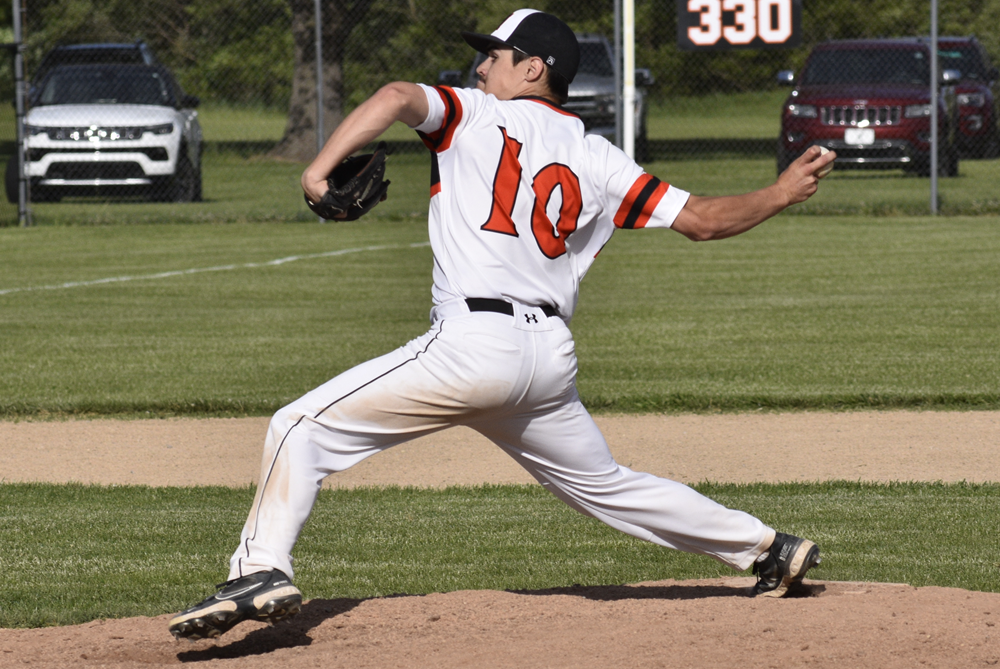
A strong pitching staff has been one of the biggest keys to the Wildcats' success. Senior Dawsen Lehew is 5-0 with one save, a 1.04 ERA and 33 strikeouts. Nathan Mihills, another senior, is also 5-0 with one save, a 2.66 ERA and 32 strikeouts and he starts at first base when freshman Cale Hackenberg takes the mound.
"Dawsen won't be outworked. He comes in day in and day out and gives his best performance," Hutson said. "Nathan is Mr. Reliable. He's the guy who stays after practice and makes sure everything is cleaned up and that the field is raked and there's no trash left in the dugout."
Mihills also fills the role of lead-off hitter and threw a no-hitter against Bangor.
"The juniors and seniors have been through the hardship of it all, but it's helped shape us to where we are now. Our freshmen are a great addition. We're all great friends. I'm not a bit scared of who the ball is hit to because I know they'll come up with a good play,” Mihills said. “I'm a lefty and I feel pretty consistent when my curveball is on. Our coaches do a great job preparing us for game situations."
 Lehew agrees with his senior teammate: "Our confidence allows us to play with high energy. We've been hitting the rock very well and our pitching has been real solid. We have a new pitching coach (Ryan Coffey) who has helped me with my velocity and control. I feel like everything is flowing really well at this point."
Two freshmen have also filled big roles on the hill for Marcellus. Hackenberg has been one of the Wildcats' top aces so far with a 6-0 record, including two saves, a 1.83 ERA and 76 strikeouts. Abram Coffey is 9-0 with two saves, a 2.21 ERA and 67 strikeouts.
"On any given night, any of one of our four pitchers could be our No. 1 starter. That's what makes us so special," Hutson said.
Hackenberg has played baseball since age 9. "It took us a couple games up on varsity to settle in as freshmen, but we've done okay. I have a couple pitches that have worked well for me this season" he said.
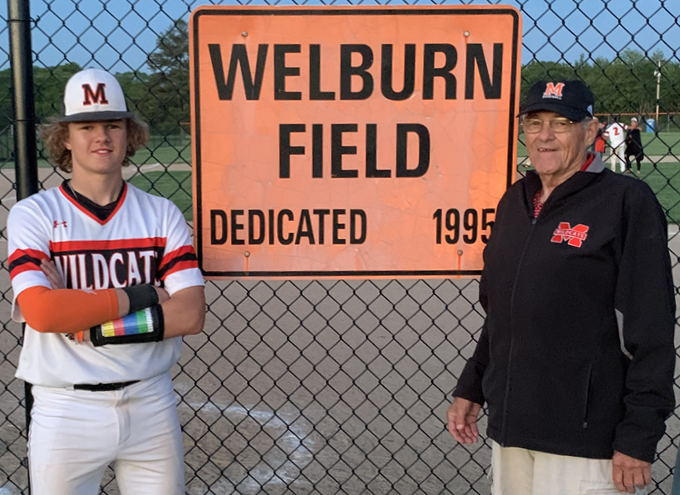
Hackenberg is the grandson of Ron Welburn, after whom Marcellus' home field is named. Welburn, a former village president, was instrumental in the construction of the field.
"When I was on the village council our old field was on the other side of town, and that was inconvenient for the school. We got a recreational grant from the State of Michigan to build a new field. I went and spoke to the school, and they thought that would be a fantastic idea. After running into some issues with the contractor, I resigned from the council and with the help of Rock Powell and Roy Mann we worked together and finished the field," Welburn said. "It's fantastic to see these boys having some success now. It's quite an honor to be able to come out and watch them."
Marcellus' team batting average is .348, and the Wildcats have scored 326 runs – an average of 12.1 per game.
Coffey, the squad's No. 2 batter and starting shortstop when he's not pitching, is Marcellus' top hitter with a .587 average, 15 doubles, four triples, four home runs, 49 RBI, 43 stolen bases and a .712 on-base percentage. Hackenberg, the No. 3 hitter, is batting .438 with 13 doubles, 37 RBI and 25 stolen bases with an on-base percentage of .566.
Batting in the clean-up spot is senior catcher Brock Buck. Buck is hitting .339 with five doubles, one home run, 17 RBI, and he has 20 stolen bases with .565 on-base percentage.
"Brock's been our glue behind the plate the last four years," Hutson said.
Senior centerfielder Cole Thornburgh is the Wildcats' No. 5 hitter with a .390 average, including eight doubles, 28 RBI, 23 stolen bases and a .465 on-base percentage.
 "Cole keeps us on our toes and always has something funny to say. We asked him to step up this year, and he's answered the bell," Hutson said.
Other starters playing critical roles for Marcellus are juniors Parker Adams at second base and right fielder Brock McWilliams, along with freshmen designated hitter Zade Tyszka and left fielder Matthew Lehew, Dawsen's younger brother.
"At the plate, it's not just one or two guys – it's our entire lineup. Everyone on this team has contributed whether it's with a hit, stolen base or scoring the go-ahead run," Hutson said.
Trust is another huge factor. "Defensively, we have a lot of versatile kids who we can shift around to different positions. I trust every kid we have out on the field," Hutson said.
Hutson points to the Wildcats' team speed as another key element. Marcellus has 229 stolen bases this season.
"We have great team speed, and we pick and choose our spots. Our kids are fast, and that translates to good things happening on the basepaths," Hutson said.
Good team chemistry has also played a vital role.
"This group is just a bunch of good ol’ country boys. They'll go out together fishing or spearing after a night of practice," Hutson said. “Our community has rallied around us, been very supportive and bring so much energy for us. That makes it a lot easier to play at such a high level. Every night feels like a homecoming.”
Marcellus' head coach also pointed out the contributions of assistant coaches Chauncey Hackenberg, Kyle Kahler and Tyler Coffey.
"My three coaches are absolutely amazing. Chauncey is our accountability guy who gets things done. Tyler has been great developing our pitchers. Kyle, my cousin, works with our infielders and is the level-headed one. I'm more of an outfield guy and work a lot with our hitters," Hutson said.
Hutson lists former Decatur head coach Ben Botti and Keith Schreiber as his biggest mentors. Botti is a member of the Michigan High School Baseball Coaches Association Hall of Fame. Schreiber, previously the head coach at Glen Oaks Community College and now heading Dowagiac’s program, coached Hutson on the 2010 GOCC squad that won a Western Conference championship.
"I've had two really good mentors in Ben and Keith. They are amazing coaches with so much baseball knowledge. They both check in with me and are good resources," Hutson said.
For Hutson and his ballclub, the feeling of being undefeated so far hasn't quite sunk in.
"Baseball is a funny game,” Hutson said. “We've had a lot of tight and one-run games, but our kids continue to battle and scrap and get the job done."
 Scott Hassinger is a contributing sportswriter for Leader Publications and previously served as the sports editor for the Three Rivers Commercial-News from 1994-2022. He can be reached at [email protected] with story ideas for Berrien, Cass, St. Joseph and Branch counties.
PHOTOS (Top) Marcellus senior pitcher Dawsen Lehew makes his move toward the plate during a recent game. (Middle) Marcellus freshman pitcher/third baseman Cale Hackenberg, left, stands with grandfather Ron Welburn, for whom the team’s field is named. (Below) The Marcellus varsity baseball team and coaching staff hold up the Southwest 10 Conference championship banner last week after a doubleheader sweep of Cassopolis. (Photos by Scott Hassinger.)