


Classes Still Create Hoosier Hysteria
July 27, 2017
By Rob Kaminski
MHSAA benchmarks editor
This is the fourth part in a series on MHSAA tournament classification, past and present, that will be published over the next two weeks. This series originally ran in this spring's edition of MHSAA benchmarks.
Twenty years ago, Bloomington North High School won the Indiana High School Athletic Association boys basketball championship, defeating Delta 75-54 at the RCA Dome in Indianapolis.
The date, March 22, 1997, is at the same time revered and disdained by traditionalists in the state who saw it as the last schoolboy championship game the state would ever host.
That’s how devout the game of basketball, particularly interscholastic basketball, had become in the Hoosier state during the 87 years a state champion – one state champion, to be precise – was crowned.
Following that 1997 season, the IHSAA moved to a four-class system for its roundball tournaments, like so many of its state association counterparts had done years earlier.
It would be shocking to find more than a small percentage of current high school basketball players around the country unfamiliar with the iconic movie Hoosiers, even though the film is now more than 30 years old.
And, the storyline for that blockbuster unfolded more than 30 years prior to its release, when small-town, undermanned Milan High School defeated Muncie Central High School 32-30 in the 1954 IHSAA title game.
Perhaps it’s because of the David vs Goliath notion, or the fame of the movie that replaced Milan with the fictional Hickory and real-life star Bobby Plump with Hollywood hero Jimmy Chitwood, or the simple fact that Indiana had something other states didn’t.
Whatever the reason, plenty of opposition remains to this day to basketball classification in the state.
The fact is, the small rural schools were regularly being beaten handily by the much larger suburban and city schools as the tournament progressed each season.
Small schools also were closing at a rapid rate following the state’s School Reorganization Act in 1959, as students converged on larger, centralized county schools. From 1960 to 2000, the number of schools entering the tournament dropped from 694 to 381, and in 1997 a total of 382 schools and 4,584 athletes began competition at the Sectional level (the first level of the IHSAA Basketball Tournament).
It was at the entry level of the tournament where school administrators felt the pain of the new class system, but not necessarily for the same nostalgic reasons as the fans who either attended or boycotted the tournament.
At the Sectional round of the tournament, the IHSAA was culling just 2 percent of the revenue, with the participating schools splitting the balance. So, when Sectional attendance dropped by 14 percent in that first year of class basketball, many schools realized a financial loss. It was money they had grown to count on in prior years to help fund various aspects of the department.
Schools cumulatively received more than $900,000 from Sectional competition in 1998, but that total was down from more than $1 million in the last year of the single-class tournament.
Yet, the current format provides a great deal more opportunity and realistic chances at championship runs for schools of all enrollments.
To date, 60 additional teams have championship or runner-up trophies on display in school trophy cases around Indiana.
That was the mission in front of then-IHSAA commissioner Bob Gardner (now National Federation executive director) once the board made its decision: to give thousands more student-athletes the opportunity for once-in-a-lifetime experiences.
As any statistician knows, figures can be manipulated to tell any side of a story. Declining attendance in year one of class basketball is such a number.
The truth is tournament attendance had been on a steady downward spiral since its peak of just over 1.5 million in 1962. By the last single-class event in 1997, the total attendance was half that.
The challenge then and today, as it is for all state associations, is to find that delicate balance for those holding onto tradition, those holding onto trophies, and the number of trophies to hand out.
Editor’s Note: Stories from the Fort Wayne Journal Gazette in 1998 and from a 2007 issue of Indianapolis Monthly provided facts in this article.
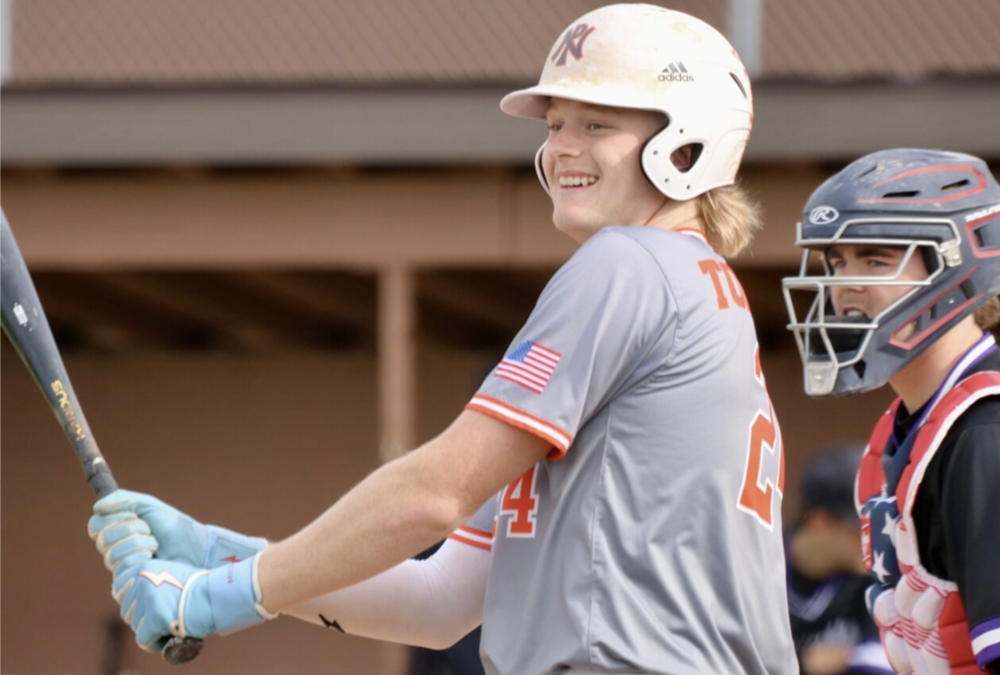
Healthy Tomlinson Gives Portage Northern Major Reason to Dream Big
By
Pam Shebest
Special for MHSAA.com
May 14, 2024
PORTAGE – Ty Tomlinson ended last season as a member of the Michigan High School Baseball Coaches Association all-state Dream Team.
 This season began as more of a nightmare for the Portage Northern senior.
The lanky shortstop stepped up to the plate for his second at-bat of the Huskies’ opening game and started legging out a double.
“On my way to first base, my first step out of the box, I heard a nice little pop,” Tomlinson said. “Coach (Ben) Neal was screaming at me because he thought I wasn’t hustling. Turns out I was just barely making it to the base.”
That’s because the “pop” was a hamstring injury that sidelined him for nearly half the team's games so far.
“It was rough,” the senior said. “Definitely not how I wanted to start my year. I played three years without getting hurt, and to start the year off like that, especially after all the work we put in this off-season, I was really excited to see it pan out.”
His dad, Ryan Tomlinson, said he knew right away what happened.
“I saw it,” he said. “I knew what happened without talking to him. He’s a very competitive kid.”
Ryan Tomlinson is no stranger to seeing injuries. After 20 years, he recently retired as Western Michigan University’s women’s tennis coach. The first thing he did after Ty’s injury was set his son up with a trainer.
 “Ty would get up at 6 a.m. to work with my trainer, then go to school, then come home to work in the training room,” Ryan said.
The injury kept the shortstop out of the game, but not out of the action.
“It was hard on a personal level because I’ve grown up as a competitor, but we have so much depth,” Tomlinson said. “I did a lot of the pitch charting, so I was in the game every pitch. As much as I hated being away, we still played great.”
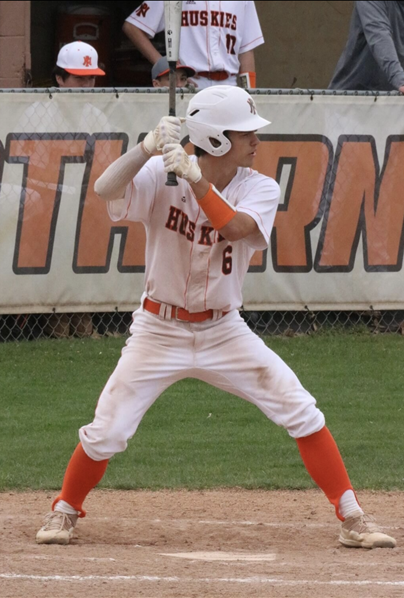
While Tomlinson was sidelined, senior second baseman Ryan Juodawlkis lost his infield partner.
“Me and Ty, we’ve been a duo for years,” Juodawlkis said. “We have great chemistry.
“We’ve played together a long time. We grew up together playing ball since 11-U. We’ve always been on the field together, talking to each other and communicating.”
With Tomlinson out, Brice Welke, one of two sophomores on the team, stepped in at shortstop.
“It’s always harder to adjust to someone else, especially a younger guy,” Juodawlkis said. “It’s the communicating, who’s got the bag for a steal, who’s gonna hold a runner on.”
Prepping to contend
When the schedule comes out at the beginning of the season, the first two dates the Huskies circle are against Mattawan and Portage Central, Tomlinson said.
Central is the crosstown rival with players who are friends outside of school, and Mattawan is the team that ended Northern’s last two seasons in Division I District Finals.
 Northern, ranked No. 15 in Division 1 this spring, was to take a 16-5 record against eighth-ranked Mattawan into a contest scheduled for last Thursday. But the devastation from the EF2 category tornado two days earlier resulted in school being canceled for three days, postponing the game.
“They know they still get to play, so they’re not too heartbroken about (postponing the game),” second-year head coach Adam Cardona said. “A few have been without power a few days, no one lost their homes, but some of their families have been affected, which I know is weighing on them a bit. Praise the Lord, everybody is safe.
“With everything that’s going on, I think they understand it puts baseball in perspective; there’s bigger things than baseball. I think they’re ready to get back into it and get some of that normalcy back.”
Games against Mattawan and Portage Central, especially, are a good indication of the Huskies' playoff potential.
“Our pitchers need to throw strikes and provide weak contact,” Juodawlkis noted as keys to making it past Districts. “Don’t try to do too much and put the ball in play.”
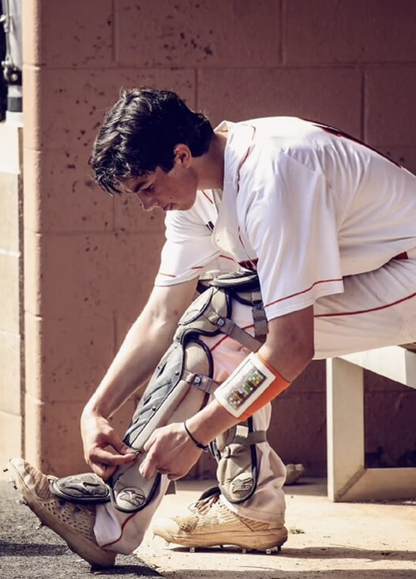
Senior catcher Braden Welke added, “It’s going to take better situational hitting and a lot better moving runners over (to advance).”
Baseball is in the Welkes’ DNA.
Their father Ben played college ball, and their grandfather Tim Welke, as well as a great uncle, Bill, are former MLB umpires.
 While their grandfather is at most games, he doesn’t try to “umpire” them.
“He more just talks and chats with the umpires. Both give me plenty of stories and pointers,” Braden Welke laughed.
Cardona said Welke is one of the best catchers in Southwest Michigan.
“That dude just loves the game of baseball,” Cardona said. “He’s happy to be out here every single day.
“Behind the dish, he calls everything. He sees the game and knows the game well.”
Welke said he likes being in control.
“I like being able to touch the ball every single play,” he said. “You’re always in the play, always talking. You’re kind of the leader on the field.”
Other seniors on the team are Maxwell Pidgeon, Jack Mick, Antonio Parsayar, Keegan McIntyre and Danny Tafoya. Juniors are Nolan Ratliff, Seth Bartlam, Drew Clyne, Thomas Horein, Mateo Icaza, Izaak Bobbio, Finn Malek, Nolan Wilson, Andrew Wagster, Braden Hembree, Mason Wesaw, David Li and Evan Elkins. Evan McIntyre is the other sophomore.
Diehard fans
While his dad played and coached tennis, Ty Tomlinson knew at an early age it was not for him.
“I grew up playing tennis along with baseball and other sports, trying other sports out,” he said. “Tennis was just not for me.
“I was not the fleetest of foot back in my day, so I couldn’t move around the court all too well,” he laughed. “Dad and I would kind of butt heads a little bit, so I was ‘I’ve got to move on.’”
Ryan Tomlinson is a huge Detroit Tigers fan.
So huge, that his three sons’ names are all derived from former Tigers greats including two Hall of Famers.
Ty is named for Ty Cobb, while his 11-year-old brother is Graydon Gibson (from Kirk Gibson) and his 7-year-old bother is Myles Kaline (Al Kaline).
However, the two younger Tomlinsons are finding their niche in hockey right now.
Ty Tomlinson originally committed to play baseball at University of Michigan next season. But after feeling he found a better fit at George Mason University in Fairfax, Va., the shortstop de-committed and opted to head south to play for the Division I Atlantic 10 Patriots.
“Plus it’s warmer,” he laughed. “I’m not a fan of the cold, and apparently neither is my hamstring.”
 Pam Shebest served as a sportswriter at the Kalamazoo Gazette from 1985-2009 after 11 years part-time with the Gazette while teaching French and English at White Pigeon High School. She can be reached at [email protected] with story ideas for Calhoun, Kalamazoo and Van Buren counties.
PHOTOS (Top) Portage Northern’s Ty Tomlinson smiles during an at bat. (2) Ryan Juodawlkis stands in for a pitch. (3) Huskies coach Adam Cardona. (4) Catcher Braden Welke puts on his equipment. (Action photos courtesy of the Portage Northern baseball program; head shot by Pam Shebest.)