


Classes Still Create Hoosier Hysteria
July 27, 2017
By Rob Kaminski
MHSAA benchmarks editor
This is the fourth part in a series on MHSAA tournament classification, past and present, that will be published over the next two weeks. This series originally ran in this spring's edition of MHSAA benchmarks.
Twenty years ago, Bloomington North High School won the Indiana High School Athletic Association boys basketball championship, defeating Delta 75-54 at the RCA Dome in Indianapolis.
The date, March 22, 1997, is at the same time revered and disdained by traditionalists in the state who saw it as the last schoolboy championship game the state would ever host.
That’s how devout the game of basketball, particularly interscholastic basketball, had become in the Hoosier state during the 87 years a state champion – one state champion, to be precise – was crowned.
Following that 1997 season, the IHSAA moved to a four-class system for its roundball tournaments, like so many of its state association counterparts had done years earlier.
It would be shocking to find more than a small percentage of current high school basketball players around the country unfamiliar with the iconic movie Hoosiers, even though the film is now more than 30 years old.
And, the storyline for that blockbuster unfolded more than 30 years prior to its release, when small-town, undermanned Milan High School defeated Muncie Central High School 32-30 in the 1954 IHSAA title game.
Perhaps it’s because of the David vs Goliath notion, or the fame of the movie that replaced Milan with the fictional Hickory and real-life star Bobby Plump with Hollywood hero Jimmy Chitwood, or the simple fact that Indiana had something other states didn’t.
Whatever the reason, plenty of opposition remains to this day to basketball classification in the state.
The fact is, the small rural schools were regularly being beaten handily by the much larger suburban and city schools as the tournament progressed each season.
Small schools also were closing at a rapid rate following the state’s School Reorganization Act in 1959, as students converged on larger, centralized county schools. From 1960 to 2000, the number of schools entering the tournament dropped from 694 to 381, and in 1997 a total of 382 schools and 4,584 athletes began competition at the Sectional level (the first level of the IHSAA Basketball Tournament).
It was at the entry level of the tournament where school administrators felt the pain of the new class system, but not necessarily for the same nostalgic reasons as the fans who either attended or boycotted the tournament.
At the Sectional round of the tournament, the IHSAA was culling just 2 percent of the revenue, with the participating schools splitting the balance. So, when Sectional attendance dropped by 14 percent in that first year of class basketball, many schools realized a financial loss. It was money they had grown to count on in prior years to help fund various aspects of the department.
Schools cumulatively received more than $900,000 from Sectional competition in 1998, but that total was down from more than $1 million in the last year of the single-class tournament.
Yet, the current format provides a great deal more opportunity and realistic chances at championship runs for schools of all enrollments.
To date, 60 additional teams have championship or runner-up trophies on display in school trophy cases around Indiana.
That was the mission in front of then-IHSAA commissioner Bob Gardner (now National Federation executive director) once the board made its decision: to give thousands more student-athletes the opportunity for once-in-a-lifetime experiences.
As any statistician knows, figures can be manipulated to tell any side of a story. Declining attendance in year one of class basketball is such a number.
The truth is tournament attendance had been on a steady downward spiral since its peak of just over 1.5 million in 1962. By the last single-class event in 1997, the total attendance was half that.
The challenge then and today, as it is for all state associations, is to find that delicate balance for those holding onto tradition, those holding onto trophies, and the number of trophies to hand out.
Editor’s Note: Stories from the Fort Wayne Journal Gazette in 1998 and from a 2007 issue of Indianapolis Monthly provided facts in this article.
Breslin Bound: 2023-24 Girls Regional Preview
By
Geoff Kimmerly
MHSAA.com senior editor
March 11, 2024
We’re a week into this season’s girls basketball playoffs, with two weeks to go, and already our Breslin Center field is beginning to change up significantly from a year ago.
 Last week’s Districts saw six of last season’s semifinalists – including the reigning Division 3 champion and Division 4 runner-up – finish their runs in this year’s tournament. Two more of those 2023 semifinalists are set to meet in a Regional Semifinal tonight, and several more face season-defining matchups over the next three days – and we detail some of those as we glance at three Regionals in each division below.
Ticket information, brackets and more can be found on the Girls Basketball page. To watch any of several games online, visit the NFHS Network.
“Breslin Bound” is powered by MI Student Aid and based on results and schedules posted for each school at MHSAA.com.
Week in Review
The countdown of last week’s five most intriguing results:
1. Sanford Meridian 59, Hemlock 47 In defeating the reigning Division 3 champion Huskies (18-6), the Mustangs (22-1) continued one of the most impressive program turnarounds over the last half-decade; they were winless five years ago but have reached 20 victories all of the last three seasons.
2. Byron Center 47, East Kentwood 44 This was a matchup of Ottawa-Kent Conference division champions, and Byron Center (20-4) avenged a 58-52 season-opening loss to the Falcons (20-4).
3. Fowler 64, Portland St. Patrick 58 These rivals had split their regular-season series, as the Shamrocks (21-3) had won the middle meeting and the Central Michigan Athletic Conference title – but the Eagles (21-3) advanced to this week.
4. Grand Rapids West Catholic 43, Grand Rapids Catholic Central 36 This was another matchup of O-K Conference division winners, as West Catholic (23-1) added to its six-point win over the Cougars (17-7) from December.
5. Vicksburg 69, Paw Paw 57 These two also split during the regular season, with Vicksburg (21-2) winning the last two meetings to first clinch the Wolverine Conference title and this time end Paw Paw’s season at 21-3.
Regionals at a Glance
These could be among our most competitive brackets. Host sites are in bold:
DIVISION 1
Bloomfield Hills Marian
Grosse Pointe North (19-5) vs. Royal Oak (18-6)
Detroit Renaissance (21-3) vs. West Bloomfield (22-1)
Both Renaissance and West Bloomfield reached last season’s Division 1 Semifinals, but didn’t meet – Renaissance fell to Rockford to start the weekend before the Rams defeated West Bloomfield in the championship game the following day. The winner of their Regional Semifinal tonight will be the likely favorite to return to East Lansing from this quarter of the statewide bracket. West Bloomfield’s only loss was to an Ohio opponent, and Renaissance lost only to Detroit Edison (18-3), Ann Arbor Father Gabriel Richard (24-0) and Tecumseh (20-4). Grosse Pointe North and Royal Oak are intriguing spoilers with great storylines, however; GPN was a Regional champion last year that ran into Renaissance in the Quarterfinals, and Royal Oak has enjoyed a memorable rise from three wins only two seasons ago.
Mason
Holt (16-8) vs. DeWitt (22-2)
Portage Central (19-2) vs. Coldwater (21-3)
This Regional features a pair of league champions – DeWitt and Portage Central – and Central opened this season by winning its first 16 games, although the Mustangs did lose their regular-season finale to Coldwater, 44-28 on Feb. 29. The Cardinals are a repeat District champ after finishing runner-up to Jackson Northwest in the Interstate 8 Athletic Conference, and their win over the Mounties on Feb. 6 started a current eight-game winning streak. Holt and DeWitt are plenty familiar with each other on the other side of the bracket, the Panthers winning their matchups 52-37 and 54-41 in clinching the Capital Area Activities Conference Blue while the Rams tied for second place. DeWitt has some added motivation as well after falling to Holt in last season’s Regional Final. Holt and Coldwater also faced off earlier this season, with Coldwater winning 40-33 on Jan. 5.
Milford
Grand Blanc (19-4) vs. Howell (17-7)
Clarkston (18-6) vs. White Lake Lakeland (20-4)
After a first-game playoff exit a year ago, Lakeland is coming off its third District title in four seasons and seeking its first Regional championship to add as well to a shared Lakes Valley Conference title this winter. After winning the Saginaw Valley League for the first time, Grand Blanc also could take another next step as it seeks to follow up its fourth-straight District championship by winning what would be a first Regional title since 1977. Howell is a league champion as well, from the Kensington Lakes Activities Association West, and a return District champ. The Highlanders and Clarkston faced off Dec. 15, with the Wolves winning 51-48. Clarkston tied for second in the Oakland Activities Association Red, won by West Bloomfield, but avenged a Feb. 13 loss to Lake Orion in defeating the Dragons 41-40 in their District Final on Friday.
DIVISION 2
Alma
Alma (19-5) vs. Flint Powers Catholic (21-3)
Frankenmuth (22-2) vs. Freeland (21-3)
Powers finished third in the Saginaw Valley League to Grand Blanc and Midland Dow, losing only to those two Division 1 rivals and Division 3 contender Ypsilanti Arbor Prep, and is joined this week by the top three teams from the Tri-Valley Conference Red – champion Frankenmuth, runner-up Freeland and third-place Alma. The Eagles, last season’s Division 2 runners-up, defeated Freeland 53-51 and 54-49 this winter and Alma 57-44 and 58-18 – and also defeated Freeland in last year’s Regional Final. Alma dealt the Falcons their only other loss this season, 62-49 on Feb. 6 to avenge a 29-point loss from Jan. 9.
Charlotte
Tecumseh (20-4) vs. Parma Western (15-9)
Lansing Catholic (19-5) vs. Haslett (18-7)
The Cougars are the reigning Division 2 champions and on a nice run with seven wins over their last eight games, the only loss to Frankenmuth, and last week’s 56-37 District Final win over Portland avenging a seven-point loss to the Raiders from Feb. 13. Lansing Catholic also defeated Haslett 48-37 on Feb. 6, but the Vikings also are on an impressive streak of seven straight wins including a 69-68 overtime victory over Chelsea last week followed by a 56-43 win over Williamston that avenged two regular-season defeats. Haslett also defeated Parma Western 53-39 during this late surge, but the Panthers otherwise have won eight of their last 10 games. They did fall to Tecumseh 59-37 on Dec. 12, and Tecumseh has won 17 of its last 18 games – the lone loss during that string to Chelsea, but with notable wins over Detroit Renaissance and Jackson Northwest at the end of the regular season.
Goodrich
Armada (16-3) vs. Goodrich (24-0)
Warren Regina (12-13) vs. Orchard Lake St. Mary’s (23-0)
At least one team will end the season this week with its lone loss. Goodrich’s last defeat came in a Semifinal at Breslin Center a year ago, and half its wins during this regular season were over teams that finished with 14 victories or more heading into the playoffs. Armada finished second in the Blue Water Area Conference but won its District by avenging a loss to league champ Yale in a big way, 49-29. St. Mary’s opened this season with a 51-42 win over Warren Regina and went on to win the Catholic High School League AA and Cardinal Tournament championships. Regina had a rough start this winter but has won eight straight and defeated Macomb Area Conference Gold champion Marine City 49-35 in its District Final.
DIVISION 3
Onsted
Allen Park Cabrini (10-13) vs. Ypsilanti Arbor Prep (20-4)
Brooklyn Columbia Central (15-8) vs. Blissfield (22-2)
A Blissfield/Arbor Prep meeting in the Regional Final would be a rematch of last year’s won by Blissfield 50-38 on the way to finishing Division 3 runner-up. Blissfield’s only losses since were to Tecumseh and Niles Brandywine this winter, and the Royals have won 16 straight games. Blissfield also opened with a 57-42 win over Columbia Central, which went on to win the Cascades Conference West. Arbor Prep readied for this run with a regular-season schedule filled with Division 1 and 2 opponents, and the Gators’ only losses were to Division 1 Jackson Northwest and Division 2 Ann Arbor Father Gabriel Richard, Detroit Edison and Detroit Country Day. Cabrini has surged late to win a third District in a row.
St. Ignace
West Iron County (14-11) vs. Harbor Springs (22-2)
Elk Rapids (22-2) vs. Roscommon (17-7)
Harbor Springs and Elk Rapids shared the Lake Michigan Conference championship, Elk Rapids winning the first meeting 61-51 and Harbor Springs the rematch 48-41 on Jan. 30. Elk Rapids also won their District Final matchup a year ago on the way to the Quarterfinals. Roscommon could throw off the rematch scenario, emerging from a tie for fourth in the Highland Conference, which sent three teams into this week. West Iron also brings some intrigue with nine wins over its last 11 games including a 52-42 District Semifinal victory over Calumet that avenged one of the losses during this recent run.
Sanford Meridian
Manton (19-5) vs. Lake City (22-2)
Sanford Meridian (22-1) vs. Morley Stanwood (19-4)
Sanford Meridian might be riding as high as any team in the state after avenging its 2023 District loss with a 59-47 win over reigning Division 3 champion Hemlock to close last week. Lake City and Manton finished first and second, respectively, in a Highland Conference that produced three District champions, and Lake City won their matchups 68-34 and 39-27 and also owns a 49-37 win over Morley Stanwood from Jan. 3. Four of Manton’s five defeats were to eventual District winners, and the fifth to a team that reached its title game last week. Morley Stanwood won the Central State Activities Association and defeated TVC White champion St. Louis in another notable District Final.
DIVISION 4
Marquette (for Regional Final)
Ewen-Trout Creek (19-5) vs. Lake Linden-Hubbell (23-1) at Houghton
Ishpeming (23-1) vs. Carney-Nadeau (18-6) at Kingsford
Lake Linden-Hubbell is seeking its first Regional title, and Ishpeming its first since 1985 – and there are challenges on both sides of the bracket. Carney-Nadeau is a league champion, from the Skyline Central Conference Small schools division, and Ewen-Trout Creek finished third to 2023 Division 4 champion Baraga and Lake Linden-Hubbell in the Copper Mountain Conference, pushing the Lakes in a 59-55 overtime game Jan. 11. Lake Linden-Hubbell’s lone defeat was to Baraga (19-5), while Ishpeming’s was to Division 2 Negaunee (23-1).
Mendon
Concord (19-5) vs. Colon (22-2)
St. Joseph Michigan Lutheran (10-14) vs. Mendon (21-3)
Colon won the Southern Central Athletic Association West thanks in part to 54-31 and 51-47 wins over runner-up Mendon, and the Magi defeated Concord 61-47 on Feb. 24. Colon and Mendon also have met during the postseason the last four years, with Colon winning three of those meetings. Mendon’s only other loss this winter was to Division 1 Sturgis, 43-38, while Concord’s other four were to larger schools as the Yellow Jackets finished second in the Big 8 Conference. Michigan Lutheran won its third District title over the last four seasons edging Three Oaks River Valley 30-29 in last week’s decider.
Mount Pleasant Sacred Heart
Bay City All Saints (19-5) vs. Breckenridge (18-6)
Brethren (19-5) vs. Mount Pleasant Sacred Heart (21-3)
This Regional includes a pair of league champions. All Saints won the North Central Thumb League Stripes and navigated a competitive District with wins of two and three points to advance. Brethren was the West Michigan D League champion and advanced with wins over a pair of league opponents, including 48-36 over WMDL runner-up Manistee Catholic Central in the District Final. Breckenridge and Sacred Heart played together in the Mid-State Activities Conference and finished third and second, respectively, to St. Charles. If the MSAC rivals meet again, it will be noted that Sacred Heart won their first matchup 50-34 and the Huskies the second 40-24 on Feb. 7
MHSAA.com's weekly “Breslin Bound” previews and reviews are powered by MI Student Aid, a division within the Department of Lifelong Education, Advancement, and Potential (MiLEAP). MI Student Aid encourages students to pursue postsecondary education by providing access to student financial resources and information. MI Student Aid administers the state’s scholarship and grant programs that help make college Accessible, Affordable and Attainable for you. Connect with MI Student Aid at www.michigan.gov/mistudentaid and find more information on Facebook and Twitter @mistudentaid.
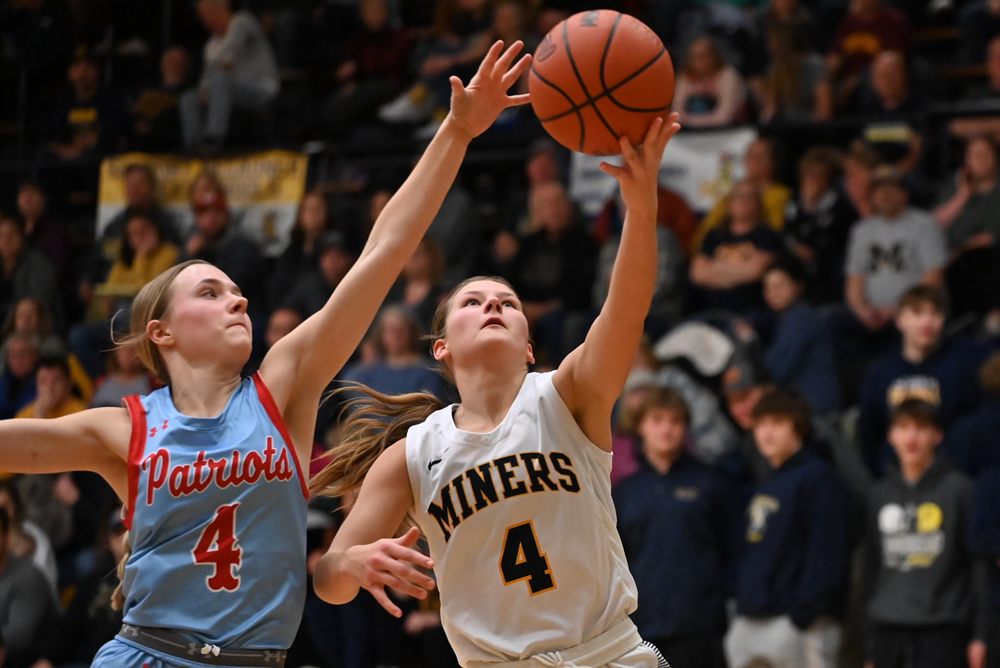
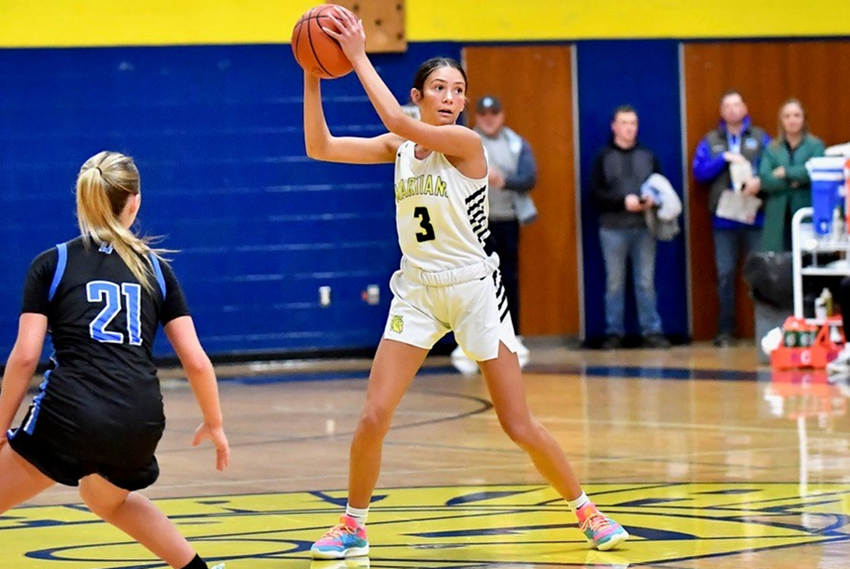
PHOTOS (Top) Negaunee's Callie Rajala goes up for a shot while being defended by Ishpeming Westwood's Lexi Olson during the Miners’ 65-33 win Dec. 21. (Middle) Goodrich moves the ball upcourt during its second of three wins over Lake Fenton this season, 61-48 on Feb. 16. (Top photo by Cara Kamps; middle photo by Terry Lyons.)