


Classes Still Create Hoosier Hysteria
July 27, 2017
By Rob Kaminski
MHSAA benchmarks editor
This is the fourth part in a series on MHSAA tournament classification, past and present, that will be published over the next two weeks. This series originally ran in this spring's edition of MHSAA benchmarks.
Twenty years ago, Bloomington North High School won the Indiana High School Athletic Association boys basketball championship, defeating Delta 75-54 at the RCA Dome in Indianapolis.
The date, March 22, 1997, is at the same time revered and disdained by traditionalists in the state who saw it as the last schoolboy championship game the state would ever host.
That’s how devout the game of basketball, particularly interscholastic basketball, had become in the Hoosier state during the 87 years a state champion – one state champion, to be precise – was crowned.
Following that 1997 season, the IHSAA moved to a four-class system for its roundball tournaments, like so many of its state association counterparts had done years earlier.
It would be shocking to find more than a small percentage of current high school basketball players around the country unfamiliar with the iconic movie Hoosiers, even though the film is now more than 30 years old.
And, the storyline for that blockbuster unfolded more than 30 years prior to its release, when small-town, undermanned Milan High School defeated Muncie Central High School 32-30 in the 1954 IHSAA title game.
Perhaps it’s because of the David vs Goliath notion, or the fame of the movie that replaced Milan with the fictional Hickory and real-life star Bobby Plump with Hollywood hero Jimmy Chitwood, or the simple fact that Indiana had something other states didn’t.
Whatever the reason, plenty of opposition remains to this day to basketball classification in the state.
The fact is, the small rural schools were regularly being beaten handily by the much larger suburban and city schools as the tournament progressed each season.
Small schools also were closing at a rapid rate following the state’s School Reorganization Act in 1959, as students converged on larger, centralized county schools. From 1960 to 2000, the number of schools entering the tournament dropped from 694 to 381, and in 1997 a total of 382 schools and 4,584 athletes began competition at the Sectional level (the first level of the IHSAA Basketball Tournament).
It was at the entry level of the tournament where school administrators felt the pain of the new class system, but not necessarily for the same nostalgic reasons as the fans who either attended or boycotted the tournament.
At the Sectional round of the tournament, the IHSAA was culling just 2 percent of the revenue, with the participating schools splitting the balance. So, when Sectional attendance dropped by 14 percent in that first year of class basketball, many schools realized a financial loss. It was money they had grown to count on in prior years to help fund various aspects of the department.
Schools cumulatively received more than $900,000 from Sectional competition in 1998, but that total was down from more than $1 million in the last year of the single-class tournament.
Yet, the current format provides a great deal more opportunity and realistic chances at championship runs for schools of all enrollments.
To date, 60 additional teams have championship or runner-up trophies on display in school trophy cases around Indiana.
That was the mission in front of then-IHSAA commissioner Bob Gardner (now National Federation executive director) once the board made its decision: to give thousands more student-athletes the opportunity for once-in-a-lifetime experiences.
As any statistician knows, figures can be manipulated to tell any side of a story. Declining attendance in year one of class basketball is such a number.
The truth is tournament attendance had been on a steady downward spiral since its peak of just over 1.5 million in 1962. By the last single-class event in 1997, the total attendance was half that.
The challenge then and today, as it is for all state associations, is to find that delicate balance for those holding onto tradition, those holding onto trophies, and the number of trophies to hand out.
Editor’s Note: Stories from the Fort Wayne Journal Gazette in 1998 and from a 2007 issue of Indianapolis Monthly provided facts in this article.
Breslin Bound: 2023-24 Boys Regional Preview
By
Geoff Kimmerly
MHSAA.com senior editor
March 5, 2024
As the saying goes, at this point in the tournament every team still playing has accomplished something – in this case, winning at least a District championship.
 And the path is much shorter for the 128 remaining contenders hoping to find their way to East Lansing in two weeks.
Once again, everything you could want to know this week about tickets, brackets and more can be found on the Boys Basketball page. To watch any of several games online, visit the NFHS Network.
“Breslin Bound” is powered by MI Student Aid and based on results and schedules posted for each school at MHSAA.com.
Week in Review
The countdown of last week’s five most intriguing results:
1. Menominee 51, Iron Mountain 49 These two have seemed on a Division 3 District Final collision course since Menominee (18-6) won their first matchup 60-58 in overtime on Feb. 5, and Iron Mountain (22-2) ended its season with its only losses to the Maroons.
2. River Rouge 59, Dearborn 58 The Panthers (14-10) clinched a Division 1 District title by handing Dearborn (23-1) its only defeat.
3. Saginaw Arthur Hill 53, Freeland 47 The Lumberjacks (17-5) earned one more matchup with rival Saginaw High in this week’s Regional by downing a Falcons team (20-4) that has been in the Division 2 conversation all season.
4. Detroit Cass Tech 61, Detroit Martin Luther King 59 (OT) This Division 1 District Final finished a season series that saw the Technicians win both matchups in overtime, the first by five points.
5. Cass City 51, Harbor Beach 48 The Red Hawks (23-1) clinched their Division 3 District title by avenging their lone loss, 56-43 to Harbor Beach (20-4) on Feb. 9.
Regionals at a Glance
These could be among our most competitive brackets. Host sites are in bold:
DIVISION 1
Detroit Renaissance
North Farmington (19-2) vs. Birmingham Groves (13-11)
Detroit U-D Jesuit (18-5) vs. Warren De La Salle Collegiate (15-7)
A Catholic High School League Central team has reached the Division 1/Class A Semifinals five straight seasons (not counting COVID-canceled 2020), and while Orchard Lake St. Mary’s (playing at Milford this week) is the favorite to do that, the regular-season champion has not always ended up the last team playing. De La Salle and Jesuit split during the regular season, Jesuit winning the first time 64-55 and De La Salle the rematch 57-56. On the other side, North Farmington shared the Oakland Activities Association Red title and Groves finished fifth, the Raiders winning their matchups 65-42 and 57-49. North Farmington finished the regular season with the third-highest Division 1 MPR.
Gaylord
Cadillac (19-5) vs. Traverse City West (22-2)
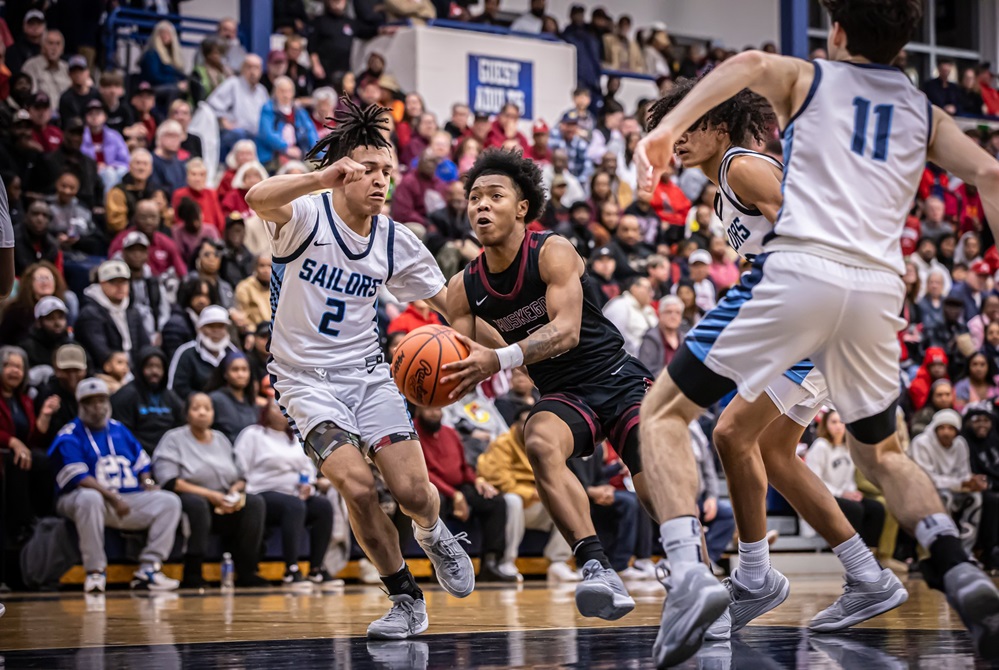
Saginaw Heritage (20-3) vs. Muskegon (21-2)
Coming off two straight trips to the Division 2 Quarterfinals, Cadillac has been even better this season while now in Division 1. The Vikings’ only losses were to Whitehall and Wayne Memorial, and they won the Big North Conference outright thanks in part to 55-44 and 58-44 wins over second-place West. On the other side of the bracket might be one of the most anticipated matchups this week. Heritage won the Saginaw Valley League title as one of eight league teams with at least 13 wins heading into this week, and the Hawks are 14-1 over their last 15 games. Muskegon is the reigning Division 1 runner-up, shared the Ottawa-Kent Conference Green title and has a 10-game winning streak.
Northville
Ypsilanti Lincoln (18-6) vs. Wayne Memorial (17-6)
Ann Arbor Huron (19-4) vs. Detroit Catholic Central (15-8)
Lincoln may have cooled off a bit after a 12-2 start, but the Railsplitters have heated up again and defeated Southeastern Conference Red champion Saline 62-57 in last week’s District Final. Lincoln also owns a Dec. 16 win over Wayne, 56-47, although the Zebras also have been surging with 10 wins over their last 12 games. Huron tied for second in the SEC Red but owns a sweep of Lincoln and edged rival Ann Arbor Pioneer 59-57 last week to get here. The favorite might still be DCC, which finished 10th in statewide Division 1 MPR while tying for fifth in the CHSL Central. All but one of the Shamrocks’ losses came in league play, with the first to Dearborn, which finished 23-1.
DIVISION 2
Corunna
Saginaw (15-9) vs. Saginaw Arthur Hill (17-5)
Shepherd (15-9) vs. Flint Powers Catholic (19-5)
Although the end of Saginaw and Arthur Hill’s 114-year rivalry was commemorated with their final regular-season matchup Feb. 16, there was always the anticipation they could meet one more time in the postseason. They’ll do so to open tonight’s Regional, with Arthur Hill having won that first matchup 84-52 but that potentially not indicating much as these rivals rev up for one last meeting. Arthur Hill was third in the SVL and Powers and Saginaw tied for fifth, with the Chargers defeating Arthur Hill 72-67 and falling to Saginaw High 66-56. Shepherd will do its best to break up the SVL reunion coming off two wins over Tri-Valley Conference teams in last week’s District.
Flat Rock
Detroit University Prep (15-8) vs. Romulus Summit Academy North (22-2)
Dundee (20-4) vs. Dearborn Heights Robichaud (19-4)
Summit is playing in a Regional for the fourth-straight season and seeking to advance to the final week for the third time during this run, this time with its losses by a combined four points to Riverview Gabriel Richard (20-3) and Detroit Old Redford (17-7). The Dragons won the Charter School Conference Gold championship thanks to an 85-58 win over runner-up University Prep on Jan. 22, but UPA has seen several more of the state’s top teams and defeated River Rouge among its best victories. Dundee opened this season 14-1 and is on a five-game winning streak that included claiming a second-straight District title. The Vikings are running into a Robichaud team that’s won nine straight games and the outright Western Wayne Athletic Conference title and is making its third-straight Regional appearance.
Wayland
Benton Harbor (23-1) vs. Paw Paw (12-13)
Grand Rapids Christian (22-2) vs. Holland Christian (15-9)
Benton Harbor entered the postseason with the highest MPR in Division 2 and continued to back it up last week with a 60-42 win over Stevensville Lakeshore (13-10) and 58-48 clincher over Niles (19-6). Paw Paw has won five of its last six and will try to add to its upset last week of South Haven (15-7). Grand Rapids Christian was No. 4 in Division 2 MPR entering the postseason and defeated Grand Rapids South Christian (19-6) narrowly last week, 52-49, to advance. It would be easy to anticipate an Eagles/Tigers matchup in the Regional Final, but GRC surely isn’t looking past Holland Christian, which has won seven of its last eight games.
DIVISION 3
Houghton Lake
Ithaca (16-8) vs. McBain (22-2)
Sanford Meridian (20-4) vs. Beal City (20-4)
Three 20-win teams at this Regional quickly grab the attention, and Ithaca like Beal City was a league runner-up this winter. McBain was first and the Aggies second in the Highland Conference, with McBain winning their matchups 60-43 and 72-48. Meridian was the champion of the Jack Pine Conference and didn’t see any of these three teams this season but has only one Division 3 loss, to Pewamo-Westphalia (22-2). Beal City and Ithaca did meet early, with the Aggies winning 74-68 on Dec. 19. The Meridian/Beal City matchup is a rematch of a 2023 District Final, won by the Mustangs 43-40.
Jackson Lumen Christi
Hanover-Horton (16-8) vs. Jackson Lumen Christi (20-4)
Chesaning (24-0) vs. Laingsburg (24-0)
All four of these teams were league champions, but the Tuesday headliner surely is the meeting of undefeated contenders. Chesaning is coming off its first District title in decades, and Laingsburg is seeking its second-straight Regional championship and is a combined 49-1 over its last 50 games. A pair of victories over P-W and a 72-65 edging of Freeland (20-4) remain the defining wins for the Wolfpack, while Chesaning has downed Saginaw Nouvel (19-5) and Durand (19-5) twice among others. Lumen Christi continues to build on its best season since at least 2014-15, with three of its four losses to teams that have won at least 20 games. Hanover-Horton also has made a nice jump returning to Regionals after missing the last two seasons while hovering near .500.
Watervliet
Union City (16-9) vs. Niles Brandywine (21-3)
Schoolcraft (21-3) vs. Watervliet (19-5)
Brandywine joins Benton Harbor (see above) in giving the five-team Lakeland Conference statewide contenders in both Divisions 2 and 3. The Bobcats reached the Semifinals a year ago and have a 64-53 win over Watervliet from Jan. 24. Watervliet and Schoolcraft were the outright champions in the Southwestern Athletic Conference – Schoolcraft in the Valley and Watervliet in the Lakeshore – and Schoolcraft won their Jan. 9 matchup 67-35. Union City finished fourth in the Big 8 Conference but has emerged with eight wins over its last 10 games as it continues to build up its first winning season since 2018-19.
DIVISION 4
Bellaire
Buckley (15-9) vs. Maple City Glen Lake (20-4)
Hillman (22-2) vs. Bellaire (20-4)
Hillman and Bellaire are both league champions, and Hillman has significant recent experience at this level making its third-straight Regional appearance and after reaching the Quarterfinals a year ago. The Tigers remain undefeated this calendar year, while Bellaire has been close winning 16 of its last 18 with the lone losses during that time by a combined three points both to Mancelona. On the other side are a pair of teams familiar with each other, as Glen Lake was second in the Northwest Conference and Buckley finished fourth. The Lakers won their matchups 55-36 and 68-48.
Petersburg Summerfield
Brighton Livingston Christian (18-5) vs. Detroit Douglass (19-5)
Britton Deerfield (18-6) vs. Allen Park Inter-City Baptist (20-4)
Douglass won the Detroit Public School League Gold on the way to its third District title over the last four seasons, and the Hurricanes have won 12 of their last 13 games with all of their defeats this season to Division 1 or 2 opponents. Livingston Christian has plenty to be glad about as well enjoying its first winning season since 2019-20 and with eight wins over its last nine games. On the other side are a pair coming off major District Final accomplishments. Deerfield was fourth in the Tri-County Conference but defeated league champion Adrian Lenawee Christian 63-59 after losing their matchup a month earlier by 50. Inter-City Baptist has won seven in a row and downed Taylor Trillium (22-2) in their District Final, 60-49.
Sault Ste. Marie (Regional Final only)
Munising (19-4) vs. Rudyard (18-6) at Manistique
St. Ignace (18-6) vs. Onaway (19-5) at Indian River Inland Lakes
The reigning Division 4 champion Mustangs have won 15 of their last 16 games with a 68-58 victory over Rudyard on Jan. 19 adding intrigue to tonight’s rematch. The Bulldogs have won 11 of 13 games since, a run that included a 73-72 victory over St. Ignace that completed a regular-season split as those two finished third and second, respectively, in the Straits Area Conference. Since navigating a rough patch of four losses over five games as January turned to February, the Saints have won six straight all by at least 20 points as they look to return to the Quarterfinals for the second-straight season. Onaway will be the first to try and stop them, entering with 10 wins over its last 11 games and the loss during that streak to Bellaire (see above).
MHSAA.com's weekly “Breslin Bound” previews and reviews are powered by MI Student Aid, a division within the Department of Lifelong Education, Advancement, and Potential (MiLEAP). MI Student Aid encourages students to pursue postsecondary education by providing access to student financial resources and information. MI Student Aid administers the state’s scholarship and grant programs that help make college Accessible, Affordable and Attainable for you. Connect with MI Student Aid at www.michigan.gov/mistudentaid and find more information on Facebook and Twitter @mistudentaid.
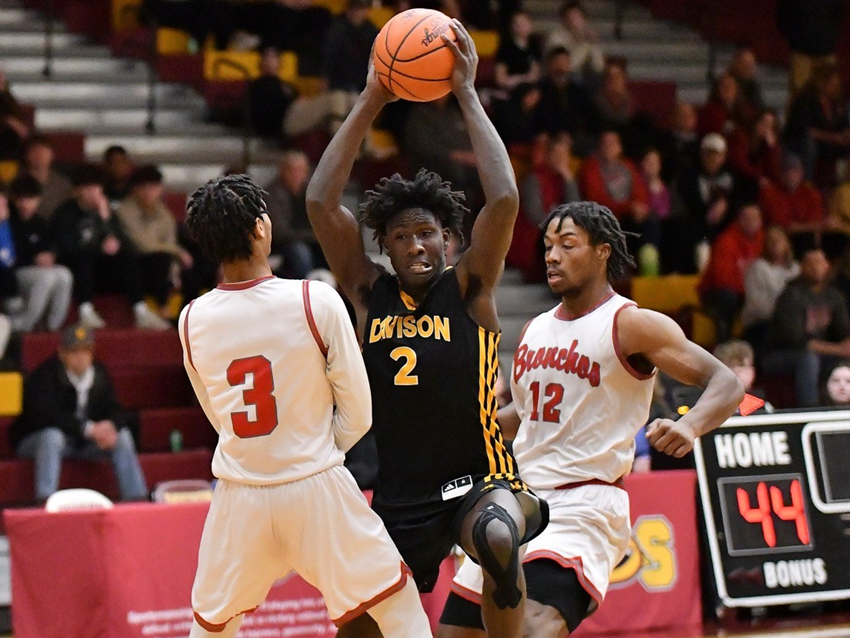
PHOTOS (Top) Muskegon finishes a season sweep of Mona Shores with a 61-29 Division 1 District Final win. (Middle) A pair of Holly defenders defend during their Division 1 District Semifinal win over Davison. (Top photo by Tim Reilly; middle photo by Terry Lyons.)