


Classes Still Create Hoosier Hysteria
July 27, 2017
By Rob Kaminski
MHSAA benchmarks editor
This is the fourth part in a series on MHSAA tournament classification, past and present, that will be published over the next two weeks. This series originally ran in this spring's edition of MHSAA benchmarks.
Twenty years ago, Bloomington North High School won the Indiana High School Athletic Association boys basketball championship, defeating Delta 75-54 at the RCA Dome in Indianapolis.
The date, March 22, 1997, is at the same time revered and disdained by traditionalists in the state who saw it as the last schoolboy championship game the state would ever host.
That’s how devout the game of basketball, particularly interscholastic basketball, had become in the Hoosier state during the 87 years a state champion – one state champion, to be precise – was crowned.
Following that 1997 season, the IHSAA moved to a four-class system for its roundball tournaments, like so many of its state association counterparts had done years earlier.
It would be shocking to find more than a small percentage of current high school basketball players around the country unfamiliar with the iconic movie Hoosiers, even though the film is now more than 30 years old.
And, the storyline for that blockbuster unfolded more than 30 years prior to its release, when small-town, undermanned Milan High School defeated Muncie Central High School 32-30 in the 1954 IHSAA title game.
Perhaps it’s because of the David vs Goliath notion, or the fame of the movie that replaced Milan with the fictional Hickory and real-life star Bobby Plump with Hollywood hero Jimmy Chitwood, or the simple fact that Indiana had something other states didn’t.
Whatever the reason, plenty of opposition remains to this day to basketball classification in the state.
The fact is, the small rural schools were regularly being beaten handily by the much larger suburban and city schools as the tournament progressed each season.
Small schools also were closing at a rapid rate following the state’s School Reorganization Act in 1959, as students converged on larger, centralized county schools. From 1960 to 2000, the number of schools entering the tournament dropped from 694 to 381, and in 1997 a total of 382 schools and 4,584 athletes began competition at the Sectional level (the first level of the IHSAA Basketball Tournament).
It was at the entry level of the tournament where school administrators felt the pain of the new class system, but not necessarily for the same nostalgic reasons as the fans who either attended or boycotted the tournament.
At the Sectional round of the tournament, the IHSAA was culling just 2 percent of the revenue, with the participating schools splitting the balance. So, when Sectional attendance dropped by 14 percent in that first year of class basketball, many schools realized a financial loss. It was money they had grown to count on in prior years to help fund various aspects of the department.
Schools cumulatively received more than $900,000 from Sectional competition in 1998, but that total was down from more than $1 million in the last year of the single-class tournament.
Yet, the current format provides a great deal more opportunity and realistic chances at championship runs for schools of all enrollments.
To date, 60 additional teams have championship or runner-up trophies on display in school trophy cases around Indiana.
That was the mission in front of then-IHSAA commissioner Bob Gardner (now National Federation executive director) once the board made its decision: to give thousands more student-athletes the opportunity for once-in-a-lifetime experiences.
As any statistician knows, figures can be manipulated to tell any side of a story. Declining attendance in year one of class basketball is such a number.
The truth is tournament attendance had been on a steady downward spiral since its peak of just over 1.5 million in 1962. By the last single-class event in 1997, the total attendance was half that.
The challenge then and today, as it is for all state associations, is to find that delicate balance for those holding onto tradition, those holding onto trophies, and the number of trophies to hand out.
Editor’s Note: Stories from the Fort Wayne Journal Gazette in 1998 and from a 2007 issue of Indianapolis Monthly provided facts in this article.
'Next Person Up' Mentality, Super Subs' Success Has Almont Returning to Ford Field
By
Paul Costanzo
Special for MHSAA.com
November 24, 2023
Gavin Szymansksi was nervous for about two plays.
 The junior was making his first start for the Almont football team in Week 3 against Imlay City, replacing injured Cole Willard at left tackle.
Willard had been hurt in the first half of the Raiders’ Week 2 game against Algonac, and while Szymanski had filled in then, there was less pressure, as his team already had a hefty cushion.
But this was different. A first varsity start, on the opposite side of the line from his more familiar right tackle position.
“It wasn’t too scary in that moment (against Algonac), plus I thought he was going to be back,” Szymanski said. “(Week 3) was kind of scary. But the team was pretty supportive, and they didn’t have any doubt I’d be able to fill in. Then we had a TD on like the first or second play in the Imlay game, and I was fine.”
Szymanski filled in seamlessly for the Raiders, which became a theme throughout the season. As players went down with injuries, both short and longterm, their backups filled in without a hitch.
While every team is banged up throughout a season, for a Division 6 school with just more than 30 players on the varsity roster, it’s a remarkable feat to remain competitive, let alone go 8-1 during the regular season, win the Blue Water Area Conference title, and, for the second time in school history, advance to the MHSAA Finals at Ford Field.
“Our motto is ‘next person up,’” Almont coach James Leusby said. “They literally live by that. You never know when your number is going to get called, but they seem to always be ready.”
Szymanski – who is back in the starting lineup for the Raiders, now as a right tackle filling in for the injured Yousif Abu-Joudeh – and his Almont teammates will play Kingsley at 4:30 p.m. Saturday in the Division 6 Final, looking for the program’s first Finals title.
While the Raiders certainly have star power – junior back Chase Battani had rushed for 1,169 yards and 18 touchdowns – it’s been the efforts of a team that has stretched well beyond it’s starting 22 that put them in this position.
The list of injuries, big and small, is extensive.
 It started with Willard and ended with Abu-Joudeh, who was injured in Week 9. Fullback Jacob Stewart, who was averaging 15 yards per carry, was injured in Week 6 and missed a stretch. Matthew Bacholzky stepped up in his place, along with Ayden Ferqueron.
Outside linebacker Eric Haddon suffered a high ankle sprain, and was replaced by Jacob Fuller, who had spent most of the season on the offensive side of the ball. Defensive end and tight end Brent Corneau missed a stretch as well, and Nolan Maxlow, who was a split end and defensive back, had to step up in his place.
And that’s just what Leusby could remember off the top of his head late Tuesday night.
“In Division 6, you don’t have much depth, so the backups have to know multiple positions,” Leusby said. “I think it talks highly of our program and our system and the coaches we have in it. In the playoffs, we’ve started two JV kids at defensive tackle. Our motto is, when we bring our sophomores up, the best kids are going to play.”
Because of that program-wide preparation, players are not only ready, but have confidence in one another when it’s someone else’s time to step up.
“I felt confident in him,” Willard said of Szymanski. “A lot of kids get a lot of reps at practice. And we’ve run the same plays for like five years, so everyone knows them.”
Leusby, who took over at Almont in 2015, credited not just his high school staff, but a youth program that’s bursting at the seams with participants.
Almont is a football community, and while there are no Finals titles listed on the city limits sign, it has a very proud history of success, especially lately.
The Raiders have made the postseason each of the past 14 seasons, and 17 of the past 18. The lone miss was 2009, when they were 5-4. Only the pandemic-shortened 2020 season resulted in a record that wasn’t over .500, and even that one ended at 3-3 with a playoff win.
“I think, all in all, the community, they invest a lot of time into the program, and they expect results,” Leusby said. “You ask anybody, Almont is a football town.”
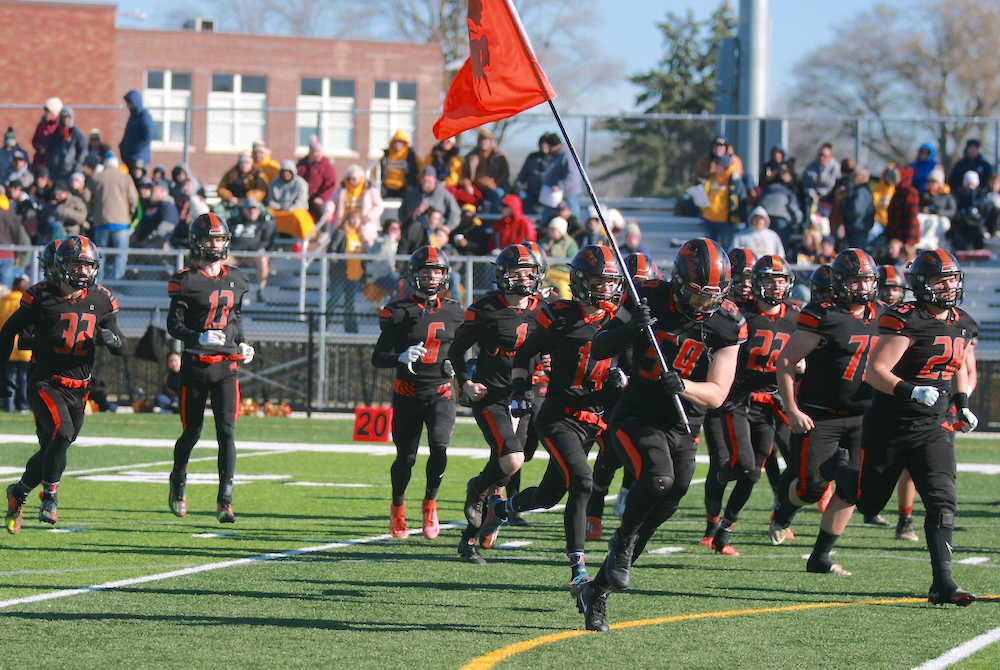
Leusby and his players are expecting that support to result in a lot of orange and black in the lower bowl of Ford Field on Saturday.
“Everybody has our back and wants us to win,” Willard said. “The whole town is travelling down there.”
They did the same in 2019 when the Raiders made their previous run to Ford Field. That ended with a 31-17 loss to Grand Rapids Catholic Central in the Division 5 Final.
“Honestly, when I was there in 2019, I was just thrilled to get to Ford Field,” Leusby said. “Yeah, it was a game and we wanted to win, but it was just cool to get to the Finals. After it was over, I thought, maybe I had sent the wrong messages. This year, we’ve reiterated that we’re going there to come home with the big daddy. Not second place – we want the big trophy.”
 Paul Costanzo served as a sportswriter at The Port Huron Times Herald from 2006-15, including three years as lead sportswriter, and prior to that as sports editor at the Hillsdale Daily News from 2005-06. He can be reached at [email protected] with story ideas for Genesee, Lapeer, St. Clair, Sanilac, Huron, Tuscola, Saginaw, Bay, Arenac, Midland and Gladwin counties.
PHOTOS (Top) Senior Isaiah Bankston (59) leads Almont onto the field before last Saturday’s Semifinal win over Ovid-Elsie. (Middle) Chase Battani (32) followers his Raiders blockers during the Regional Final win over Detroit Edison. (Photos by Maureen Flannery Walton.)