


Classes Still Create Hoosier Hysteria
July 27, 2017
By Rob Kaminski
MHSAA benchmarks editor
This is the fourth part in a series on MHSAA tournament classification, past and present, that will be published over the next two weeks. This series originally ran in this spring's edition of MHSAA benchmarks.
Twenty years ago, Bloomington North High School won the Indiana High School Athletic Association boys basketball championship, defeating Delta 75-54 at the RCA Dome in Indianapolis.
The date, March 22, 1997, is at the same time revered and disdained by traditionalists in the state who saw it as the last schoolboy championship game the state would ever host.
That’s how devout the game of basketball, particularly interscholastic basketball, had become in the Hoosier state during the 87 years a state champion – one state champion, to be precise – was crowned.
Following that 1997 season, the IHSAA moved to a four-class system for its roundball tournaments, like so many of its state association counterparts had done years earlier.
It would be shocking to find more than a small percentage of current high school basketball players around the country unfamiliar with the iconic movie Hoosiers, even though the film is now more than 30 years old.
And, the storyline for that blockbuster unfolded more than 30 years prior to its release, when small-town, undermanned Milan High School defeated Muncie Central High School 32-30 in the 1954 IHSAA title game.
Perhaps it’s because of the David vs Goliath notion, or the fame of the movie that replaced Milan with the fictional Hickory and real-life star Bobby Plump with Hollywood hero Jimmy Chitwood, or the simple fact that Indiana had something other states didn’t.
Whatever the reason, plenty of opposition remains to this day to basketball classification in the state.
The fact is, the small rural schools were regularly being beaten handily by the much larger suburban and city schools as the tournament progressed each season.
Small schools also were closing at a rapid rate following the state’s School Reorganization Act in 1959, as students converged on larger, centralized county schools. From 1960 to 2000, the number of schools entering the tournament dropped from 694 to 381, and in 1997 a total of 382 schools and 4,584 athletes began competition at the Sectional level (the first level of the IHSAA Basketball Tournament).
It was at the entry level of the tournament where school administrators felt the pain of the new class system, but not necessarily for the same nostalgic reasons as the fans who either attended or boycotted the tournament.
At the Sectional round of the tournament, the IHSAA was culling just 2 percent of the revenue, with the participating schools splitting the balance. So, when Sectional attendance dropped by 14 percent in that first year of class basketball, many schools realized a financial loss. It was money they had grown to count on in prior years to help fund various aspects of the department.
Schools cumulatively received more than $900,000 from Sectional competition in 1998, but that total was down from more than $1 million in the last year of the single-class tournament.
Yet, the current format provides a great deal more opportunity and realistic chances at championship runs for schools of all enrollments.
To date, 60 additional teams have championship or runner-up trophies on display in school trophy cases around Indiana.
That was the mission in front of then-IHSAA commissioner Bob Gardner (now National Federation executive director) once the board made its decision: to give thousands more student-athletes the opportunity for once-in-a-lifetime experiences.
As any statistician knows, figures can be manipulated to tell any side of a story. Declining attendance in year one of class basketball is such a number.
The truth is tournament attendance had been on a steady downward spiral since its peak of just over 1.5 million in 1962. By the last single-class event in 1997, the total attendance was half that.
The challenge then and today, as it is for all state associations, is to find that delicate balance for those holding onto tradition, those holding onto trophies, and the number of trophies to hand out.
Editor’s Note: Stories from the Fort Wayne Journal Gazette in 1998 and from a 2007 issue of Indianapolis Monthly provided facts in this article.
P-W's Miss Volleyball Smith Shows What's Possible, But More Goals Await
By
Steve Vedder
Special for MHSAA.com
November 21, 2023
Don't get Taylor Smith wrong: Volleyball is, without doubt, her greatest passion.
 It's just that Smith's ultimate goals for herself include far more than being defined by athletics.
The Pewamo-Westphalia senior, named the first Lansing-area winner of the state’s Miss Volleyball Award, said her work in a variety of areas outside of volleyball is as equally rewarding as excelling on the court.
"I just want to be known as an all-around good person," Smith said. "That's what makes me feel real good. If you work hard at something, that's what makes you feel good about yourself."
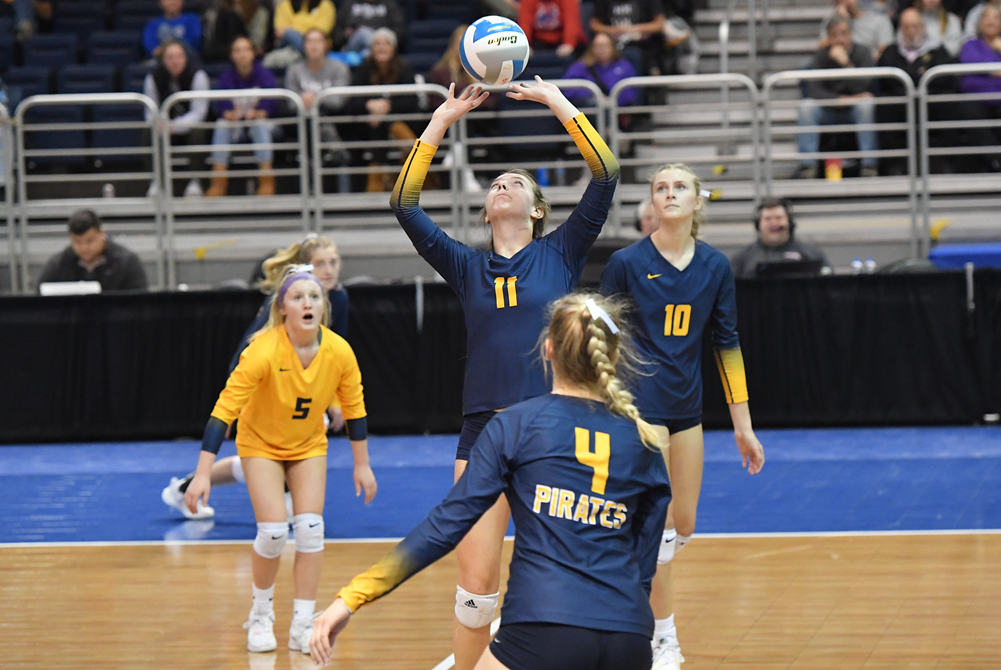
In addition to becoming the 20th Miss Volleyball, Smith is a three-time all-stater and the foundation of an outstanding Pirates program which has won three league titles over the last four years, four Districts and Regionals, the Division 3 championship a year ago and finished with a 53-2 record this season.
The remarkable team success aside, it comes as no surprise to P-W coach Jon Thelen that his star setter wants to be known for more than athletics. Smith works in special needs and peer mentoring programs within the school district. She carries a 3.98 grade point average and will continue her volleyball career next season at Eastern Michigan.
"She's the type of kid who just wants to give of herself," Thelen said. "She works her butt off on everything she does. She'll be one of those kids that you'll want to hire as an adult. She's a driven kid who has been a blessing to coach."
Smith's journey from fledging sixth-grade volleyball player to receiving the Michigan Interscholastic Volleyball Coaches Association's highest honor is a bit unconventional.
She began her volleyball career as an 11-year-old, moved on to the December-to-July club volleyball season where Smith estimates she's played in 50 tournaments over her career, and finally became the cornerstone of the P-W program.
A four-time all-conference and three-time volleyball all-stater, Smith said she gave up a moderate interest in basketball to throw herself into volleyball. She was a varsity starter as a freshman, began gaining notice from college coaches as a sophomore, and committed to Eastern Michigan in April of her junior season. She also considered Gannon University (Pa.) and Wright State among others.
 Smith is the first to admit she was no immediate volleyball sensation. Smith believes her game has improved in increments since the sixth grade. The last two facets of her game to fall in place were improvements in attacking and location in setting the ball. Those finishing touches transformed Smith from an excellent high school player to one capable of playing at the Division I college level.
A connection can easily be made, Smith said, from her love of the game to the sport providing a sense of community pride.
"Volleyball means everything to me," she said. "But it's not just playing volleyball, it's the sense of school and community I have from playing. I think that's helped my life in general. Overall, volleyball is fun and I love playing. But there is also that connection you have with community. That's important to me, too."
Smith said she began thinking playing volleyball at the next level would be possible after her freshman year of high school, That's when word began spreading that a school of 300 students possessed a 6-foot-1 setter who could help a college roster. But when Smith completed her own self-evaluations as a high school player, college seemed only a sketchy possibility lurking just over the horizon.
"Only because people told me I had a chance," Smith said of a college scholarship. "My game definitely needed work, and it wasn't just one thing. There were a lot of little things that came together for me."
The work has paid dividends. Smith's 165 points in the Miss Volleyball voting were 22 more than runner-up Zoey Dodd of Grandville. Smith said she considered herself a longshot in winning an award that recently has been dominated by Metro Detroit honorees. The last four played for Division 1 contenders.
This season’s Miss Volleyball ballot was filled mostly by candidates from the Grand Rapids area and also included representatives from Oakland County and the Thumb.
"I'm not kidding you; I didn't really think I had a chance. I was just happy to be in the top 10," she said. "When you see the (nominations), you see that there are a lot of good volleyball players in the state. I'm in a state of shock that I won."
Thelen said Smith winning the award is a statement about what players from smaller schools can accomplish. It's not about bigger always being better, he said.
"The neat thing is someone from a smaller school won it," Thelen said. "I think now those kids can go, 'I can do this.' You don't need to be at a bigger school to be represented on the big stage."
PHOTOS (Top) Taylor Smith (11) sets to her teammates during Pewamo-Westphalia’s 2022 Division 3 championship win at Kellogg Arena. (Middle) Smith accepts her medal.