


Classes Still Create Hoosier Hysteria
July 27, 2017
By Rob Kaminski
MHSAA benchmarks editor
This is the fourth part in a series on MHSAA tournament classification, past and present, that will be published over the next two weeks. This series originally ran in this spring's edition of MHSAA benchmarks.
Twenty years ago, Bloomington North High School won the Indiana High School Athletic Association boys basketball championship, defeating Delta 75-54 at the RCA Dome in Indianapolis.
The date, March 22, 1997, is at the same time revered and disdained by traditionalists in the state who saw it as the last schoolboy championship game the state would ever host.
That’s how devout the game of basketball, particularly interscholastic basketball, had become in the Hoosier state during the 87 years a state champion – one state champion, to be precise – was crowned.
Following that 1997 season, the IHSAA moved to a four-class system for its roundball tournaments, like so many of its state association counterparts had done years earlier.
It would be shocking to find more than a small percentage of current high school basketball players around the country unfamiliar with the iconic movie Hoosiers, even though the film is now more than 30 years old.
And, the storyline for that blockbuster unfolded more than 30 years prior to its release, when small-town, undermanned Milan High School defeated Muncie Central High School 32-30 in the 1954 IHSAA title game.
Perhaps it’s because of the David vs Goliath notion, or the fame of the movie that replaced Milan with the fictional Hickory and real-life star Bobby Plump with Hollywood hero Jimmy Chitwood, or the simple fact that Indiana had something other states didn’t.
Whatever the reason, plenty of opposition remains to this day to basketball classification in the state.
The fact is, the small rural schools were regularly being beaten handily by the much larger suburban and city schools as the tournament progressed each season.
Small schools also were closing at a rapid rate following the state’s School Reorganization Act in 1959, as students converged on larger, centralized county schools. From 1960 to 2000, the number of schools entering the tournament dropped from 694 to 381, and in 1997 a total of 382 schools and 4,584 athletes began competition at the Sectional level (the first level of the IHSAA Basketball Tournament).
It was at the entry level of the tournament where school administrators felt the pain of the new class system, but not necessarily for the same nostalgic reasons as the fans who either attended or boycotted the tournament.
At the Sectional round of the tournament, the IHSAA was culling just 2 percent of the revenue, with the participating schools splitting the balance. So, when Sectional attendance dropped by 14 percent in that first year of class basketball, many schools realized a financial loss. It was money they had grown to count on in prior years to help fund various aspects of the department.
Schools cumulatively received more than $900,000 from Sectional competition in 1998, but that total was down from more than $1 million in the last year of the single-class tournament.
Yet, the current format provides a great deal more opportunity and realistic chances at championship runs for schools of all enrollments.
To date, 60 additional teams have championship or runner-up trophies on display in school trophy cases around Indiana.
That was the mission in front of then-IHSAA commissioner Bob Gardner (now National Federation executive director) once the board made its decision: to give thousands more student-athletes the opportunity for once-in-a-lifetime experiences.
As any statistician knows, figures can be manipulated to tell any side of a story. Declining attendance in year one of class basketball is such a number.
The truth is tournament attendance had been on a steady downward spiral since its peak of just over 1.5 million in 1962. By the last single-class event in 1997, the total attendance was half that.
The challenge then and today, as it is for all state associations, is to find that delicate balance for those holding onto tradition, those holding onto trophies, and the number of trophies to hand out.
Editor’s Note: Stories from the Fort Wayne Journal Gazette in 1998 and from a 2007 issue of Indianapolis Monthly provided facts in this article.
Everest Collegiate Begins Championship Era as Another Ends for Leland Legend
By
Paul Costanzo
Special for MHSAA.com
November 18, 2023
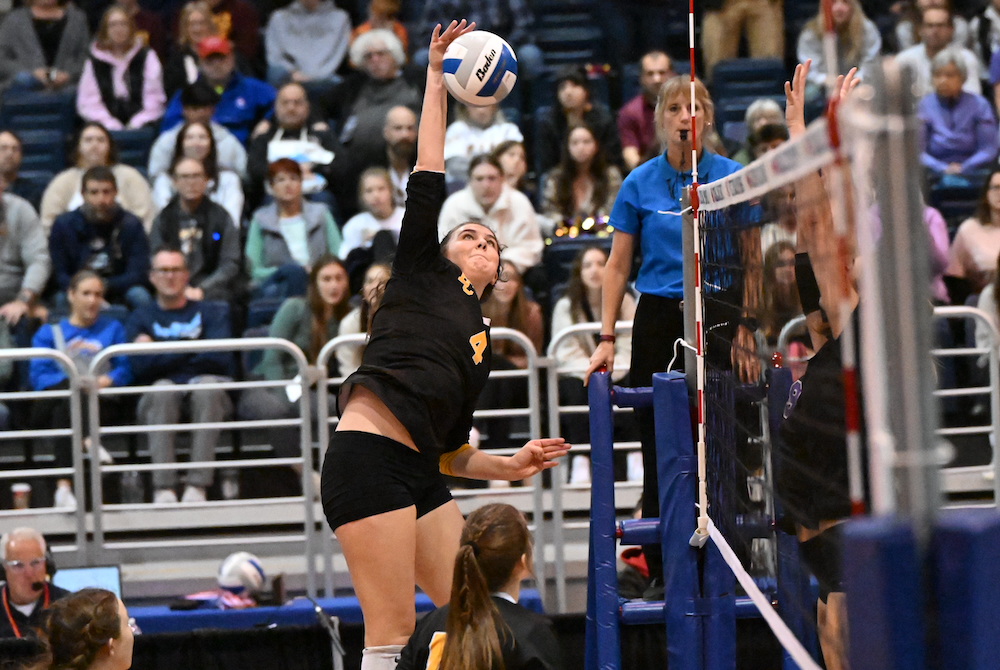
BATTLE CREEK – With the biggest serves of her volleyball career in front of her Saturday, Sarah Bradley did what she always does – took a deep breath and came through for Clarkston Everest Collegiate.
The junior served out the final three points of the Division 4 championship match, including a match-point ace to give the Moutaineers a five-set victory and their first Finals title.
“I believe very much in taking a deep breath when I’m serving and zoning everything out,” Bradley said. “In my head, I’m like, ‘All for you, God. All for you.’ Then I take a deep breath and I serve. Every single time. So I was very confident, and I went out there and did it.”
Bradley’s final ace put an exclamation point on an improbable comeback, as Everest trailed 2 sets to none, and 10-3 in the fifth before winning 24-26, 18-25, 25-22, 25-19, 15-13.
It also capped off a historic season for the 10th-ranked Moutaineers, who hadn’t won a Regional title prior to this season, let alone compete in Kellogg Arena. They more than made their mark in their first trip, with a pair of 0-2 comebacks, including a Semifinal win Friday over top-ranked Adrian Lenawee Christian.
“I’m blown away by these girls,” first-year Everest coach Danielle Walker said. “To come back two days in a row from two sets down. It’s just amazing.”
 Playing five sets twice certainly wasn’t the plan for the Moutaineers, but they didn’t shrink in the moment despite having never been on this stage.
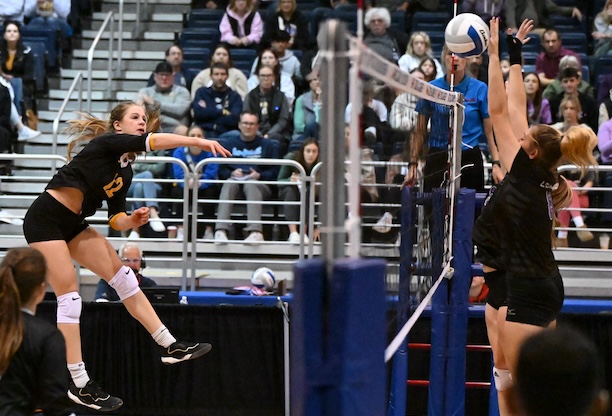
“We knew we had done it before, we knew it’s been done in the state Finals before, and we trust in ourselves,” said junior Madelyn Krappmann. “We trust in our ability as a team and in each other. We know our strengths, we know our weaknesses and we know how to adapt to the other team’s strengths and weaknesses. We really just dug in, took a deep breath and said, ‘All right, we did it yesterday, we can do it today.’ And that’s what we did.”
It looked early in the fifth set that the rally in sets 3 and 4 may have been for naught. Leland jumped out to a quick 5-1 lead and had stretched it to 10-3 before Everest was able to find its way back in.
The Comets took a 13-11 lead when Kelsey Allen and Abby Hicks teamed up for a block of Bradley. She came back immediately with a kill, however, and then served out the match.
“Honestly, it got me even more motivated,” Bradley said. “They blocked me, but I just kept going. I believe in myself, and I trust myself to get over it. Me and (junior setter Erica Walker) talked about what we were going to do different. It just all fit together. I got out there with all the confidence I can, because that’s how I know I can play my best.”
Bradley finished with a match-high 31 kills, tied for sixth all-time in a Finals match. Walker finished with 57 assists, tied for second all-time. The 64 team kills for the Mountaineers (32-4-2) are tied for fourth all-time.
“My little thing is, I want to succeed so my hitters can succeed,” said Walker, who didn’t start playing volleyball for Everest until this season, and was also a Finals qualifier in cross country. “I want them to have the spotlight, and in order to do that, I have to have good sets. I play with three of the best hitters that I’ve ever seen. To be able to set them up and see them succeed makes me so happy.”
 While this weekend served as an introduction to the rest of the state for Everest – the Mountaineers are set to bring back all six starters in 2024 and graduate one senior – it was goodbye from a legend on the other side.
Leland coach Laurie Glass, who has amassed more than 1,100 wins and three Finals titles in her 29 years leading the Comets, announced after the match that it was her last, and that assistant Travis Baker would be taking over.
“I’ve known all along that I wanted to see this group through and be there with them in this moment,” she said. “I’m proud to be from Leland. I’m proud to have coached at Leland, and I couldn’t have gone out in a better way. I wanted the season to be about them, 100 percent. I didn’t want to have big farewells and have a farewell tour of Laurie Glass’ coaching career. I wanted them to have their season. It’s time. It’s time to move on and pass the torch to Travis Baker, who really is the reason this season has gone as well as it has.”
The Comets finished Glass’ final season 41-17-2, and did so fielding a team of just seven players, five of whom were seniors.
While they didn’t know Glass was stepping down until after the match, they very nearly sent her out with a fourth title. Getting to raise a runner-up trophy wasn’t a bad way to go out, though.
“There’s a lot of teams out there that would give their eye teeth to have this moment, even if they were crying,” Glass said. “There were only two teams left in the state, and we were one of them. I don’t think that’s a horrible thing.”
Fiona Moord led Leland with 17 kills, while Shelby Plamondon and Allen both had 12. Olive Ryder had 10 kills and 21 digs, Hicks had 45 assists and Mallory Lowe had 18 digs.
Krappman had 20 kills for Everest, while Addison Pearce added 11. Krappman and Bradley both had 18 digs, while Samantha Pietras had 15.
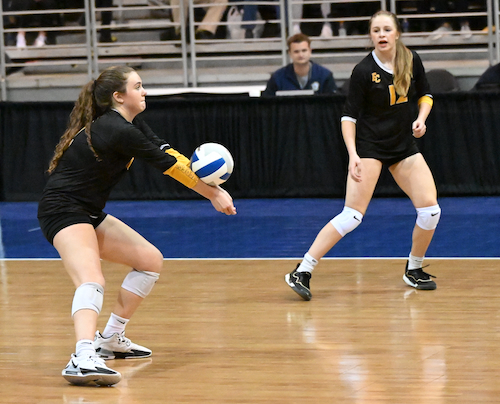
PHOTOS (Top) Clarkton Everest Collegiate’s Sarah Bradley takes a big swing on a kill attempt during Saturday’s Division 4 Final at Kellogg Arena. (Middle) The Mountaineers’ Madelyn Krappmann sends a kill attempt toward a pair of Leland blockers. (Below) Everest sets up its offense. (Photos by Hockey Weekly Action Photos.)