


Classes Still Create Hoosier Hysteria
July 27, 2017
By Rob Kaminski
MHSAA benchmarks editor
This is the fourth part in a series on MHSAA tournament classification, past and present, that will be published over the next two weeks. This series originally ran in this spring's edition of MHSAA benchmarks.
Twenty years ago, Bloomington North High School won the Indiana High School Athletic Association boys basketball championship, defeating Delta 75-54 at the RCA Dome in Indianapolis.
The date, March 22, 1997, is at the same time revered and disdained by traditionalists in the state who saw it as the last schoolboy championship game the state would ever host.
That’s how devout the game of basketball, particularly interscholastic basketball, had become in the Hoosier state during the 87 years a state champion – one state champion, to be precise – was crowned.
Following that 1997 season, the IHSAA moved to a four-class system for its roundball tournaments, like so many of its state association counterparts had done years earlier.
It would be shocking to find more than a small percentage of current high school basketball players around the country unfamiliar with the iconic movie Hoosiers, even though the film is now more than 30 years old.
And, the storyline for that blockbuster unfolded more than 30 years prior to its release, when small-town, undermanned Milan High School defeated Muncie Central High School 32-30 in the 1954 IHSAA title game.
Perhaps it’s because of the David vs Goliath notion, or the fame of the movie that replaced Milan with the fictional Hickory and real-life star Bobby Plump with Hollywood hero Jimmy Chitwood, or the simple fact that Indiana had something other states didn’t.
Whatever the reason, plenty of opposition remains to this day to basketball classification in the state.
The fact is, the small rural schools were regularly being beaten handily by the much larger suburban and city schools as the tournament progressed each season.
Small schools also were closing at a rapid rate following the state’s School Reorganization Act in 1959, as students converged on larger, centralized county schools. From 1960 to 2000, the number of schools entering the tournament dropped from 694 to 381, and in 1997 a total of 382 schools and 4,584 athletes began competition at the Sectional level (the first level of the IHSAA Basketball Tournament).
It was at the entry level of the tournament where school administrators felt the pain of the new class system, but not necessarily for the same nostalgic reasons as the fans who either attended or boycotted the tournament.
At the Sectional round of the tournament, the IHSAA was culling just 2 percent of the revenue, with the participating schools splitting the balance. So, when Sectional attendance dropped by 14 percent in that first year of class basketball, many schools realized a financial loss. It was money they had grown to count on in prior years to help fund various aspects of the department.
Schools cumulatively received more than $900,000 from Sectional competition in 1998, but that total was down from more than $1 million in the last year of the single-class tournament.
Yet, the current format provides a great deal more opportunity and realistic chances at championship runs for schools of all enrollments.
To date, 60 additional teams have championship or runner-up trophies on display in school trophy cases around Indiana.
That was the mission in front of then-IHSAA commissioner Bob Gardner (now National Federation executive director) once the board made its decision: to give thousands more student-athletes the opportunity for once-in-a-lifetime experiences.
As any statistician knows, figures can be manipulated to tell any side of a story. Declining attendance in year one of class basketball is such a number.
The truth is tournament attendance had been on a steady downward spiral since its peak of just over 1.5 million in 1962. By the last single-class event in 1997, the total attendance was half that.
The challenge then and today, as it is for all state associations, is to find that delicate balance for those holding onto tradition, those holding onto trophies, and the number of trophies to hand out.
Editor’s Note: Stories from the Fort Wayne Journal Gazette in 1998 and from a 2007 issue of Indianapolis Monthly provided facts in this article.
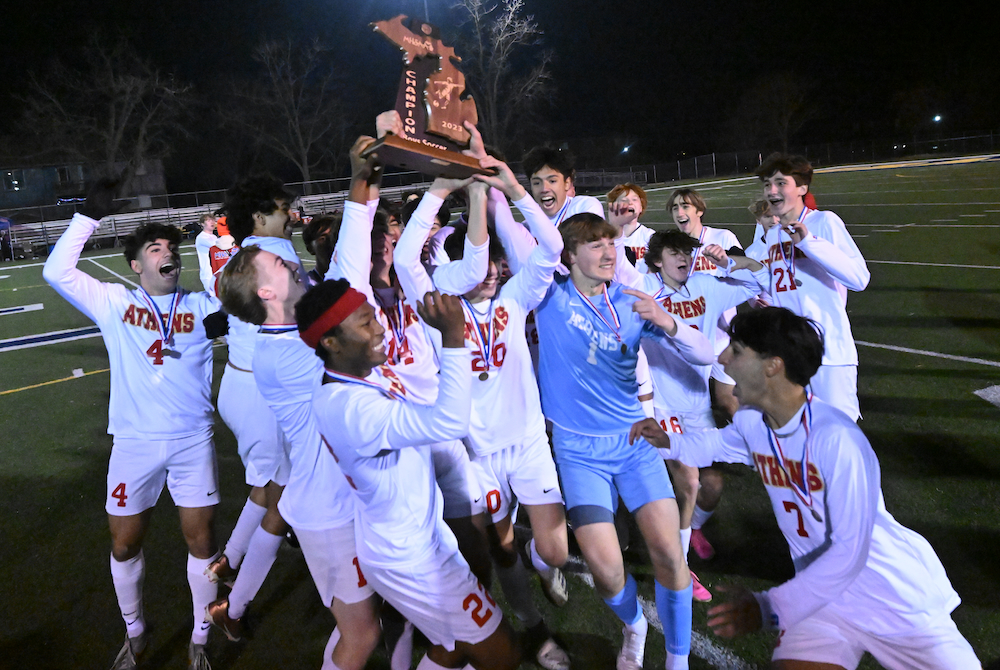
Troy Athens Comes Back Again, This Time to Claim Program's 6th Finals Win
By
Keith Dunlap
Special for MHSAA.com
November 4, 2023
GRAND LEDGE — Usually if a soccer teams falls behind late in a state championship game, there’s a big “uh-oh” and sense of dejection.
But falling behind late against Brighton in the 2023 MHSAA Division 1 Final put Troy Athens in a comfort zone.
“We were behind in the District Final, we were behind in the Regional Semifinal, we were behind in the Regional Final, we took the lead in the Semifinal but then fell behind, and we were behind again tonight,” Athens head coach Todd Heugh said. “Certainly, there’s a lot of resolve and resiliency in our group.”
As it turned out, it was championship resolve and resiliency for Athens.
Thanks to a goal late in regulation that tied the game and one more 2:59 into overtime, Athens is once again a Finals champion in boys soccer following a 2-1 win over Brighton.
The title was the sixth in program history for Athens (20-3-2).
The winning goal with 7:01 left in the first portion of overtime came from senior Manny Aigbedo, who put home a loose ball in the Brighton box after a mad scramble following an Athens corner kick.
“I just kneed it,” Aigbedo said. “I got anything I could on it. Just a little bit and went in. I didn’t even know I scored at that moment because there was so many people trying to get it.”
The game was scoreless until 9:02 remained in regulation, when Brighton took a 1-0 lead on a goal from senior Colin Robertson.
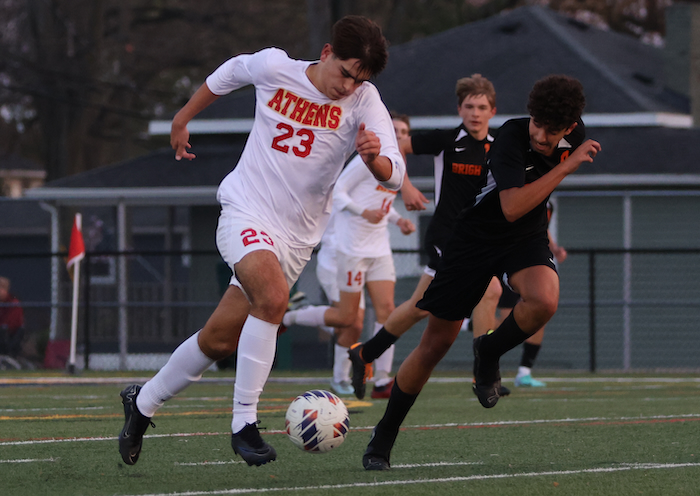 The goal came after a flurry of shots on Athens goalkeeper Adam Ethridge, who initially stopped Brighton leading scorer Devlin McGinnis on a point-blank shot in the box. A rebound caromed to Brighton junior Owen Buckley, but he was stopped by Ethridge.
But with Ethridge out of the net, another rebound came to the left side of the box to Robertson, who fired a shot into essentially an empty net just past multiple Athens defenders who tried to scramble back to the goal line.
From there, Athens pressured to get the equalizer, and finally did.
With 1:56 remaining in the second half, senior Brody Fahnestock stepped into a fast-paced shot from roughly 30 yards out that went past Brighton’s keeper and into the goal to tie the game at 1-1.
The tying goal seemed to deflate Brighton (19-4-2), which was less than two minutes from winning a first Finals championship in school history.
Athens dominated the overtime period, outshooting Brighton 10-1 overall and 8-0 on goal.
“When they got that tying goal, it kind of took the wind out of our sails there at the end,” Brighton head coach Mark Howell said. “We knew overtime was going to be an uphill battle trying to climb back in it momentum-wise. We knew they had a lot of experience returning on the big stage. It just didn’t fall the way we wanted it to.”
Athens got off to a slow start this season, but got rolling in September and never looked back, showing once again there’s no substitute for experience as the team had 16 seniors.
“We don’t always play the prettiest brand,” Heugh said. “But we’re usually organized, and we usually are going to fight to the end.”
Click for the box score.
PHOTOS (Top) Troy Athens celebrates its overtime win in Saturday's Division 1 Final at Grand Ledge. (Middle) The Red Hawks' Daniel Kadiu (23) races upfield with a Brighton defender chasing.