


Classes Still Create Hoosier Hysteria
July 27, 2017
By Rob Kaminski
MHSAA benchmarks editor
This is the fourth part in a series on MHSAA tournament classification, past and present, that will be published over the next two weeks. This series originally ran in this spring's edition of MHSAA benchmarks.
Twenty years ago, Bloomington North High School won the Indiana High School Athletic Association boys basketball championship, defeating Delta 75-54 at the RCA Dome in Indianapolis.
The date, March 22, 1997, is at the same time revered and disdained by traditionalists in the state who saw it as the last schoolboy championship game the state would ever host.
That’s how devout the game of basketball, particularly interscholastic basketball, had become in the Hoosier state during the 87 years a state champion – one state champion, to be precise – was crowned.
Following that 1997 season, the IHSAA moved to a four-class system for its roundball tournaments, like so many of its state association counterparts had done years earlier.
It would be shocking to find more than a small percentage of current high school basketball players around the country unfamiliar with the iconic movie Hoosiers, even though the film is now more than 30 years old.
And, the storyline for that blockbuster unfolded more than 30 years prior to its release, when small-town, undermanned Milan High School defeated Muncie Central High School 32-30 in the 1954 IHSAA title game.
Perhaps it’s because of the David vs Goliath notion, or the fame of the movie that replaced Milan with the fictional Hickory and real-life star Bobby Plump with Hollywood hero Jimmy Chitwood, or the simple fact that Indiana had something other states didn’t.
Whatever the reason, plenty of opposition remains to this day to basketball classification in the state.
The fact is, the small rural schools were regularly being beaten handily by the much larger suburban and city schools as the tournament progressed each season.
Small schools also were closing at a rapid rate following the state’s School Reorganization Act in 1959, as students converged on larger, centralized county schools. From 1960 to 2000, the number of schools entering the tournament dropped from 694 to 381, and in 1997 a total of 382 schools and 4,584 athletes began competition at the Sectional level (the first level of the IHSAA Basketball Tournament).
It was at the entry level of the tournament where school administrators felt the pain of the new class system, but not necessarily for the same nostalgic reasons as the fans who either attended or boycotted the tournament.
At the Sectional round of the tournament, the IHSAA was culling just 2 percent of the revenue, with the participating schools splitting the balance. So, when Sectional attendance dropped by 14 percent in that first year of class basketball, many schools realized a financial loss. It was money they had grown to count on in prior years to help fund various aspects of the department.
Schools cumulatively received more than $900,000 from Sectional competition in 1998, but that total was down from more than $1 million in the last year of the single-class tournament.
Yet, the current format provides a great deal more opportunity and realistic chances at championship runs for schools of all enrollments.
To date, 60 additional teams have championship or runner-up trophies on display in school trophy cases around Indiana.
That was the mission in front of then-IHSAA commissioner Bob Gardner (now National Federation executive director) once the board made its decision: to give thousands more student-athletes the opportunity for once-in-a-lifetime experiences.
As any statistician knows, figures can be manipulated to tell any side of a story. Declining attendance in year one of class basketball is such a number.
The truth is tournament attendance had been on a steady downward spiral since its peak of just over 1.5 million in 1962. By the last single-class event in 1997, the total attendance was half that.
The challenge then and today, as it is for all state associations, is to find that delicate balance for those holding onto tradition, those holding onto trophies, and the number of trophies to hand out.
Editor’s Note: Stories from the Fort Wayne Journal Gazette in 1998 and from a 2007 issue of Indianapolis Monthly provided facts in this article.
Macomb Lutheran North Standout on Mend After Knee Injury
October 3, 2023
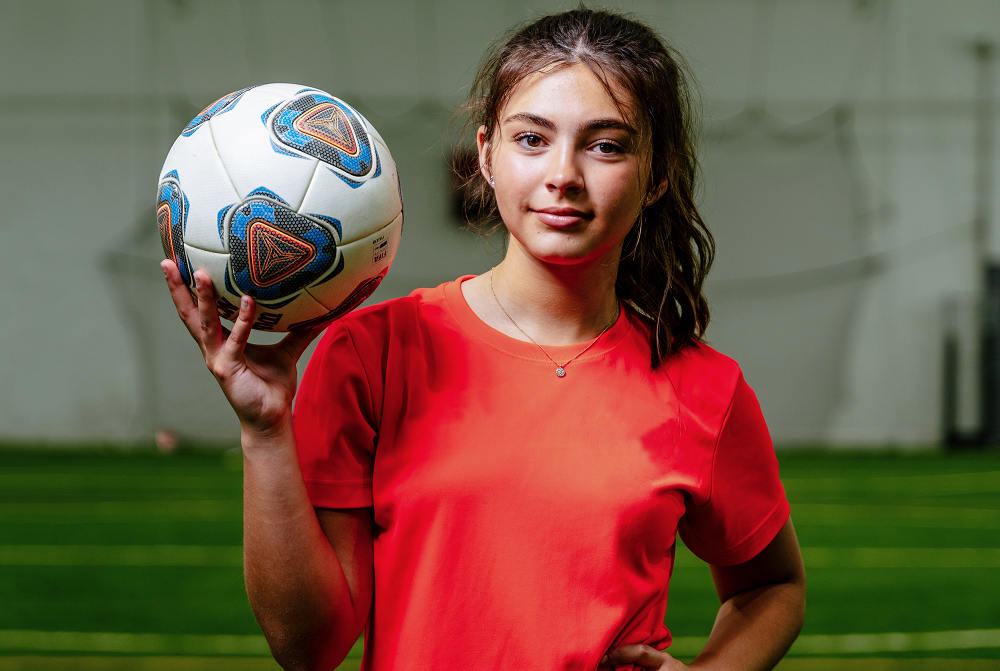
Macomb Lutheran North freshman Emiliana Manzo has already achieved a long list of accomplishments, including a 3.8 grade-point average while juggling two sports she loves.
 As a point guard, she led her basketball team to an undefeated season in its division. She is also a center attacking midfielder, sometimes playing forward, on the 2009 Nationals Girls Academy Blue soccer team, ranked No. 1 in Michigan and 14th in the country.
In June of 2022, Emiliana hit a detour on her sports journey when she was participating in a club soccer national championship in Oceanside, Calif. With a few seconds left in the game and her team up 2-1, she ran 20 yards full speed to get to the ball. Hyperextending her left knee, she felt two pops. It was the first time she experienced an injury.
“I was screaming and crying and got taken off the field on a golf cart,” explains Emiliana. The trainer felt she was OK. Fortunately, she had the next day off and her knee was feeling better. The following day she played again, and 20 minutes into the game she knew there was an issue.
“Someone hit me from behind and I heard the pop again. I knew there was a problem.”
Emiliana’s father Vince Manzo said she experienced swelling, and the athletic trainer thought she may have a meniscus injury; however, she was able to continue to walk around during the championship in California before heading home.
Finding the Right Provider
Back in Michigan, Emiliana saw a few surgeons during her evaluation to seek treatment. When she met with Vasilios Bill Moutzouros, MD, chief of Sports Medicine at Henry Ford Health, she felt she met the right match.
“He treated me like an athlete and made me feel really comfortable,” she says.
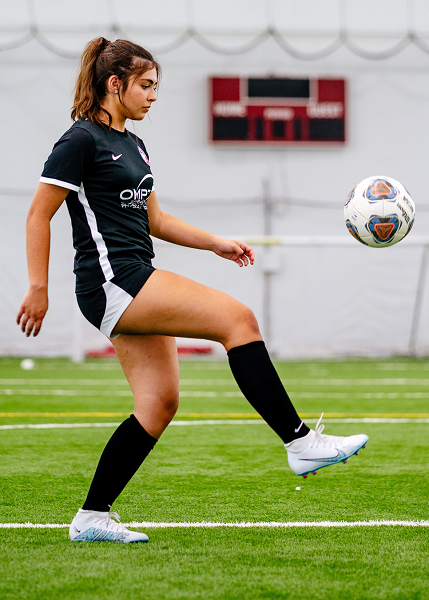 Vince adds that both he and Emiliana were also appreciative of something Dr. Moutzouros said during her evaluation: “He emphasized to Emiliana that she was an athlete before this injury, and she would be an athlete after the injury.”
A detailed evaluation by Dr. Moutzouros revealed Emiliana had a complete anterior cruciate ligament (ACL) tear and medial and lateral meniscal tears. The meniscus, a C-shaped piece of tough, rubbery cartilage, acts as a shock absorber between the shinbone and the thighbone. It is one of the most common knee injuries. The ACL, one of the strong bands of tissue that help connect the thigh bone (femur) to the shinbone (tibia), is also prone to injury during sports when there are sudden stops or changes in direction.
Emiliana required physical therapy to get the swelling down and increase mobility before surgical repair.
Dr. Moutzouros reconstructed her ACL with her own patellar tendon graft and repaired her medial meniscus.
“She handled the surgery well and has been working very hard in her rehabilitation,” he says. “Her high-level soccer experience likely helped in her recovery as her range of motion and strengthening advanced so quickly.”
Understandably, Emiliana was nervous and scared when she went into surgery but expressed appreciation for the little things from Henry Ford like hearing “great music” as she was entering surgery, which gave her a sense of calm.
“That’s when I knew I picked the right doctor,” she said.
The Road to Recovery
As part of her recovery, after surgery which took place in July of 2022, Emiliana has undergone six months of physical therapy to increase mobility and strength training to get her leg strong again.
She also participated in the Return to Sport Program at the Henry Ford Center for Athletic Medicine to optimize recovery.
“We loved it,” says Vince. “It gave us peace of mind.”
Dr. Moutzouros explains that ACL prevention and rehabilitation programs are critical, especially for women because they have a four times greater risk of ACL tear than men. He says performance training post-surgery, along with an injury prevention program for those playing cutting sports, can markedly reduce the likelihood of future ACL injury.
“At Henry Ford, we work with physical therapists across the Midwest as well as our own. They do a great job in following our Henry Ford specific post-ACL reconstruction protocol,” he says. “After therapy runs its course, we strongly encourage our athletes to undergo performance training to allow a smooth transition back to sport.”
Nick Parkinson, supervisor of Athletic Training and Sports Performance at Henry Ford Health, emphasizes that the return to sport program is designed to bridge the gap between rehabilitation and returning to full activity in your chosen sport.
“Many times, insurance limits rehabilitation to regaining activities of daily living and not necessarily rebuilding the skills needed to play a sport or return to activity,” Nick says. “This program provides an affordable option to fill this need and return athletes to competition at the highest level.”
As for Emiliana, who hopes to play soccer in college and pursue a career in the medical field, she says this experience has taught her to not be afraid of injuries and treatment. She has also used the experience to volunteer for a program through the Girls Academy which serves as an advisory board to come up with ideas to help with mental and physical issues girls her age may be facing.
“For other kids who experience injuries, I’ve learned that this does not define you,” she said. “You can push through it, recover from it and be way better than you even were before.”
To find a sports medicine doctor or athletic trainer at Henry Ford, visit henryford.com/athletes.