


Classes Still Create Hoosier Hysteria
July 27, 2017
By Rob Kaminski
MHSAA benchmarks editor
This is the fourth part in a series on MHSAA tournament classification, past and present, that will be published over the next two weeks. This series originally ran in this spring's edition of MHSAA benchmarks.
Twenty years ago, Bloomington North High School won the Indiana High School Athletic Association boys basketball championship, defeating Delta 75-54 at the RCA Dome in Indianapolis.
The date, March 22, 1997, is at the same time revered and disdained by traditionalists in the state who saw it as the last schoolboy championship game the state would ever host.
That’s how devout the game of basketball, particularly interscholastic basketball, had become in the Hoosier state during the 87 years a state champion – one state champion, to be precise – was crowned.
Following that 1997 season, the IHSAA moved to a four-class system for its roundball tournaments, like so many of its state association counterparts had done years earlier.
It would be shocking to find more than a small percentage of current high school basketball players around the country unfamiliar with the iconic movie Hoosiers, even though the film is now more than 30 years old.
And, the storyline for that blockbuster unfolded more than 30 years prior to its release, when small-town, undermanned Milan High School defeated Muncie Central High School 32-30 in the 1954 IHSAA title game.
Perhaps it’s because of the David vs Goliath notion, or the fame of the movie that replaced Milan with the fictional Hickory and real-life star Bobby Plump with Hollywood hero Jimmy Chitwood, or the simple fact that Indiana had something other states didn’t.
Whatever the reason, plenty of opposition remains to this day to basketball classification in the state.
The fact is, the small rural schools were regularly being beaten handily by the much larger suburban and city schools as the tournament progressed each season.
Small schools also were closing at a rapid rate following the state’s School Reorganization Act in 1959, as students converged on larger, centralized county schools. From 1960 to 2000, the number of schools entering the tournament dropped from 694 to 381, and in 1997 a total of 382 schools and 4,584 athletes began competition at the Sectional level (the first level of the IHSAA Basketball Tournament).
It was at the entry level of the tournament where school administrators felt the pain of the new class system, but not necessarily for the same nostalgic reasons as the fans who either attended or boycotted the tournament.
At the Sectional round of the tournament, the IHSAA was culling just 2 percent of the revenue, with the participating schools splitting the balance. So, when Sectional attendance dropped by 14 percent in that first year of class basketball, many schools realized a financial loss. It was money they had grown to count on in prior years to help fund various aspects of the department.
Schools cumulatively received more than $900,000 from Sectional competition in 1998, but that total was down from more than $1 million in the last year of the single-class tournament.
Yet, the current format provides a great deal more opportunity and realistic chances at championship runs for schools of all enrollments.
To date, 60 additional teams have championship or runner-up trophies on display in school trophy cases around Indiana.
That was the mission in front of then-IHSAA commissioner Bob Gardner (now National Federation executive director) once the board made its decision: to give thousands more student-athletes the opportunity for once-in-a-lifetime experiences.
As any statistician knows, figures can be manipulated to tell any side of a story. Declining attendance in year one of class basketball is such a number.
The truth is tournament attendance had been on a steady downward spiral since its peak of just over 1.5 million in 1962. By the last single-class event in 1997, the total attendance was half that.
The challenge then and today, as it is for all state associations, is to find that delicate balance for those holding onto tradition, those holding onto trophies, and the number of trophies to hand out.
Editor’s Note: Stories from the Fort Wayne Journal Gazette in 1998 and from a 2007 issue of Indianapolis Monthly provided facts in this article.
Working Together, with Neighbor's Help, Schoolcraft Teams Making Selves at 'Home'
By
Pam Shebest
Special for MHSAA.com
September 19, 2023
SCHOOLCRAFT — If it is a home game for the Schoolcraft football team, head over to Vicksburg.
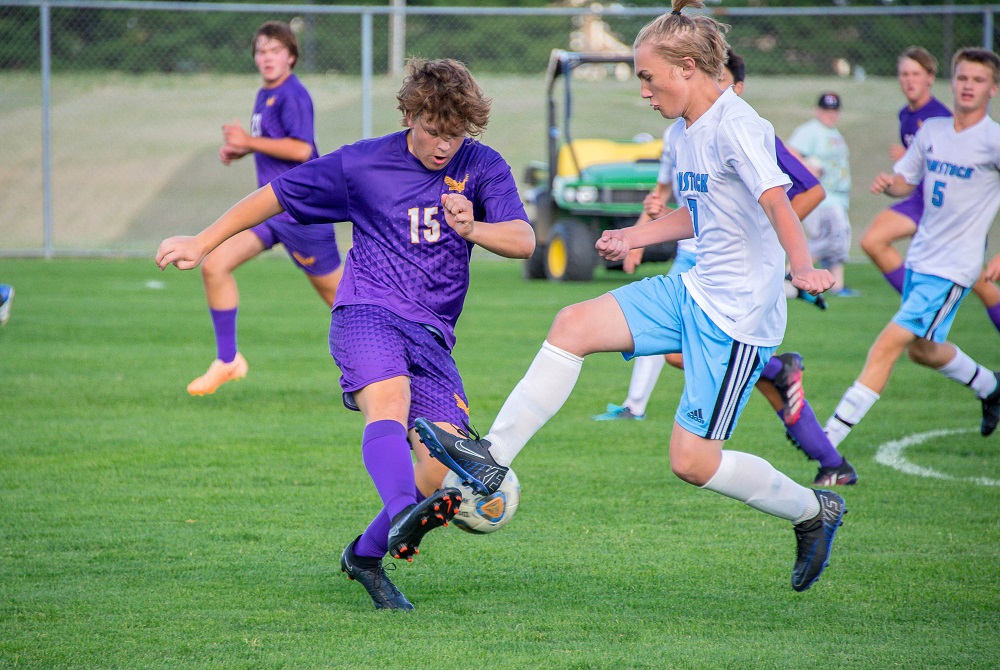
 If it is soccer, go to Schoolcraft’s baseball field.
Things are a bit jumbled in the sports world for the Eagles this season.
With a new football field under construction and a new elementary school built on the site of the former practice fields, the two teams have been a bit displaced.
“Along with our football field, we had three practice fields that were utilized by a lot of our youth programs, Rocket football, youth soccer and our soccer and football programs,” Schoolcraft athletic director Bryan Applin said. “It’s taken a lot of understanding and flexibility from our coaches, players and our community to make it work out, and it has.”
Meanwhile, all four Eagles home football games will be played at Vicksburg High School.
If Vicksburg is home on a Friday, then the Eagles will play Saturday, including their Homecoming game this Saturday against Galesburg-Augusta.
The Eagles won their only “home” game so far, 33-14 against Kalamazoo United, and take a 3-1 record into Saturday’s contest.
The soccer team gave up its field to the football team for practices and has been practicing and playing their matches in the outfield of the baseball stadium.
For the soccer team, “It’s kind of an upgrade,” Applin said. “The soccer field they traditionally play on, they don’t have a scoreboard, they don’t have a bathroom facility, so we’ve been able to use the (baseball) scoreboard, the PA system, open up the bathroom building.
 “The goal at some point is to give soccer a home, and we’re very, very excited about that.”
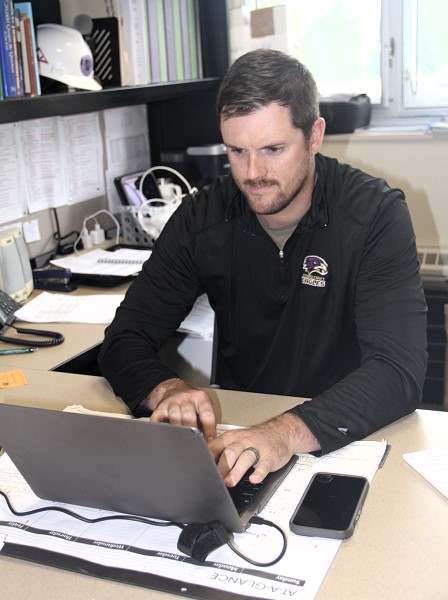
This year definitely has been challenging for the first-year AD, who credits Vicksburg athletic director Mike Roy with being a tremendous help.
“Mike Roy has been nothing but accommodating to us,” Applin said. “He’s been super helpful to me stepping in and assuming this scenario.
“The communities are so close, it almost feels like home for us.”
Roy said Jeff Clark, former Schoolcraft AD, reached out once the bond was passed for the new stadium last year.
“We had to make small accommodations as did Schoolcraft to make the schedules work,” Roy said. “By moving (Schoolcraft’s) games to Saturday, Vicksburg had to work with our Rocket football organization to make sure games were completed” before the Eagles varsity games.
Schoolcraft football coach Nathan Ferency said his team has been “rolling with the punches.
“These guys don’t care where it’s at; they just want to play football. We’re all taking care of each other. What a great place to be when everybody works together.”
When Jake Bailey heard the team would be playing at Vicksburg, “That got me excited,” the junior offensive tackle said. “They’ve got a really nice facility. I know the school will come out to support us no matter where we are, but it’s definitely different.
“Good thing we don’t play Vicksburg, although it would be fun because it would be both our home fields. The new facilities and being back at our home field at Roy Davis (Field next year) will be really fun.”
Vicksburg is Division 4, while Schoolcraft is Division 7.
 The soccer team was “just being a team player” in giving up its own field for football practice, second-year head coach Jeremy Mutchler said.
“For the soccer team to be a team player and get behind the football team will help the community get behind the soccer team as well,” he added.
The biggest drawback is that part of the current field includes a piece of the baseball infield.
“The only odd thing is it is a smaller field, still regulation size, but smaller,” Mutchler said. “Part of the field is in the diamond, so we have to play in the dirt and it gets tricky, especially when you’re trying to throw it in or just play down the line.”
The move has cost the team a few home games.
“At the beginning of the year, we allowed schools, if they didn’t want to play here, we would go to their house,” Mutchler said. “We had to go to a few schools we would have played at home.”
Maintenance supervisor Eric McGehee was instrumental in preparing the field.
“He laid out exactly the parameters, so I was able to send that to all the ADs that were going to visit to give them an opportunity to decide whether that’s something they wanted to help us out for our home games,” Applin said. “A lot of schools were more than willing to come and play us to give our boys some home games. A couple wanted to be cautious and play on a more traditional surface, and we were able to make those arrangements as well.”
In only its second year as a varsity sport, the boys soccer team is still finding its identity, posting a 2-5 record so far.
 “We’re a very young team,” Mutchler said. “All juniors and freshmen. This is the juniors' second regular season. It’s all been a learning phase with maturity and sportsmanship.”
Junior captain Jack Curtis said he was a bit “bummed out” when he heard the team would move to the baseball field.
“The first practice, I drove over to our practice field,” he said. “No one was there.
“I drove over to the high school and saw everyone practicing (at the baseball field). I didn’t think a soccer field could fit on a baseball field.”
Curtis said in spite of the temporary move, “I’m just glad we can have some home games this year on Schoolcraft soil.”
As for Applin, he spent much of his career coaching basketball at both the high school and college levels and most recently worked as a salesman for Zeigler. His wife, Meredith, is an assistant coach for Western Michigan University’s women’s basketball team.
Ferency is appreciative of the work Clark and Applin have done to make this season’s changes relatively seamless.
“I’d like to highlight how great our athletic department is,” he said. “It takes a lot of moving pieces and parts to move people around and have a space for everybody.
“I’m really proud of our athletic department and all our coaches and kids for just rolling with the punches.”
 Pam Shebest served as a sportswriter at the Kalamazoo Gazette from 1985-2009 after 11 years part-time with the Gazette while teaching French and English at White Pigeon High School. She can be reached at [email protected] with story ideas for Calhoun, Kalamazoo and Van Buren counties.
PHOTOS (Top) Schoolcraft’s varsity boys soccer team, including Nyan Wonders (15), faces Comstock this season on its field in the outfield of the baseball stadium. (2) Schoolcraft’s Kolby Lloyd (10) works to break away from a tackler during a “home” game played at Vicksburg this fall. (3) Clockwise, from top left: Schoolcraft football coach Nathan Ferency, Schoolcraft boys soccer coach Jeremy Mutchler, soccer player Jack Curtis and football player Jake Bailey. (4) Schoolcraft athletic director Bryan Applin has taken over the maneuvering of the teams’ home sites during his first year on the job. (Action photos by Stephanie Blentlinger/Lingering Memories Photography. Headshots and Applin photo by Pam Shebest.)