


Classes Still Create Hoosier Hysteria
July 27, 2017
By Rob Kaminski
MHSAA benchmarks editor
This is the fourth part in a series on MHSAA tournament classification, past and present, that will be published over the next two weeks. This series originally ran in this spring's edition of MHSAA benchmarks.
Twenty years ago, Bloomington North High School won the Indiana High School Athletic Association boys basketball championship, defeating Delta 75-54 at the RCA Dome in Indianapolis.
The date, March 22, 1997, is at the same time revered and disdained by traditionalists in the state who saw it as the last schoolboy championship game the state would ever host.
That’s how devout the game of basketball, particularly interscholastic basketball, had become in the Hoosier state during the 87 years a state champion – one state champion, to be precise – was crowned.
Following that 1997 season, the IHSAA moved to a four-class system for its roundball tournaments, like so many of its state association counterparts had done years earlier.
It would be shocking to find more than a small percentage of current high school basketball players around the country unfamiliar with the iconic movie Hoosiers, even though the film is now more than 30 years old.
And, the storyline for that blockbuster unfolded more than 30 years prior to its release, when small-town, undermanned Milan High School defeated Muncie Central High School 32-30 in the 1954 IHSAA title game.
Perhaps it’s because of the David vs Goliath notion, or the fame of the movie that replaced Milan with the fictional Hickory and real-life star Bobby Plump with Hollywood hero Jimmy Chitwood, or the simple fact that Indiana had something other states didn’t.
Whatever the reason, plenty of opposition remains to this day to basketball classification in the state.
The fact is, the small rural schools were regularly being beaten handily by the much larger suburban and city schools as the tournament progressed each season.
Small schools also were closing at a rapid rate following the state’s School Reorganization Act in 1959, as students converged on larger, centralized county schools. From 1960 to 2000, the number of schools entering the tournament dropped from 694 to 381, and in 1997 a total of 382 schools and 4,584 athletes began competition at the Sectional level (the first level of the IHSAA Basketball Tournament).
It was at the entry level of the tournament where school administrators felt the pain of the new class system, but not necessarily for the same nostalgic reasons as the fans who either attended or boycotted the tournament.
At the Sectional round of the tournament, the IHSAA was culling just 2 percent of the revenue, with the participating schools splitting the balance. So, when Sectional attendance dropped by 14 percent in that first year of class basketball, many schools realized a financial loss. It was money they had grown to count on in prior years to help fund various aspects of the department.
Schools cumulatively received more than $900,000 from Sectional competition in 1998, but that total was down from more than $1 million in the last year of the single-class tournament.
Yet, the current format provides a great deal more opportunity and realistic chances at championship runs for schools of all enrollments.
To date, 60 additional teams have championship or runner-up trophies on display in school trophy cases around Indiana.
That was the mission in front of then-IHSAA commissioner Bob Gardner (now National Federation executive director) once the board made its decision: to give thousands more student-athletes the opportunity for once-in-a-lifetime experiences.
As any statistician knows, figures can be manipulated to tell any side of a story. Declining attendance in year one of class basketball is such a number.
The truth is tournament attendance had been on a steady downward spiral since its peak of just over 1.5 million in 1962. By the last single-class event in 1997, the total attendance was half that.
The challenge then and today, as it is for all state associations, is to find that delicate balance for those holding onto tradition, those holding onto trophies, and the number of trophies to hand out.
Editor’s Note: Stories from the Fort Wayne Journal Gazette in 1998 and from a 2007 issue of Indianapolis Monthly provided facts in this article.
2023 Bush Award Honorees Groat, Albright, Show Dedication in Multiple Roles
By
Geoff Kimmerly
MHSAA.com senior editor
August 3, 2023
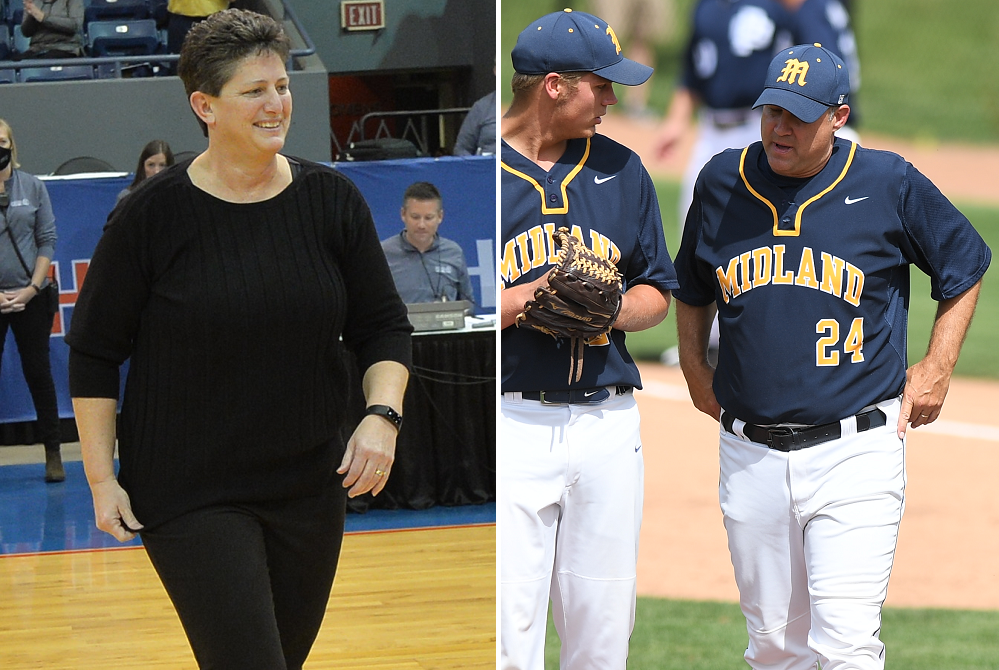
Battle Creek St. Philip’s Vicky Groat and Midland High’s Eric Albright both have devoted themselves to Michigan school sports for multiple decades – and both continue to lead as highly-successful coaches while also serving in multiple administrative roles within their schools and as important voices in statewide leadership as well.
To recognize their dedication and far-reaching contributions to educational athletics, Groat and Albright have been named recipients of the Michigan High School Athletic Association’s Allen W. Bush Award for 2023.
Al Bush served as executive director of the MHSAA for 10 years. The award honors individuals for past and continuing service to school athletics as a coach, administrator, official, trainer, doctor or member of the media. The award was developed to bring recognition to people who are giving and serving without a lot of attention. This is the 32nd year of the award.
Groat will enter this fall’s girls volleyball season with a career coaching record of 1,240-304-95, ranking seventh on the MHSAA coaching wins list for her sport. She took over for her mother, equally-legendary Sheila Guerra, for the 1997-98 winter season, stepped away briefly after her second year, and returned to lead the program again in 2000-01. Groat has guided the Tigers to 14 MHSAA Finals championships, including a record nine straight in Class D from Winter 2006-07 through Fall 2014 (volleyball moved to the fall with the 2007-08 school year), and most recently guided St. Philip to back-to-back Division 4 championships to cap the 2020 and 2021 seasons.
A 1985 graduate of the school, Groat is entering her 17th year as the athletic director and also took over as principal on an interim basis in December 2014 and then permanently to begin the 2016-17 school year. She previously had served as the school’s student services director and as an assistant principal. She also served on the MHSAA Representative Council from 2016-20 and is a longtime leader as part of the Michigan Interscholastic Volleyball Coaches Association (MIVCA).
Groat is a member of the Battle Creek St. Philip Athletic and MIVCA Halls of Fame. She was named Michigan High School Coaches Association volleyball Coach of the Year in 2009, and the national Coach of the Year for her sport by the National High School Athletic Coaches Association in 2021. She earned her bachelor's degree from Central Michigan University in 1989 and master’s from Fort Hays State University (Kan.) in 2019.
“Vicky Groat has established herself as one of the most accomplished volleyball coaches in the state and also wears multiple difficult hats so well as the athletic director and principal,” MHSAA Executive Director Mark Uyl said. “Her passion for St. Philip school and its students is evident at every turn, and her desire to help all students excel has been a great benefit to her school and throughout Michigan.”
Albright came to Michigan from Minnesota, graduating from Royalton High School in 1992 and then Hamline University with his bachelor’s degree in 1996. He began at Midland High as a teacher in 1997 and continued in the classroom through 2013-14, adding the varsity baseball coaching job in 2003 and building a 520-199 record over the last two decades while also leading the Chemics to seven league and four District titles and a Division 1 Semifinals appearance in 2018. He became the school’s athletic director in 2010 and serves as an assistant principal as well.
Midland has hosted various MHSAA postseason events under Albright’s direction, including Finals tennis, Semifinals in soccer and football and Quarterfinals for basketball, softball and volleyball. Albright has served on seven committees or task forces for the Association and as part of the Representative Council since 2019.
Albright also is beginning his tenure as president of the Michigan Interscholastic Athletic Administrators Association (MIAAA) and is a Leadership Training Course instructor for the National Interscholastic Athletic Administrators Association (NIAAA). He received a master’s degree from Central Michigan University in 2000 and earned a certified athletic administrator designation from the NIAAA in 2013. Albright also has been an MHSAA registered official in basketball and baseball over the last two decades, most recently in both sports since 2018-19. He worked as a professional baseball umpire in the Gulf Coast League during the 1997 season before beginning his tenure at Midland.
“Eric Albright is a leader in school-based athletics across Michigan with his work with the MIAAA and MHSAA, and he’s become a go-to person for other athletic directors statewide,” Uyl said. “He has worked tirelessly to provide a wealth of guidance and vision, continuously demonstrating his passion for educational athletics.”
PHOTOS Battle Creek St. Philip volleyball coach Vicky Groat steps on the court to receive her team's Division 4 championship trophy in 2021, and Midland's Eric Albright (far right) confers with his pitcher during the 2018 Division 1 Baseball Semifinals.