


Classes Still Create Hoosier Hysteria
July 27, 2017
By Rob Kaminski
MHSAA benchmarks editor
This is the fourth part in a series on MHSAA tournament classification, past and present, that will be published over the next two weeks. This series originally ran in this spring's edition of MHSAA benchmarks.
Twenty years ago, Bloomington North High School won the Indiana High School Athletic Association boys basketball championship, defeating Delta 75-54 at the RCA Dome in Indianapolis.
The date, March 22, 1997, is at the same time revered and disdained by traditionalists in the state who saw it as the last schoolboy championship game the state would ever host.
That’s how devout the game of basketball, particularly interscholastic basketball, had become in the Hoosier state during the 87 years a state champion – one state champion, to be precise – was crowned.
Following that 1997 season, the IHSAA moved to a four-class system for its roundball tournaments, like so many of its state association counterparts had done years earlier.
It would be shocking to find more than a small percentage of current high school basketball players around the country unfamiliar with the iconic movie Hoosiers, even though the film is now more than 30 years old.
And, the storyline for that blockbuster unfolded more than 30 years prior to its release, when small-town, undermanned Milan High School defeated Muncie Central High School 32-30 in the 1954 IHSAA title game.
Perhaps it’s because of the David vs Goliath notion, or the fame of the movie that replaced Milan with the fictional Hickory and real-life star Bobby Plump with Hollywood hero Jimmy Chitwood, or the simple fact that Indiana had something other states didn’t.
Whatever the reason, plenty of opposition remains to this day to basketball classification in the state.
The fact is, the small rural schools were regularly being beaten handily by the much larger suburban and city schools as the tournament progressed each season.
Small schools also were closing at a rapid rate following the state’s School Reorganization Act in 1959, as students converged on larger, centralized county schools. From 1960 to 2000, the number of schools entering the tournament dropped from 694 to 381, and in 1997 a total of 382 schools and 4,584 athletes began competition at the Sectional level (the first level of the IHSAA Basketball Tournament).
It was at the entry level of the tournament where school administrators felt the pain of the new class system, but not necessarily for the same nostalgic reasons as the fans who either attended or boycotted the tournament.
At the Sectional round of the tournament, the IHSAA was culling just 2 percent of the revenue, with the participating schools splitting the balance. So, when Sectional attendance dropped by 14 percent in that first year of class basketball, many schools realized a financial loss. It was money they had grown to count on in prior years to help fund various aspects of the department.
Schools cumulatively received more than $900,000 from Sectional competition in 1998, but that total was down from more than $1 million in the last year of the single-class tournament.
Yet, the current format provides a great deal more opportunity and realistic chances at championship runs for schools of all enrollments.
To date, 60 additional teams have championship or runner-up trophies on display in school trophy cases around Indiana.
That was the mission in front of then-IHSAA commissioner Bob Gardner (now National Federation executive director) once the board made its decision: to give thousands more student-athletes the opportunity for once-in-a-lifetime experiences.
As any statistician knows, figures can be manipulated to tell any side of a story. Declining attendance in year one of class basketball is such a number.
The truth is tournament attendance had been on a steady downward spiral since its peak of just over 1.5 million in 1962. By the last single-class event in 1997, the total attendance was half that.
The challenge then and today, as it is for all state associations, is to find that delicate balance for those holding onto tradition, those holding onto trophies, and the number of trophies to hand out.
Editor’s Note: Stories from the Fort Wayne Journal Gazette in 1998 and from a 2007 issue of Indianapolis Monthly provided facts in this article.
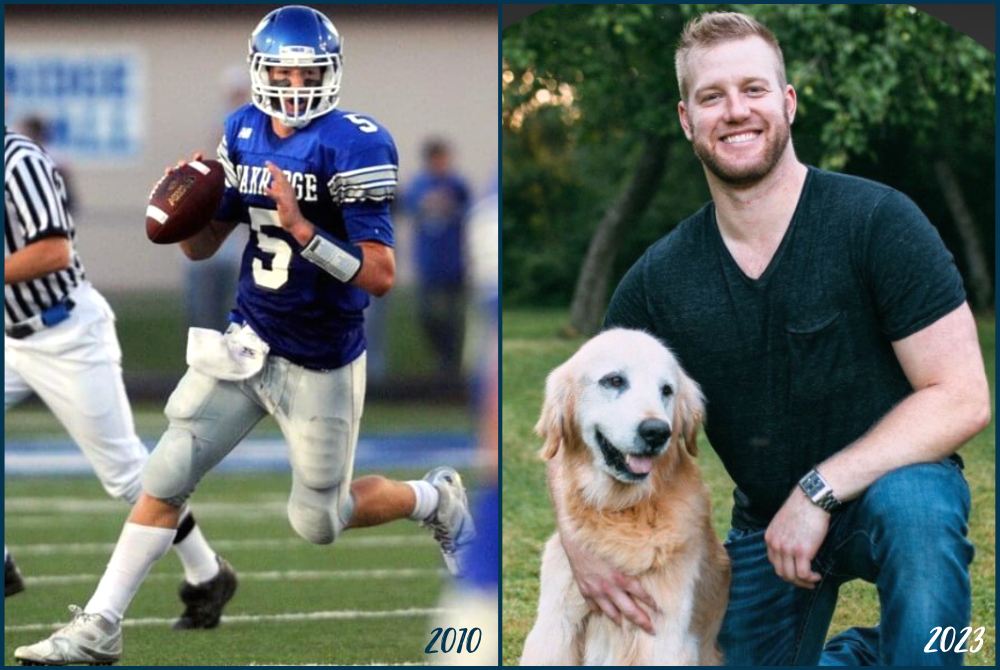
Oakridge 3-Sport Star Potts Applying Lessons to 'Second Chapter' in Sales
By
Tom Kendra
Special for MHSAA.com
July 20, 2023
Jamie Potts put a major strain on his feet and ankles for many years.

Potts was constantly twisting and contorting in cleats and sneakers as a three-sport standout at Muskegon Oakridge and later as a rare two-sport star at Grand Valley State University, where he is still listed in the school’s football and baseball record books.
So it’s fitting that the 30-yeaar-old Potts is now helping to heal feet and ankles as a medical device salesman for Stryker.
“It’s a very competitive, fast-paced job and lifestyle,” said Potts, who graduated from Oakridge in 2011.
“I am very thankful for that because there is a huge void there. When you put so much of your time and energy into it, transitioning out of competitive sports is difficult.”
Potts is the youngest of four boys, so he practically grew up in the bleachers at Oakridge. By the time he got to high school, he fell effortlessly into the rhythm of football in the fall, basketball in the winter and baseball in the spring – all while maintaining a 4.1 GPA, good for fifth overall in his class.
Potts did everything on the football field at Oakridge, as a 6-foot-3, 200-pound dual-threat quarterback. As a senior, he rushed for 1,561 yards and 24 touchdowns and threw for 696 yards and 10 TDs – along with totaling 64 tackles and successfully booting 9-of-13 field goal attempts.
“He was a fantastic high school athlete and one of the best athletes to ever come out of Oakridge,” said former Eagles coach Jack Schugars, the all-time winningest high school coach in the Muskegon area who is now the special teams coordinator at Ferris State. “He was a tremendous leader and the epitome of a role model for younger kids.”
Potts was a solid, if not spectacular, basketball player, known as a defensive specialist who wasn’t afraid to guard anybody.
Then in the spring, he was back to all-state status in baseball as an outfielder, batting .584 his senior year with six home runs, 38 RBIs and 34 stolen bases.
That meant it was decision time when it came to college – would it be football or baseball?
Potts received several Division I offers, including from Central Michigan University for football and Oakland University for baseball.
But it was Division II Grand Valley, particularly then-assistant coach Matt Yoches (now the director of football operations at Miami of Ohio) that floated the possibility of playing both sports – a very rare feat at the DII level.
Potts made the GVSU coaches look like geniuses. He was a four-year starter at tight end and receiver, finishing his career second all-time for the Lakers in TD receptions (35) and third in career receptions (169). In baseball, he finished with 241 career hits, the fifth-most in school history at the time.
“People told me that playing both in Division II wasn’t realistic,” said Potts, who now lives on the east side of the state in Fenton, with his 1-year-old daughter, Brooklyn. “But I wanted to give it a shot and I think I did all right with it. Growing up in Oakridge, my life was all about sports, so it prepared me.”
 Potts was drafted by the Texas Rangers shortly after his senior collegiate baseball season in 2015 and played that summer for Class A Spokane (Wash.), batting .217 with four home runs in 57 games. He missed training camp and the first two games of the 2015 football season, but returned to help the Lakers to the DII Semifinals his senior year.
He prepared to resume his baseball career and left in late February for the Rangers spring training complex in Surprise, Ariz., before announcing his retirement in March with a long and heartfelt Facebook post, which concluded:
“My best advice I can give is that you should always chase your dreams until your heart says it’s time to stop,” Potts wrote. “No matter how far out of reach you think it is or how old you are, you can do it with enough hard work and preparation.”
Potts, who completed his degree in allied health sciences with a minor in psychology during the Lakers’ 2015 football run, then had to shift gears and find his place in the “real world,” outside of competitive sports.
Potts said Oakridge, in addition to being a hard-working sports community, also did a mighty fine job preparing him and his three older brothers, sons of Tom and Kathy Potts, for life after athletics. Oldest brother Chris is an engineer, Andy works as a logistics manager and Aaron is an orthopedic surgeon.
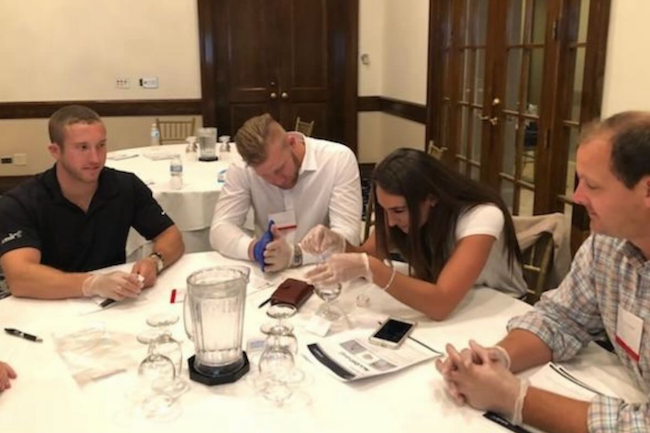
It was actually Aaron who pointed him in the direction of medical device sales. He went through five interviews shortly after his retirement before landing his first job in the field at Arthrex in Grand Rapids, before moving on to Kalamazoo-headquartered Stryker last year.
“A big part of my job is being in the operating room with the surgeons and making sure that everything is working,” explained Potts, who is part of a six-member team which covers much of eastern Michigan. “It’s very intense, very much like the feel of a close game. No doubt all of those years of sports help me every day.”
But Potts could not leave sports behind completely after his baseball retirement.
He was back in Muskegon in the spring of 2016 and attended a Muskegon Ironmen indoor football game. He spoke with team owner TJ Williams, who Potts used to watch playing for Oakridge as a kid, and a few weeks later, he was in an Ironmen uniform.
Potts played two years with the Ironmen as a receiver, linebacker and kicker.
“It was a lot of fun, really, getting to play in front of fans in Muskegon again,” said Potts. “The worst part was the walls. I’ve never experienced getting tackled into walls before and, I tell you, that takes some getting used to.”
More recently, Potts helped out last month as a coach at Schugars’ kicking camp at Oakridge, getting him back on the turf at Russell Erickson Stadium, where the field is now known as Jack Schugars Field.
“I’m happy to be a role model for kids,” said Potts. “You learn so many life lessons from playing sports. It really gets you ready for the second chapter of life.”
2023 Made In Michigan
July 18: Frankfort Hoops Staff Bolstered by Past Stars Giving Back in Banktson, Kreski - Read
July 12: Championship Memories, High School Tennis' Impact Stick with Hackett Pair - Read
July 6: Brother Rice Finals Hero Aiming to Ace Family Life, Financial World - Read
July 5: Lapeer West 4-Time Finals Winner Set to Build Champions at Oklahoma - Read
PHOTOS (Top) Jamie Potts runs the offense for Muskegon Oakridge as a senior in 2010, and now. (Middle) Potts, second from left, is advancing in his career in medical device sales. (Photos courtesy of Jamie Potts.)