


Classes Still Create Hoosier Hysteria
July 27, 2017
By Rob Kaminski
MHSAA benchmarks editor
This is the fourth part in a series on MHSAA tournament classification, past and present, that will be published over the next two weeks. This series originally ran in this spring's edition of MHSAA benchmarks.
Twenty years ago, Bloomington North High School won the Indiana High School Athletic Association boys basketball championship, defeating Delta 75-54 at the RCA Dome in Indianapolis.
The date, March 22, 1997, is at the same time revered and disdained by traditionalists in the state who saw it as the last schoolboy championship game the state would ever host.
That’s how devout the game of basketball, particularly interscholastic basketball, had become in the Hoosier state during the 87 years a state champion – one state champion, to be precise – was crowned.
Following that 1997 season, the IHSAA moved to a four-class system for its roundball tournaments, like so many of its state association counterparts had done years earlier.
It would be shocking to find more than a small percentage of current high school basketball players around the country unfamiliar with the iconic movie Hoosiers, even though the film is now more than 30 years old.
And, the storyline for that blockbuster unfolded more than 30 years prior to its release, when small-town, undermanned Milan High School defeated Muncie Central High School 32-30 in the 1954 IHSAA title game.
Perhaps it’s because of the David vs Goliath notion, or the fame of the movie that replaced Milan with the fictional Hickory and real-life star Bobby Plump with Hollywood hero Jimmy Chitwood, or the simple fact that Indiana had something other states didn’t.
Whatever the reason, plenty of opposition remains to this day to basketball classification in the state.
The fact is, the small rural schools were regularly being beaten handily by the much larger suburban and city schools as the tournament progressed each season.
Small schools also were closing at a rapid rate following the state’s School Reorganization Act in 1959, as students converged on larger, centralized county schools. From 1960 to 2000, the number of schools entering the tournament dropped from 694 to 381, and in 1997 a total of 382 schools and 4,584 athletes began competition at the Sectional level (the first level of the IHSAA Basketball Tournament).
It was at the entry level of the tournament where school administrators felt the pain of the new class system, but not necessarily for the same nostalgic reasons as the fans who either attended or boycotted the tournament.
At the Sectional round of the tournament, the IHSAA was culling just 2 percent of the revenue, with the participating schools splitting the balance. So, when Sectional attendance dropped by 14 percent in that first year of class basketball, many schools realized a financial loss. It was money they had grown to count on in prior years to help fund various aspects of the department.
Schools cumulatively received more than $900,000 from Sectional competition in 1998, but that total was down from more than $1 million in the last year of the single-class tournament.
Yet, the current format provides a great deal more opportunity and realistic chances at championship runs for schools of all enrollments.
To date, 60 additional teams have championship or runner-up trophies on display in school trophy cases around Indiana.
That was the mission in front of then-IHSAA commissioner Bob Gardner (now National Federation executive director) once the board made its decision: to give thousands more student-athletes the opportunity for once-in-a-lifetime experiences.
As any statistician knows, figures can be manipulated to tell any side of a story. Declining attendance in year one of class basketball is such a number.
The truth is tournament attendance had been on a steady downward spiral since its peak of just over 1.5 million in 1962. By the last single-class event in 1997, the total attendance was half that.
The challenge then and today, as it is for all state associations, is to find that delicate balance for those holding onto tradition, those holding onto trophies, and the number of trophies to hand out.
Editor’s Note: Stories from the Fort Wayne Journal Gazette in 1998 and from a 2007 issue of Indianapolis Monthly provided facts in this article.
Championship Memories, High School Tennis' Impact Stick with Hackett Pair
By
Pam Shebest
Special for MHSAA.com
July 12, 2023
KALAMAZOO — As a senior at Hackett Catholic Central, Luke Samra knew that season was his last chance to win a state title.
Enter freshman Alex Dombos.
 “When I saw Alex for the first time at Hackett, I said, ‘If you play tennis, we’ll win state,’” Samra said.
The senior nailed it.
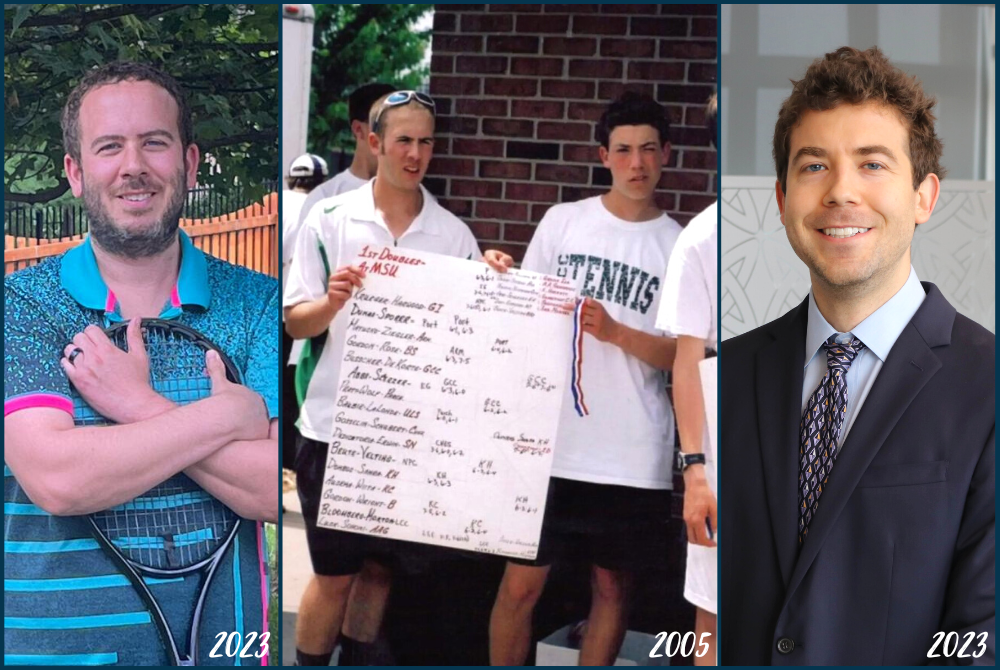
Coach Matt Boven paired the two, and they not only won the No. 1 doubles title, but helped lead the Irish to the 2005 MHSAA Lower Peninsula Division 4 team co-championship with Grosse Ile.
The pair defeated T.J. Busscher and Paul Dekorte, from Grandville Calvin Christian, 7-6(2), 6-2 to clinch their flight.
Eighteen years later, Dombos remembers it well.
“I’m pretty sure we were down a set point in the first set, and we saved at least one set point and won the set. The second was a little bit easier,” Dombos recalled.
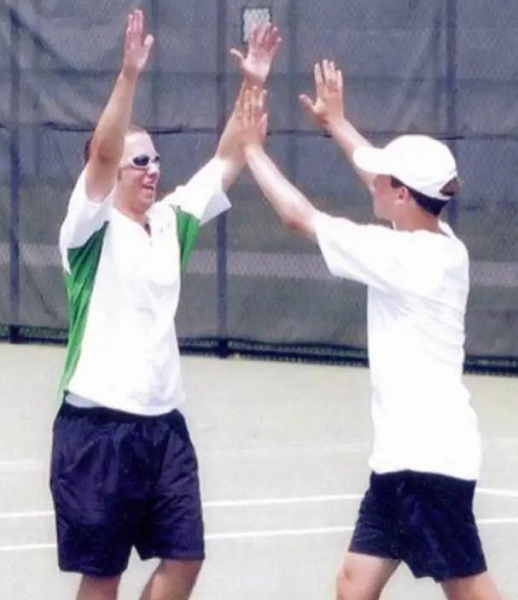
“I remember match point. I hit a backhand down the line for a winner, and then Luke and I looked at each then and I’m pretty sure we jumped up and did a Bryan Brothers chest bump.”
After graduation, Samra headed to Kalamazoo Valley Community College and then Marian University in Indianapolis, playing tennis and earning a bachelor’s degree in business management.
Dombos remained at Hackett, adding a Finals title at No. 2 singles as a sophomore and earning D4 first-team all-state honors.
“The experience I gained from playing doubles as a freshman was really beneficial,” Dombos said. “Playing doubles helped my net game in singles, where there’s a translation of skills.”
Although Samra and Dombos took different paths, they have kept in touch through texting and social media.
Samra and his wife, Adrianna Story Samra, live in Indianapolis where he is a teaching pro at Carmel (Ind.) Racquet Club after a similar position at Western Michigan University’s West Hills Athletic Club.
Dombos works in a data science role at Stryker Corporation in Kalamazoo, “applying a lot of the data analysis skills that I learned from high school, college and graduate school at Stryker.”
After Hackett, Dombos continued his tennis career at Kalamazoo College, earning a degree in physics with a minor in mathematics. He was a four-year letter winner and helped lead the Hornets to four Michigan Intercollegiate Athletic Association tennis titles.
Dombos spent study-abroad time in Aberdeen, Scotland, where he and his girlfriend Kelsey Hassevoort found a way to keep their tennis skills from atrophying.
Hassevoort, who is now his wife, played for the Hornets women’s tennis team and “very quickly we found the lone tennis court in the center of campus,” he said.
“When it got too dark too early in the day, we found the Aberdeen Tennis Center but to get there was a 45-minute trip through a lot of bus rides.”
After K-College, Dombos continued studying at Michigan State.
“They’ve got a lab on campus called the National Superconducting Cyclotron Laboratory, so I got my Ph.D. there in a six-year long program,” he said.
Next came three years at Notre Dame for a post-doctoral research associate position in physics and astronomy.
“My particular area of physics, there’s a lot of fundamental research part of it, but also practical applications,” he said. “A lot of the physics work I did, it’s common for people to go to a national lab.
“They’re doing research that’s usually funded by the government. Postdoctoral research associate positions are similar to the residency portion of medical school.”
With such in-depth studies, tennis has currently faded to the background, although Dombos has tried his hand at pickleball.
Looking back
Boven, currently the boys and girls tennis coach at Mattawan High School, remembers Hackett’s team title well.
“It was really Kyle Bedford at No. 2 singles and the No. 1 doubles team that gave us the (2005) title,” he said. “Alex and Luke seemed to complement each other. I knew Alex was a very gifted ground-stroker, and Luke’s volleys were improving. Alex was dominant at the baseline and could set up Luke at the net.”
Since Dombos rarely played doubles while competing in USTA events, he did not have many expectations as part of a doubles duo.
 “Having played singles for pretty much all of my tennis at that point, I didn’t see it as a setback, but had an open mind and open attitude: Let’s see where this goes,” he said.
“We ended up winning the state title, so that was exciting.”
Besides his high school tennis success — Dombos did not lose a set at the MHSAA Tournament his first two years — he said he continued learning from his experiences.
During USTA tournaments, Andrew Devlieger from Grand Rapids NorthPointe Christian was his nemesis.
“I had lost to him consistently,” Dombos said. “I ended up playing him in a high school match (in 2006), and I won. I was like, I can beat him now.
“In the (2006) finals at the state tournament, I played him and won again with a better score (6-1, 6-2). It was that belief of having won in the regular season that gave me the belief going into the state tournament.”
Dombos’ streak of not losing a set at the MHSAA Tournament ended during the 2007 No. 1 singles semifinals, where he fell to eventual champ Michael Calderone from Jackson Lumen Christi. Calderone was named Michigan’s Mr. Tennis and played collegiately at Western Michigan University.
Dombos said much of what he learned in high school has helped him in his career, including how to balance things in everyday life.
“As a student-athlete, you’re playing tennis and studying,” he said. “That’s really important for anything in life, especially in graduate school, having your attention pulled in a lot of different directions.”
Another advantage was learning teamwork.
“Working as part of a team and working with new people,” he said. “You’ll be doing that in any type of professional setting; learning that you don’t succeed alone.
“In general, there is also the importance of staying active for your physical and mental health.”
Advice he would give to young athletes today includes: “Hard work will be important for anything in life, and a lot of the lessons you learn on the tennis court will be very helpful later in life. They can be just as important as some of the lessons you learn in the classroom.”
Samra said tennis has changed since his high school days.
“The game is a lot faster now,” he said. “I tried to model my game on Pete Sampras and Andy Roddick, but you can’t play like that anymore.
“Serve and volley is out of the question, too. The ball comes back too fast.”
Samra said he can’t believe that with all the good players on his Hackett team, he is the only one who ended up with tennis as a career.
“My parents invested a lot of money in me growing up,” he said. “I’m glad they know it wasn’t a waste.”
Boven is not surprised by Samra’s career pursuit.
“I remember how intense Luke was and how much he cared about the team,” he said. “I’m so excited he stuck with it because he cared for it so much.”
Made in Michigan is powered by Michigan Army National Guard.
2023 Made In Michigan
July 6: Brother Rice Finals Hero Aiming to Ace Family Life, Financial World - Read
July 5: Lapeer West 4-Time Finals Winner Set to Build Champions at Oklahoma - Read
PHOTOS (Top) Luke Samra, left, and Alex Dombos hold up their championship bracket after winning the No. 1 doubles flight at the 2005 LP Division 4 Finals. (Middle) Samra and Dombos celebrate their victory. (Photos from 2005 courtesy of Luke Samra; current photos courtesy of Samra and Dombos.)