


Classes Still Create Hoosier Hysteria
July 27, 2017
By Rob Kaminski
MHSAA benchmarks editor
This is the fourth part in a series on MHSAA tournament classification, past and present, that will be published over the next two weeks. This series originally ran in this spring's edition of MHSAA benchmarks.
Twenty years ago, Bloomington North High School won the Indiana High School Athletic Association boys basketball championship, defeating Delta 75-54 at the RCA Dome in Indianapolis.
The date, March 22, 1997, is at the same time revered and disdained by traditionalists in the state who saw it as the last schoolboy championship game the state would ever host.
That’s how devout the game of basketball, particularly interscholastic basketball, had become in the Hoosier state during the 87 years a state champion – one state champion, to be precise – was crowned.
Following that 1997 season, the IHSAA moved to a four-class system for its roundball tournaments, like so many of its state association counterparts had done years earlier.
It would be shocking to find more than a small percentage of current high school basketball players around the country unfamiliar with the iconic movie Hoosiers, even though the film is now more than 30 years old.
And, the storyline for that blockbuster unfolded more than 30 years prior to its release, when small-town, undermanned Milan High School defeated Muncie Central High School 32-30 in the 1954 IHSAA title game.
Perhaps it’s because of the David vs Goliath notion, or the fame of the movie that replaced Milan with the fictional Hickory and real-life star Bobby Plump with Hollywood hero Jimmy Chitwood, or the simple fact that Indiana had something other states didn’t.
Whatever the reason, plenty of opposition remains to this day to basketball classification in the state.
The fact is, the small rural schools were regularly being beaten handily by the much larger suburban and city schools as the tournament progressed each season.
Small schools also were closing at a rapid rate following the state’s School Reorganization Act in 1959, as students converged on larger, centralized county schools. From 1960 to 2000, the number of schools entering the tournament dropped from 694 to 381, and in 1997 a total of 382 schools and 4,584 athletes began competition at the Sectional level (the first level of the IHSAA Basketball Tournament).
It was at the entry level of the tournament where school administrators felt the pain of the new class system, but not necessarily for the same nostalgic reasons as the fans who either attended or boycotted the tournament.
At the Sectional round of the tournament, the IHSAA was culling just 2 percent of the revenue, with the participating schools splitting the balance. So, when Sectional attendance dropped by 14 percent in that first year of class basketball, many schools realized a financial loss. It was money they had grown to count on in prior years to help fund various aspects of the department.
Schools cumulatively received more than $900,000 from Sectional competition in 1998, but that total was down from more than $1 million in the last year of the single-class tournament.
Yet, the current format provides a great deal more opportunity and realistic chances at championship runs for schools of all enrollments.
To date, 60 additional teams have championship or runner-up trophies on display in school trophy cases around Indiana.
That was the mission in front of then-IHSAA commissioner Bob Gardner (now National Federation executive director) once the board made its decision: to give thousands more student-athletes the opportunity for once-in-a-lifetime experiences.
As any statistician knows, figures can be manipulated to tell any side of a story. Declining attendance in year one of class basketball is such a number.
The truth is tournament attendance had been on a steady downward spiral since its peak of just over 1.5 million in 1962. By the last single-class event in 1997, the total attendance was half that.
The challenge then and today, as it is for all state associations, is to find that delicate balance for those holding onto tradition, those holding onto trophies, and the number of trophies to hand out.
Editor’s Note: Stories from the Fort Wayne Journal Gazette in 1998 and from a 2007 issue of Indianapolis Monthly provided facts in this article.
Grosse Ile's Molnar Wins Title in 2nd Sport, EGR Top Team for 2nd-Straight Year
By
Steve Vedder
Special for MHSAA.com
June 3, 2023
ADA – The only common denominator that Kaitlyn Molnar can think of between her two sports is that brief feeling of pure freedom as she soars through the air.
The big difference, of course, is that one comes in a swimming pool and the other while hurling herself along a long jump pit.
The Grosse Ile junior added a state long jump title to a state diving championship at Saturday's Lower Peninsula Division 2 Track & Field Finals at Forest Hills Eastern. The long jump win came after Molnar won a Division 3 diving title in the fall and followed a fifth-place finish in the long jump as a sophomore.
While the necessary talents for both sports may seem incompatible, Molnar sees one significant similarity.
"I just love that feeling of being in the air," she said after a jump of 18-feet, 5 inches. "You just take off and go as high as possible. It takes a lot of focus, but I love the long jump.
"It was kind of a surprise, but it was nice to pull it off. (Jumping and diving) are about foot placement and keeping your head up."
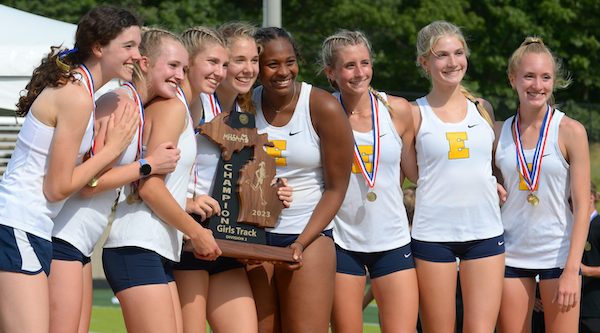
While Molnar's individual exploits were impressive, East Grand Rapids successfully defended its team title with 50 points, 16 better than runner-up Sturgis. Mason, New Boston Huron and Otsego tied for third with 26 points. Tecumseh was sixth with 24.
 EGR coach Mike Dykstra said the loss of four major point scorers from last season was overcome by depth and young talent stepping up to fill in gaps. But if you had asked the 19-year coach two months ago if the Pioneers had a realistic shot a back-to-back titles, he would have hedged.
"Maybe," he said. "We had some good competitors back and a lot of talented young kids trying to fill in spots. Today, I think the (90-plus degree) weather was helpful in a way because it made us focus on the weather as the enemy. It helped us focus on ourselves. It was kind of a blessing in a way."
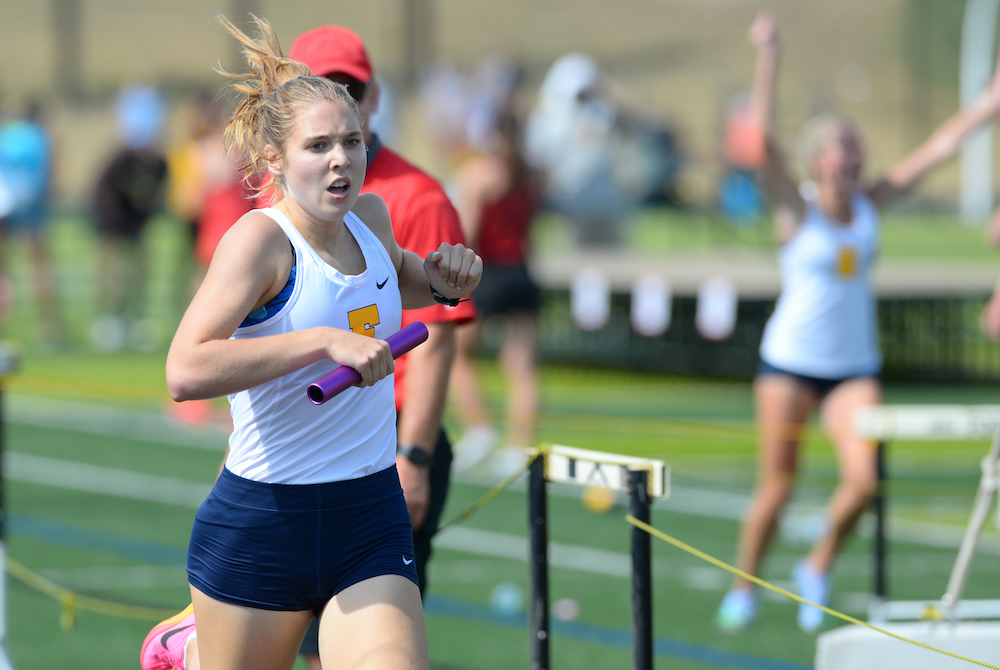
Among the Pioneers champions was the 3,200 relay team (9:28.17) and the 1,600 relay (3:58.18), while junior Drew Muller repeated in the 1,600 (4:56.01) and senior Camryn Bodine won the 800 (2:11.53).
"There definitely was more pressure this year," she said. "People look out for me just as I look for them. There was awesome competition both years, but I'm happy because I had better times this year. It took a lot of work behind the scenes."
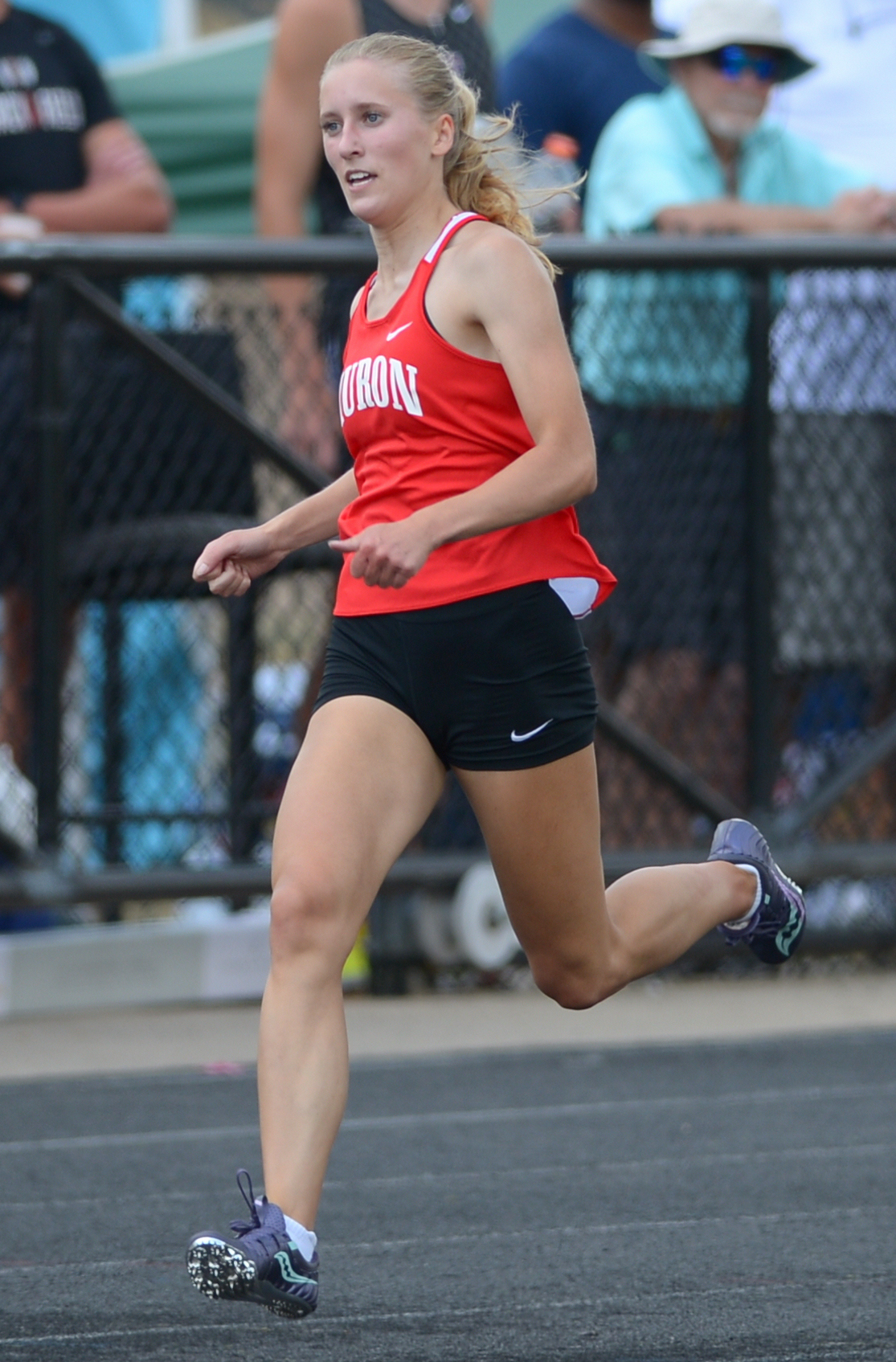
New Boston Huron senior Elizabeth Anderson had a big day that included winning the 400 (55.38). She also was second in both the 100 and 200 and part of the 1,600 relay team. Anderson followed last season's championships in the 200 and 400 and runner-up in the 100. But by at least one measurement, this season was an improvement, she said.
"It was better this year because my times were better," said Anderson, who will run track at Michigan State next season. "I just felt heathier and wanted to finish my season strong. I really wanted to win the 400 because it's my favorite event. That was my goal the whole year. I trained all year to do it."
Other LPD2 champs included Keyanna O'Tey of Sturgis, who won the 100 (11.84). O'Tey said winning the Regional made her realize she could become a Finals champ.
"It's a mindset; I have confidence in myself," she said. There's a lot going on with me right now, but the right people said they have confidence in me and that gave me a positive mindset."
Saginaw Swan Valley's Lyberty Brandt won the high jump in 5 feet, 5 inches. Brandt was second as a junior with a leap of 5-3.
 "This was a chance to redeem myself," said Brandt, who swept every high jump event she entered this season. "My dad said this was going to be the year and I just said, 'whatever.' When I went 5-4 in my first event this year ,I thought maybe I could do this. I just trusted myself, the confidence just came."
Marysville junior Janae Hudson won the shot put with a toss of 42 feet, 7 inches. That followed a 10th in the shot and a third in the discus a year ago. Hudson said the improvement was a matter of fine-tuning technique. She compares throwing the shot to golf in that even the smallest changes can result in a large reward.
"There were very few days when I wasn't working on that," she said. "It was a lot of little things in technique. You fix one little thing and you're better. You have to have the determination to have a good season."
Other champs were the Cadillac 800 relay (1:44.76) and the 400 relay of Berrien Springs (49.32).
Ella Jenkins of Warren Regina won the 100 hurdles (14.64), and Annabelle Densmore of Charlotte the 300 hurdles (45.06). Natalie VanOtteren of Grand Rapids Christian won the 3,200 (10:57.20), Allison Shelton of Ortonville Brandon the pole vault (12 feet) and Haley Guerrant of Otsego the discus (136-11). Sturgis' Jillian Romanyk competed in the adaptive 100 (30.53) and shot put (13-7).
PHOTOS (Top) East Grand Rapids closes in on the 1,600 relay championship Saturday. (Middle) New Boston Huron's Elizabeth Anderson leads the field in the 400. (Below) The Pioneers celebrate their championship. (Photos by Dave McCauley/RunMichigan.com.)