


Classes Still Create Hoosier Hysteria
July 27, 2017
By Rob Kaminski
MHSAA benchmarks editor
This is the fourth part in a series on MHSAA tournament classification, past and present, that will be published over the next two weeks. This series originally ran in this spring's edition of MHSAA benchmarks.
Twenty years ago, Bloomington North High School won the Indiana High School Athletic Association boys basketball championship, defeating Delta 75-54 at the RCA Dome in Indianapolis.
The date, March 22, 1997, is at the same time revered and disdained by traditionalists in the state who saw it as the last schoolboy championship game the state would ever host.
That’s how devout the game of basketball, particularly interscholastic basketball, had become in the Hoosier state during the 87 years a state champion – one state champion, to be precise – was crowned.
Following that 1997 season, the IHSAA moved to a four-class system for its roundball tournaments, like so many of its state association counterparts had done years earlier.
It would be shocking to find more than a small percentage of current high school basketball players around the country unfamiliar with the iconic movie Hoosiers, even though the film is now more than 30 years old.
And, the storyline for that blockbuster unfolded more than 30 years prior to its release, when small-town, undermanned Milan High School defeated Muncie Central High School 32-30 in the 1954 IHSAA title game.
Perhaps it’s because of the David vs Goliath notion, or the fame of the movie that replaced Milan with the fictional Hickory and real-life star Bobby Plump with Hollywood hero Jimmy Chitwood, or the simple fact that Indiana had something other states didn’t.
Whatever the reason, plenty of opposition remains to this day to basketball classification in the state.
The fact is, the small rural schools were regularly being beaten handily by the much larger suburban and city schools as the tournament progressed each season.
Small schools also were closing at a rapid rate following the state’s School Reorganization Act in 1959, as students converged on larger, centralized county schools. From 1960 to 2000, the number of schools entering the tournament dropped from 694 to 381, and in 1997 a total of 382 schools and 4,584 athletes began competition at the Sectional level (the first level of the IHSAA Basketball Tournament).
It was at the entry level of the tournament where school administrators felt the pain of the new class system, but not necessarily for the same nostalgic reasons as the fans who either attended or boycotted the tournament.
At the Sectional round of the tournament, the IHSAA was culling just 2 percent of the revenue, with the participating schools splitting the balance. So, when Sectional attendance dropped by 14 percent in that first year of class basketball, many schools realized a financial loss. It was money they had grown to count on in prior years to help fund various aspects of the department.
Schools cumulatively received more than $900,000 from Sectional competition in 1998, but that total was down from more than $1 million in the last year of the single-class tournament.
Yet, the current format provides a great deal more opportunity and realistic chances at championship runs for schools of all enrollments.
To date, 60 additional teams have championship or runner-up trophies on display in school trophy cases around Indiana.
That was the mission in front of then-IHSAA commissioner Bob Gardner (now National Federation executive director) once the board made its decision: to give thousands more student-athletes the opportunity for once-in-a-lifetime experiences.
As any statistician knows, figures can be manipulated to tell any side of a story. Declining attendance in year one of class basketball is such a number.
The truth is tournament attendance had been on a steady downward spiral since its peak of just over 1.5 million in 1962. By the last single-class event in 1997, the total attendance was half that.
The challenge then and today, as it is for all state associations, is to find that delicate balance for those holding onto tradition, those holding onto trophies, and the number of trophies to hand out.
Editor’s Note: Stories from the Fort Wayne Journal Gazette in 1998 and from a 2007 issue of Indianapolis Monthly provided facts in this article.
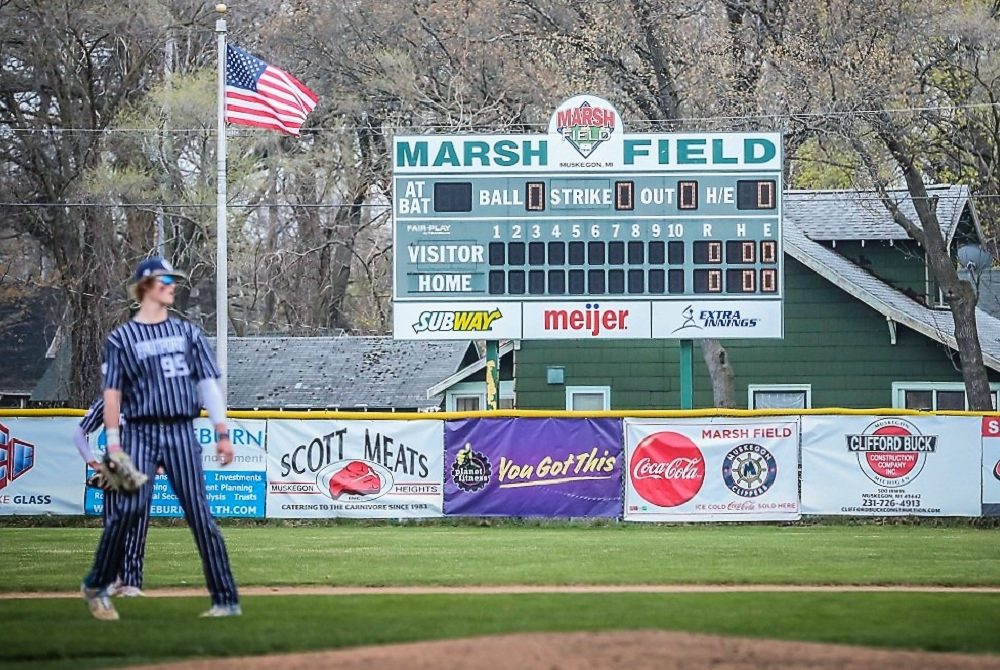
Historic Marsh Field Showcasing Muskegon-Area Baseball Under 'Friday Night Lights'
By
Tom Kendra
Special for MHSAA.com
May 3, 2023
Fruitport’s Ryan Bosch took advantage of his moment underneath the “Friday Night Lights.”
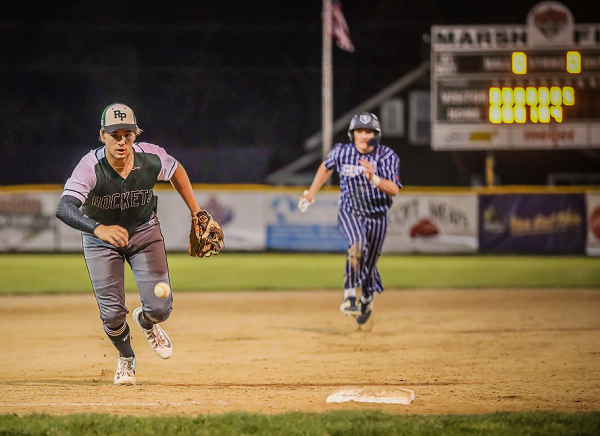
 Bosch, a 6-foot-8 sophomore, lined a two-out, bases-loaded single up the middle in the seventh inning Friday night to drive in two runs and the tie the score, 5-5. The Trojans didn’t let up, eventually scoring 10 runs in the top of the seventh for a 10-5 win over rival Muskegon Reeths-Puffer at historic Marsh Field in downtown Muskegon.
“It doesn’t get much better than that,” said Bosch, a dominating pitcher who verbally committed to the University of Michigan last month.
“It makes it more special doing it here at this field where so many pros and college players have come through.”
Fruitport’s thrilling comeback was just the latest in thousands of baseball games played at Marsh Field over the past 107 years, dating to 1916.
Marsh Field, the current home of the Muskegon Clippers of the Great Lakes Summer College League, has been the home of two minor league teams (the original Clippers and the Reds), the Muskegon Lassies of the All-American Girls Professional League and a “who’s who” of baseball greats from Harry Heilman to Grover Cleveland Alexander to Satchel Paige.
 The seven-week “Friday Night Lights” – featuring two West Michigan high school teams each spring Friday – was the brainchild of Clippers general manager Walt Gawkowski as a way to share the refurbished stadium with the community and provide a bigger stage for local high school baseball.
“High school baseball flies under the radar and doesn’t get near the attention of basketball or football,” said Gawkowski, a longtime Muskegon-area prep baseball coach who, along with his brother Pete, founded the new Clippers organization six years ago.
“We have the facility, and this is a way to promote baseball. It has been very well-received, and the crowds have been outstanding.”
Fruitport topped Ludington 15-0 in this year’s first edition of Friday Night Lights on April 14, followed by Central Montcalm’s 7-5 win over Greenville on April 21.
Remaining games in the series are Fremont vs. Hesperia (May 5), Muskegon Catholic Central vs. Muskegon Western Michigan Christian (May 12), North Muskegon vs. Muskegon Oakridge (May 19) and Muskegon Mona Shores vs. Grandville (May 26).
The latest edition of the series, played on a mild and calm Friday night, featured a crowd of about 400 who were treated to a pitchers’ duel between Reeths-Puffer’s Brayden Mitchelson and Fruitport’s Trevor Rusnak.
Puffer held a slim 1-0 lead for much of the game, before seemingly putting it away with four runs in the bottom of the sixth inning. First baseman David Wilhelm had the big hit with a two-run single.
A comeback seemed highly unlikely, with the bottom of Fruitport’s lineup leading off in the top of the seventh. But the Trojans loaded the bases on a hit batter, a single and a walk, then plated runs on a pair of walks and a sacrifice fly by Braxton Ward.
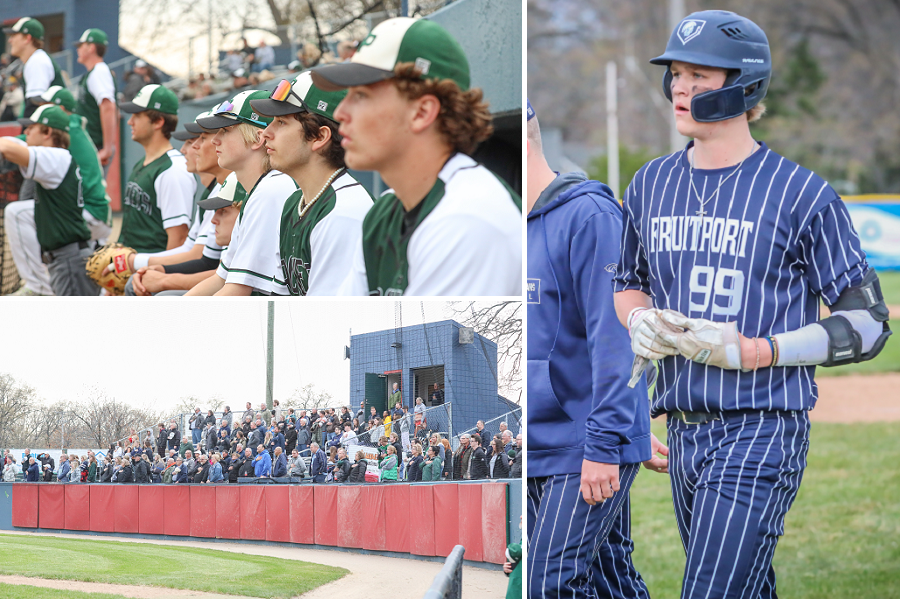 That set the stage for Bosch’s game-tying single, which ignited the Trojans’ dugout and crowd. Bosch, a physically intimidating left-hander who throws close to 90 mph, did not pitch in Friday’s game.
Fruitport pulled away on a run-scoring single by Andrew Spyke and a two-run triple by Jax Flynn.
The Marsh Field crowd was then treated to a local Michael Jackson impersonator doing a dance to “Billie Jean,” after which Fruitport coach Nick Reed received a surprise ice bath following the comeback – two things you don’t often see at a regular-season high school baseball game.
“We just tried to keep the energy up and stay positive,” said Bosch as he and his teammates celebrated on the field after the game.
“Once we got the bats going a little bit and got some guys on base, you could feel things turning. It was a lot of fun.”
Fruitport and Puffer, former rivals in the Seaway Conference who now compete in different divisions of the Ottawa-Kent Conference, could meet again in this weekend’s Greater Muskegon Athletic Association county tournament. Mona Shores is the defending GMAA champion.
 Tom Kendra worked 23 years at The Muskegon Chronicle, including five as assistant sports editor and the final six as sports editor through 2011. E-mail him at [email protected] with story ideas for Muskegon, Oceana, Mason, Lake, Oceola, Mecosta and Newaygo counties.
PHOTOS (Top) Fruitport 6-foot-8 sophomore Ryan Bosch, who recently committed to the University of Michigan as a pitcher, warms up at Muskegon's historic Marsh Field before a game in the "Friday Night Lights" series April 28. (Middle) Reeths-Puffer third baseman Trent Reichert goes for the ball as a Fruitport baserunner closes in during Fruitport's seventh-inning rally in the 10-5 victory. (Below, clockwise from top left) Reeths-Puffer's dugout keeps a close eye on the action, Bosch heads back to his team’s dugout, and a good-sized crowd stands for the national anthem. (Photos by Joe Lane.)