


Classes Still Create Hoosier Hysteria
July 27, 2017
By Rob Kaminski
MHSAA benchmarks editor
This is the fourth part in a series on MHSAA tournament classification, past and present, that will be published over the next two weeks. This series originally ran in this spring's edition of MHSAA benchmarks.
Twenty years ago, Bloomington North High School won the Indiana High School Athletic Association boys basketball championship, defeating Delta 75-54 at the RCA Dome in Indianapolis.
The date, March 22, 1997, is at the same time revered and disdained by traditionalists in the state who saw it as the last schoolboy championship game the state would ever host.
That’s how devout the game of basketball, particularly interscholastic basketball, had become in the Hoosier state during the 87 years a state champion – one state champion, to be precise – was crowned.
Following that 1997 season, the IHSAA moved to a four-class system for its roundball tournaments, like so many of its state association counterparts had done years earlier.
It would be shocking to find more than a small percentage of current high school basketball players around the country unfamiliar with the iconic movie Hoosiers, even though the film is now more than 30 years old.
And, the storyline for that blockbuster unfolded more than 30 years prior to its release, when small-town, undermanned Milan High School defeated Muncie Central High School 32-30 in the 1954 IHSAA title game.
Perhaps it’s because of the David vs Goliath notion, or the fame of the movie that replaced Milan with the fictional Hickory and real-life star Bobby Plump with Hollywood hero Jimmy Chitwood, or the simple fact that Indiana had something other states didn’t.
Whatever the reason, plenty of opposition remains to this day to basketball classification in the state.
The fact is, the small rural schools were regularly being beaten handily by the much larger suburban and city schools as the tournament progressed each season.
Small schools also were closing at a rapid rate following the state’s School Reorganization Act in 1959, as students converged on larger, centralized county schools. From 1960 to 2000, the number of schools entering the tournament dropped from 694 to 381, and in 1997 a total of 382 schools and 4,584 athletes began competition at the Sectional level (the first level of the IHSAA Basketball Tournament).
It was at the entry level of the tournament where school administrators felt the pain of the new class system, but not necessarily for the same nostalgic reasons as the fans who either attended or boycotted the tournament.
At the Sectional round of the tournament, the IHSAA was culling just 2 percent of the revenue, with the participating schools splitting the balance. So, when Sectional attendance dropped by 14 percent in that first year of class basketball, many schools realized a financial loss. It was money they had grown to count on in prior years to help fund various aspects of the department.
Schools cumulatively received more than $900,000 from Sectional competition in 1998, but that total was down from more than $1 million in the last year of the single-class tournament.
Yet, the current format provides a great deal more opportunity and realistic chances at championship runs for schools of all enrollments.
To date, 60 additional teams have championship or runner-up trophies on display in school trophy cases around Indiana.
That was the mission in front of then-IHSAA commissioner Bob Gardner (now National Federation executive director) once the board made its decision: to give thousands more student-athletes the opportunity for once-in-a-lifetime experiences.
As any statistician knows, figures can be manipulated to tell any side of a story. Declining attendance in year one of class basketball is such a number.
The truth is tournament attendance had been on a steady downward spiral since its peak of just over 1.5 million in 1962. By the last single-class event in 1997, the total attendance was half that.
The challenge then and today, as it is for all state associations, is to find that delicate balance for those holding onto tradition, those holding onto trophies, and the number of trophies to hand out.
Editor’s Note: Stories from the Fort Wayne Journal Gazette in 1998 and from a 2007 issue of Indianapolis Monthly provided facts in this article.
Aspirations High as Reigning Champion Hackett Vaults Into New Season
By
Pam Shebest
Special for MHSAA.com
March 14, 2023
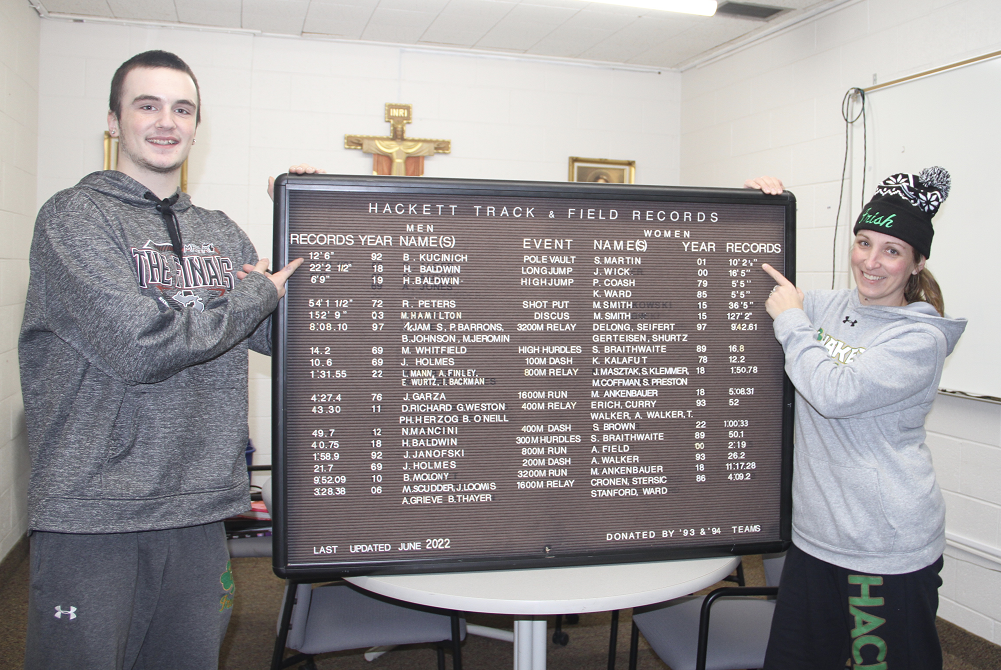
KALAMAZOO — Harrison Wheeler has not been a pole vaulter for very long – two weeks to be exact – but he already has some lofty goals.
 The sophomore is aiming for the Kalamazoo Hackett Catholic Prep record board and, if he makes it, he will be in good company.
Coach Shelly (Martin) Germinder, a 2001 Hackett graduate, still holds the girls record of 10 feet, 2½ inches.
“I’m hoping to have my name next to hers (on the record board),” Wheeler said.
The sophomore has a few feet to go before surpassing current record holder Brian Kucinich, who vaulted 12 feet, 6 inches in 1992.
Wheeler’s unofficial best is 9 feet; officially it is 8 feet, 6 inches.
“That is going to be a very big jump in my pole vaulting career,” he said.
Wheeler is one of 42 athletes on the reigning MHSAA Lower Peninsula Division 4 champion boys team, which includes 12 seniors and 13 juniors. Besides Wheeler, the team has six sophomores and 10 freshmen.
One of the returners is senior Liam Mann, who helped lead the Irish to the Finals title last year.
Mann, Andrew Finley, Evan Wurtz and Isaac Backman won the 800-meter relay with a time of 1:31.55 last season, setting a school record as well.
While he lost his relay mates, Mann said there are good runners to replace them.
“(Senior) Brice Brown is coming out to do track, and I’ve been working with him this winter,” Mann said. “Jude Coffman, who is a sophomore, is coming out this year. I think he’s going to be a good addition to our 4-by-1.
“(Junior) Gabe Oeurn, last year he was running solid times, but this year he’s been putting in the work and I think he’ll be able to break that 12-second barrier.”
Mann, who will attend Ashland (Ohio) University on a track scholarship in the fall, also added gold in the 200-meter dash (22.82) last season.
“Last year, I played basketball and was able to lift to keep in shape,” he said. “This year, I wanted to focus all my time on track, so I’ve been doing indoor track, practicing once a week and going to meets on weekends.”
He continued to put his skills on display as a running back during football season with Kalamazoo United, ending the fall with 1,413 rushing yards on 177 carries and 267 receiving yards on 10 catches.
Opportunities & possibilities
The biggest group of competitors impacted by graduation are the sprinters, coach Charissa Dean said.
“Hackett’s been really big on sprinting talent in general,” she said. “But track has 17 events, and only two of them are open sprint events and two are relays.
 “The other 13 are wide open for possibilities, and there’s a lot of younger talent that’s coming back this year. While they didn’t go to the state meet, they are the next generation of athletes coming up.”
Among that next generation are freshmen Marek Butkiewicz and Sean Siems, who “are incredibly talented athletes,” Dean said.
“(Junior) Gavin Sehy figured out how to do the distance thing this year in cross country.”
Sehy said he wanted to run track, but wasn’t sure where he fit.
“I thought I was mid-distance when I was younger, but my dad forced me to do cross country my sixth-grade year and it turned out I was decent at it so I kept doing (long distance) in track,” he said.
“It’s kind of brutal at times to train for long distance, mentally and physically, because you have to go on long runs, but I have fun with it. At the cross country state finals, I hit an 11 flat split at the two-mile, which beat my 3,200 best from last season, so we have yet to see my best times.”
Butkiewicz and Sehy have been running consistently six days a week all winter to prepare for their first meet, March 22.
“I’ve never done track,” the freshman said. “I know I can perform well. I know my times compared to other people.”
A sophomore this year, Alex Dumont had a 400-meter time that “came out of nowhere,” Dean said. “Toward the end of the season we recruited him to do the 4x8, so an 800-meter runner. That kid came through.
‘We actually took him to the state meet in the 4x8. He did the lead leg, and I clocked him at a 2:07. He was sprinting. It was an amazing leg in that relay.”
Seeing potential
It was Germinder who converted Wheeler to the pole vault last year.
“Harrison’s a strong athlete, and just the way his mind works in that he asks questions and he wants to learn and he wants to improve,” she said.
“He wants to work hard, and he wants to put in the time. That’s something you need for that, along with the athletic component.”
 Wheeler, who said he was shocked at being successful right away, competed for two weeks last season before a foot injury suffered on a vault sidelined him.
“It took her a whole season to finally convince me to do it,” he said. “I grabbed a pole one day and ended up being really good at it. Ever since, I’ve had a love of it.
“The feeling I have once I get in the air is almost like I’m just floating. When you get really good vaults and you get that nice height and good form, you get what we call a ‘stall.’ You just feel like you’re sitting up in the air for a second. It’s gotta be the coolest thing ever.”
Germinder has the background to help the Irish vaulters.
While at Hackett, she competed in the AAU National Championships and said she learned from the best, Oran Mitchell, a noted pole vaulting coach.
Her own coaching style revolves around the safety of the athletes.
“You can teach a lot of people to grab hold of a pole and pop yourself over,” she said. “But I want to make sure my athletes are safe. That’s really, really important to me, and that’s something that was instilled in me.
“When you’re jumping 6 to 16 feet, that’s a long way to fall. Safety is very important to me. If you’re not willing to put in the time, then I’m not the coach for you.”
Germinder said one of the foundations on which the team is built is leadership, which was instilled in the younger athletes by last year’s seniors.
“That’s one of the things our program is built on,” she said. “If you’re there because you want to get ready for the next sports season, we’ll coach you for that.
“If you want to be a state champion, we’ll coach you for that. That’s the really unique thing about track. There’s something for everyone, whatever that might be.”
As for the girls team, numbers are steadily climbing.
Five years ago, the team had just two girls. This year, 25 girls are on the team.
No matter girls or boys, track or field events, one thing is common for all the athletes.
“We pray before every meet, we put God first, and all those pieces have fallen into place for us.” Germinder said.
“I really believe that foundation is what is going to be our success this year. It’s there, it’s just a different team.”
 Pam Shebest served as a sportswriter at the Kalamazoo Gazette from 1985-2009 after 11 years part-time with the Gazette while teaching French and English at White Pigeon High School. She can be reached at [email protected] with story ideas for Calhoun, Kalamazoo and Van Buren counties.
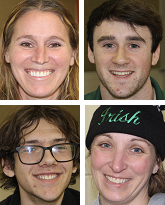
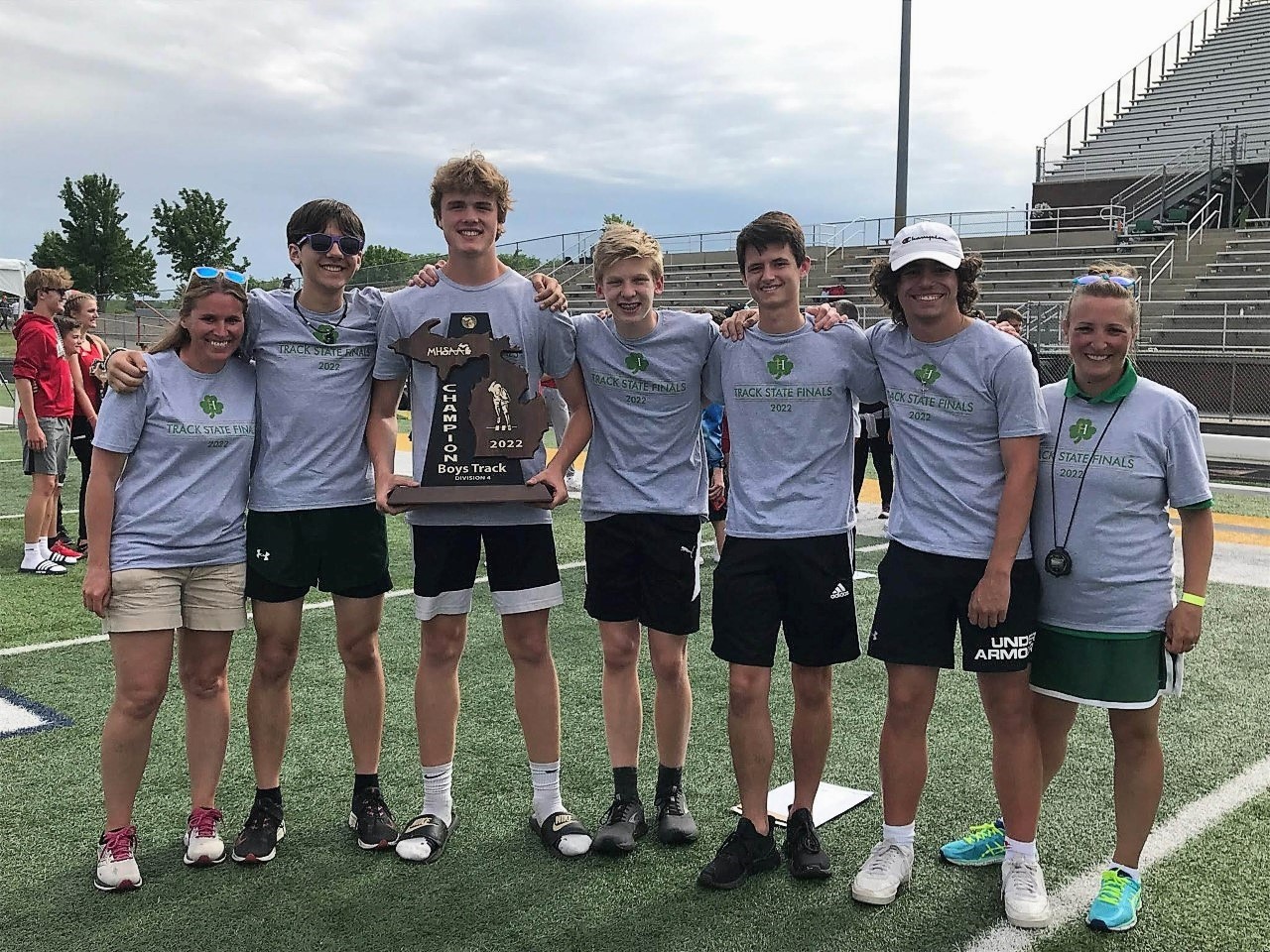
PHOTOS (Top) Hackett's Harrison Wheeler points to the pole vaulting record he hopes to break this season, while pole vaulting coach Shelly (Martin) Germinder points to the record she still holds at the school. (Middle) Clockwise from top left: Hackett head track & field coach Charissa Dean, Liam Mann, Germinder and Gavin Sehy. (Below) The Irish celebrate last season’s Finals championship, from left: Dean, Sehy, Logan St. Martin, Alex Dumont, Mitch Eastman, Nick Doerr and Germinder. (Top photo and head shots by Pam Shebest; team photo courtesy of Hackett track & field.)