


Classes Still Create Hoosier Hysteria
July 27, 2017
By Rob Kaminski
MHSAA benchmarks editor
This is the fourth part in a series on MHSAA tournament classification, past and present, that will be published over the next two weeks. This series originally ran in this spring's edition of MHSAA benchmarks.
Twenty years ago, Bloomington North High School won the Indiana High School Athletic Association boys basketball championship, defeating Delta 75-54 at the RCA Dome in Indianapolis.
The date, March 22, 1997, is at the same time revered and disdained by traditionalists in the state who saw it as the last schoolboy championship game the state would ever host.
That’s how devout the game of basketball, particularly interscholastic basketball, had become in the Hoosier state during the 87 years a state champion – one state champion, to be precise – was crowned.
Following that 1997 season, the IHSAA moved to a four-class system for its roundball tournaments, like so many of its state association counterparts had done years earlier.
It would be shocking to find more than a small percentage of current high school basketball players around the country unfamiliar with the iconic movie Hoosiers, even though the film is now more than 30 years old.
And, the storyline for that blockbuster unfolded more than 30 years prior to its release, when small-town, undermanned Milan High School defeated Muncie Central High School 32-30 in the 1954 IHSAA title game.
Perhaps it’s because of the David vs Goliath notion, or the fame of the movie that replaced Milan with the fictional Hickory and real-life star Bobby Plump with Hollywood hero Jimmy Chitwood, or the simple fact that Indiana had something other states didn’t.
Whatever the reason, plenty of opposition remains to this day to basketball classification in the state.
The fact is, the small rural schools were regularly being beaten handily by the much larger suburban and city schools as the tournament progressed each season.
Small schools also were closing at a rapid rate following the state’s School Reorganization Act in 1959, as students converged on larger, centralized county schools. From 1960 to 2000, the number of schools entering the tournament dropped from 694 to 381, and in 1997 a total of 382 schools and 4,584 athletes began competition at the Sectional level (the first level of the IHSAA Basketball Tournament).
It was at the entry level of the tournament where school administrators felt the pain of the new class system, but not necessarily for the same nostalgic reasons as the fans who either attended or boycotted the tournament.
At the Sectional round of the tournament, the IHSAA was culling just 2 percent of the revenue, with the participating schools splitting the balance. So, when Sectional attendance dropped by 14 percent in that first year of class basketball, many schools realized a financial loss. It was money they had grown to count on in prior years to help fund various aspects of the department.
Schools cumulatively received more than $900,000 from Sectional competition in 1998, but that total was down from more than $1 million in the last year of the single-class tournament.
Yet, the current format provides a great deal more opportunity and realistic chances at championship runs for schools of all enrollments.
To date, 60 additional teams have championship or runner-up trophies on display in school trophy cases around Indiana.
That was the mission in front of then-IHSAA commissioner Bob Gardner (now National Federation executive director) once the board made its decision: to give thousands more student-athletes the opportunity for once-in-a-lifetime experiences.
As any statistician knows, figures can be manipulated to tell any side of a story. Declining attendance in year one of class basketball is such a number.
The truth is tournament attendance had been on a steady downward spiral since its peak of just over 1.5 million in 1962. By the last single-class event in 1997, the total attendance was half that.
The challenge then and today, as it is for all state associations, is to find that delicate balance for those holding onto tradition, those holding onto trophies, and the number of trophies to hand out.
Editor’s Note: Stories from the Fort Wayne Journal Gazette in 1998 and from a 2007 issue of Indianapolis Monthly provided facts in this article.
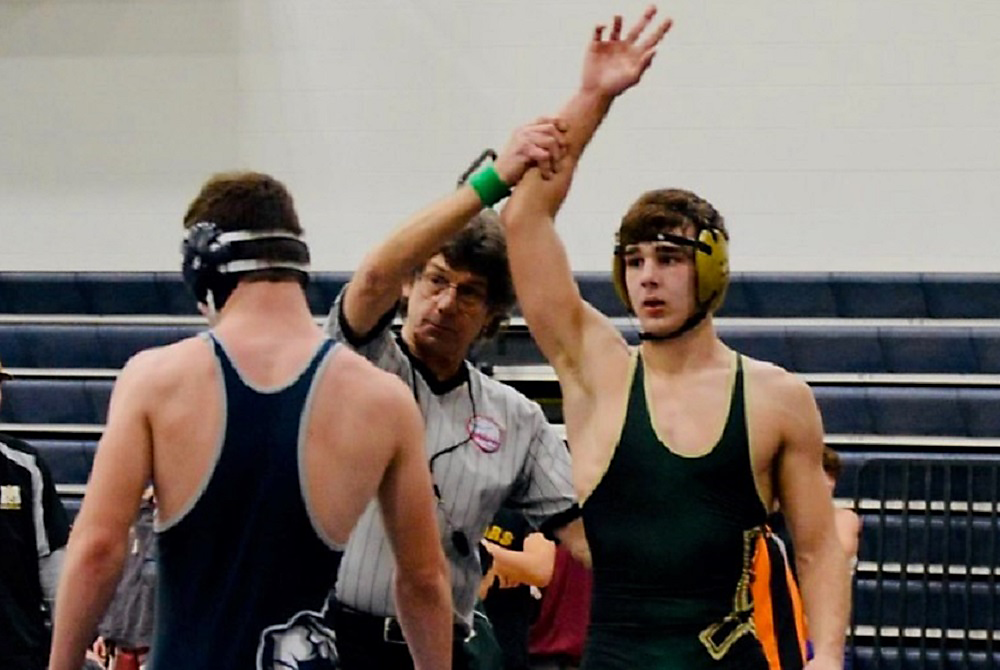
Finals Qualifiers Show Strength of Muskegon Catholic Central's Gains on Mat
By
Tom Kendra
Special for MHSAA.com
March 2, 2023
Muskegon Catholic Central is the smallest wrestling school in Muskegon County, with just 124 students in the high school.
 It also happens to be the only school in the county with two individual Regional champions in senior David Hill (157 pounds) and junior Easten Cook (165 pounds), who hope to add all-state honors to their resume when they compete at the MHSAA Individual Finals on Friday and Saturday at Ford Field in Detroit.
Now, don’t expect wrestling to usurp football as the sport of choice at MCC – which with 12 state titles during the playoff era is behind only now-closed Farmington Hills Harrison’s 13 championships – but throw in another Finals qualifier in senior Zach Michael (175) and the Crusaders grapplers boast three headed to Ford Field, not bad for a school which had only four wrestlers in the entire program in 2019.
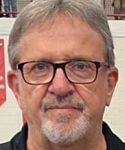
“It’s been a great year for our program and our school, and we’re having a blast,” said fifth-year MCC coach Barry Kieft, who is assisted by PJ Mitchell.
“Those three state qualifiers are all stud football players. That sends a great message to the younger kids that wrestling will make you better on the football field.”
Hill was a star running back for the Crusaders’ Division 6 District finalist football team this fall, who had to get over a stigma to become a star on the mat.
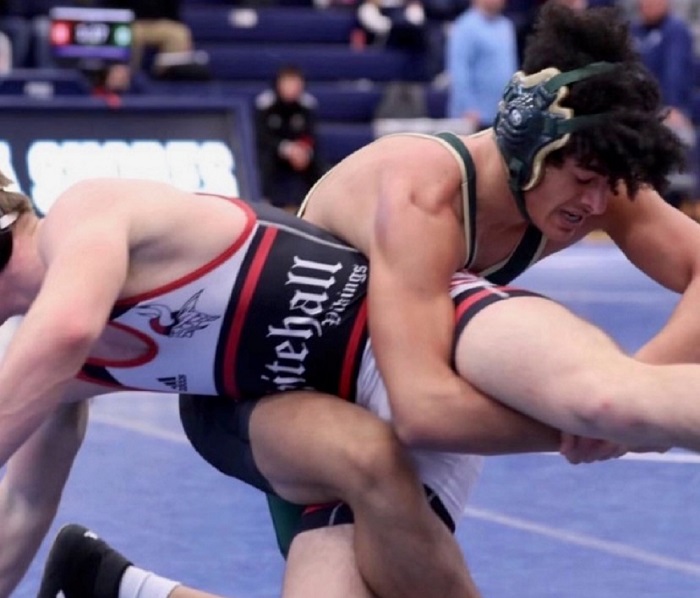
“I used to be a germaphobe, so it’s hard to believe I even started wrestling,” said Hill, who is 32-7 this season and has 107 career wins. “But at some point, something changed. I love the independent part of it. You have to go out there and do it; you can’t blame anything on other people.”
 Hill, the son of former Muskegon Reeths-Puffer all-state running back DeMarkeo Hill, who led the Rockets to the Class A championship in 1992 and tragically died of brain cancer five years ago at the age of 44, calls his dad his athletic hero and his inspiration before every match.
David Hill made short work of the field at 157 pounds at the Feb. 11 Division 4 Regional at Ithaca, including a pin at the 1:00 mark in the championship match.
This will be his second appearance at the Individual Finals, after placing fourth at Regionals last year. He believes his experience, speed and unorthodox style give him a shot at the title.
“I have a unique style, that’s for sure,” said Hill, a three-sport athlete who also runs track in the spring. “My coaches don’t know what to say to me because a lot of what I do isn’t conventional wrestling moves. So they just say, ‘Go out there and wrestle like David Hill.’”
Cook, meanwhile, is a conventional tactician at 165, the next weight class up from Hill.
Cook, a starting guard and linebacker on the football field, embraces the mental and physical challenges of wrestling.
“I think my biggest strength is my mental preparation and thinking things through,” said Cook, who got started in the sport in fifth grade when he was hanging around his older brother and now-MCC assistant coach, Aiden Cook. “I like the hardships that come with wrestling and seeing if you are strong enough to overcome it.”
Easten Cook, who as his name suggests, loves to experiment with different foods (right now, he and Hill eat a small granola bar dipped in honey before each match), won his Regional championship match 9-4.
 Cook sports his team’s best record at 37-7, with city, District and Regional titles. He has 82 career wins.
The third member of the Crusaders’ Finals trio is Michael, who has a 32-9 season record and 89 career wins.
In addition to the three qualifiers, MCC also had two wrestlers eclipse the 20-win plateau this season in juniors Andrew Rosema (138) and Sawyer Hanson (190).
That additional depth nearly pushed the Crusaders to a team District championship Feb. 8. MCC downed Holton, 52-18, in the District Semifinal, before a narrow loss to Ravenna, 42-36, in the championship match.
Kieft said his team’s three Finals qualifiers are all ultra-competitive and have pushed each other to greater heights.
“They just pound each other in practice, sometimes too much,” Kieft said with a laugh, thinking of some of the trio’s practice battles in the wrestling room above MCC’s James Morse Jr. auxiliary gymnasium. “We had to go to 30-second rounds when they practice because if they go 1 minute, it gets too intense.”
Kieft said another reason for his team’s postseason success is a regular season of competing against larger schools.
Kieft, 71, has also been an assistant football and baseball coach at MCC in recent years. He recently decided to retire from coaching those two sports, but plans to continue leading the wrestling program.
“People ask me all the time: “Don’t you want to be in Florida during the winter?’,” said Kieft, who was an assistant wrestling coach at Fruitport in the 1990s. “No, I love doing this. I’ve been down there in the sun and all that, but I miss this. I enjoy being with the wrestling kids.”
 Tom Kendra worked 23 years at The Muskegon Chronicle, including five as assistant sports editor and the final six as sports editor through 2011. E-mail him at [email protected] with story ideas for Muskegon, Oceana, Mason, Lake, Oceola, Mecosta and Newaygo counties.
PHOTOS (Top) Easten Cook’s arm is raised in victory after a match this season. (Middle) Muskegon Catholic Central wrestling coach Barry Kieft. (Below) David Hill works to establish control during a match against Whitehall. (Photos courtesy of Karen Kieft.)