


Classes Still Create Hoosier Hysteria
July 27, 2017
By Rob Kaminski
MHSAA benchmarks editor
This is the fourth part in a series on MHSAA tournament classification, past and present, that will be published over the next two weeks. This series originally ran in this spring's edition of MHSAA benchmarks.
Twenty years ago, Bloomington North High School won the Indiana High School Athletic Association boys basketball championship, defeating Delta 75-54 at the RCA Dome in Indianapolis.
The date, March 22, 1997, is at the same time revered and disdained by traditionalists in the state who saw it as the last schoolboy championship game the state would ever host.
That’s how devout the game of basketball, particularly interscholastic basketball, had become in the Hoosier state during the 87 years a state champion – one state champion, to be precise – was crowned.
Following that 1997 season, the IHSAA moved to a four-class system for its roundball tournaments, like so many of its state association counterparts had done years earlier.
It would be shocking to find more than a small percentage of current high school basketball players around the country unfamiliar with the iconic movie Hoosiers, even though the film is now more than 30 years old.
And, the storyline for that blockbuster unfolded more than 30 years prior to its release, when small-town, undermanned Milan High School defeated Muncie Central High School 32-30 in the 1954 IHSAA title game.
Perhaps it’s because of the David vs Goliath notion, or the fame of the movie that replaced Milan with the fictional Hickory and real-life star Bobby Plump with Hollywood hero Jimmy Chitwood, or the simple fact that Indiana had something other states didn’t.
Whatever the reason, plenty of opposition remains to this day to basketball classification in the state.
The fact is, the small rural schools were regularly being beaten handily by the much larger suburban and city schools as the tournament progressed each season.
Small schools also were closing at a rapid rate following the state’s School Reorganization Act in 1959, as students converged on larger, centralized county schools. From 1960 to 2000, the number of schools entering the tournament dropped from 694 to 381, and in 1997 a total of 382 schools and 4,584 athletes began competition at the Sectional level (the first level of the IHSAA Basketball Tournament).
It was at the entry level of the tournament where school administrators felt the pain of the new class system, but not necessarily for the same nostalgic reasons as the fans who either attended or boycotted the tournament.
At the Sectional round of the tournament, the IHSAA was culling just 2 percent of the revenue, with the participating schools splitting the balance. So, when Sectional attendance dropped by 14 percent in that first year of class basketball, many schools realized a financial loss. It was money they had grown to count on in prior years to help fund various aspects of the department.
Schools cumulatively received more than $900,000 from Sectional competition in 1998, but that total was down from more than $1 million in the last year of the single-class tournament.
Yet, the current format provides a great deal more opportunity and realistic chances at championship runs for schools of all enrollments.
To date, 60 additional teams have championship or runner-up trophies on display in school trophy cases around Indiana.
That was the mission in front of then-IHSAA commissioner Bob Gardner (now National Federation executive director) once the board made its decision: to give thousands more student-athletes the opportunity for once-in-a-lifetime experiences.
As any statistician knows, figures can be manipulated to tell any side of a story. Declining attendance in year one of class basketball is such a number.
The truth is tournament attendance had been on a steady downward spiral since its peak of just over 1.5 million in 1962. By the last single-class event in 1997, the total attendance was half that.
The challenge then and today, as it is for all state associations, is to find that delicate balance for those holding onto tradition, those holding onto trophies, and the number of trophies to hand out.
Editor’s Note: Stories from the Fort Wayne Journal Gazette in 1998 and from a 2007 issue of Indianapolis Monthly provided facts in this article.
COMMENTARY: Public Act 184 a Real Loser for School Sports in Michigan
By
Mark Uyl
MHSAA Executive Director
October 20, 2022
There is a crisis in Michigan schools today that centers on one problem:
Not having enough people.
In discussions with school district personnel, we are being told there has never been a more difficult time for finding people than today. All of us are searching high and low to find coaches for athletic teams, and officials, referees and umpires to administer those games in an orderly and safe way. Dig a little deeper, and school districts are desperate to find those willing to serve as substitute teachers and bus drivers.
Because of this current reality, we continue to be dumbfounded over the approval of Public Act 184 this past summer. This created a new set of retirement rules stipulating that a retiring teacher or administrator cannot be rehired to serve as a coach until after a nine-month waiting period. Even more frustrating: Individuals who had served as high school coaches for many years, who retired from the classroom last June but had planned to keep coaching for a few more seasons, are being told they cannot do so. Those coaches are sidelined, and for no sensible reason.
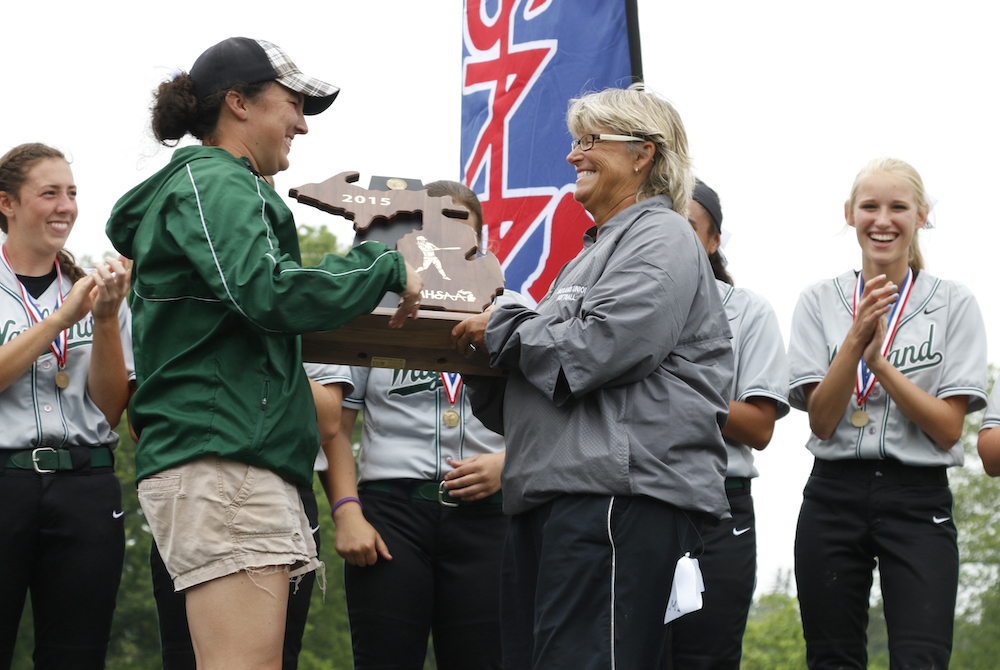
Cheri Ritz has been the varsity softball coach at Wayland High School since 1995. Cheri has won numerous championships, and has been a model coach and great leader of students throughout her career. Cheri retired as a teacher in June and planned to keep coaching the softball team for a few more years, making a small fraction of what her classroom salary was before retirement. Under the “old” retirement law, Cheri could have retired in June and been detached from the district for 30 days, and then returned and worked for the district in any capacity as long as she was making less than 30 percent of her compensation at the time of her retirement. Under PA 184, this scenario can no longer happen.
In the state of Michigan, we have hundreds of recently-retired school people who want to continue to be some of our best coaches, making pennies on the hour for their time. Now they simply aren’t allowed to do so because of a law that had no intention of impacting coaches and school sports. Cheri is just one example. The same issue has found several more longtime, successful coaches including Northville’s golf coach Chris Cronin and cross country & track field’s Steve Porter at Milan High School.
For the past few months, the MHSAA has met with the Office of Retirement Services, representatives from the Governor’s office and even the bill sponsor of PA 184. Every single conversation revealed the fact that coaches were not even part of the discussion when this new retirement law was passed. In other words, recent retirees continuing to coach were not the issue, but yet this new law now treats coaches as some sort of enemy with zero phase-in period, modification or even the ability to seek a waiver of this new law which became effective immediately on July 25, 2022. We have tried to work within the system to seek some commonsense approaches and solutions to this problem, but to no avail as of yet.
We need your help. We need you to contact the Governor’s office and your State Representative and State Senator’s offices. Let them know PA 184 needs to be fixed now. We need to find a way to let these individuals continue to coach and lead our student-athletes. Let them know our kids cannot play their games without individuals who want to coach, and let them know our kids will miss out on learning valuable life lessons if these coaches are not allowed to continue.
And let them know that PA 184 could not have been passed at a worse time given our most valuable resource – people – is at an all-time low.
PHOTO: Wayland softball coach Cheri Ritz, front right, accepts the Division 2 championship trophy in 2015.