


Classes Still Create Hoosier Hysteria
July 27, 2017
By Rob Kaminski
MHSAA benchmarks editor
This is the fourth part in a series on MHSAA tournament classification, past and present, that will be published over the next two weeks. This series originally ran in this spring's edition of MHSAA benchmarks.
Twenty years ago, Bloomington North High School won the Indiana High School Athletic Association boys basketball championship, defeating Delta 75-54 at the RCA Dome in Indianapolis.
The date, March 22, 1997, is at the same time revered and disdained by traditionalists in the state who saw it as the last schoolboy championship game the state would ever host.
That’s how devout the game of basketball, particularly interscholastic basketball, had become in the Hoosier state during the 87 years a state champion – one state champion, to be precise – was crowned.
Following that 1997 season, the IHSAA moved to a four-class system for its roundball tournaments, like so many of its state association counterparts had done years earlier.
It would be shocking to find more than a small percentage of current high school basketball players around the country unfamiliar with the iconic movie Hoosiers, even though the film is now more than 30 years old.
And, the storyline for that blockbuster unfolded more than 30 years prior to its release, when small-town, undermanned Milan High School defeated Muncie Central High School 32-30 in the 1954 IHSAA title game.
Perhaps it’s because of the David vs Goliath notion, or the fame of the movie that replaced Milan with the fictional Hickory and real-life star Bobby Plump with Hollywood hero Jimmy Chitwood, or the simple fact that Indiana had something other states didn’t.
Whatever the reason, plenty of opposition remains to this day to basketball classification in the state.
The fact is, the small rural schools were regularly being beaten handily by the much larger suburban and city schools as the tournament progressed each season.
Small schools also were closing at a rapid rate following the state’s School Reorganization Act in 1959, as students converged on larger, centralized county schools. From 1960 to 2000, the number of schools entering the tournament dropped from 694 to 381, and in 1997 a total of 382 schools and 4,584 athletes began competition at the Sectional level (the first level of the IHSAA Basketball Tournament).
It was at the entry level of the tournament where school administrators felt the pain of the new class system, but not necessarily for the same nostalgic reasons as the fans who either attended or boycotted the tournament.
At the Sectional round of the tournament, the IHSAA was culling just 2 percent of the revenue, with the participating schools splitting the balance. So, when Sectional attendance dropped by 14 percent in that first year of class basketball, many schools realized a financial loss. It was money they had grown to count on in prior years to help fund various aspects of the department.
Schools cumulatively received more than $900,000 from Sectional competition in 1998, but that total was down from more than $1 million in the last year of the single-class tournament.
Yet, the current format provides a great deal more opportunity and realistic chances at championship runs for schools of all enrollments.
To date, 60 additional teams have championship or runner-up trophies on display in school trophy cases around Indiana.
That was the mission in front of then-IHSAA commissioner Bob Gardner (now National Federation executive director) once the board made its decision: to give thousands more student-athletes the opportunity for once-in-a-lifetime experiences.
As any statistician knows, figures can be manipulated to tell any side of a story. Declining attendance in year one of class basketball is such a number.
The truth is tournament attendance had been on a steady downward spiral since its peak of just over 1.5 million in 1962. By the last single-class event in 1997, the total attendance was half that.
The challenge then and today, as it is for all state associations, is to find that delicate balance for those holding onto tradition, those holding onto trophies, and the number of trophies to hand out.
Editor’s Note: Stories from the Fort Wayne Journal Gazette in 1998 and from a 2007 issue of Indianapolis Monthly provided facts in this article.
'Go-To Guy' Kanitz Sets Selfless Example in Helping Make St. Francis Sports Go
By
Tom Spencer
Special for MHSAA.com
August 26, 2022
Traverse City has had a few head football coaches named Kanitz.
 But Mike Kanitz has no interest in becoming a head football coach. In fact, no interest in being a head coach of any sport.
So far he’s worked for nine head coaches. He’s seen what it takes to be a head varsity coach and he’ll stay where he is, which is pretty much anywhere there is a high school sporting event.
Kanitz spends his days and nights dedicated to the Traverse City St. Francis student-athletes, staff, administration and Gladiators community. He is the junior varsity girls basketball coach, volleyball game manager, volleyball announcer and volleyball scorekeeper, football press box manager, and the Glads’ soccer game manager. Additionally, as director of basketball operations at St. Francis, he finds himself at the scorer’s table for boys basketball games.
The volleyball, soccer and football duties are performed at every home game. He doesn’t take a paycheck for any of it. If the school does pay for his services, he promptly donates the funds to the source.
The soft-spoken and renowned St. Francis supporter is not the slightest bit interested in getting any recognition for his efforts.
Tonight he’ll run the Thirlby Field press box as the Gladiators host Ogemaw Heights. And, he’s ready for the Glads’ first home volleyball match Sept. 8.
“He is one of those unique people that shies away from the spotlight — he is a pure servant, said Aaron Biggar, St. Francis’ athletic director. “He doesn’t want any accolades or anything like that.”
Kanitz’ father, Hugo Kanitz – who also went by Mike all his life – was the head football coach of Traverse City St. Francis during the 1960s. Another Kanitz, Dutch — not related to the father-son combo —was at the helm of the Traverse City Central High School football program.
 Mike Kanitz finds himself regularly receiving phone calls and letters from former players intended for the Kanitz coaches. He has to explain he’s not the deceased Central coach, nor his father. And he’s glad he gets to pass on positive feedback to his father, also a former athletic director for St. Francis.
“My grandmother said, ‘Never call him Hugo – his name is Mike,’” Kanitz said. “Don’t ask me where it came from, but he was Mike his whole life.
“I am junior in most people’s minds,” Kanitz went on. “Traverse City was a small town back then; to have two Coach Kanitz was confusing.”
His father now lives in Traverse City after retiring as a teacher and professor. The son enjoys picking his brain.
“I am blessed to still be able to run stuff by him (because) that’s really where I got my coaching start,” he said. “I used to get calls after coming back to Traverse City and the callers would say, ‘Is this Coach Kanitz?’ and I started to catch on that these were his former students.
“I don’t think my dad ever knew the impact he was having on kids,” Kanitz continued. “I don’t think coaches really know what an impact they have on kids.”
Hearing from his father’s former players helped shape his coaching.
“It made me realize as a coach you have the ability every time you open your mouth to either hurt a kid or help a kid,” he said. “So helping a kid is my desire.”
Officials, media and visiting coaches for many sports have noted Kanitz’ demeanor and contributions. They also know he’ll do anything to make sure they have a good experience at St. Francis.
Among other things, Mike reportedly once became a makeshift tailor when a basketball official showed up without his referee pants. Mostly using safety pins, a borrowed pair of pants went from 2XL to large in time for tip-off.
“Mike Kanitz should have a name tag that says, ‘Nicest Man on the Planet,’” said former St. Francis AD Tom Hardy. “Mike is the perfect representative that you can have for any event at school.
 “He greets every team, official, and spectator with such grace and compassion, which leads to a very positive experience for all involved,” Hardy continued. “Mike has volunteered too many hours to count at basketball and soccer games as a game manager and coach.”
Hardy believes all sports fans need to follow Kanitz’ lead.
“Mike Kanitz is the example of how people should treat each other at any athletic event,” he said. “You truly would have to look long and hard to find a more compassionate and caring individual, and I would challenge anyone to find a person that has a negative thing to say about him.”
Barb Becket, a longtime MHSAA official and assignor, has similar views of Kanitz. She’s worked with him while he’s served as a coach, game manager and during community activities through her role with the Grand Traverse YMCA.
“Mike is the go-to guy,” she said. “He is a servant in the true sense of the word.
“Besides being the go-to guy for coaches, admin, and players, Mike also acts as the liaison between the sports officials and the sports participants,” she continued. “Mike handles his responsibilities with grace, humility, common sense, and accountability.”
Kanitz’ favorite sport to play is baseball, but his favorite sport to coach is basketball. After graduating from Alma College where he competed in track & field, he was thrilled to move back to Traverse City to start a family with his wife Marcy, a Traverse City obstetrician.
The couple’s three children graduated from St. Francis, and Kanitz first focused on elementary baseball. He was able to step away from his pharmaceutical career to step in and fill pretty much any need the St. Francis community had.
Kanitz points to his wife’s passion for caring for women as a motivator for him to get more girls involved in sports and receiving the benefits they provide.
“Marcy spent her whole life taking care of women,” he said. “So she sees the side effects of women not being given opportunities.
“So we’ve got to correct that stuff.”
Kanitz’s first job was as a water boy, along with his siblings born to Hugo and Margo Kanitz. If he ever can’t coach or serve in other capacities for the Gladiators, he hopes to return to the very first job he had as a preschooler.
“I am sincere when I say I started as a water boy, and I am going to finish as a water boy,” Kanitz said. “I am very blessed and I am thankful for the life I’ve had here in Traverse City.
“I am thankful for the school allowing me to be a part of it.”
 Tom Spencer is a longtime MHSAA-registered basketball and soccer official, and former softball and baseball official, and he also has coached in the northern Lower Peninsula area. He previously has written for the Saginaw News, Bay County Sports Page and Midland Daily News. He can be reached at [email protected] with story ideas for Manistee, Wexford, Missaukee, Roscommon, Ogemaw, Iosco, Alcona, Oscoda, Crawford, Kalkaska, Grand Traverse, Benzie, Leelanau, Antrim, Otsego, Montmorency, Alpena, Presque Isle, Cheboygan, Charlevoix and Emmet counties.
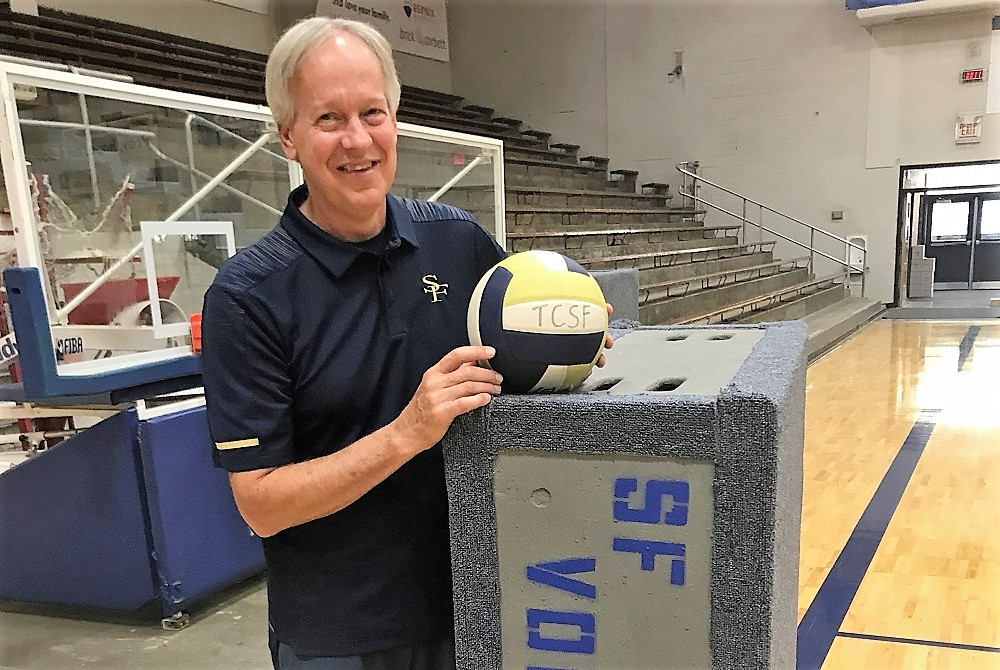
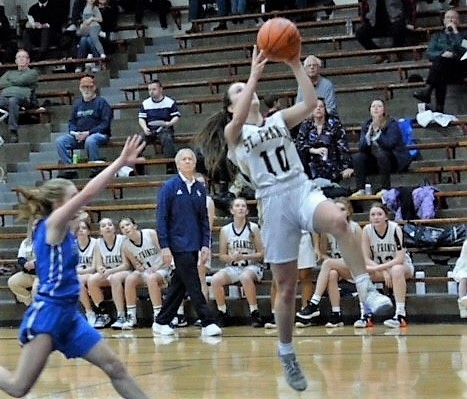
PHOTOS (Top) Mike Kanitz fills many roles for Traverse City St. Francis including girls junior varsity basketball coach and game manager for a variety of sports including volleyball. (Middle) Kanitz walks the sideline during one of his games leading the JV Gladiators. (Below) Mike Kanitz enjoys his daughter Delin’s Senior Night game with wife Marcy Verplank-Kanitz. (Top photo by Mike Spencer; middle and below photos by Julie English.)