


Classes Still Create Hoosier Hysteria
July 27, 2017
By Rob Kaminski
MHSAA benchmarks editor
This is the fourth part in a series on MHSAA tournament classification, past and present, that will be published over the next two weeks. This series originally ran in this spring's edition of MHSAA benchmarks.
Twenty years ago, Bloomington North High School won the Indiana High School Athletic Association boys basketball championship, defeating Delta 75-54 at the RCA Dome in Indianapolis.
The date, March 22, 1997, is at the same time revered and disdained by traditionalists in the state who saw it as the last schoolboy championship game the state would ever host.
That’s how devout the game of basketball, particularly interscholastic basketball, had become in the Hoosier state during the 87 years a state champion – one state champion, to be precise – was crowned.
Following that 1997 season, the IHSAA moved to a four-class system for its roundball tournaments, like so many of its state association counterparts had done years earlier.
It would be shocking to find more than a small percentage of current high school basketball players around the country unfamiliar with the iconic movie Hoosiers, even though the film is now more than 30 years old.
And, the storyline for that blockbuster unfolded more than 30 years prior to its release, when small-town, undermanned Milan High School defeated Muncie Central High School 32-30 in the 1954 IHSAA title game.
Perhaps it’s because of the David vs Goliath notion, or the fame of the movie that replaced Milan with the fictional Hickory and real-life star Bobby Plump with Hollywood hero Jimmy Chitwood, or the simple fact that Indiana had something other states didn’t.
Whatever the reason, plenty of opposition remains to this day to basketball classification in the state.
The fact is, the small rural schools were regularly being beaten handily by the much larger suburban and city schools as the tournament progressed each season.
Small schools also were closing at a rapid rate following the state’s School Reorganization Act in 1959, as students converged on larger, centralized county schools. From 1960 to 2000, the number of schools entering the tournament dropped from 694 to 381, and in 1997 a total of 382 schools and 4,584 athletes began competition at the Sectional level (the first level of the IHSAA Basketball Tournament).
It was at the entry level of the tournament where school administrators felt the pain of the new class system, but not necessarily for the same nostalgic reasons as the fans who either attended or boycotted the tournament.
At the Sectional round of the tournament, the IHSAA was culling just 2 percent of the revenue, with the participating schools splitting the balance. So, when Sectional attendance dropped by 14 percent in that first year of class basketball, many schools realized a financial loss. It was money they had grown to count on in prior years to help fund various aspects of the department.
Schools cumulatively received more than $900,000 from Sectional competition in 1998, but that total was down from more than $1 million in the last year of the single-class tournament.
Yet, the current format provides a great deal more opportunity and realistic chances at championship runs for schools of all enrollments.
To date, 60 additional teams have championship or runner-up trophies on display in school trophy cases around Indiana.
That was the mission in front of then-IHSAA commissioner Bob Gardner (now National Federation executive director) once the board made its decision: to give thousands more student-athletes the opportunity for once-in-a-lifetime experiences.
As any statistician knows, figures can be manipulated to tell any side of a story. Declining attendance in year one of class basketball is such a number.
The truth is tournament attendance had been on a steady downward spiral since its peak of just over 1.5 million in 1962. By the last single-class event in 1997, the total attendance was half that.
The challenge then and today, as it is for all state associations, is to find that delicate balance for those holding onto tradition, those holding onto trophies, and the number of trophies to hand out.
Editor’s Note: Stories from the Fort Wayne Journal Gazette in 1998 and from a 2007 issue of Indianapolis Monthly provided facts in this article.
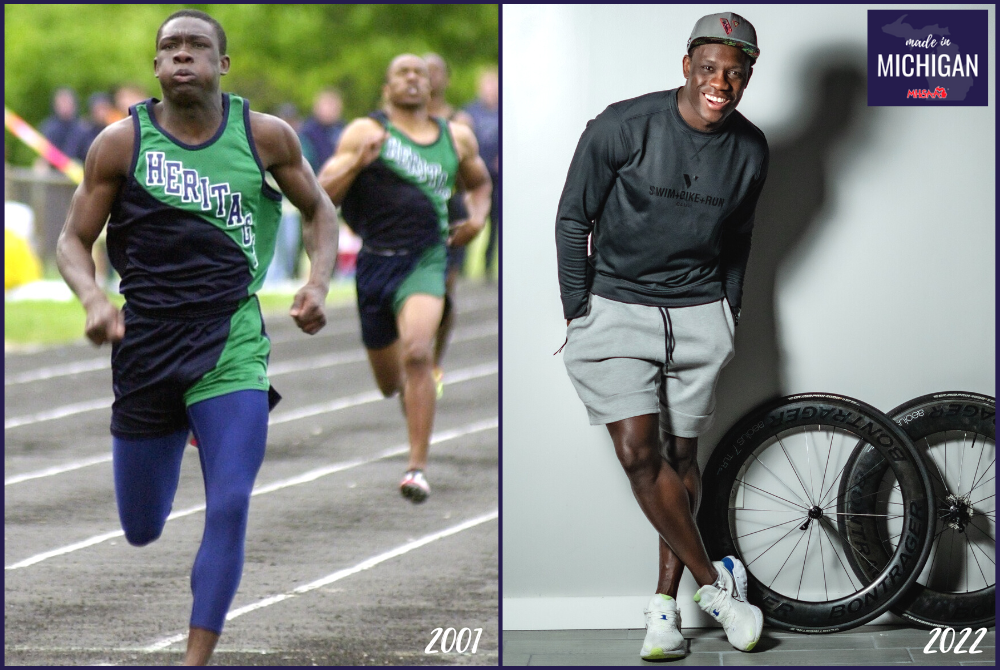
Lessons Learned on Track Have Jibowu's Business Surging to Quick Success
By
Paul Costanzo
Special for MHSAA.com
August 1, 2022
Athletics showed Soj Jibowu just how far he could push himself.
All the time spent on the track, working to become the state’s best high school 400-meter runner, and then more than that, taught him to stretch beyond what he thought were his limits.
So, when it came time to make a decision on whether to jump fully into his apparel company, Varlo, or keep it as a part-time side venture, the 2001 Saginaw Heritage graduate knew he could take himself to another level if needed.
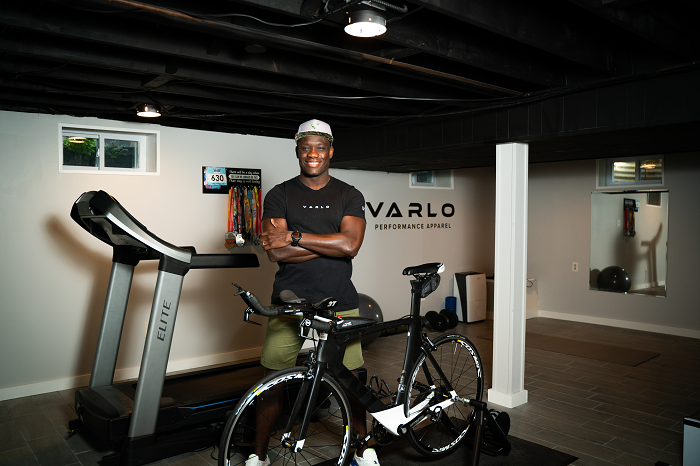
Jibowu is the founder and CEO of Varlo, a clothing company that specializes in outfitting triathletes, but also offers casual wear for men and women. The company is just over three years old, but its clientele includes hundreds of triathletes, eight professionals, three NCAA programs and even hospitals. Merchandise is sold in eight countries.
All of that is validation for Jibowu, who took the leap to pursuing the company full-time just one year into its existence.
“When I resigned (from a medical sales job) to do this full-time, my wife was pregnant with our second child, my daughter wasn’t even walking yet,” said Jibowu, who now lives in Cherry Hill, N.J., with his wife and two young children. “Where was my state of mind to leave my very comfortable, high-paying job to pursue this – to sell clothes?”
His mind was in the same place that helped him reach tremendous heights as a runner, both at Heritage and Central Michigan University.
Jibowu, who was born in Nigeria and spent much of his childhood in Huntsville, Ala., was part of some incredible Heritage teams. He graduated a year behind eventual NFL safety Stuart Schweigert, who he ran with on the Finals-winning 1,600 relay in 2000. Another member of that relay was Derold Sligh, who won the 400-meter Finals title that year, setting the Lower Peninsula Division 1 Finals record in the process. The Hawks were LP Division 1 runners-up as a team that season.
“I ran track when I was younger, and I was terrible,” Jibowu said. “In high school, if I look back at it, I probably would have called it impostor syndrome. I think that was me up until maybe like somewhere in my senior year when I started to think, ‘I’m pretty fast.’ … I had so many dominant people around me, in my mind, I was still the slow guy.”
 As a senior, Jibowu erased that self-doubt. He led Heritage to its first, and still only, Division 1 Finals title, running the 400 in 48.28 and breaking the record Sligh had set the year prior.
It was working to get to that point that Jibowu still credits with his ability to push himself in all things.
“I preach this all the time: if you have the ability to be involved in sports at a young age, do it,” Jibowu said. “It’s a gift, first of all. You don’t know any better when you’re young, you think you’re just training your body, but what’s really, truly occurring is you’re training your mind and building discipline. You’re building your character as far as who you are as a person. What is your will? How far are you willing to push? Am I able to be coached? Am I able to learn? Am I able to lose over and over again and keep going? Am I able to navigate to feel what it’s like to win? What you’re truly developing is how to manage and handle life.”
Jibowu said he didn’t finalize his college decision until late in the process, as he had to work on his test scores into the summer. While at CMU, he majored in biomedical science and chemistry, and he excelled, admitting he was a much better student in college than in high school.
He was also reunited with Sligh on the Chippewas track team, and had a successful career. He was regularly within the top five in the 200 and 400 in the Mid-American Conference, and won a MAC title in the 400 at the 2004 indoor championships. His personal bests in the races were 21.19 and 46.81, respectively.
After graduating from CMU, Jibowu began working as a pharmaceutical rep, then moved into medical sales.
While he remained active, it wasn’t until he took a trip to Chicago that he discovered triathlons.
“I remember seeing these really cool bikes and these really fit people, and then they jumped into Lake Michigan,” he said. “And I didn’t know that was possible, because I didn’t grow up swimming. I didn’t know that volume of people knew how to swim like that. Then they get out of Lake Michigan, jump on their bikes and they’re flying. Then they’re sprinting a 6K and I remember thinking, ‘Oh my God, these guys are the real freaking deal.’ I was hooked and wanted to start competing.”
As he began competing, the wheels for his current venture began turning. At this point, Jibowu was living out east and had worked for a pair of successful start-ups in the medical industry. That helped give him knowledge, and confidence, to make his own moves.
“I had always been into clothes and fashion, and how you express yourself with what you wear,” Jibowu said. “There was an opportunity there. The sport of triathlon is as old as me; it started in (1983). That’s a baby. That’s like basketball without the 3-point line. There’s so much opportunity for innovation.”
With that, Varlo was born, and it has since thrived, with Jibowu and the lessons he learned on a track in Saginaw paving the way.
“If you are in high school and have the ability to be in a sport, it’s a gift,” he said. “At that young of an age, truly learning to manage the trials and tribulations of life. That is a gift.”
2021-22 Made in Michigan
July 28: Running Set Life's Stage for Grosse Pointe South's Record-Setting Meier Sisters - Read
July 25: 2005 Miss Basketball DeHaan Cherishing Newest Title: 1st-Time Mom - Read
July 21: Championship Memories Still Resonate with St. Thomas Star Lillard - Read
July 14: Portage Central Champ Rolls to Vanderbilt, Writing Next Chapter in Alabama - Read
July 12: Coaching Couple Passing On Knowledge, Providing Opportunities for Frankfort Wrestlers - Read
June 30: Hrynewich's Star Continuing to Rise with Olympic, Pro Sports Arrivals - Read
PHOTOS (Top) At left, Heritage’s Soj Jibowu wins the 400 meters during the 2001 Saginaw Valley League championship meet. At right, Jibowu is the founder and CEO of the Varlo clothing company. (Middle) Jibowu’s company specializes in outfitting triathletes, and he has taken up the sport after a successful college track & field career. (Heritage photo courtesy of Saginaw News/MLive; current photos courtesy of Soj Jibowu.)