


Classes Still Create Hoosier Hysteria
July 27, 2017
By Rob Kaminski
MHSAA benchmarks editor
This is the fourth part in a series on MHSAA tournament classification, past and present, that will be published over the next two weeks. This series originally ran in this spring's edition of MHSAA benchmarks.
Twenty years ago, Bloomington North High School won the Indiana High School Athletic Association boys basketball championship, defeating Delta 75-54 at the RCA Dome in Indianapolis.
The date, March 22, 1997, is at the same time revered and disdained by traditionalists in the state who saw it as the last schoolboy championship game the state would ever host.
That’s how devout the game of basketball, particularly interscholastic basketball, had become in the Hoosier state during the 87 years a state champion – one state champion, to be precise – was crowned.
Following that 1997 season, the IHSAA moved to a four-class system for its roundball tournaments, like so many of its state association counterparts had done years earlier.
It would be shocking to find more than a small percentage of current high school basketball players around the country unfamiliar with the iconic movie Hoosiers, even though the film is now more than 30 years old.
And, the storyline for that blockbuster unfolded more than 30 years prior to its release, when small-town, undermanned Milan High School defeated Muncie Central High School 32-30 in the 1954 IHSAA title game.
Perhaps it’s because of the David vs Goliath notion, or the fame of the movie that replaced Milan with the fictional Hickory and real-life star Bobby Plump with Hollywood hero Jimmy Chitwood, or the simple fact that Indiana had something other states didn’t.
Whatever the reason, plenty of opposition remains to this day to basketball classification in the state.
The fact is, the small rural schools were regularly being beaten handily by the much larger suburban and city schools as the tournament progressed each season.
Small schools also were closing at a rapid rate following the state’s School Reorganization Act in 1959, as students converged on larger, centralized county schools. From 1960 to 2000, the number of schools entering the tournament dropped from 694 to 381, and in 1997 a total of 382 schools and 4,584 athletes began competition at the Sectional level (the first level of the IHSAA Basketball Tournament).
It was at the entry level of the tournament where school administrators felt the pain of the new class system, but not necessarily for the same nostalgic reasons as the fans who either attended or boycotted the tournament.
At the Sectional round of the tournament, the IHSAA was culling just 2 percent of the revenue, with the participating schools splitting the balance. So, when Sectional attendance dropped by 14 percent in that first year of class basketball, many schools realized a financial loss. It was money they had grown to count on in prior years to help fund various aspects of the department.
Schools cumulatively received more than $900,000 from Sectional competition in 1998, but that total was down from more than $1 million in the last year of the single-class tournament.
Yet, the current format provides a great deal more opportunity and realistic chances at championship runs for schools of all enrollments.
To date, 60 additional teams have championship or runner-up trophies on display in school trophy cases around Indiana.
That was the mission in front of then-IHSAA commissioner Bob Gardner (now National Federation executive director) once the board made its decision: to give thousands more student-athletes the opportunity for once-in-a-lifetime experiences.
As any statistician knows, figures can be manipulated to tell any side of a story. Declining attendance in year one of class basketball is such a number.
The truth is tournament attendance had been on a steady downward spiral since its peak of just over 1.5 million in 1962. By the last single-class event in 1997, the total attendance was half that.
The challenge then and today, as it is for all state associations, is to find that delicate balance for those holding onto tradition, those holding onto trophies, and the number of trophies to hand out.
Editor’s Note: Stories from the Fort Wayne Journal Gazette in 1998 and from a 2007 issue of Indianapolis Monthly provided facts in this article.

Running Set Life's Stage for Grosse Pointe South's Record-Setting Meier Sisters
By
Tom Markowski
Special for Second Half
July 28, 2022
A decade ago the Meier twins, Haley and Hannah, were instrumental in changing the dynamics of the track & field and cross country programs at Grosse Pointe South.
South had never won an MHSAA Finals team title in either sport before their arrival at the school in 2009. Under longtime coach Steve Zaranek, the Meiers led South to three consecutive MHSAA Lower Peninsula Division 1 track titles (2011-13) and another championship in cross country (2011), while forming half of a national record-setting 3,200-meter relay in the former.
“I've never seen anything like it,” said Zaranek, who will lead the program for a 44th season next spring and recently retired from teaching. “We had all of those athletes. The highlight was the distance (events) with the Meier twins. It was the perfect storm.”
The Meiers attended Duke University for their first two years of college before they transferred to University of Michigan. Their career paths have taken them in different directions, but they remain as close as ever.
Two years ago Haley moved to Adelaide, Australia, with her fiancé Jordy Hewitt, who she met at U-M. Hannah soon will leave Ann Arbor for Charlottesville, Va., where she will begin work as a dietitian within the medical school at the University of Virginia.
Two weeks ago, Haley and Hannah were together in Nashville, Tenn., along with four friends, for Haley's bachelorette celebration. The wedding is scheduled for Oct. 8 on the island of Kauai in Hawaii.
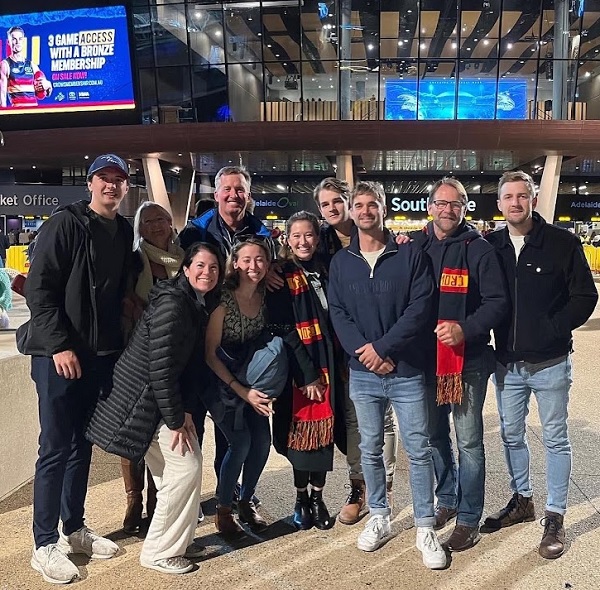 Haley, who received her bachelor’s degree in education, is in her second year as a middle school teacher in Adelaide, and Hewitt works as a consultant at Price Waterhouse just blocks from St. Mary's College, the all-girls private school where Haley teaches.
“I always loved spending time with kids,” Haley said when asked why she chose the teaching profession. “When they figure things out, it's so rewarding. It comes with its challenges. I've been practicing my patience daily.”
This past spring Hannah completed her master's degrees in both sports management and public health from U-M, to go with her bachelor’s in kinesiology. Her longterm goal is to work with athletes in their efforts to maintain a healthy lifestyle.
Hannah Meier began researching various types of food and how they affects athletes and their eating habits. For instance, Hannah is a firm believer in a person eating breakfast 30-to-60 minutes after rising to allow for metabolism to kick in properly.
“I was getting injured (so often) between lifting and cross training that I decided to go into public health,” Hannah said. “That's one of the reasons I left Duke. They didn't offer a public health (curriculum).”
The Meiers were highly competitive at both Duke and U-M. At Duke, Haley won the Atlantic Coast Conference title in the 1,500, and for U-M she won the Big Ten Conference title in the indoor mile. In her last season (2019), Hannah won the Big Ten title in the mile with a school-record time of 4:32.46. Both qualified for the NCAA Championships on multiple occasions.
Their college accomplishments stacked on top of significant achievements that helped Grosse Pointe South to those three Finals teams championships.
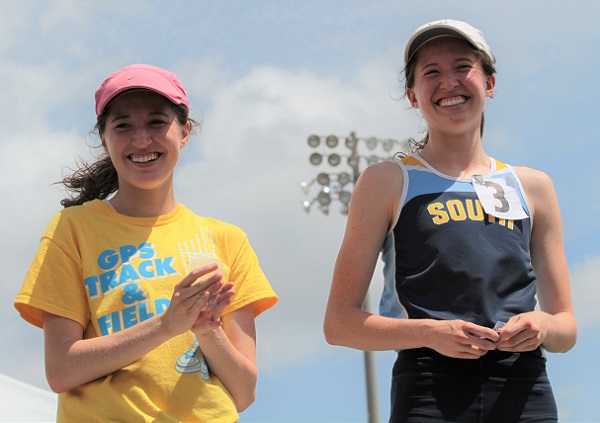
Hannah continues to own the all-Class/Division Finals records in the 800-meter run (2:06.35, 2013) and 1,600 run (4:39.23, 2013 – also ninth-best all-time nationally at the high school level). She and Haley, along with Kelsie Schwartz and Ersula Farrow, set that national high school record in the 3,200 relay of 8:48.29 in 2012. (Of note, the second-best 3,200 relay time in MHSAA LPD1 Finals history was recorded by Oak Park in 2015, 8:54.29, as Farrow teamed with Jayla Fleming, Lashae Bowens and Dorriann Coleman.)
To show how competitive and talented the twins were, when Hannah set the all-Finals record in the 1,600 in 2013, the previous all-Finals record was the 4:42.60 she had run in 2011. Haley's time of 4:42.43 in 2013 was good enough to top her sister's 2011 record, but not the time Hannah posted that June afternoon – as Haley finished in that race to her sister.
For Zaranek, the post-Meier era has included a team that placed sixth in LP Division 1 in 2014 and another top-15 finisher since, with at least a few Finals qualifiers almost every season.
 “For me and our program,” Zaranek said, “to get to the Regional level and compete, that's the sign of a really good program. I really think the best programs are the ones that allow the students to try different events. We talk about opportunities. We talk about contributing to the team.”
For the Meiers, they cherish the memories and continue to run but at a much slower pace. In addition to the memories and accomplishments, they say the sport made them better people, more appreciative for what they have and who they are.
“Haley and I ... we have a better perspective on life,” Hannah said. “We are able to handle situations much more calmly.
“And it's all because of Coach Z. We weren't fans of running in middle school. Without running we wouldn't have gone to U-M and graduated. If we hadn't gone to U-M, we wouldn’t have met our significant others.”
(Hewitt, from Australia, was a middle distance runner for U-M when he and Haley met. Hannah's boyfriend, Kevin Haughn, was competing in the pole vault for the Wolverines when they first crossed paths.)
Haley said her life, and Hannah's, are so busy that finding time to run requires a few less hours of sleep at times.
“I enjoy it, but the hardest part is getting up in the morning to do it,” she said. “It's a transition.
“After all these years, it's still practicing good habits. Running has taught us to be resilient, to persevere.”
2021-22 Made in Michigan
July 25: 2005 Miss Basketball DeHaan Cherishing Newest Title: 1st-Time Mom - Read
July 21: Championship Memories Still Resonate with St. Thomas Star Lillard - Read
July 14: Portage Central Champ Rolls to Vanderbilt, Writing Next Chapter in Alabama - Read
July 12: Coaching Couple Passing On Knowledge, Providing Opportunities for Frankfort Wrestlers - Read
June 30: Hrynewich's Star Continuing to Rise with Olympic, Pro Sports Arrivals - Read
PHOTOS (Top) At left, Hannah and Hailey Meier enjoy the moment after helping set a national high school record for Grosse Pointe South in the 3,200 relay in 2012. At top right, Haley and fiancé Jordy Hewitt. At bottom right, Hannah and boyfriend Kevin Haughn. (Middle) The Meier sisters, center, bring their family together in Australia. (Below) Haley, left, and Hannah Meier top the LPD1 1,600 medalist podium in 2013. (MHSAA Finals photos from RunMichigan.com; recent photos courtesy of Hannah and Haley Meier.)