


Classes Still Create Hoosier Hysteria
July 27, 2017
By Rob Kaminski
MHSAA benchmarks editor
This is the fourth part in a series on MHSAA tournament classification, past and present, that will be published over the next two weeks. This series originally ran in this spring's edition of MHSAA benchmarks.
Twenty years ago, Bloomington North High School won the Indiana High School Athletic Association boys basketball championship, defeating Delta 75-54 at the RCA Dome in Indianapolis.
The date, March 22, 1997, is at the same time revered and disdained by traditionalists in the state who saw it as the last schoolboy championship game the state would ever host.
That’s how devout the game of basketball, particularly interscholastic basketball, had become in the Hoosier state during the 87 years a state champion – one state champion, to be precise – was crowned.
Following that 1997 season, the IHSAA moved to a four-class system for its roundball tournaments, like so many of its state association counterparts had done years earlier.
It would be shocking to find more than a small percentage of current high school basketball players around the country unfamiliar with the iconic movie Hoosiers, even though the film is now more than 30 years old.
And, the storyline for that blockbuster unfolded more than 30 years prior to its release, when small-town, undermanned Milan High School defeated Muncie Central High School 32-30 in the 1954 IHSAA title game.
Perhaps it’s because of the David vs Goliath notion, or the fame of the movie that replaced Milan with the fictional Hickory and real-life star Bobby Plump with Hollywood hero Jimmy Chitwood, or the simple fact that Indiana had something other states didn’t.
Whatever the reason, plenty of opposition remains to this day to basketball classification in the state.
The fact is, the small rural schools were regularly being beaten handily by the much larger suburban and city schools as the tournament progressed each season.
Small schools also were closing at a rapid rate following the state’s School Reorganization Act in 1959, as students converged on larger, centralized county schools. From 1960 to 2000, the number of schools entering the tournament dropped from 694 to 381, and in 1997 a total of 382 schools and 4,584 athletes began competition at the Sectional level (the first level of the IHSAA Basketball Tournament).
It was at the entry level of the tournament where school administrators felt the pain of the new class system, but not necessarily for the same nostalgic reasons as the fans who either attended or boycotted the tournament.
At the Sectional round of the tournament, the IHSAA was culling just 2 percent of the revenue, with the participating schools splitting the balance. So, when Sectional attendance dropped by 14 percent in that first year of class basketball, many schools realized a financial loss. It was money they had grown to count on in prior years to help fund various aspects of the department.
Schools cumulatively received more than $900,000 from Sectional competition in 1998, but that total was down from more than $1 million in the last year of the single-class tournament.
Yet, the current format provides a great deal more opportunity and realistic chances at championship runs for schools of all enrollments.
To date, 60 additional teams have championship or runner-up trophies on display in school trophy cases around Indiana.
That was the mission in front of then-IHSAA commissioner Bob Gardner (now National Federation executive director) once the board made its decision: to give thousands more student-athletes the opportunity for once-in-a-lifetime experiences.
As any statistician knows, figures can be manipulated to tell any side of a story. Declining attendance in year one of class basketball is such a number.
The truth is tournament attendance had been on a steady downward spiral since its peak of just over 1.5 million in 1962. By the last single-class event in 1997, the total attendance was half that.
The challenge then and today, as it is for all state associations, is to find that delicate balance for those holding onto tradition, those holding onto trophies, and the number of trophies to hand out.
Editor’s Note: Stories from the Fort Wayne Journal Gazette in 1998 and from a 2007 issue of Indianapolis Monthly provided facts in this article.
Portage Central Champ Rolls to Vanderbilt, Writing Next Chapter in Alabama
By
Pam Shebest
Special for MHSAA.com
July 14, 2022
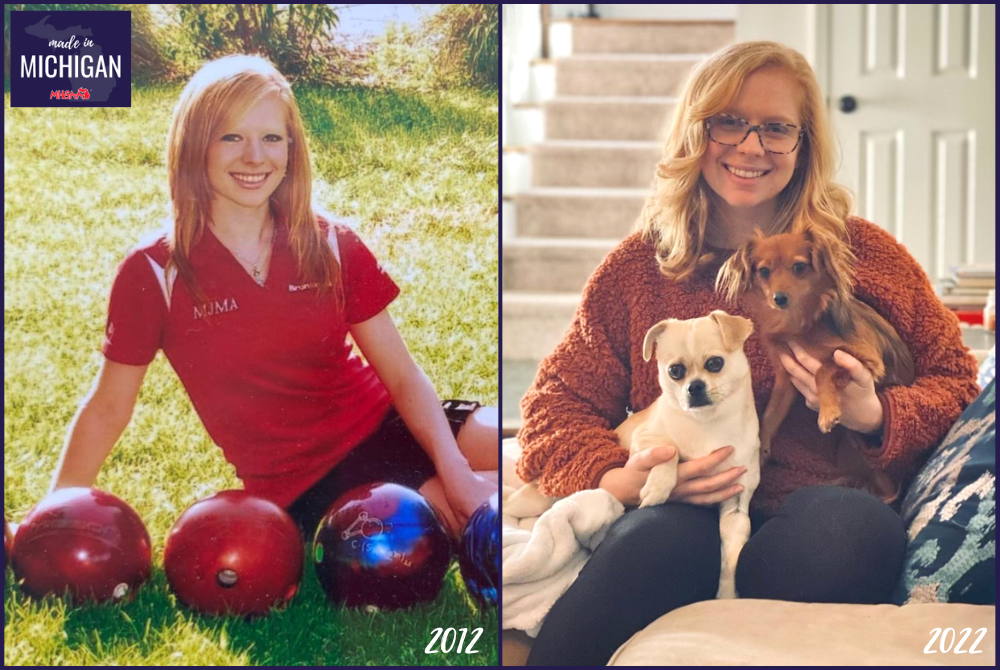
After graduating from Portage Central High School in 2012, bowling phenom Tori Ferris – now Tori Lovell – decided she wanted to explore areas outside the Midwest.
Vanderbilt University in Nashville, Tenn., was such a perfect fit that she remained in the South after graduating with a degree in human and organizational development in 2016, with her current home in Huntsville, Ala.
Although she is no longer living in Michigan, her influence on young bowlers is still strong.
“She’s one of my examples that I use today: That it doesn’t matter if it’s Division I or Division III, you can still go to (college) for bowling,” said Scott Brunner, whose pro shop is located in Continental Lanes in Portage.
“Tori was a big sister to my youngest daughter, Morgan, out on the lanes. Watching her go to a Division I school gives Morgan even more of a drive to go.”
While bowling was her life through high school and college, Lovell took a four-year break once she graduated before trying her hand at league bowling.
“(League bowling) was a great experience and I met a lot of people in the area, but, for me it’s hard to bowl just for fun,” she said. “Having a full-time job, for me, bowling is not sustainable.”
She did return to Michigan two years ago, visiting Brunner for some new equipment and a few tips.
“(In the past Brunner) gave Dad and me advice, small lessons when I was trying out new equipment,” she said.
 “I saw him when I came back to town in 2020 and he watched me bowl and gave me tips. It’s nice to have people who know you help you.”
After meeting Jon Lovell when she was a senior at Vanderbilt, the couple married in 2019 and moved to Huntsville, where they have two chihuahua mixes, Gus and Ellie.
“I’m a crazy dog mom,” she laughed.
Lovell works in human resources at Invariant Corporation, a federal contracting company in Huntsville, and her husband is in the Air National Guard.
Lovell is still the same outgoing person she was when she was collecting bowling trophies at Portage Central, including the MHSAA Division 1 Finals singles championship as a junior.
She continued making her mark on the bowling lanes at Vanderbilt, which she chose for several reasons.
“Growing up I loved country music, so the idea of living in Nashville was so exciting,” Lovell said.
“Once I got to visit Vanderbilt and saw how beautiful the campus was and started learning about the program from the coaches, it felt like an opportunity I couldn’t pass up.”
The bonus was going there on a bowling scholarship.
“To be at one of the most prestigious universities in the country and then to be there for bowling, I had a bit of imposter syndrome, like am I good enough for this?” Lovell said.
She was more than good enough.
As a freshman, she and her Commodores teammates made it to the NCAA Division I Finals, eventually losing to Nebraska in the championship match.
“We had an amazing national showing,” Lovell said. “With bowling, it’s like one frame can change the momentum. It was an amazing experience.
“I was one of two freshmen who were playing out of the five. It was a really humbling experience.”
Vanderbilt also placed among the top eight at the NCAA Finals her next three years, with Lovell making her television debut at the Nationals.
“Nothing can compare to it,” Lovell said of bowling on TV. “Our assistant, Josie Earnest Barnes, was a freshman on the team when they won a national title (in 2007).
“She was trying to prepare us as much as she could, giving us tips: ‘All you can do is breathe and throw the ball, give it a chance.’ It was intimidating.”
Looking back at her high school and college bowling careers, Lovell said: “I’m grateful for the opportunities that bowling has given me, even though I’m not bowling right now.”
 Lovell credits her Portage Central coaching staff with helping her achieve success.
“Karen Fawley (who died in 2017), assistant Doug Ferris (her dad) and boys coach Bill Huey were really advocates for us,” she said. “They made sure we had every opportunity we needed to be successful, even from a young age.
“We had a really good group of girls while I was there. Not everyone was planning to go to college for bowling, but they wanted to compete and be the best they could for high school bowling. Some really wanted to have a good time and bowl, so it was a really good mix, which made us successful for several years.”
A similar event occurred during both high school and college: an injury which did not interfere with her successes.
“I hurt my back the year I won the (MHSAA) state tournament, and Karen (Fawley) actually had a back brace in the car,” Lovell laughed.
Her freshman year at Vanderbilt, Lovell had a finger injury while competing in the NCAA Tournament.
“I had torn a tendon in my ring finger, and it was wrapped up in a lidocaine patch,” she said. “My coach would help me change it every hour.
“I kept competing, and I was having one of the best tournaments.”
Lovell had some extra support at Vanderbilt.
“I don’t know if people I grew up with know, but when I went to Vanderbilt, both my parents moved to Nashville,” Lovell said. “My parents (Andrea Struijk and Doug Ferris) divorced when I was real young, then remarried and had kids and they all moved to Nashville.
“That also made the decision a lot easier because I knew I wasn’t going to be totally alone. I was living on campus, but my parents were 20 minutes away instead of 10 hours away.”
Now that her competitive years are over, at least for a while, Lovell offers the following advice to high school bowlers:
“I would say, listen to your coaches,” she said. “Enjoy the time you have, because it does not last long. Even though you think the next four years are going to take forever, it flies by.
“High school bowling is competitive, but not as hard core as collegiate bowling. You can still enjoy it and have that camaraderie. It’s your last chance to be a kid and compete.”
2021-22 Made in Michigan
July 12: Coaching Couple Passing On Knowledge, Providing Opportunities for Frankfort Wrestlers - Read
June 30: Hrynewich's Star Continuing to Rise with Olympic, Pro Sports Arrivals - Read
PHOTOS (Top) Tori (Ferris) Lovell, as a high school senior (left) and currently with her dogs Gus and Ellie. (Middle) Lovell was an immediate standout bowling for Vanderbilt. (Below) Lovell and husband Jon were married in 2019. (Photos courtesy of Tori Lovell; college bowling photo also courtesy of the Vanderbilt athletic department.) VIDEO Vanderbilt and Nebraska face off for the 2013 NCAA Division I title.