


Classes Still Create Hoosier Hysteria
July 27, 2017
By Rob Kaminski
MHSAA benchmarks editor
This is the fourth part in a series on MHSAA tournament classification, past and present, that will be published over the next two weeks. This series originally ran in this spring's edition of MHSAA benchmarks.
Twenty years ago, Bloomington North High School won the Indiana High School Athletic Association boys basketball championship, defeating Delta 75-54 at the RCA Dome in Indianapolis.
The date, March 22, 1997, is at the same time revered and disdained by traditionalists in the state who saw it as the last schoolboy championship game the state would ever host.
That’s how devout the game of basketball, particularly interscholastic basketball, had become in the Hoosier state during the 87 years a state champion – one state champion, to be precise – was crowned.
Following that 1997 season, the IHSAA moved to a four-class system for its roundball tournaments, like so many of its state association counterparts had done years earlier.
It would be shocking to find more than a small percentage of current high school basketball players around the country unfamiliar with the iconic movie Hoosiers, even though the film is now more than 30 years old.
And, the storyline for that blockbuster unfolded more than 30 years prior to its release, when small-town, undermanned Milan High School defeated Muncie Central High School 32-30 in the 1954 IHSAA title game.
Perhaps it’s because of the David vs Goliath notion, or the fame of the movie that replaced Milan with the fictional Hickory and real-life star Bobby Plump with Hollywood hero Jimmy Chitwood, or the simple fact that Indiana had something other states didn’t.
Whatever the reason, plenty of opposition remains to this day to basketball classification in the state.
The fact is, the small rural schools were regularly being beaten handily by the much larger suburban and city schools as the tournament progressed each season.
Small schools also were closing at a rapid rate following the state’s School Reorganization Act in 1959, as students converged on larger, centralized county schools. From 1960 to 2000, the number of schools entering the tournament dropped from 694 to 381, and in 1997 a total of 382 schools and 4,584 athletes began competition at the Sectional level (the first level of the IHSAA Basketball Tournament).
It was at the entry level of the tournament where school administrators felt the pain of the new class system, but not necessarily for the same nostalgic reasons as the fans who either attended or boycotted the tournament.
At the Sectional round of the tournament, the IHSAA was culling just 2 percent of the revenue, with the participating schools splitting the balance. So, when Sectional attendance dropped by 14 percent in that first year of class basketball, many schools realized a financial loss. It was money they had grown to count on in prior years to help fund various aspects of the department.
Schools cumulatively received more than $900,000 from Sectional competition in 1998, but that total was down from more than $1 million in the last year of the single-class tournament.
Yet, the current format provides a great deal more opportunity and realistic chances at championship runs for schools of all enrollments.
To date, 60 additional teams have championship or runner-up trophies on display in school trophy cases around Indiana.
That was the mission in front of then-IHSAA commissioner Bob Gardner (now National Federation executive director) once the board made its decision: to give thousands more student-athletes the opportunity for once-in-a-lifetime experiences.
As any statistician knows, figures can be manipulated to tell any side of a story. Declining attendance in year one of class basketball is such a number.
The truth is tournament attendance had been on a steady downward spiral since its peak of just over 1.5 million in 1962. By the last single-class event in 1997, the total attendance was half that.
The challenge then and today, as it is for all state associations, is to find that delicate balance for those holding onto tradition, those holding onto trophies, and the number of trophies to hand out.
Editor’s Note: Stories from the Fort Wayne Journal Gazette in 1998 and from a 2007 issue of Indianapolis Monthly provided facts in this article.
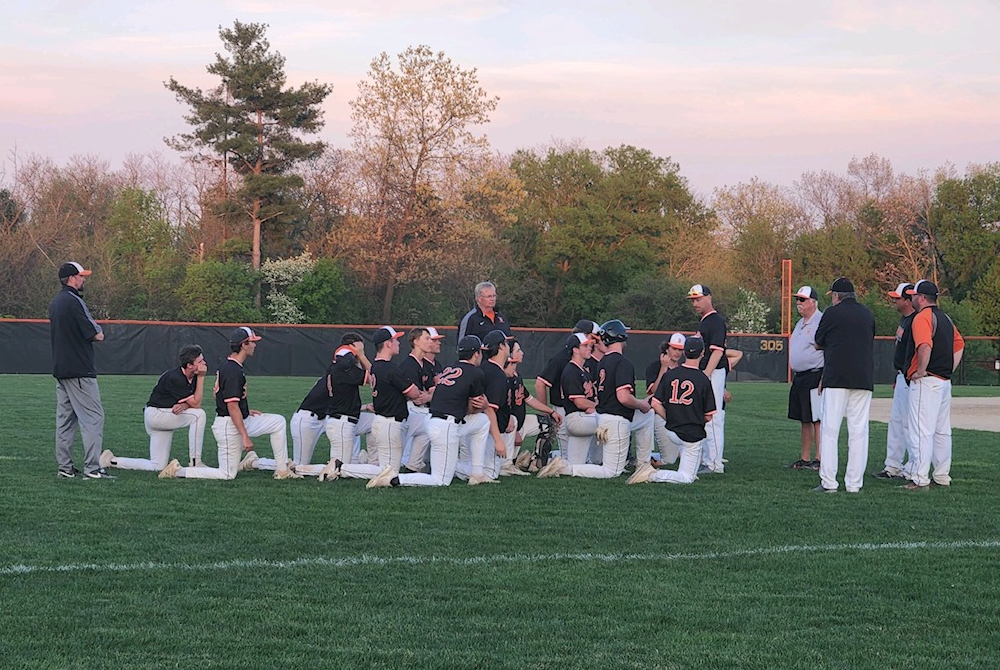
Brighton Baseball, Community Rally as Coach Comes Back Strong from Health Scare
By
Tim Robinson
Special for MHSAA.com
July 13, 2022
At first, Charlie Christner thought it was a case of heartburn.
 It was Jan. 12. He had taught social studies at Scranton Middle School for five hours and now was beginning his prep hour by preparing for his other job as baseball coach at Brighton High School.
“I was actually … in my last hour (of) the day, and just started having heartburn,” he said.
So he made a quick trip to a nearby store to get an over-the-counter heartburn remedy.
“I wanted something to help me before I went to (offseason) hitting,” he recalled.
But the feeling didn’t go away, and about 4 p.m. Christner told his coaches he wasn’t feeling well and was going home.
He didn’t get there.
“I made it about a mile down the road and had to pull over and just started throwing up,” he said. “(I) felt better and started back down the road and stopped, (and) just started throwing up again, and I said ‘I’ve got to get to the hospital.’”
He called his wife, Jackie, who was at home working, and she rushed to the hospital.
Once he was admitted, Christner was diagnosed with pancreatitis.
Waiting out a serious situation
The pancreas is a gland located under the stomach which secretes hormones, including insulin, to aid in digestion.
In Charlie’s case, gallstones had blocked the ducts connecting his pancreas to his small intestine. This, in turn, was leading to part of the tissue in his pancreas beginning to die.
Over the next several weeks, the Christners made several trips to the hospital while he dealt with pain and a gradual buildup of fluid due to a cyst that had formed around the inflammation in his pancreas. The cyst made him feel full all of the time and made it difficult to eat or drink.
The pain medication affected him, too.
“It messed up his thought process a little,” Jackie said. “Some days he didn't know what day it was or, you know, he doesn't remember those days.”
Although the diagnosis was fairly swift — the Christners knew from the beginning what was wrong and what needed to be done — surgery was delayed for nearly two months to let the inflammation in his pancreas go down.
But it was still a serious situation.
“It’s a most sobering experience to have a surgeon come out and tell you your son is very sick and it’s a very serious situation and has a 70 percent chance of survival,” said Dan Christner, who coaches with his son after a long career as a basketball coach at Brighton. “I’ve seen enough missed free throws to know that if you make 70 percent of your free throws, that means 30 percent aren’t going in. It gives you pause, and (you) say let’s make sure we’re a part of that 70 percent.”
 The delay was to help increase those odds.
“They didn't want to do surgery (right away) because of all the inflammation and everything that's going on inside your body,“ Charlie said. “If you have to do it soon, then you end up being in a position where the odds of surviving are less if we have to do emergency surgery. So they delayed it.”
Charlie and Jackie made several trips to and from the hospital during the six weeks after the initial diagnosis.
When he felt up to it, Charlie was working on lesson plans along with administrative tasks while his coaches ran offseason workouts.
“He really wanted to make sure things were coordinated,” Jackie said. “And you know, that's Charlie to a T. He wants to make sure that everything runs smoothly and in that, you know, he's informed of any decisions or changes or things that are happening with the team.”
A veteran coaching staff, led by former Pinckney baseball coach Matt Evans, stepped into the breach.
“I think the big thing on our part was making sure that it was business as usual,” Evans said. “We weren’t going to let Charlie not being there through the winter be an excuse for why we performed or didn’t perform. He’s been a stable force and head of the program for a number of years now. We knew what we needed to do, and so it was about executing a plan that's pretty familiar to us.”
Christner went to a few offseason workouts, watching from a chair.
“(Jackie) would drive me up to hitting and I'd sit in there and watch the guys for as long as I could, 30 minutes or an hour, just to give me something to do," Charlie said. “Otherwise it was, you know, a lot of daytime TV and naps. I did do some stuff with baseball during that time, even if it was just to go watch hitting for an hour and talk to the coaches on how kids are doing. ... It gave me definitely something to do and something to look forward to.”
In the meantime, the Christners were flooded with cards, texts and phone calls of support, prompting Jackie to post regular updates on her Facebook page to lighten that load.
Their families were supportive, as was the community.
“Everybody was so gracious and heartwarming and opened their arms to us and said, ‘anything you need,’” Jackie said. “There's nothing that we really needed that the community could help us with too much because we were just stuck in a hospital, just kind of sitting there waiting for medicines, waiting for diagnosis, waiting for the doctor to progress the treatment, etc. And that was kind of what we needed.”
“I’m proud of the way that everybody came together and did what had to be done, and how excited people were to see him," Evans said. “That speaks to the time that Charlie’s put into this program over the last however many years as a coach, Any time you’re a coach, you look for those moments you can point to as having a positive impact on kids and the baseball community and all those things, and I would say the willingness of everyone to pitch in is a testament to how much he’s appreciated as part of the Brighton baseball community.”
On the way back
Surgery was March 3. Christner’s gallbladder was removed, along with the dead tissue on his pancreas. A pair of cysts were drained, and he went home a few days later.
Christner, always slender in physique, had lost 40 pounds – 10 of which liquid that had been building up in the cysts.
But, albeit from a chair, he was at tryouts March 15.
His voice was weak at first, but he made his presence known.
“When he was back at tryouts, those first couple times, he would cut loose and let out a yell,” Evans said. “And it was ‘OK, Charlie’s back, and he’s in it,’ and that made everyone feel good. Same old Charlie. He’s locked in. Same old competitor.”
A frustrated competitor, at one point, irritated because fungos weren’t being hit by his coaches in the manner he prefers. But he coached from third base, albeit from his normal spot a step or two from the dugout.
He progressed from liquids to solid food (his first solid food was pizza), and returned to the classroom April 12, three months to the day his medical odyssey began.
After an 8-8 start, the Bulldogs won District and Regional titles before falling in a Division 1 Quarterfinal.
The healing continues, but things are back on schedule for Christner, who turned 40 on Saturday.
He’s not outwardly emotional. He appreciates the love and support he and his family have received, but also wishes he could have accomplished more for his team during the time he was critically ill.
Jackie Christner is not as reserved.
“I just thank God every day that he is healthy,” said Jackie, who married Charlie in 2019. “And yes, our bond has strengthened. I think everything for us just knowing that we need each other and we need people in our lives as everybody does. But especially to know that we had each other and he had me. He often said, ‘I don't know what I would do if you weren't here. I don't know what I would do. If I hadn't met you, this would be 10 times harder to go through if you weren't here.’"
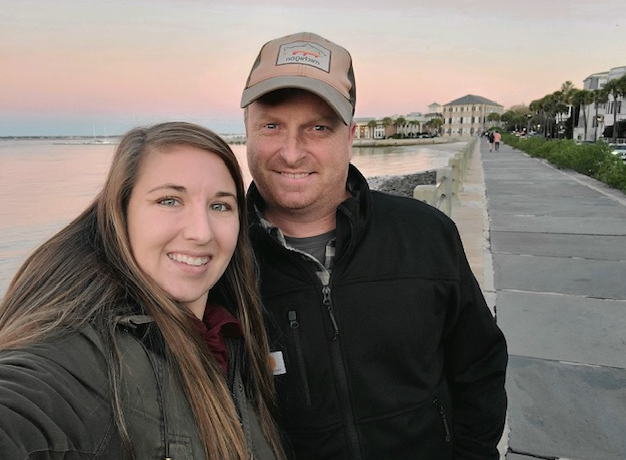
PHOTOS (Top) Brighton varsity baseball coach Charlie Christner, fifth from right, addresses his team. (Middle) Charlie and wife Jackie Christner enjoy a moment on the lakeshore. (Photos courtesy of Jackie Christner.)