


Classes Still Create Hoosier Hysteria
July 27, 2017
By Rob Kaminski
MHSAA benchmarks editor
This is the fourth part in a series on MHSAA tournament classification, past and present, that will be published over the next two weeks. This series originally ran in this spring's edition of MHSAA benchmarks.
Twenty years ago, Bloomington North High School won the Indiana High School Athletic Association boys basketball championship, defeating Delta 75-54 at the RCA Dome in Indianapolis.
The date, March 22, 1997, is at the same time revered and disdained by traditionalists in the state who saw it as the last schoolboy championship game the state would ever host.
That’s how devout the game of basketball, particularly interscholastic basketball, had become in the Hoosier state during the 87 years a state champion – one state champion, to be precise – was crowned.
Following that 1997 season, the IHSAA moved to a four-class system for its roundball tournaments, like so many of its state association counterparts had done years earlier.
It would be shocking to find more than a small percentage of current high school basketball players around the country unfamiliar with the iconic movie Hoosiers, even though the film is now more than 30 years old.
And, the storyline for that blockbuster unfolded more than 30 years prior to its release, when small-town, undermanned Milan High School defeated Muncie Central High School 32-30 in the 1954 IHSAA title game.
Perhaps it’s because of the David vs Goliath notion, or the fame of the movie that replaced Milan with the fictional Hickory and real-life star Bobby Plump with Hollywood hero Jimmy Chitwood, or the simple fact that Indiana had something other states didn’t.
Whatever the reason, plenty of opposition remains to this day to basketball classification in the state.
The fact is, the small rural schools were regularly being beaten handily by the much larger suburban and city schools as the tournament progressed each season.
Small schools also were closing at a rapid rate following the state’s School Reorganization Act in 1959, as students converged on larger, centralized county schools. From 1960 to 2000, the number of schools entering the tournament dropped from 694 to 381, and in 1997 a total of 382 schools and 4,584 athletes began competition at the Sectional level (the first level of the IHSAA Basketball Tournament).
It was at the entry level of the tournament where school administrators felt the pain of the new class system, but not necessarily for the same nostalgic reasons as the fans who either attended or boycotted the tournament.
At the Sectional round of the tournament, the IHSAA was culling just 2 percent of the revenue, with the participating schools splitting the balance. So, when Sectional attendance dropped by 14 percent in that first year of class basketball, many schools realized a financial loss. It was money they had grown to count on in prior years to help fund various aspects of the department.
Schools cumulatively received more than $900,000 from Sectional competition in 1998, but that total was down from more than $1 million in the last year of the single-class tournament.
Yet, the current format provides a great deal more opportunity and realistic chances at championship runs for schools of all enrollments.
To date, 60 additional teams have championship or runner-up trophies on display in school trophy cases around Indiana.
That was the mission in front of then-IHSAA commissioner Bob Gardner (now National Federation executive director) once the board made its decision: to give thousands more student-athletes the opportunity for once-in-a-lifetime experiences.
As any statistician knows, figures can be manipulated to tell any side of a story. Declining attendance in year one of class basketball is such a number.
The truth is tournament attendance had been on a steady downward spiral since its peak of just over 1.5 million in 1962. By the last single-class event in 1997, the total attendance was half that.
The challenge then and today, as it is for all state associations, is to find that delicate balance for those holding onto tradition, those holding onto trophies, and the number of trophies to hand out.
Editor’s Note: Stories from the Fort Wayne Journal Gazette in 1998 and from a 2007 issue of Indianapolis Monthly provided facts in this article.
Negaunee Out-Throws, Out-Races Expectations to Reign in UPD1
By
John Vrancic
Special for MHSAA.com
June 5, 2022
KINGSFORD — The Negaunee girls were ranked third coming into the Upper Peninsula Division 1 Track & Field Finals here Saturday.
Apparently, the Miners didn’t pay much attention to that as they captured their first title in four years with 119½ points. They were followed by two-time reigning champion Marquette with 98 and Sault Ste. Marie at 86.
“They outperformed their ranking,” said Negaunee coach Vickie Paupore. “Every single girl stepped up. I’m so proud of their grit and determination. Endla (Harris) was ranked eighth and placed second in the 1,600 (5:43.82) and Madison Pekrul winning the 100 hurdles (17.35) and taking second in the 300s (50.32) is an example of a freshman stepping up. We have good senior leaders, and they got the job done today. I appreciate the effort of all the assistant coaches. They make my job so much easier.”
In the weight events, Negaunee grabbed the top three places in shot put and senior Alyssa Hill, who plans to continue her track & field career at Bemidji (Minn.) State University, won discus at 120 feet.
“I had hoped to throw a little farther in disc,” said Hill, who set the school record at 123-4 in the Regional at Negaunee on May 19. “There was a little bit of wind, and I probably started thinking about it a little too much. I thought I had pretty good technique.
“A lot of girls on our team had PRs (personal records) today. Our 3,200 relay had its best time by about 30 seconds, and Natalie Bell had a PR in shot. We were ranked 1-2-7-8 in shot and got 1-2-3-5. We moved up a little.”
Junior Eliana Juchemich took shot put with a personal-best throw of 36-3¼. Hill was runner-up (32-5½) and Bell took third (31-6½).
 “This is awesome,” she said. “I think my speed was pretty good in the circle, but I had to fix my angle before my release. You want to go with a 45-degree angle. You want to get good enough elevation and yet not too much. If you throw too high, you might not get the distance you want. That was an awesome thing today because everybody wants to win. Our team is real good. We push each other in practice, and it showed today.”
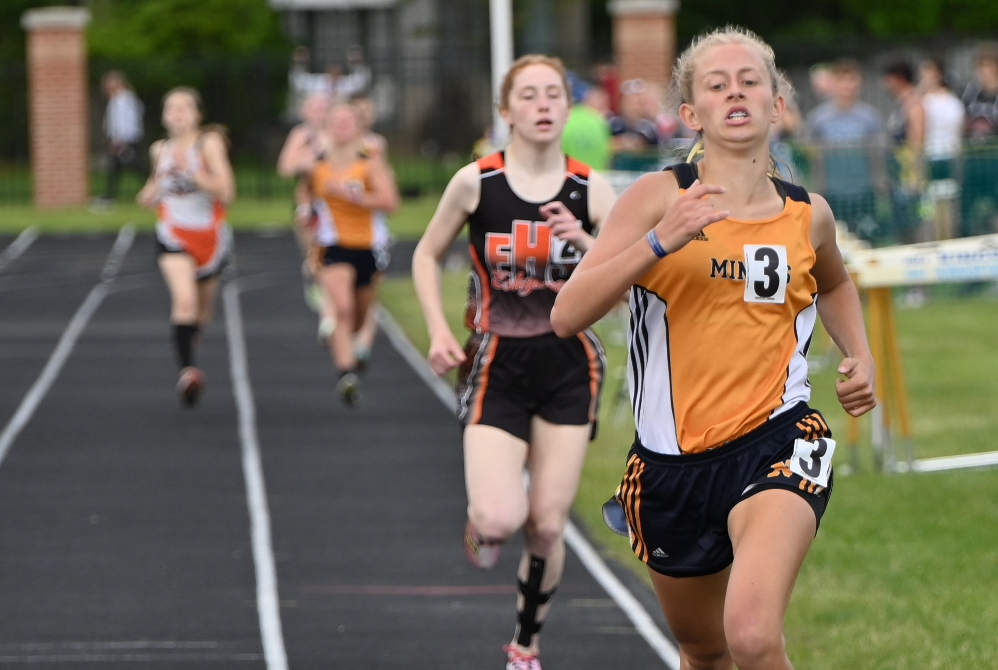
Aubrey Johnson provided Negaunee with an additional first in the 800-meter run (2:30.44).
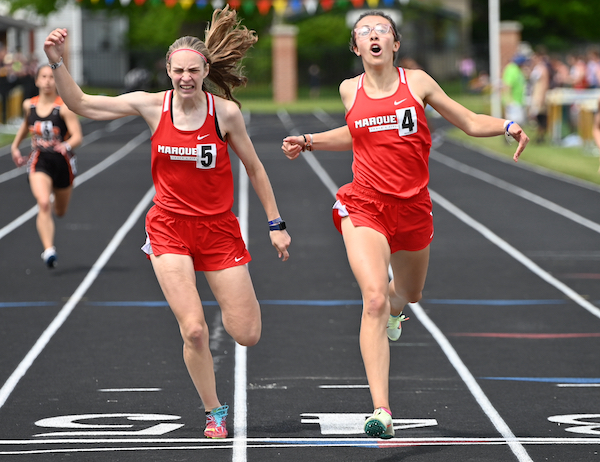
Marquette showed its speed with Beax Truckey and Julia Ott placing 1-2 in the 100 and 200.
Truckey took the 100 (12.98) and 200 (26.51) and Ott was clocked at 13.01 and 26.59, respectively. The Redettes also captured the 400 (51.99) and 800 relays (1:48.37).
Sault Ste. Marie’s Claire Erickson won the 300 hurdles (49.55) and Cassandra Gallagher took the 3,200 (12:36.83).
Houghton senior and Michigan Tech recruit Ingrid Seagren, who led the entire 3,200 until the final home stretch, was runner-up (12:37).
“This is a real heartbreaker,” said Seagren, who helped the Gremlins win the 3,200 relay (10:19.08). “I’m disappointed in my finish.
“(But) we ran a decent time in our relay. I’m proud of our team.”
Escanaba senior Ciara Ostrenga won the 400 in a personal-best 1:00.22 and helped the winning 1,600 relay (4:16.27).
“After we got fourth in the 3,200 relay, I just wanted to work hard and try to leave here with an individual medal,” she said. “I think our relay did pretty good. All the girls worked and tried hard.”
Houghton's Maria Velat competed in the first-time adaptive events in the 100 (26.56), 200 (51.15), 400 (1:35.96) and shot put (10-0).
PHOTOS (Top) Negaunee’s Aubrey Johnson charges toward the finish on the way to winning the 800 on Saturday. (Middle) Marquette’s Julia Ott (5) and Baux Truckey (4) have a close finish in the 200, with Truckey edging her teammate by eight hundredths of a second. (Click for more from Cara Kamps/Run Michigan.)