


Classes Still Create Hoosier Hysteria
July 27, 2017
By Rob Kaminski
MHSAA benchmarks editor
This is the fourth part in a series on MHSAA tournament classification, past and present, that will be published over the next two weeks. This series originally ran in this spring's edition of MHSAA benchmarks.
Twenty years ago, Bloomington North High School won the Indiana High School Athletic Association boys basketball championship, defeating Delta 75-54 at the RCA Dome in Indianapolis.
The date, March 22, 1997, is at the same time revered and disdained by traditionalists in the state who saw it as the last schoolboy championship game the state would ever host.
That’s how devout the game of basketball, particularly interscholastic basketball, had become in the Hoosier state during the 87 years a state champion – one state champion, to be precise – was crowned.
Following that 1997 season, the IHSAA moved to a four-class system for its roundball tournaments, like so many of its state association counterparts had done years earlier.
It would be shocking to find more than a small percentage of current high school basketball players around the country unfamiliar with the iconic movie Hoosiers, even though the film is now more than 30 years old.
And, the storyline for that blockbuster unfolded more than 30 years prior to its release, when small-town, undermanned Milan High School defeated Muncie Central High School 32-30 in the 1954 IHSAA title game.
Perhaps it’s because of the David vs Goliath notion, or the fame of the movie that replaced Milan with the fictional Hickory and real-life star Bobby Plump with Hollywood hero Jimmy Chitwood, or the simple fact that Indiana had something other states didn’t.
Whatever the reason, plenty of opposition remains to this day to basketball classification in the state.
The fact is, the small rural schools were regularly being beaten handily by the much larger suburban and city schools as the tournament progressed each season.
Small schools also were closing at a rapid rate following the state’s School Reorganization Act in 1959, as students converged on larger, centralized county schools. From 1960 to 2000, the number of schools entering the tournament dropped from 694 to 381, and in 1997 a total of 382 schools and 4,584 athletes began competition at the Sectional level (the first level of the IHSAA Basketball Tournament).
It was at the entry level of the tournament where school administrators felt the pain of the new class system, but not necessarily for the same nostalgic reasons as the fans who either attended or boycotted the tournament.
At the Sectional round of the tournament, the IHSAA was culling just 2 percent of the revenue, with the participating schools splitting the balance. So, when Sectional attendance dropped by 14 percent in that first year of class basketball, many schools realized a financial loss. It was money they had grown to count on in prior years to help fund various aspects of the department.
Schools cumulatively received more than $900,000 from Sectional competition in 1998, but that total was down from more than $1 million in the last year of the single-class tournament.
Yet, the current format provides a great deal more opportunity and realistic chances at championship runs for schools of all enrollments.
To date, 60 additional teams have championship or runner-up trophies on display in school trophy cases around Indiana.
That was the mission in front of then-IHSAA commissioner Bob Gardner (now National Federation executive director) once the board made its decision: to give thousands more student-athletes the opportunity for once-in-a-lifetime experiences.
As any statistician knows, figures can be manipulated to tell any side of a story. Declining attendance in year one of class basketball is such a number.
The truth is tournament attendance had been on a steady downward spiral since its peak of just over 1.5 million in 1962. By the last single-class event in 1997, the total attendance was half that.
The challenge then and today, as it is for all state associations, is to find that delicate balance for those holding onto tradition, those holding onto trophies, and the number of trophies to hand out.
Editor’s Note: Stories from the Fort Wayne Journal Gazette in 1998 and from a 2007 issue of Indianapolis Monthly provided facts in this article.
Self-Taught Lutzke Leaving Williamston with Decades of Memorable Lessons
By
Geoff Kimmerly
MHSAA.com senior editor
June 1, 2022
WILLIAMSTON – If it were possible to string together all of the moments that made Mitch Lutzke into a Hall of Fame high school track & field coach, the first half of the video would look like a one-man pentathlon.
 At most, the now-longtime Williamston leader brought into coaching a season of mostly-junior varsity cross country experience as a student at Albion High, and some additional knowledge gleaned from marrying a college All-American runner.
He also didn’t have the internet back then to speed up the learning curve. But he had books to show him technique, and coaching clinics where he’d learn more. The skills he was using as a morning radio news reporter surely helped him digest information and pass it on to his pupils. And he had an open track facility, where he’d go when no one else was around and try to teach himself all of the events so he could better serve as his wife Karen’s assistant as she was coaching middle school kids in Illinois before she herself would go on to lead college programs for most of the last three decades.
“I just wanted to make my wife happy and said, ‘I'll coach middle school track,’ which I didn't want to do. And I almost tried to quit. I'm like, I don't want to do this. I don't even know what I'm doing. And she's like, ‘No, you could just learn,’” Mitch Lutzke recalled last week.
“I tell people I’d do this, and they think I’m making this up. I’d stand there with a book and say, ‘OK,’ and I would go do it, and like, ‘OK, that’s how you do it right.’ So I decided, but nobody needs to know when they do it right – they need to know when they do it wrong. So I would take a book and look at discus. I said, ‘OK, I’m throwing it straight. How do I throw it left? So I’ve changed my feet. And if I step in a bucket, I’m going left. Or if I don’t block out, or if I do this … so I’d write down all these things to fix the kids. I did trial and error; what do I do if it goes too high in shot? OK, what did I do with my thumb? So I wrote a bunch of little notes down.”
His experiences, especially over the last 32 years leading the Hornets girls and now both the girls and boys programs, could fill a book – and he’s written a few of those too, on other subjects that have interested the also big-time sports fan and local historian.
Lutzke has begun the final week of a coaching career that’s seen him build upon one of the state’s most consistently-strong track & field programs and make it his own. Since taking over the Hornets girls team in 1993 and then adding the boys team in 2014, Lutzke has amassed 250 meet wins, 16 girls league championships and five conference titles with the boys, 12 Regional championships, eight top-10 MHSAA Finals finishes and nine Michigan Interscholastic Track Coaches Association team state titles. In 2020, he was named to the MITCA Hall of Fame.
 That’s a whale of a list for someone whose “gift for gab” had him headed initially down a path aspiring to be the next Dan Rather. He had earned accolades and opportunities to continue in broadcasting, but found himself instead taking a path back to school to become a teacher, into the classroom and onto the track and sideline, with his communication skills and knowledge no doubt pouring into the multiple books and other pieces he’s written on baseball and local history, the classes he’s taught as a popular social studies and television broadcast teacher at Williamston and the years serving most recently as the public address announcer at many Hornets events.
“The thing about Mitch is he’s not one dimensional, even in coaching – he can coach many different events. He has many different interests outside of track & field. And when he does something, he does it 100 percent,” Karen Lutzke said. “Even when he started coaching a long, long time ago with me … he just kept learning. He likes working with kids. He enjoys that and watching them get better, whether it’s a guy who’s a 30-foot shot putter or a 45-foot shot putter, or any event. It’s not how far they throw, it’s are they doing the best they can?
“He just likes the kids, and being around them. I think it’s going to be harder than he thinks, retiring – because the kids are what make coaching fun. Being around the kids and watching them have success, and he’s had a lot of success.”
‘Expectation of Excellence’
Williamston has had its fair share of MHSAA Finals individual placers over the years, with the best of those eight top-10 team finishes under Lutzke coming in 2007 when the girls placed fourth in Lower Peninsula Division 3.
The MHSAA Finals team championships are determined by the success of individuals who qualify from Regionals, which could be just a handful. Williamston has shined even brighter, however, at the MITCA Team Finals, where the competition pits full teams against each other and the Hornets’ talent and depth across all events frequently has stood out.
Longtime and similarly-legendary coach Paul Nilsson led both Williamston track & field programs from the 1970s into the 1990s. Lutzke joined him as an assistant for both in 1991 – following Karen after she’d been hired to coach women’s cross country and assist with track & field at Michigan State. In 1993, Lutzke took over the Hornets girls track & field program.
Known now for success in a variety of sports, Williamston during the first decade of the 2000s was most consistently revered for that MHSAA championship-caliber track & field success – and on the girls side, that superiority was rooted in part in the daily grind of January and February workouts often in the school’s hallways or later on an inside track that circles the gym.
 Lutzke’s “Winter Warriors” got a T-shirt if they trained a certain number of days during the offseason. But that was just a small bonus for showing up. The memorable pay offs came three and four months later in league titles, Regional successes, MITCA titles and MHSAA Finals achievements.
“I’ve never quite had another experience in my lifetime that demonstrated that as much to me. Now I know moving forward in my life that if I expect to be great at something, or I expect to achieve results, I have to put the work in myself,” said 2019 graduate Jessica Robach, who that spring helped Williamston finish 10th at the MHSAA LPD2 Final running on a championship relay and placing third in long jump and as part of another relay. “It’s really kind of a personal integrity and motivation thing that draws a direct parallel to my career in track and to when I really decided to push myself to be great – you put in the hours of work, and then it finally happens.
“That’s just something Mitch always reiterated to us: That you can have all the natural talent in the world, but a person who works hard is going to get to where they want to be.”
Robach began attending Williamston as a freshman, and didn’t feel entirely comfortable with her new school until track season came – when “everything fell together.”
That “expectation of excellence” wasn’t just about competing athletically, but striving to be a good person. The camaraderie he established, the way he made sure knowledge was passed down from the oldest athletes to the youngest, and again, the emphasis on work ethic overcoming talent, have continued to stick with Robach as she’s gone on to study at Western Michigan.
“Mitch does things the right way. He believes in fair play, hard work, and preparation. He keeps an even keel with athletes – he doesn't get overly hyped when the team is successful or overly critical when the team struggles,” said assistant Ray Herek, who has coached with Lutzke since 2002 and taught with him since 2000. “I have learned a ton from watching him coach. He does an excellent job of knowing how to approach each athlete – he reads people very well. He seems to know what makes each person tick, and finds the right words or coaching tips to help each athlete excel.”
A decade before Robach, Leanne Selinger was learning the same lessons. The team’s leadership award is named after her, and after running on two Finals-placing relays as a senior in 2010 she actually went on to serve as an assistant coach on Lutzke’s staff over the next four seasons while at college.
These days she’s working in supply chain management – a higher-pressure-than-usual field lately because of headline-making materials shortages in a number of industries. But what she learned from Lutzke about being flexible and prepared for the unexpected – in a track meet, maybe a scratch or an injury – while trying to lead people from different subgroups (sprinters, distance runners, jumpers, etc.) toward a common goal are among lessons she continues to keep front of mind.
“Even in my professional career now, I get a lot of feedback that I am not afraid to roll up my sleeves, get dirty,” Selinger said. “And I think that comes from some of my track history with Coach Lutzke and being able to go out, let’s go out and get the job done. If we have to do X-Y-Z, let’s go do it.”
Signing Off
After the couple moved from Illinois, Mitch Lutzke taught in Lansing for five years while coaching at Williamston, then came to Williamston to teach as well. He added coaching in basketball and cross country at the middle school and subvarsity levels, and immersed himself in the family’s new community. Karen Lutzke is now in her second tenure at Olivet College, coaching the women’s and men’s cross country and track & field teams, and the couple has sent three children through Williamston schools with two going on to run at the college level.
Mitch let the decision to retire sink in over this school year – he’s retiring from teaching as well – and eventually he had one more major objective to complete this spring. And he accomplished it.
Williamston track & field wasn’t alone trying to dodge the wrenches thrown its way by COVID-19. But the effects certainly were noticeable.
When the 2020 spring season was suspended (to be ultimately canceled) late that March, Williamston’s teams had practiced four days – with 125 students (nearly 20 percent of the entire student body) signed up and hopes high with lots of talent and experience returning. When spring sports returned a year ago, Williamston was down to 49 athletes in the program – including only 16 girls – with that missing year of older athletes recruiting and mentoring the younger ones striking a massive blow.
 This spring, numbers didn’t return all the way to pre-COVID levels. But 90 athletes came out to put the program on solid footing for this season and whoever comes next.
“I've been amazed this year how many coaches have approached Mitch with words of appreciation and admiration for the job he has done at Williamston,” Herek said. “Anybody that has coached track and field knows that it is so hard getting kids outside in the spring when it is 40 degrees outside. It is difficult to know how to coach all of the events. It is difficult to know how to reach each athlete – there are so many different types of students that go out for track. But Mitch is as good as it gets.”
He’ll pour his energies into other things. He’s going to do some announcing of Olivet College events. He wants to write more. He’d like to visit baseball spring training for the first time. “Whatever he’s involved, in he’s very passionate about and gets things done,” Karen Lutzke said. “Maybe we’ll have a very clean house (and) the lawn will look wonderful after this.”
Although Williamston’s boys team won’t send anyone to the MHSAA Finals this weekend for the first time in a number of seasons, Mitch Lutzke will bring five athletes to Saturday’s Lower Peninsula Division 2 championship meet at Ada Forest Hills Eastern. They will combine to run two relays, in two more individual races and participate in one field event.
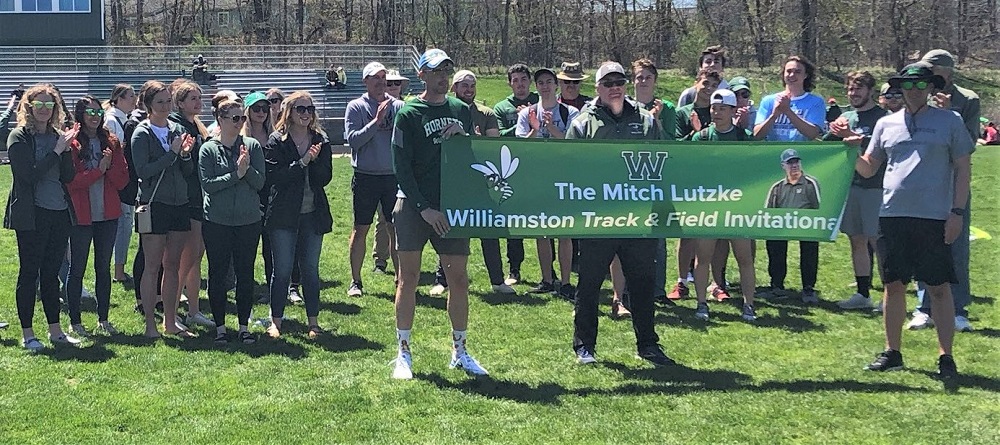
Next year, he’ll cheer from the stands, maybe help move hurdles or clerk a meet if needed. Williamston has renamed its annual meet the Mitch Lutzke Williamston Track & Field Invitational, after all, and the namesake can’t be a no show.
“I say at the end of every year, if you've got more negatives than positives in what you did in track this year, then don't come out (next year). Because we're not changing. This is what we do,” Lutzke said. “I always tell the kids, I want you to support the program of track & field in the community you grow up in or you move to, that you put your kids in track & field because you thought it was a positive experience because of what you went through here in the program, and you just give back.”
 Geoff Kimmerly joined the MHSAA as its Media & Content Coordinator in Sept. 2011 after 12 years as Prep Sports Editor of the Lansing State Journal. He has served as Editor of Second Half since its creation in January 2012, and MHSAA Communications Director since January 2021. Contact him at [email protected] with story ideas for the Barry, Eaton, Ingham, Livingston, Ionia, Clinton, Shiawassee, Gratiot, Isabella, Clare and Montcalm counties.
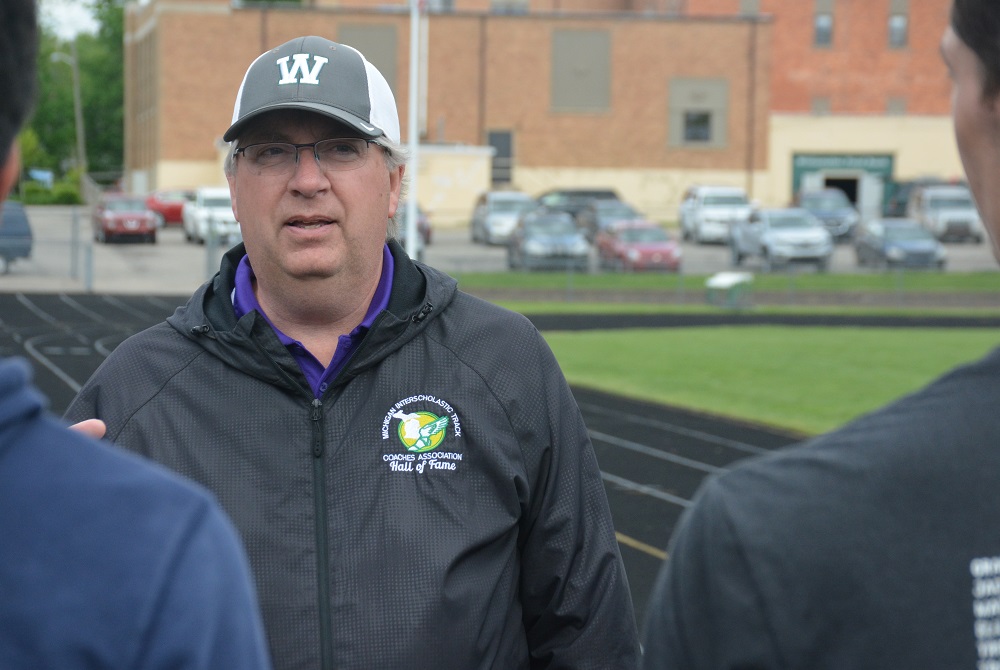
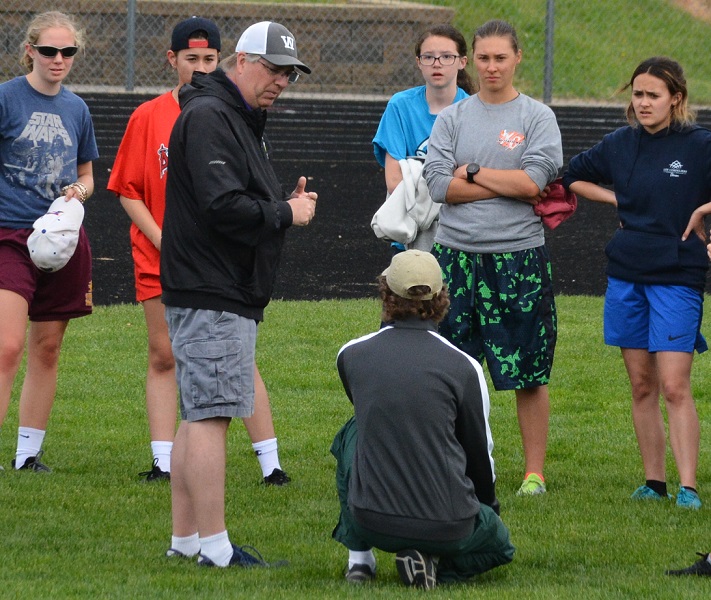
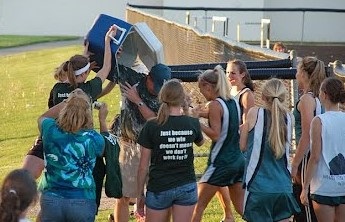
PHOTOS (Top) Williamston coach Mitch Lutzke talks things over with his boys team captains last week. (2) Lutzke stands with, from left, Diana Eidt, Cassidy Metzer, Mallory Metzer and Elizabeth Dutcher – who ran on school record-setting 400 and 800 relays in 2011. (3) Lutzke is recognized earlier this spring as Williamston’s annual meet is named after him. (4) Lutzke and assistant Ray Herek (kneeling) confer with their girls team. (5) The 2009 team dumps a cooler over Lutzke’s head to celebrate a Capital Area Activities Conference league meet championship. (Last week’s photos by Geoff Kimmerly; others courtesy of Williamston track & field and athletic department.)