


Classes Still Create Hoosier Hysteria
July 27, 2017
By Rob Kaminski
MHSAA benchmarks editor
This is the fourth part in a series on MHSAA tournament classification, past and present, that will be published over the next two weeks. This series originally ran in this spring's edition of MHSAA benchmarks.
Twenty years ago, Bloomington North High School won the Indiana High School Athletic Association boys basketball championship, defeating Delta 75-54 at the RCA Dome in Indianapolis.
The date, March 22, 1997, is at the same time revered and disdained by traditionalists in the state who saw it as the last schoolboy championship game the state would ever host.
That’s how devout the game of basketball, particularly interscholastic basketball, had become in the Hoosier state during the 87 years a state champion – one state champion, to be precise – was crowned.
Following that 1997 season, the IHSAA moved to a four-class system for its roundball tournaments, like so many of its state association counterparts had done years earlier.
It would be shocking to find more than a small percentage of current high school basketball players around the country unfamiliar with the iconic movie Hoosiers, even though the film is now more than 30 years old.
And, the storyline for that blockbuster unfolded more than 30 years prior to its release, when small-town, undermanned Milan High School defeated Muncie Central High School 32-30 in the 1954 IHSAA title game.
Perhaps it’s because of the David vs Goliath notion, or the fame of the movie that replaced Milan with the fictional Hickory and real-life star Bobby Plump with Hollywood hero Jimmy Chitwood, or the simple fact that Indiana had something other states didn’t.
Whatever the reason, plenty of opposition remains to this day to basketball classification in the state.
The fact is, the small rural schools were regularly being beaten handily by the much larger suburban and city schools as the tournament progressed each season.
Small schools also were closing at a rapid rate following the state’s School Reorganization Act in 1959, as students converged on larger, centralized county schools. From 1960 to 2000, the number of schools entering the tournament dropped from 694 to 381, and in 1997 a total of 382 schools and 4,584 athletes began competition at the Sectional level (the first level of the IHSAA Basketball Tournament).
It was at the entry level of the tournament where school administrators felt the pain of the new class system, but not necessarily for the same nostalgic reasons as the fans who either attended or boycotted the tournament.
At the Sectional round of the tournament, the IHSAA was culling just 2 percent of the revenue, with the participating schools splitting the balance. So, when Sectional attendance dropped by 14 percent in that first year of class basketball, many schools realized a financial loss. It was money they had grown to count on in prior years to help fund various aspects of the department.
Schools cumulatively received more than $900,000 from Sectional competition in 1998, but that total was down from more than $1 million in the last year of the single-class tournament.
Yet, the current format provides a great deal more opportunity and realistic chances at championship runs for schools of all enrollments.
To date, 60 additional teams have championship or runner-up trophies on display in school trophy cases around Indiana.
That was the mission in front of then-IHSAA commissioner Bob Gardner (now National Federation executive director) once the board made its decision: to give thousands more student-athletes the opportunity for once-in-a-lifetime experiences.
As any statistician knows, figures can be manipulated to tell any side of a story. Declining attendance in year one of class basketball is such a number.
The truth is tournament attendance had been on a steady downward spiral since its peak of just over 1.5 million in 1962. By the last single-class event in 1997, the total attendance was half that.
The challenge then and today, as it is for all state associations, is to find that delicate balance for those holding onto tradition, those holding onto trophies, and the number of trophies to hand out.
Editor’s Note: Stories from the Fort Wayne Journal Gazette in 1998 and from a 2007 issue of Indianapolis Monthly provided facts in this article.
Among State's Best in Both, Johnston Has Almont Climbing in Softball, Track
By
Paul Costanzo
Special for MHSAA.com
May 26, 2022
It’s been quite a spring for Almont girls athletics.
 The softball team finished the Blue Water Area Conference season 10-4, its best-ever mark in the league, which features three top-10 teams and 2021 Division 3 champion Richmond.
Almont’s girls track & field team also had its best finish in the BWAC, placing third at Tuesday’s league meet.
A major reason for both? Devin Johnston.
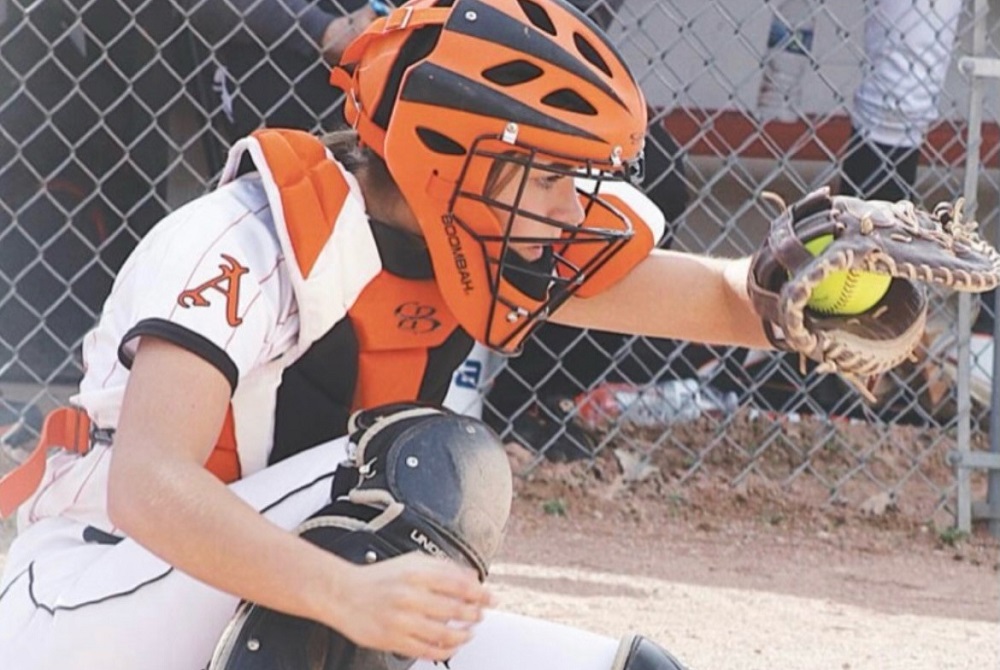
The Almont junior is a record-setting third baseman for the softball team and a record-setting sprinter for the track team.
“Devin is such a great kid,” Almont softball coach Erik Johnson said. “She’s a hard-working athlete, and she puts so much time into both. You can see it in the way she plays the game and the way she runs her events. She doesn’t miss much practice, she juggles both and she’s a great student.”
Johnston was a first-team all-state selection in softball as a sophomore, and has followed that up with a masterful junior campaign. She was hitting .550 with a .589 on-base percentage, four home runs, 10 doubles and a school-record eight triples heading into Wednesday’s doubleheader against Yale. She’s approaching the single-season hits record (63), which she set as a sophomore. Her .930 slugging percentage is also on pace to set a school record.
On the track, she has qualified for the Lower Peninsula Division 3 Finals in three events: 100 meters, 200 meters and the 400-meter relay. Her 200 time of 25.49 broke an 18-year-old Almont school record and is the second-fastest time in LPD3 this season. She’s ranked fifth in the 100 with her personal best of 12.63.
Being that good at two things during the same season can make for a lot of long days. But Johnston doesn’t mind.
“I enjoy doing both,” she said. “It doesn’t seem like a burden. I don’t see it as a struggle. I chose to do that. At the end of the week, yes, I’m exhausted every single week. But both of my coaches are very supportive. If I need to sit out of a certain thing on a certain day, or if I need to skip out on running in softball for that day, they understand.”
This level of individual and team success does, unfortunately, leaves Johnston with a difficult choice, as Almont’s Division 3 Softball District at Richmond is June 4, the same day as the Division 3 Track & Field Finals in Kent City.
She knows what she will be doing, and while she has told those who need to know, she is not ready to divulge that publicly.
“I want to help both teams, but I have to choose one or the other,” she said. “It’s really difficult, but it’s something that, going in, I knew I would have to do eventually.”
A year ago, Johnston chose the softball District. Although, at that time, she was Almont’s lone Finals qualifier in track and did not rank as highly as she does this year. The realization it was a choice she was going to have to make also hit her later, as she wasn’t expecting to see a ton of track success in her first year as a serious competitor in the sport.
“I didn’t even expect to qualify for states; especially that year in our region, there were some pretty good girls,” she said. “When I found out, I cried over it, actually. I didn’t know if I would have the chance to go to states again. When it did hit me, it was not good. I realized how big of a decision it was.”
 This year, she was more aware of the chance. A campaign to move the District softball tournament to Friday, which is allowed, didn’t come to fruition. (All schools in the bracket must approve a switch.)
Moving things around is something Johnson has become used to as Almont’s softball coach, as getting one team to agree to a change in schedule is easier than having multiple track teams adjust a quad meet.
“I worked really hard to look at schedules ahead of time and anything in my power to make adjustments that would fit and allow her to do both,” he said. “I learned a lot from last year, when we did what we could last minute. This season, I got well ahead of it. My perspective is that I want to do anything I can for my girls. When you have someone like Devin who puts an immense amount of time into both track and softball, I’m going to do what I can for her. When I share that with other coaches, they’re like, ‘Yeah, OK.’”
Johnson and track coach James Wade have worked together for a decade with Almont’s girls basketball program, as Johnson is the varsity coach and Wade has been a JV coach and varsity assistant. That, combined with Johnston’s commitment to both, makes things a bit easier.
“I think she wants to succeed in both,” Wade said. “I don’t think she wants to let either of us down. That puts us in a position where we want to do what we can to help her. She’s committed to both, and she lets us know when she can’t be there for a practice. She does what she needs to do to make it work.”
Johnston appreciates that level of support.
“Them allowing me to do this and being lenient allows me to succeed so much more because I don’t have to worry about making a coach mad,” she said. “Their support contributes to my success, and I can just play freely. It means a lot.”
All of this could lead to another decision down the road – and not just this with same possible scenario a year from now. Johnston has spent the majority of her life playing softball, and continuing that collegiately always seemed to be her most likely path. That changes a bit, though, each time she steps on the track.
“I’ve played softball my whole life, and we’ve spent so much time and money on that,” she said. “My parents (who are assistant coaches on the Almont softball team) love track now. They don’t care which one I choose. In my mind, if I put a ton of time into track, and just worked and worked at it, I feel like my times will get even better. That is an opportunity that is really intriguing. That’s a decision that I’ll have to make next year.”
The support of her softball coach parents, who have become massive track fans, takes some pressure off of Johnston.
That’s becoming a trend, as the people closest to her continue to back her as she chases all of her dreams.
“This year, I think she’s probably going to run track,” Johnson said. “And rightly so, because she has a chance to be a state champion. I’ll support her 100 percent, and the kids will, too. Hopefully we can make it through to the Regional, and she can join us the next weekend.”
 Paul Costanzo served as a sportswriter at The Port Huron Times Herald from 2006-15, including three years as lead sportswriter, and prior to that as sports editor at the Hillsdale Daily News from 2005-06. He can be reached at [email protected] with story ideas for Genesee, Lapeer, St. Clair, Sanilac, Huron, Tuscola, Saginaw, Bay, Arenac, Midland and Gladwin counties.
PHOTOS (Top) Almont’s Devin Johnston focuses on receiving a pitch during a rare appearance behind the plate this season. (Middle) Johnston, right, emerges from the blocks during a race. (Photos courtesy of the Johnston family.)