


Classes Still Create Hoosier Hysteria
July 27, 2017
By Rob Kaminski
MHSAA benchmarks editor
This is the fourth part in a series on MHSAA tournament classification, past and present, that will be published over the next two weeks. This series originally ran in this spring's edition of MHSAA benchmarks.
Twenty years ago, Bloomington North High School won the Indiana High School Athletic Association boys basketball championship, defeating Delta 75-54 at the RCA Dome in Indianapolis.
The date, March 22, 1997, is at the same time revered and disdained by traditionalists in the state who saw it as the last schoolboy championship game the state would ever host.
That’s how devout the game of basketball, particularly interscholastic basketball, had become in the Hoosier state during the 87 years a state champion – one state champion, to be precise – was crowned.
Following that 1997 season, the IHSAA moved to a four-class system for its roundball tournaments, like so many of its state association counterparts had done years earlier.
It would be shocking to find more than a small percentage of current high school basketball players around the country unfamiliar with the iconic movie Hoosiers, even though the film is now more than 30 years old.
And, the storyline for that blockbuster unfolded more than 30 years prior to its release, when small-town, undermanned Milan High School defeated Muncie Central High School 32-30 in the 1954 IHSAA title game.
Perhaps it’s because of the David vs Goliath notion, or the fame of the movie that replaced Milan with the fictional Hickory and real-life star Bobby Plump with Hollywood hero Jimmy Chitwood, or the simple fact that Indiana had something other states didn’t.
Whatever the reason, plenty of opposition remains to this day to basketball classification in the state.
The fact is, the small rural schools were regularly being beaten handily by the much larger suburban and city schools as the tournament progressed each season.
Small schools also were closing at a rapid rate following the state’s School Reorganization Act in 1959, as students converged on larger, centralized county schools. From 1960 to 2000, the number of schools entering the tournament dropped from 694 to 381, and in 1997 a total of 382 schools and 4,584 athletes began competition at the Sectional level (the first level of the IHSAA Basketball Tournament).
It was at the entry level of the tournament where school administrators felt the pain of the new class system, but not necessarily for the same nostalgic reasons as the fans who either attended or boycotted the tournament.
At the Sectional round of the tournament, the IHSAA was culling just 2 percent of the revenue, with the participating schools splitting the balance. So, when Sectional attendance dropped by 14 percent in that first year of class basketball, many schools realized a financial loss. It was money they had grown to count on in prior years to help fund various aspects of the department.
Schools cumulatively received more than $900,000 from Sectional competition in 1998, but that total was down from more than $1 million in the last year of the single-class tournament.
Yet, the current format provides a great deal more opportunity and realistic chances at championship runs for schools of all enrollments.
To date, 60 additional teams have championship or runner-up trophies on display in school trophy cases around Indiana.
That was the mission in front of then-IHSAA commissioner Bob Gardner (now National Federation executive director) once the board made its decision: to give thousands more student-athletes the opportunity for once-in-a-lifetime experiences.
As any statistician knows, figures can be manipulated to tell any side of a story. Declining attendance in year one of class basketball is such a number.
The truth is tournament attendance had been on a steady downward spiral since its peak of just over 1.5 million in 1962. By the last single-class event in 1997, the total attendance was half that.
The challenge then and today, as it is for all state associations, is to find that delicate balance for those holding onto tradition, those holding onto trophies, and the number of trophies to hand out.
Editor’s Note: Stories from the Fort Wayne Journal Gazette in 1998 and from a 2007 issue of Indianapolis Monthly provided facts in this article.
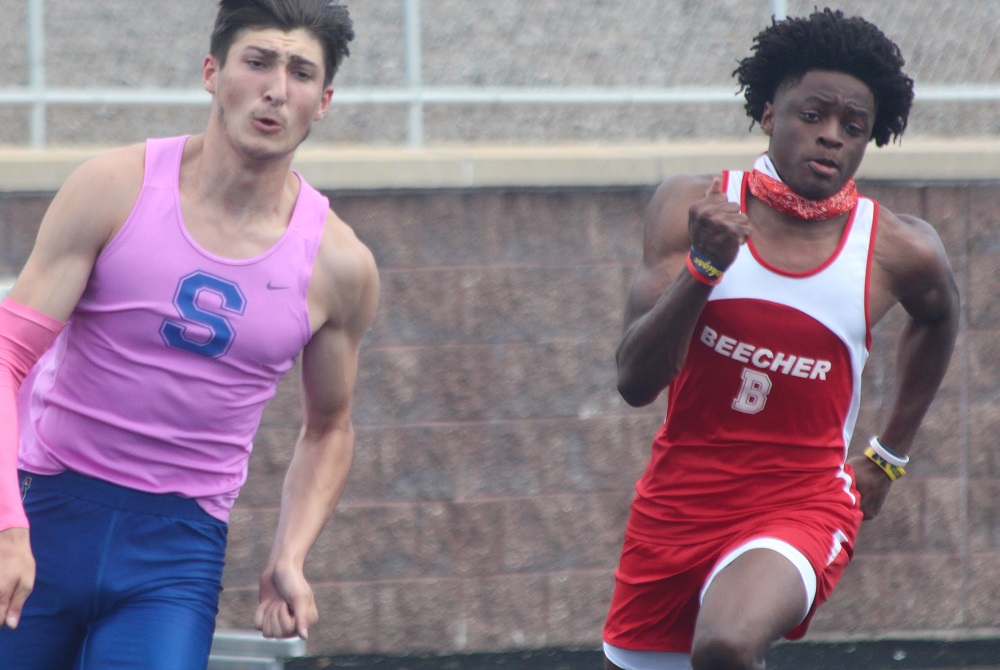
Beecher's Townsend Ready to Lead Chase Among State's Speediest Sprinters
By
Paul Costanzo
Special for MHSAA.com
April 13, 2022
Jaylin Townsend’s introduction to the state’s track & field scene came a year later than planned, but it was quite a first impression.
 As a sophomore, the Flint Beecher star walked out of the Lower Peninsula Division 4 Finals with two individual titles, one relay title and a runner-up finish in another relay.
“It kind of surprised me,” Townsend said. “Coming into the season off of COVID, we could barely get into the weight room, and it was hard to get on the track and run. We couldn’t get the blocks out. It was kind of an eye opener, really.”
Despite it being his first season – the 2020 season was canceled completely – Townsend was dominant throughout. He won all but one of the individual races he competed in, with the lone loss coming in the 200 meters in the first meet of the season.
That was quickly corrected, as he cut nearly four seconds off his time in his next meet and never lost the race again.
He won the 100 meters at the Division 4 Finals with a personal best of 10.98 seconds. He won the 200 in 22.75. His personal best in that event is 22.37, which was run in the prelims of the Regional.
Beecher’s relay teams that featured Townsend were equally dominant. The 800-meter relay team suffered just one defeat – disqualification at the Genesee Area Conference championship meet. Townsend, Micah Brown, Danny Bradley and Jacoby Sanders ran a season-best 1:30.59 to win at the Division 4 Finals.
The 400 relay team of Townsend, Bradley, Carmelo Harris and James Cummings II took second at the Division 4 Finals with a time of 44.11. It was their first non-DQ loss of the season.
It was close, but Jaylin Townsend (@Jay23Trip) took home two State Championship medals for Flint Beecher, winning the 100 Meter Dash and the 200 Meter Dash.#StateChamps x @MHSAA pic.twitter.com/BMnhp2GaPV
— STATE CHAMPS! Michigan (@statechampsmich) June 19, 2021
Townsend’s contributions were good for 38 team points, which alone would have placed fourth in Division 4. Beecher as a team finished third with 54 points.
While the immediate success came as a surprise to Townsend, it didn't to his coach.
“I saw it in him,” Beecher coach Joe Wilkerson said. “I knew he could be something special. I told his mother when I talked to her, ‘This guy is going to be a state champ this year.’ There was just something about him that I saw it in him. Lo and behold, he was a three-time state champ. It just made me feel good, because I could trust my own instincts a little bit right now.”
Townsend knows his success will motivate his future opponents even more, but he’s fine with that.
“Going into this year, I know they’re coming for me,” he said. “I know I have to put in some extra work.”
Putting in extra work is something Townsend is used to, as he had to a year ago to get up to speed. He said working on his stride and coming out of the blocks were the main points of emphasis.
“I had to learn a lot, actually,” he said. “Most of the stuff, I was just doing off raw talent. I would make sure to ask Coach, ‘Hey, do you have an extra 30 minutes? Can you stay after?’ My first-ever track meet, when I came out of the blocks, I used to pop right up.”
That has Wilkerson excited, as he believes the sky is the limit for his young star.
 “This guy, he’s exceptional,” said Wilkerson, who has coached track at Beecher on and off since 1979. “I’ve been coaching for a long time, and I’ve never had a student quite like him with that kind of natural ability.”
Townsend’s focus on track is essentially limited to the spring season, as he also plays football and basketball for the Buccaneers.
“I’ve always been a great athlete, and I wanted to continue to be great,” Townsend said. “Going into basketball, it keeps me in shape for track.”
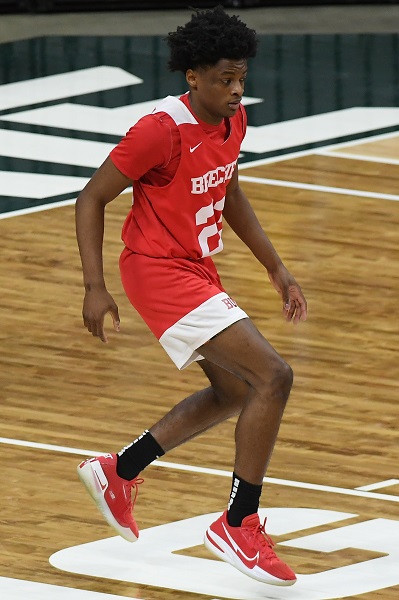
He was a key reserve forward for the Beecher basketball team, which advanced to the Division 3 Semifinals this season. He plays mostly in the post, despite being a shade under 6-foot-1 and 165 pounds.
Football is the sport he’s most focused on, particularly when it comes to competing in college. He plays receiver, free safety and cornerback for Beecher, and said he’s had talks with Central Michigan, Ferris State and Grand Valley State.
It was his performance on the track, though, that really helped to start those.
“When I started posting the speed, some of the colleges started to look like, ‘Hey, we can use this kid,’” Townsend said. “It helped out a lot.”
Heading into his junior track season, he hopes to turn a few more heads. He knows the best way to do that is to hold off the challengers who now have him in their sights, and continue to improve on his times. His goal is to work his 100 time down to 10.5 and his 200 time into the mid 21s.
“It kind of goes together,” he said. “Coming off last season, it put a target on my back, but it made some college coaches want to come to the track meets. They want to see me run. They want to see my speed. It’s nothing I can’t handle, though.”
 Paul Costanzo served as a sportswriter at The Port Huron Times Herald from 2006-15, including three years as lead sportswriter, and prior to that as sports editor at the Hillsdale Daily News from 2005-06. He can be reached at [email protected] with story ideas for Genesee, Lapeer, St. Clair, Sanilac, Huron, Tuscola, Saginaw, Bay, Arenac, Midland and Gladwin counties.
PHOTOS (Top) Flint Beecher’s Jaylin Townsend, right, turns a corner as he works to get a pace ahead of Saugatuck’s Benny Diaz on the way to winning last season’s LPD4 200 championship. (Middle) Townsend gets ready to defend during last month’s Division 3 Semifinal against Schoolcraft. (Top photo by Will Kennedy; middle photo by Hockey Weekly Action Photos.)