


Classes Still Create Hoosier Hysteria
July 27, 2017
By Rob Kaminski
MHSAA benchmarks editor
This is the fourth part in a series on MHSAA tournament classification, past and present, that will be published over the next two weeks. This series originally ran in this spring's edition of MHSAA benchmarks.
Twenty years ago, Bloomington North High School won the Indiana High School Athletic Association boys basketball championship, defeating Delta 75-54 at the RCA Dome in Indianapolis.
The date, March 22, 1997, is at the same time revered and disdained by traditionalists in the state who saw it as the last schoolboy championship game the state would ever host.
That’s how devout the game of basketball, particularly interscholastic basketball, had become in the Hoosier state during the 87 years a state champion – one state champion, to be precise – was crowned.
Following that 1997 season, the IHSAA moved to a four-class system for its roundball tournaments, like so many of its state association counterparts had done years earlier.
It would be shocking to find more than a small percentage of current high school basketball players around the country unfamiliar with the iconic movie Hoosiers, even though the film is now more than 30 years old.
And, the storyline for that blockbuster unfolded more than 30 years prior to its release, when small-town, undermanned Milan High School defeated Muncie Central High School 32-30 in the 1954 IHSAA title game.
Perhaps it’s because of the David vs Goliath notion, or the fame of the movie that replaced Milan with the fictional Hickory and real-life star Bobby Plump with Hollywood hero Jimmy Chitwood, or the simple fact that Indiana had something other states didn’t.
Whatever the reason, plenty of opposition remains to this day to basketball classification in the state.
The fact is, the small rural schools were regularly being beaten handily by the much larger suburban and city schools as the tournament progressed each season.
Small schools also were closing at a rapid rate following the state’s School Reorganization Act in 1959, as students converged on larger, centralized county schools. From 1960 to 2000, the number of schools entering the tournament dropped from 694 to 381, and in 1997 a total of 382 schools and 4,584 athletes began competition at the Sectional level (the first level of the IHSAA Basketball Tournament).
It was at the entry level of the tournament where school administrators felt the pain of the new class system, but not necessarily for the same nostalgic reasons as the fans who either attended or boycotted the tournament.
At the Sectional round of the tournament, the IHSAA was culling just 2 percent of the revenue, with the participating schools splitting the balance. So, when Sectional attendance dropped by 14 percent in that first year of class basketball, many schools realized a financial loss. It was money they had grown to count on in prior years to help fund various aspects of the department.
Schools cumulatively received more than $900,000 from Sectional competition in 1998, but that total was down from more than $1 million in the last year of the single-class tournament.
Yet, the current format provides a great deal more opportunity and realistic chances at championship runs for schools of all enrollments.
To date, 60 additional teams have championship or runner-up trophies on display in school trophy cases around Indiana.
That was the mission in front of then-IHSAA commissioner Bob Gardner (now National Federation executive director) once the board made its decision: to give thousands more student-athletes the opportunity for once-in-a-lifetime experiences.
As any statistician knows, figures can be manipulated to tell any side of a story. Declining attendance in year one of class basketball is such a number.
The truth is tournament attendance had been on a steady downward spiral since its peak of just over 1.5 million in 1962. By the last single-class event in 1997, the total attendance was half that.
The challenge then and today, as it is for all state associations, is to find that delicate balance for those holding onto tradition, those holding onto trophies, and the number of trophies to hand out.
Editor’s Note: Stories from the Fort Wayne Journal Gazette in 1998 and from a 2007 issue of Indianapolis Monthly provided facts in this article.
Winningest Coach Moving on from Matside, but Leaving Lasting Lakeshore Impact
By
Wes Morgan
Special for MHSAA.com
April 11, 2022
Bruce Bittenbender’s impact on the sport of wrestling in Michigan is immeasurable.
 And the fact that he’ll no longer occupy a chair next to the mats at Stevensville Lakeshore High School is almost unfathomable after a legendary 52-year career there.
His list of accomplishments over that span is staggering, though the incalculable number of lives he touched — a realization that came from the outpouring of messages from his former student-athletes following his retirement announcement in late March — is what Bittenbender believes is the most important part of his legacy.
“It is absolutely heartwarming,” Bittenbender said at his retirement press conference April 1. “In many cases (some students) are on the edge. I had a guy say to me yesterday, ‘Coach, I didn’t have a father. I want to thank you.’
“How many state titles is that worth? There is a lot of that I appreciate.”
What can be quantified are the competition results during his tenure.
Bittenbender leaves with a dual meet record of 981-270-2 — the most victories in state history and the second most in the country. The program claimed 28 District titles, 13 Regional championships and 33 conference titles. The Lancers were undefeated in duals four times (1976, 1978, 1984 and 1986) and finished as MHSAA Finals runners-up twice (1986 and 1994).
“There are no shortcuts to being successful,” Lakeshore athletic director Greg Younger said. “Coach is always here. He’s probably here more than most teachers (although he retired in 2010). He is in the building early and often. He’s scrubbing the mats. I know it doesn’t magically happen. He’s always here preparing for a match and doing something here, talking to kids in the halls and building those relationships.
“He’s been a testament to hard work and what it takes to really have a goal all the time. When he steps into the wrestling room he’s always prepared, he’s always planning for tomorrow and he’s always planned for what’s coming up next. Nothing has ever surprised him.”
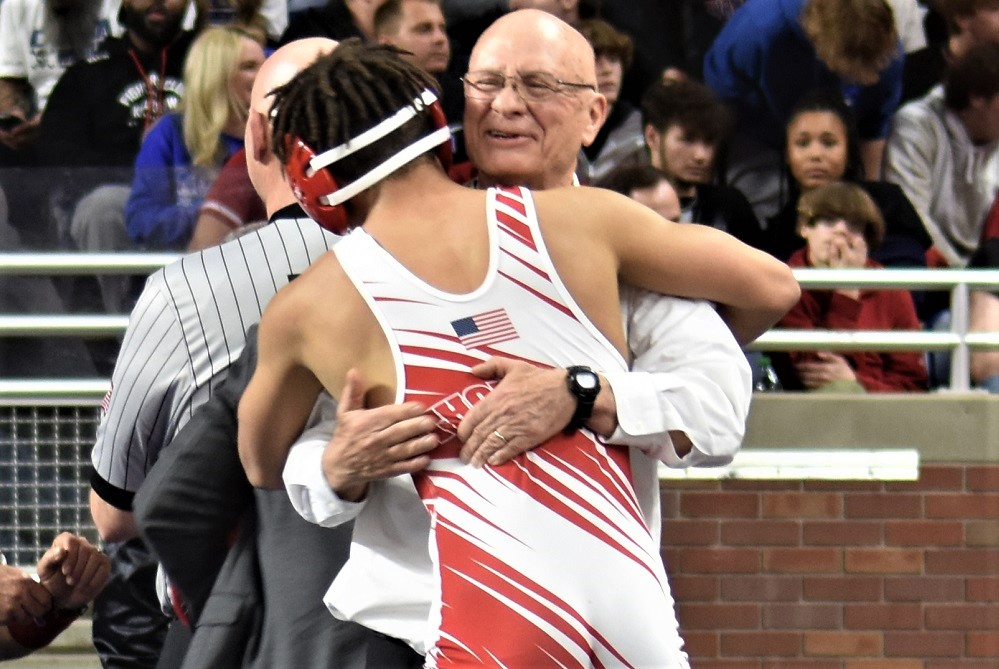
 There were a total of 26 Individual Finals champions and 116 state placers under his watch, with Micah Hanau (also a winner in 2020), Zamuel Thompson and Aaron Lucio the most recent to have stood atop the podium and celebrate championships with Bittenbender last month at Ford Field.
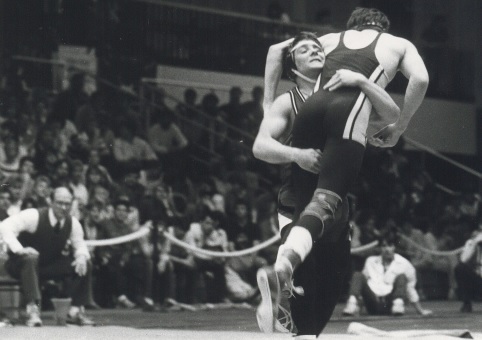
Shane Williams (2020), Riley Bettich (2018), Tyler Humes (2010), Tyler Daniel (2009), Ryan Huebner (2002), John King (1992), Scott Mabrey (1992), Mark McKie (1992, 1991), Jason Cluff (1988, 1987, 1986), Dave Strejc (1988), Matt Cluff (1987, 1986, 1985), John Spear (1986), Gary Smith (1981, 1980) John Murphy (1979), Doug Smith (1978), and Rick McGrath (1974) all were guided to the state’s top individual level by Bittenbender.
For his accomplishments, Bittenbender was named Regional Coach of the Year 11 times, Michigan Wrestling Coach of the Year by the Coaches Association (2002) and National Coach of the Year twice, by the National Federation of State High School Associations (2002) and National High School Athletic Coaches Association (2010). His rightful spot in the Michigan Wrestling Coaches Association Hall of Fame was claimed in 2010, and he was inducted into the National Coaches Association Hall of Fame the following year. In 2012, his home state honored Bittenbender with an induction into the Pennsylvania Wrestling Hall of Fame, and Milligan University (Tenn.), where he wrestled four years, did the same in 2019.
“We went through three years of pulling teeth and hard work,” said Bittenbender, who took over at struggling Lakeshore in 1970. “Finally, we hit pay dirt. We got a kid to be state champion (in 1974), Ricky McGrath. This guy opened it up. After that, kids wanted to be Lakeshore wrestlers.”
But there were thousands of others that also laid bricks over the years to help build the program up to where it is today.
“There were a lot of kids that weren’t state champions here; there were a lot of kids that weren’t District champions or Regional champions or even conference champions,” Bittenbender said. “But they were here everyday, they were working everyday, they were part of this program and you’ve got to give those kids credit.”
Ryan Quinn takes over the program after serving as assistant coach.
“I’m incredibly blessed, grateful and humbled to be part of this school, to be taking over the reins of such a successful wrestling program,” Quinn said. “It is truly an honor to succeed Coach Bittenbender. He has made such a lasting impression on my life in such a short period of time. I know with confidence he has made lasting impacts on all who are involved in his as well. His fingerprints will forever remain on this school district and wrestling program.”
Bittenbender thanked his family, all the parents, volunteers and sponsors that supported the program over the last 52 years.
“It was a great place to live; it was a great place to coach. I’m lucky. It is a great community, my kids got a great education here, and it has been great to see kids go on to be good fathers and go to work every day,” he said.
“I want to thank my family over the years. If you’re going to be a wrestling coach’s wife, you’ve got to be something special. We’re going to spend a lot more time together.”
When Bittenbender was named 2010 National Coach of the Year, Nebraska’s Tom Osborne was the keynote speaker. Bittenbender recalled him saying: ‘If you want to know if you’re a good man, write down the 10 things you want the guy to say in your obituary. If he says eight of them, you’re a good man.”
“I hope I’m a good man,” Bittenbender said.
 Wes Morgan has reported for the Kalamazoo Gazette, ESPN and ESPNChicago.com, 247Sports and Blue & Gold Illustrated over the last 12 years and is the publisher of JoeInsider.com. He can be reached at [email protected] with story ideas for Berrien, Cass, St. Joseph and Branch counties.
PHOTOS (Top) Retiring Stevensville Lakeshore wrestling coach Bruce Bittenbender, right, embraces Zamuel Thompson after Thompson’s Individual Finals championship win last month at Ford Field. (Middle) Lakeshore’s Matt Cluff lifts Eaton Rapids’ Scott Bolin during their 1986 Class B championship match. (Top photo by HighSchoolSportsScene.com, middle photo courtesy of the St. Joseph Herald-Palladium.)