


Classes Still Create Hoosier Hysteria
July 27, 2017
By Rob Kaminski
MHSAA benchmarks editor
This is the fourth part in a series on MHSAA tournament classification, past and present, that will be published over the next two weeks. This series originally ran in this spring's edition of MHSAA benchmarks.
Twenty years ago, Bloomington North High School won the Indiana High School Athletic Association boys basketball championship, defeating Delta 75-54 at the RCA Dome in Indianapolis.
The date, March 22, 1997, is at the same time revered and disdained by traditionalists in the state who saw it as the last schoolboy championship game the state would ever host.
That’s how devout the game of basketball, particularly interscholastic basketball, had become in the Hoosier state during the 87 years a state champion – one state champion, to be precise – was crowned.
Following that 1997 season, the IHSAA moved to a four-class system for its roundball tournaments, like so many of its state association counterparts had done years earlier.
It would be shocking to find more than a small percentage of current high school basketball players around the country unfamiliar with the iconic movie Hoosiers, even though the film is now more than 30 years old.
And, the storyline for that blockbuster unfolded more than 30 years prior to its release, when small-town, undermanned Milan High School defeated Muncie Central High School 32-30 in the 1954 IHSAA title game.
Perhaps it’s because of the David vs Goliath notion, or the fame of the movie that replaced Milan with the fictional Hickory and real-life star Bobby Plump with Hollywood hero Jimmy Chitwood, or the simple fact that Indiana had something other states didn’t.
Whatever the reason, plenty of opposition remains to this day to basketball classification in the state.
The fact is, the small rural schools were regularly being beaten handily by the much larger suburban and city schools as the tournament progressed each season.
Small schools also were closing at a rapid rate following the state’s School Reorganization Act in 1959, as students converged on larger, centralized county schools. From 1960 to 2000, the number of schools entering the tournament dropped from 694 to 381, and in 1997 a total of 382 schools and 4,584 athletes began competition at the Sectional level (the first level of the IHSAA Basketball Tournament).
It was at the entry level of the tournament where school administrators felt the pain of the new class system, but not necessarily for the same nostalgic reasons as the fans who either attended or boycotted the tournament.
At the Sectional round of the tournament, the IHSAA was culling just 2 percent of the revenue, with the participating schools splitting the balance. So, when Sectional attendance dropped by 14 percent in that first year of class basketball, many schools realized a financial loss. It was money they had grown to count on in prior years to help fund various aspects of the department.
Schools cumulatively received more than $900,000 from Sectional competition in 1998, but that total was down from more than $1 million in the last year of the single-class tournament.
Yet, the current format provides a great deal more opportunity and realistic chances at championship runs for schools of all enrollments.
To date, 60 additional teams have championship or runner-up trophies on display in school trophy cases around Indiana.
That was the mission in front of then-IHSAA commissioner Bob Gardner (now National Federation executive director) once the board made its decision: to give thousands more student-athletes the opportunity for once-in-a-lifetime experiences.
As any statistician knows, figures can be manipulated to tell any side of a story. Declining attendance in year one of class basketball is such a number.
The truth is tournament attendance had been on a steady downward spiral since its peak of just over 1.5 million in 1962. By the last single-class event in 1997, the total attendance was half that.
The challenge then and today, as it is for all state associations, is to find that delicate balance for those holding onto tradition, those holding onto trophies, and the number of trophies to hand out.
Editor’s Note: Stories from the Fort Wayne Journal Gazette in 1998 and from a 2007 issue of Indianapolis Monthly provided facts in this article.

Blissfield's Smith Aims to Spring into More Long-Jumping Success
By
Doug Donnelly
Special for MHSAA.com
March 30, 2022
BLISSFIELD – The 2021 track & field season didn’t start the way Annabelle Smith had hoped, but it sure finished the way she wanted.
 Smith opened the season by long jumping only 15 feet, 5 inches, well short of her best. She bounced back quickly and never lost in the event again, culminating with a Lower Peninsula Division 3 championship in the event.
“I think it was probably my worst day since middle school,” she said of last spring’s start.
Those days are long behind her. As she prepares for her senior season, she is confident, mentally strong, and physically ready to beat the early spring Michigan weather.
“It’s sort of hard for me because I much prefer warmer weather,” the Blissfield senior said. “Spring is my time to prepare. I try to give as much as I can.”
Michigan’s weather doesn’t do prep athletes any favors this time of the year. But, Smith said, it’s something you have to set aside and push through. It’s part of being mentally strong and focused.
“It’s something you can’t really control. You just have to deal with it.”
Smith picked up track & field in middle school. Her coaches had all of the athletes try every event to see what they were best at. She immediately took to the long jump. She qualified for the Finals as a freshman and tied for eighth place in the long jump but missed out on being named all-state due to a tiebreaker.
She trained hard for her sophomore year, only to have it canceled due to COVID-19. Last year she recovered from that early-season meet to win the Lenawee County championship, Lenawee County Athletic Association championship, Regional and Finals titles. She set a personal record at the LPD3 Finals meet with a jump of 18-1.5 and became Blissfield’s first female athlete to win a state track title in 30 years.
“What sets her apart is her competitiveness and ability to adapt in any situation,” said Calvin Sullins, a former decathlete at Siena Heights University who now coaches Smith at Blissfield. “She trusts our process and is an exceptional student of the sport.”
There was a time that Smith just went out, located her marks, and jumped.
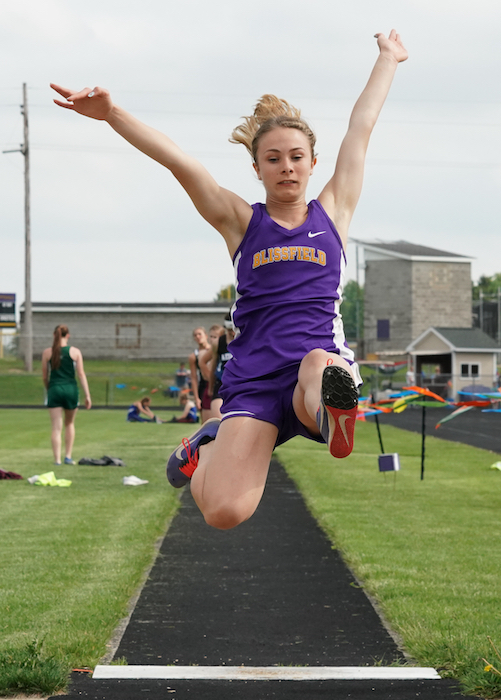 Sullins and the rest of the Royals coaching staff turned her head by concentrating on technique.
“Coach Sullins has a lot of knowledge about track in general,” she said. “It’s been great to work with him. Being a decathlete, he knows about every event.”
One of the techniques she learned was to count steps rather than just look for her mark when starting to sprint as she approaches the long jump platform.
“I use an 11-step approach,” she said. “I count 11 strides, and I lift off.”
She counts down in her head every time her left foot hits the ground.
“I jump when I’m at one,” she said. “I don’t have to worry where I’m at. It took a little bit to get used to, but it makes everything easier.”
She has scratched on occasion, but she trusts in her ability to take equal strides and count the 11 steps during her approach.
Being consistent in her events is her biggest challenge. She also takes pride in her mental approach to every event. There can be long breaks during a track meet, but she makes sure to get focused when she has to.
“Mentally, I’ve changed a lot,” she said. “For me, what works is to be very involved with the team and not spend my down time thinking about my event. When I start to warm up, I just envision what my jumps are going to look like. That’s my time to myself, my time to get focused.”
In between her junior and senior year of high school, she competed in a United States Track and Field Junior Olympic event in Atlanta, placing third in her division. She also had a national event in Florida. Closer to home, she entered some indoor meets in the open class in the area and trained whenever she found the opportunity to get out of the cold.
“I just tried to stay consistent all winter,” she said. “For me, technique is very important.”
Smith is looking at a few colleges, some nearby and some across the country. She’s undecided what she wants to do or where she wants to compete at the next level.
This year she intends to compete in the 100 or 200 meters and possibly some relays as well as the long jump. Her goal is to start stronger than last year and steadily improve as the season goes on and be at her best come the first weekend in June – when the MHSAA Finals take place.
“This year, my goal is to PR and get back to the state meet and place,” she said. “I have a lot of time to improve myself. That’s my main goal – to be better.”
 Doug Donnelly has served as a sports and news reporter and city editor over 25 years, writing for the Daily Chief-Union in Upper Sandusky, Ohio from 1992-1995, the Monroe Evening News from 1995-2012 and the Adrian Daily Telegram since 2013. He's also written a book on high school basketball in Monroe County and compiles record books for various schools in southeast Michigan. E-mail him at [email protected] with story ideas for Jackson, Washtenaw, Hillsdale, Lenawee and Monroe counties.
PHOTOS (Top) Annabelle Smith, right, and credits her Blissfield coach Calvin Sullins with helping her become a championship long jumper. (Middle) Smith jumps during the 2019 Lenawee County Championships. (Top photo courtesy of the Smith family; middle photo by Mike Dickie.)