


Classes Still Create Hoosier Hysteria
July 27, 2017
By Rob Kaminski
MHSAA benchmarks editor
This is the fourth part in a series on MHSAA tournament classification, past and present, that will be published over the next two weeks. This series originally ran in this spring's edition of MHSAA benchmarks.
Twenty years ago, Bloomington North High School won the Indiana High School Athletic Association boys basketball championship, defeating Delta 75-54 at the RCA Dome in Indianapolis.
The date, March 22, 1997, is at the same time revered and disdained by traditionalists in the state who saw it as the last schoolboy championship game the state would ever host.
That’s how devout the game of basketball, particularly interscholastic basketball, had become in the Hoosier state during the 87 years a state champion – one state champion, to be precise – was crowned.
Following that 1997 season, the IHSAA moved to a four-class system for its roundball tournaments, like so many of its state association counterparts had done years earlier.
It would be shocking to find more than a small percentage of current high school basketball players around the country unfamiliar with the iconic movie Hoosiers, even though the film is now more than 30 years old.
And, the storyline for that blockbuster unfolded more than 30 years prior to its release, when small-town, undermanned Milan High School defeated Muncie Central High School 32-30 in the 1954 IHSAA title game.
Perhaps it’s because of the David vs Goliath notion, or the fame of the movie that replaced Milan with the fictional Hickory and real-life star Bobby Plump with Hollywood hero Jimmy Chitwood, or the simple fact that Indiana had something other states didn’t.
Whatever the reason, plenty of opposition remains to this day to basketball classification in the state.
The fact is, the small rural schools were regularly being beaten handily by the much larger suburban and city schools as the tournament progressed each season.
Small schools also were closing at a rapid rate following the state’s School Reorganization Act in 1959, as students converged on larger, centralized county schools. From 1960 to 2000, the number of schools entering the tournament dropped from 694 to 381, and in 1997 a total of 382 schools and 4,584 athletes began competition at the Sectional level (the first level of the IHSAA Basketball Tournament).
It was at the entry level of the tournament where school administrators felt the pain of the new class system, but not necessarily for the same nostalgic reasons as the fans who either attended or boycotted the tournament.
At the Sectional round of the tournament, the IHSAA was culling just 2 percent of the revenue, with the participating schools splitting the balance. So, when Sectional attendance dropped by 14 percent in that first year of class basketball, many schools realized a financial loss. It was money they had grown to count on in prior years to help fund various aspects of the department.
Schools cumulatively received more than $900,000 from Sectional competition in 1998, but that total was down from more than $1 million in the last year of the single-class tournament.
Yet, the current format provides a great deal more opportunity and realistic chances at championship runs for schools of all enrollments.
To date, 60 additional teams have championship or runner-up trophies on display in school trophy cases around Indiana.
That was the mission in front of then-IHSAA commissioner Bob Gardner (now National Federation executive director) once the board made its decision: to give thousands more student-athletes the opportunity for once-in-a-lifetime experiences.
As any statistician knows, figures can be manipulated to tell any side of a story. Declining attendance in year one of class basketball is such a number.
The truth is tournament attendance had been on a steady downward spiral since its peak of just over 1.5 million in 1962. By the last single-class event in 1997, the total attendance was half that.
The challenge then and today, as it is for all state associations, is to find that delicate balance for those holding onto tradition, those holding onto trophies, and the number of trophies to hand out.
Editor’s Note: Stories from the Fort Wayne Journal Gazette in 1998 and from a 2007 issue of Indianapolis Monthly provided facts in this article.
Pioneer Meets Lofty Expectations with Another Trophy Finish
By
Scott DeCamp
Special for MHSAA.com
March 12, 2022
HOLLAND – Nothing gets the attention of Ann Arbor Pioneer’s swimmers quicker than a glance up at the state championship banners in their home facility.
The piercing whistle of Pioneers coach Stefanie Kerska might be a close second, however.
Pioneer’s boys swimming & diving team made some more noise this weekend at Holland Aquatic Center, capped by another championship in runaway fashion at the MHSAA’s Lower Peninsula Division 1 Finals on Saturday.
On the strength of their depth and relays, the Pioneers amassed 365 points. Northville was runner-up with 267 points, followed by Holland West Ottawa in third (195), Saline fourth (187.50) and Macomb Dakota fifth (157).
It was the second-straight boys Finals title for Pioneer and Kerska. The Pioneers’ girls team, also coached by Kerska, captured a second consecutive championship in November at the Holland facility.
“They walk in every day to a facility that has multiple, multiple, dozens of banners on the wall and they know. We have alumni come back to speak about the program and what it means. There is a lot of pressure – people don’t realize that,” Kerska said about her boys team.
“There is a daily pressure on these guys to not only be the best here, but to live up to what’s come before them. I know I feel it, walking into my office every day. I’ve got a picture of Liz and Denny Hill on my desk, and I just try to be what they were.”
Under the Hills, Pioneer captured 15 Division 1 or Class A Finals titles in boys swimming and 16 more on the girls’ side. Kerska and the Pioneers certainly have kept that championship tradition afloat with four more titles between the boys and girls teams the last two years.
Kerska also learned from Denny Hill, her mentor, how handy the shrieking whistle across a noisy natatorium can be. When she does it, the Pioneers tend to stop in their tracks on the pool deck. They can hear her in the pool, too, and take their cues.
“I’ve been doing it for a long time. Actually, Denny Hill tried to teach me how to do it without my fingers, which is probably the better way, especially with COVID, to do it,” Kerska said with a smile. “I’ve been doing it for years and years and years. Although, I think I do have the same shrillness and tone that he did, so I’m trying to follow in his footsteps.
“We kind of do, like, the Von Trapps: Wherever they are on the pool deck, when they hear my whistle, they look. It comes in very handy with 17 boys.”
Kerska’s boys answered the call. Seniors Ryan Hume and Jack Wilkening led the way for Pioneer.
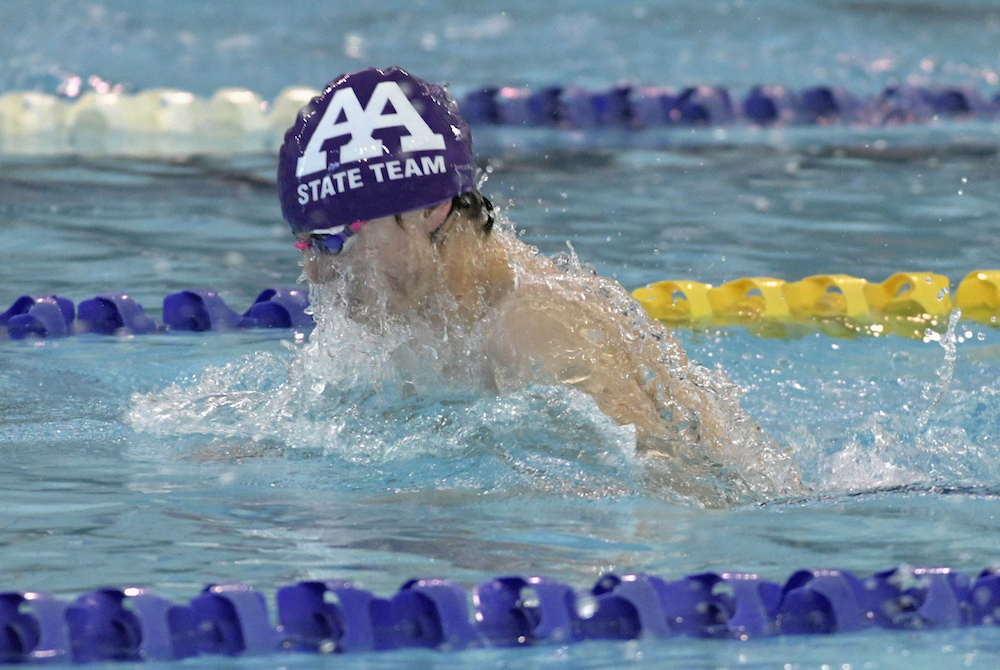
Hume repeated in the 200-yard individual medley (1:49.44) and he also won the 500 freestyle (4:26.65) after finishing runner-up in the latter event last year. Wilkening captured first place in the 100 free (45.06) and swam a leg on the victorious 200 medley relay (1:31.91) along with seniors Robert Yang and Alex Farmer plus junior Gabriel Sanchez-Burks.
Hume and Wilkening also joined Yang and senior Harrison Sanders on the Pioneers’ winning 400 free relay (3:03.99), which closed the Finals meet with an exclamation point.
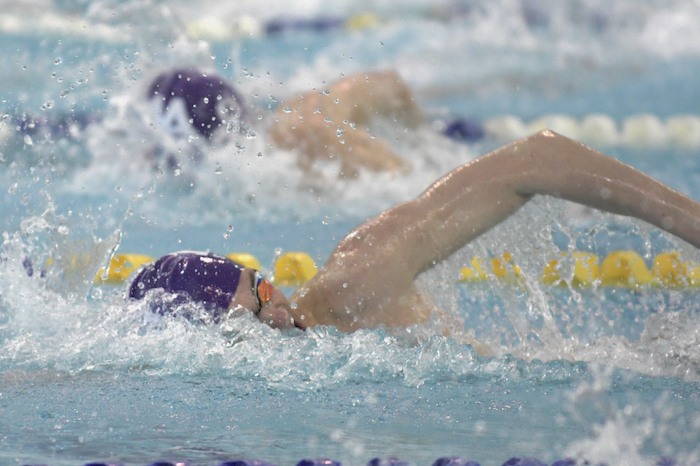
Pioneer senior Teodor Jaworski captured the title in the 200 free (1:39.45), and he took second in the 500 free behind teammate Hume. Wilkening also placed second in the 100 backstroke.
 “It’s all about the team. I had to have (a strong) relay for the team and I was performing for the team at that point,” said Wilkening, who signed to swim at University of Michigan.
As a member of back-to-back state title teams, Wilkening said this one was a little more special, mostly because things were a lot closer to “normal” in comparison to 2021.
Last season was shortened amid the COVID-19 pandemic.
“Last year was a crazy year for swimming in particular, men’s swimming, just because of how shortened our season was, how different everything was – the training, too,” Wilkening said.
“We really got to become a team again, I think. That’s what really set this one apart. We actually got to bond as one, be as one in total, more than last year.”
As Wilkening put it, being surrounded by the “greatness” of high-achieving coaches and peers has driven him and his teammates to achieve at this high level.
Sanchez-Burks can vouch for that. He is not a year-round swimmer like many others in the Pioneer program, as he also focuses his attention to water polo – but he played a key role for his team.
Sanchez-Burks was especially pleased by his runner-up finish in the 50 free, which established a school record with a time of 20.60.
“It’s been a struggle for me to keep up with everybody,” Sanchez-Burks said. “In practice, I always try to push myself to stay with all the year-round swimmers and I always try to push myself to stay with all the people I’m competing against today. It’s a lot of fun.
“All the relays, I think that’s where we strive because we have such a diverse team – we spread out so many good swimmers.”
Other first-place finishes belonged to West Ottawa senior Kevin Maas in the 50 free (20.58), Saline senior Joshua Brunty in the 100 breaststroke (55.85), Rochester senior Jack VanHowe in the 100 backstroke (48.13), Canton junior Ryan Gurgel in the 100 butterfly (49.34), Waterford Mott junior Alex Poulin in 1-meter diving (456.70), and Northville’s 200 free relay team (1:23.88) of Evan Scotto-DiVetta, Kyle McCullough, Nate Obrigkeit and Leonardo Simoncini.
Maas, who also is taking his swimming talents to U-M, was a back-to-back winner in the 50 free. Last year, he swam on the winning 200 free relay and tied for second in the 100 free.
On Saturday, VanHowe repeated in the backstroke.
“It was super emotional and super electric in so many ways,” Maas said about his performance Saturday in a venue that’s very familiar to him. “I never knew I could be so happy and so energetic after dropping only 0.02 (in the 50 free), but just to get the ‘W’ for the team and repeat for my team and my family, it meant a lot to me and I was emotional.
“That was the happiest I’ve ever been, and it felt so good.”
PHOTOS (Top) Robert Yang swims the third leg of the winning 200 medley relay for Ann Arbor Pioneer. (Middle) Pioneer’s Teodor Jaworski pulls to the front on the way to winning the 200 freestyle. (Click for more from HighSchoolSportsScene.com.)