


Classes Still Create Hoosier Hysteria
July 27, 2017
By Rob Kaminski
MHSAA benchmarks editor
This is the fourth part in a series on MHSAA tournament classification, past and present, that will be published over the next two weeks. This series originally ran in this spring's edition of MHSAA benchmarks.
Twenty years ago, Bloomington North High School won the Indiana High School Athletic Association boys basketball championship, defeating Delta 75-54 at the RCA Dome in Indianapolis.
The date, March 22, 1997, is at the same time revered and disdained by traditionalists in the state who saw it as the last schoolboy championship game the state would ever host.
That’s how devout the game of basketball, particularly interscholastic basketball, had become in the Hoosier state during the 87 years a state champion – one state champion, to be precise – was crowned.
Following that 1997 season, the IHSAA moved to a four-class system for its roundball tournaments, like so many of its state association counterparts had done years earlier.
It would be shocking to find more than a small percentage of current high school basketball players around the country unfamiliar with the iconic movie Hoosiers, even though the film is now more than 30 years old.
And, the storyline for that blockbuster unfolded more than 30 years prior to its release, when small-town, undermanned Milan High School defeated Muncie Central High School 32-30 in the 1954 IHSAA title game.
Perhaps it’s because of the David vs Goliath notion, or the fame of the movie that replaced Milan with the fictional Hickory and real-life star Bobby Plump with Hollywood hero Jimmy Chitwood, or the simple fact that Indiana had something other states didn’t.
Whatever the reason, plenty of opposition remains to this day to basketball classification in the state.
The fact is, the small rural schools were regularly being beaten handily by the much larger suburban and city schools as the tournament progressed each season.
Small schools also were closing at a rapid rate following the state’s School Reorganization Act in 1959, as students converged on larger, centralized county schools. From 1960 to 2000, the number of schools entering the tournament dropped from 694 to 381, and in 1997 a total of 382 schools and 4,584 athletes began competition at the Sectional level (the first level of the IHSAA Basketball Tournament).
It was at the entry level of the tournament where school administrators felt the pain of the new class system, but not necessarily for the same nostalgic reasons as the fans who either attended or boycotted the tournament.
At the Sectional round of the tournament, the IHSAA was culling just 2 percent of the revenue, with the participating schools splitting the balance. So, when Sectional attendance dropped by 14 percent in that first year of class basketball, many schools realized a financial loss. It was money they had grown to count on in prior years to help fund various aspects of the department.
Schools cumulatively received more than $900,000 from Sectional competition in 1998, but that total was down from more than $1 million in the last year of the single-class tournament.
Yet, the current format provides a great deal more opportunity and realistic chances at championship runs for schools of all enrollments.
To date, 60 additional teams have championship or runner-up trophies on display in school trophy cases around Indiana.
That was the mission in front of then-IHSAA commissioner Bob Gardner (now National Federation executive director) once the board made its decision: to give thousands more student-athletes the opportunity for once-in-a-lifetime experiences.
As any statistician knows, figures can be manipulated to tell any side of a story. Declining attendance in year one of class basketball is such a number.
The truth is tournament attendance had been on a steady downward spiral since its peak of just over 1.5 million in 1962. By the last single-class event in 1997, the total attendance was half that.
The challenge then and today, as it is for all state associations, is to find that delicate balance for those holding onto tradition, those holding onto trophies, and the number of trophies to hand out.
Editor’s Note: Stories from the Fort Wayne Journal Gazette in 1998 and from a 2007 issue of Indianapolis Monthly provided facts in this article.
Jack Pine Powers Shepherd, Gladwin Sweep D3 Championships
By
Tim Robinson
Special for MHSAA.com
March 5, 2022
JACKSON — Dave Carson’s Shepherd girls team had been knocking off higher seeds all afternoon long, but seemed to hit a wall against Cheboygan in Friday’s Division 3 Girls Bowling Final.
“After the two baker games, we were up by about 60 pins, he said. “In the fifth frame, we were still up by about 30, and I pulled my girls together and I told them, ‘Forget about how the first five frames went. I don’t care about your scores now. Just win me the last five frames.’ And they did.”
As a result, the Bluejays, who had never competed in the MHSAA Tournament, or even won a conference championship, are Finals champions.
“It was closer than it needed to be,” Carson joked.
The Bluejays, who squeaked into the quarterfinals by 18 pins over Boyne City, ousted top seed Kent City by 12 pins and No. 4 seed Flint Powers by 23 before downing sixth-seeded Cheboygan in the final, 1,041-987.
“We started faltering a bit in the middle of the last game,” Carson said. “They were getting tired. Both teams did. You could see it. We just weathered the storm a little longer than they did.”
It was the first bowling state title for Shepherd, and Carson admitted it came as a surprise to him.
“They had the potential to do it,” he said. “They had the potential last year, but didn’t gel as a team. This year, they gelled as a team all season.”
The Bluejays won the Jack Pine Conference title for the first time, then finished third in their Regional to punch a ticket to Jax 60, site of the Finals.
There was a certain bit of familial ties as well.
Carson’s cousin, Kendra Walch, was one of the Bluejays’ top bowlers, and he went to high school with Josh King, the coach at Mid-Michigan Community College whose daughter Amelia was a team member.
Amelia King was in the starting lineup for Shepherd, while Walch rolled a 187 to lead Shepherd in the final. Walch and Sara Montney took turns leading the team throughout the day.
“I told them throughout the season they had the potential to do it,” Carson said. “This was beyond my expectations to bring a team here the first year and win the whole thing.”
The future looks bright for Shepherd. Montney is a sophomore and Walch a junior.
“It’s a great feeling,” Carson said, laughing. “Everything seemed to come together this year. They started acting as a team, more than as individuals.”
Shelby Rolston was the only senior on this year’s Shepherd team.
“I’ve had her for four years and watched her grow,” Carson said. “It all came together, and I’m glad I was able to win it with her.”
It was the first trip to the final for Cheboygan as well. The Chiefs downed No. 3 Jonesville by 30 pins and rolled past No. 2 Hudsonville Unity Christian in the semifinals.
Jenna Knaffle had a game-high 210 and Izzy Portman rolled a 171 for Cheboygan.
Gladwin’s boys bowling team was the top seed after qualifying and the Flying G’s acted like it down the stretch, beating Midland Bullock Creek by a wide margin to take their second Finals title in four years.
 “The first match (against eighth-seeded Armada) was kind of close,” Gladwin coach Kent Crawford said, “but we persevered and kept picking up spares.”
Gladwin then dispatched Standish-Sterling by 126 pins in the semifinals before taking the title with a 1,287-1,110 victory over Bullock Creek.
It was the third overall Finals title – all sports included – for the Flying G’s, who won the Class C girls basketball title in 1975.
Friday’s title had a family connection. Ethan Weston was on the 2019 champ, while Brady Weston is a mainstay on a Gladwin team that saw four bowlers roll a score of 200 or more. Weston had a 200 in the final.
But it was a freshman who led Gladwin on Friday.
Brayden Phillips rolled a 211, second only to JR Phillips’ 225. Gladwin rolled a 993 as a team in the final round, which was more than enough to overcome a 72-pin deficit after Baker play.
“We said, ‘Man, we need to get to work,” Crawford said. “They’re going to give us a run for our money. They were ahead of us for a little while until about the fifth frame, and then we started striking and you could tell they were getting fatigued.”
Meanwhile, the Flying G’s were getting a little too quiet for Crawford’s taste.
“I started to raise my voice to keep them pumped up,'' Crawford said. “Our guys started to sit down, and I said, ‘Boys, you’ve got to stand up. Let’s go!’ I wanted to keep everyone moving, and they came through. They started striking and having a good time and hollering and yelling and we passed them.”
But, Crawford said, the match wasn’t decided until the 10th frame.
“It could have gone either way if (Bullock Creek) had gotten more strikes,” he said.
Instead, the Flying G’s went home with a trophy and Crawford with a good feeling about Brayden Phillips, whom he called his “horse.”
“He kind of came out of the woodwork,” Crawford said. “He was getting spares and strikes, and he was just on course today.”
Crawford feels good knowing he’ll have Phillips for three more seasons.
“Especially with him,” Crawford said. “The rest of the group is sophomores, so I get a couple more years with them, too.”
The Flying G’s finished second in the Jack Pine Conference.
Gladwin lost to Sanford Meridian in league play, but got its measure of revenge during qualifying. Meridian was the No. 7 seed, but was eliminated by Madison Heights Bishop Foley in the quarterfinals.
The key, Crawford said, is team chemistry.
“Most of these boys have grown up together,” he said. “Most of them are sophomores. They’ve played football together since they were 5 or 6 years old. They hang out together. They support each other 110 percent.”
Coaching is a cooperative affair as well.
Crawford, who describes himself as “the CEO,” is assisted by Dan Hagar and Kevin Van Tiem.
Bullock Creek, which was in its first Final, got there as the No. 6 seed.
The Lancers downed No. 3 Jonesville and No. 2 seed Bishop Foley to advance.
Cole Gilbert had a 158 to pace the Lancers, who saw four of their five bowlers roll a 150 or better in the final.
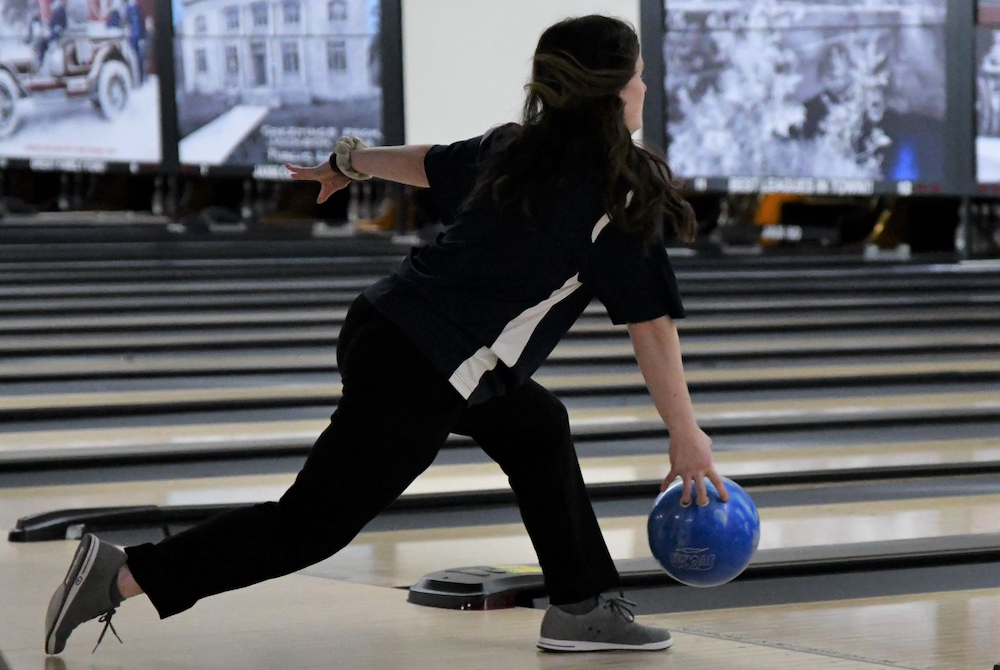
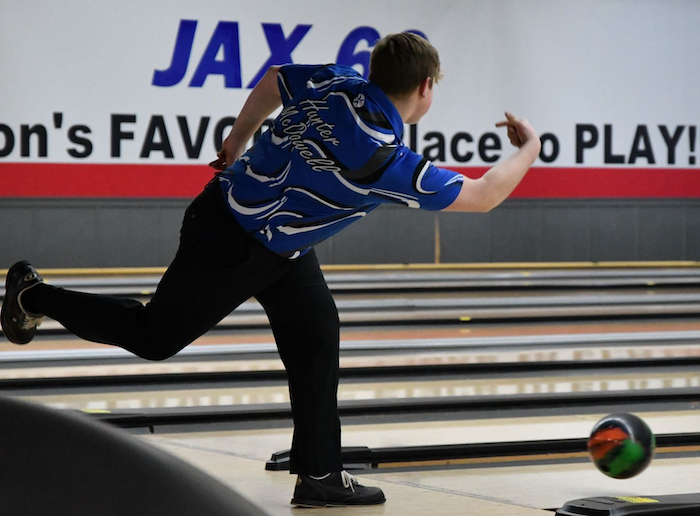
PHOTOS Shepherd and Gladwin bowlers send shots during Friday's Division 3 Team Finals at Jax 60. (Click to see more from Champions Photography.)