


Classes Still Create Hoosier Hysteria
July 27, 2017
By Rob Kaminski
MHSAA benchmarks editor
This is the fourth part in a series on MHSAA tournament classification, past and present, that will be published over the next two weeks. This series originally ran in this spring's edition of MHSAA benchmarks.
Twenty years ago, Bloomington North High School won the Indiana High School Athletic Association boys basketball championship, defeating Delta 75-54 at the RCA Dome in Indianapolis.
The date, March 22, 1997, is at the same time revered and disdained by traditionalists in the state who saw it as the last schoolboy championship game the state would ever host.
That’s how devout the game of basketball, particularly interscholastic basketball, had become in the Hoosier state during the 87 years a state champion – one state champion, to be precise – was crowned.
Following that 1997 season, the IHSAA moved to a four-class system for its roundball tournaments, like so many of its state association counterparts had done years earlier.
It would be shocking to find more than a small percentage of current high school basketball players around the country unfamiliar with the iconic movie Hoosiers, even though the film is now more than 30 years old.
And, the storyline for that blockbuster unfolded more than 30 years prior to its release, when small-town, undermanned Milan High School defeated Muncie Central High School 32-30 in the 1954 IHSAA title game.
Perhaps it’s because of the David vs Goliath notion, or the fame of the movie that replaced Milan with the fictional Hickory and real-life star Bobby Plump with Hollywood hero Jimmy Chitwood, or the simple fact that Indiana had something other states didn’t.
Whatever the reason, plenty of opposition remains to this day to basketball classification in the state.
The fact is, the small rural schools were regularly being beaten handily by the much larger suburban and city schools as the tournament progressed each season.
Small schools also were closing at a rapid rate following the state’s School Reorganization Act in 1959, as students converged on larger, centralized county schools. From 1960 to 2000, the number of schools entering the tournament dropped from 694 to 381, and in 1997 a total of 382 schools and 4,584 athletes began competition at the Sectional level (the first level of the IHSAA Basketball Tournament).
It was at the entry level of the tournament where school administrators felt the pain of the new class system, but not necessarily for the same nostalgic reasons as the fans who either attended or boycotted the tournament.
At the Sectional round of the tournament, the IHSAA was culling just 2 percent of the revenue, with the participating schools splitting the balance. So, when Sectional attendance dropped by 14 percent in that first year of class basketball, many schools realized a financial loss. It was money they had grown to count on in prior years to help fund various aspects of the department.
Schools cumulatively received more than $900,000 from Sectional competition in 1998, but that total was down from more than $1 million in the last year of the single-class tournament.
Yet, the current format provides a great deal more opportunity and realistic chances at championship runs for schools of all enrollments.
To date, 60 additional teams have championship or runner-up trophies on display in school trophy cases around Indiana.
That was the mission in front of then-IHSAA commissioner Bob Gardner (now National Federation executive director) once the board made its decision: to give thousands more student-athletes the opportunity for once-in-a-lifetime experiences.
As any statistician knows, figures can be manipulated to tell any side of a story. Declining attendance in year one of class basketball is such a number.
The truth is tournament attendance had been on a steady downward spiral since its peak of just over 1.5 million in 1962. By the last single-class event in 1997, the total attendance was half that.
The challenge then and today, as it is for all state associations, is to find that delicate balance for those holding onto tradition, those holding onto trophies, and the number of trophies to hand out.
Editor’s Note: Stories from the Fort Wayne Journal Gazette in 1998 and from a 2007 issue of Indianapolis Monthly provided facts in this article.
Jackson's Janke Recalled as 'Larger than Life,' Always Willing to Help
By
Doug Donnelly
Special for MHSAA.com
January 26, 2022
JACKSON – A few days before Christmas, Jackson boys track & field head coach Corey Pryor was called to meet with Charles Janke, the longtime former Jackson coach and teacher.
 Janke was very ill and in the final days of his life. Janke, it turns out, wasn’t leaving anything to chance.
“He asked me if the stadium was ready for our big track meet, the one named after him,” Pryor said. “Believe it or not, that’s what he asked. He was always so organized and meticulous. He wanted to make sure everything was always on schedule.
“I am grateful for getting the chance to spend a few more moments with him.”
Janke, 85, died Dec. 30 at Henry Ford Allegiance Hospice Home in Jackson.
Janke was a track and cross country coach for Jackson who was recognized statewide for his commitment to high school athletics, student athletes and the two sports he loved the most. Although he retired from coaching nearly two decades ago, he remained very involved in high school sports. He was a leader in both sports across the state, a giant in the high school running community.
A Detroit native who went to Central Michigan University to play football, Janke had short stints at Southfield and Milford schools before moving to Jackson where he taught history and physical education. Although he got his start as a football coach, at Jackson he took over the track and cross country programs in 1966. He pulled double duty for years before stepping down as track coach in 1990, but he continued with cross country through 2003 while helping coach the distance runners in track for several more years.
If it involved track & field or cross country in Michigan, Janke was probably involved. He was an early pioneer in the Michigan Interscholastic Track Coaches Association, the first statewide sports-specific association for coaches in the state. He founded several events, including the first countywide cross country meet in Jackson. He hosted, organized and gave presentations at coaching clinics for years and in the early 1970s helped organize indoor track & field meets through MITCA by contacting colleges across the state to see if they were interested in hosting events. He also was the first to publish a MITCA newsletter.
In cross country, he was among those who played a role in bringing all four classes together for a Lower Peninsula championship meet at Michigan International Speedway in Brooklyn. He helped with the event long after coaching. He also served as head field events judge at Big Ten Indoor Championships and became a high school official after retiring as head coach.
His passion for the sport was evident.
“He had a genuine love for the sport,” Pryor said. “He always had his way of doing things. He was a special kind of guy.”
When Pryor was a high school sprinter at Jackson, Janke was an assistant coach who mainly worked with long distance runners.
“He coached hard,” Pryor said, adding that he never fully appreciated Coach Janke until later in life and especially after he became track coach. Pryor found pages and pages of handwritten notes with dates, times and athletes’ names.
“He even wrote down the weather,” Pryor said.
He and Janke had a lot of discussions, often over breakfast, about track events.
“He would be at almost all of the meets,” Pryor said. “He learned every kid by name. He told them he wanted to see them at the state meet. I welcomed him with open arms. When I began to see just what he meant to our state, I realized this guy was a diamond.
“I was blessed to see him behind the curtain. I saw he was the type of guy who really cared about people and wanted to see them succeed. He was more than a coach.”
Vandercook Lake cross country coach Dan Roggenbaum is one of several from the Jackson area who would seek out Janke for advice and mentorship. He said Janke approached officiating with the same rigor and commitment he did coaching.
“Charlie was always willing to help me out with any questions I ever had,” he said. “He was larger than life to me and most other coaches in our county. He was always willing to help and give advice to any of us who were a lot newer to the cross country and track & field scene.”
Two things Janke was most proud of was Withington Stadium in Jackson and the cross country course at Ella Sharp Park named after him.
“I always admired his love and passion for cross country, track & field,” said Ben Pack, now a coach and administrator at Manchester, but once a shot and discus thrower for Janke. “On days of track meets he would have the track set up before the school day started, with the blocks at the starting line, the hurdles stacked along the track to be placed for the first hurdle race, and the throws event areas lined. Every detail for the practices and meets were paid attention to.
“He didn’t do this because he had to do it; he did it because he loved doing it. He always wanted everything to be first class.”
Janke was admittedly a tough coach.
In winning the Al Cotton Award for his dedication to Jackson athletics, the Jackson Citizen-Patriot wrote this about Janke in 2003: “One does not need to talk to many of Janke's athletes or listen very long to get a clear picture of the type of coach he was. He was intense. He was in charge. He demanded respect and he expected the best, and he received a huge measure of both from those who followed his regimen.”
Janke was inducted into both the Michigan High School Coaches Association Hall of Fame and the MITCA Hall of Fame.
Pack said, “During high school we had a sign that read, ‘The mind controls the body.’ In PE strength class we often did exercises that helped us understand how much more we could push ourselves if we fought off the pain of the exercise. Without question, this built mental toughness. He taught kids how to set goals, and the step-by-step process to get to the goal.”
All told, Janke spent more than 60 years involved in track and cross country. His impact will roll on in both sports. A number of former athletes have gone on to become teachers and coaches themselves, like Pack, who not only was an athlete for Janke but coached alongside him. Pack served as Jackson’s varsity football coach from 1987-2002 and again in 2012.
“As peers we often would guide kids to each other’s sports,” Pack said. “Kids that I felt would be better at running cross country, I sent to him. Kids that he felt would be good football players he sent to me. Working together was an honor.”
Jim Martin ran for Janke at Jackson in the 1970s. He’s now in his 36th year coaching track and cross country, the last 26 at Sault Ste. Marie High School. He said he’s a coach today because of the impact Janke had on him.
“At a time in my life that I needed structure and guidance, he was the rock,” Martin said. “He was always there. There's no way I'm in this (coaching) 35 years without him. He was my role model. He cannot be replaced.”
Last fall, Martin took his Sault Ste. Marie team to Jackson for the Charles Janke Invitational. His Blue Devils team won. Going into the meet, he didn’t think that was possible.
“For the life of me I couldn’t figure out how we won that,” Martin said. “We were good, but not Jackson good. … That was the last time Coach Janke saw my team. Now I know why.”
A Celebration of Life service will be held at 2 p.m. on June 12, 2022, at, appropriately, Withington Stadium.
 Doug Donnelly has served as a sports and news reporter and city editor over 25 years, writing for the Daily Chief-Union in Upper Sandusky, Ohio from 1992-1995, the Monroe Evening News from 1995-2012 and the Adrian Daily Telegram since 2013. He's also written a book on high school basketball in Monroe County and compiles record books for various schools in southeast Michigan. E-mail him at [email protected] with story ideas for Jackson, Washtenaw, Hillsdale, Lenawee and Monroe counties.
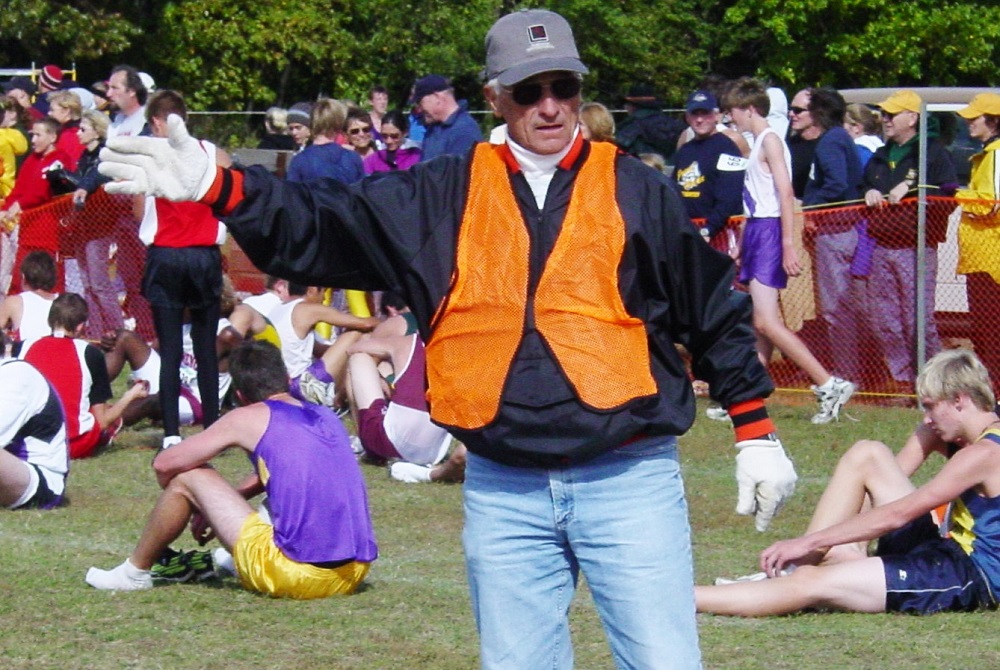
PHOTO: Charles Janke coaches his Jackson team during a cross country meet in 2003. (Photo by John Johnson.)