


Classes Still Create Hoosier Hysteria
July 27, 2017
By Rob Kaminski
MHSAA benchmarks editor
This is the fourth part in a series on MHSAA tournament classification, past and present, that will be published over the next two weeks. This series originally ran in this spring's edition of MHSAA benchmarks.
Twenty years ago, Bloomington North High School won the Indiana High School Athletic Association boys basketball championship, defeating Delta 75-54 at the RCA Dome in Indianapolis.
The date, March 22, 1997, is at the same time revered and disdained by traditionalists in the state who saw it as the last schoolboy championship game the state would ever host.
That’s how devout the game of basketball, particularly interscholastic basketball, had become in the Hoosier state during the 87 years a state champion – one state champion, to be precise – was crowned.
Following that 1997 season, the IHSAA moved to a four-class system for its roundball tournaments, like so many of its state association counterparts had done years earlier.
It would be shocking to find more than a small percentage of current high school basketball players around the country unfamiliar with the iconic movie Hoosiers, even though the film is now more than 30 years old.
And, the storyline for that blockbuster unfolded more than 30 years prior to its release, when small-town, undermanned Milan High School defeated Muncie Central High School 32-30 in the 1954 IHSAA title game.
Perhaps it’s because of the David vs Goliath notion, or the fame of the movie that replaced Milan with the fictional Hickory and real-life star Bobby Plump with Hollywood hero Jimmy Chitwood, or the simple fact that Indiana had something other states didn’t.
Whatever the reason, plenty of opposition remains to this day to basketball classification in the state.
The fact is, the small rural schools were regularly being beaten handily by the much larger suburban and city schools as the tournament progressed each season.
Small schools also were closing at a rapid rate following the state’s School Reorganization Act in 1959, as students converged on larger, centralized county schools. From 1960 to 2000, the number of schools entering the tournament dropped from 694 to 381, and in 1997 a total of 382 schools and 4,584 athletes began competition at the Sectional level (the first level of the IHSAA Basketball Tournament).
It was at the entry level of the tournament where school administrators felt the pain of the new class system, but not necessarily for the same nostalgic reasons as the fans who either attended or boycotted the tournament.
At the Sectional round of the tournament, the IHSAA was culling just 2 percent of the revenue, with the participating schools splitting the balance. So, when Sectional attendance dropped by 14 percent in that first year of class basketball, many schools realized a financial loss. It was money they had grown to count on in prior years to help fund various aspects of the department.
Schools cumulatively received more than $900,000 from Sectional competition in 1998, but that total was down from more than $1 million in the last year of the single-class tournament.
Yet, the current format provides a great deal more opportunity and realistic chances at championship runs for schools of all enrollments.
To date, 60 additional teams have championship or runner-up trophies on display in school trophy cases around Indiana.
That was the mission in front of then-IHSAA commissioner Bob Gardner (now National Federation executive director) once the board made its decision: to give thousands more student-athletes the opportunity for once-in-a-lifetime experiences.
As any statistician knows, figures can be manipulated to tell any side of a story. Declining attendance in year one of class basketball is such a number.
The truth is tournament attendance had been on a steady downward spiral since its peak of just over 1.5 million in 1962. By the last single-class event in 1997, the total attendance was half that.
The challenge then and today, as it is for all state associations, is to find that delicate balance for those holding onto tradition, those holding onto trophies, and the number of trophies to hand out.
Editor’s Note: Stories from the Fort Wayne Journal Gazette in 1998 and from a 2007 issue of Indianapolis Monthly provided facts in this article.
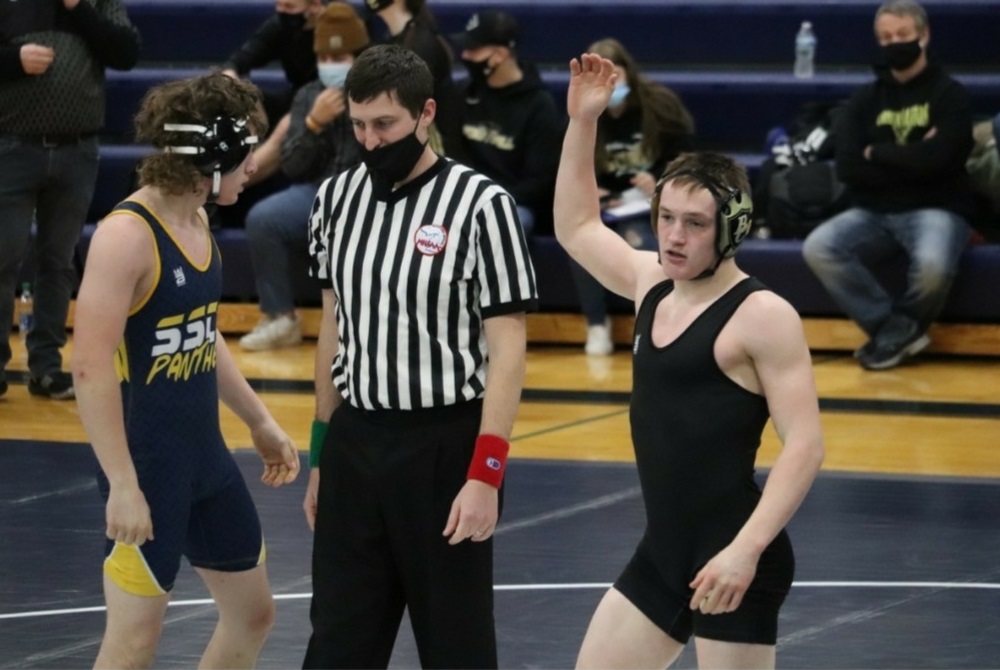
Bullock Creek's Brooks Turns Heartbreak Into Motivation
By
Paul Costanzo
Special for MHSAA.com
December 9, 2021
It didn’t take long for Peyton Brooks to turn disappointment into motivation.
 This past spring, he was undefeated and ranked No. 1 in Division 3 at 152 pounds, but on the day before the Regional tournament, the Bullock Creek star had his junior season cut short because of a positive COVID-19 test on the team.
“I got home, and I was kind of disappointed and I was really down on myself for about a day,” Brooks said. “I saw no point in feeling that way, so I actually started using that feeling to better myself for the next year.”
It’s now next year, and Brooks – a Finals runner-up in 2020 – is focused on putting himself in a position to finish what he started and reach the top of the podium.
“I think I’ve been putting a little bit of extra work in, going harder in practice,” he said. “I want to make sure I do everything right. I know it’s my senior year, and it’s my last chance to win a state championship, so I want to do everything to make sure that happens.”
Brooks seemed to have done all he could a year ago, as well. He was 24-0 through the Individual District, and had helped lead Bullock Creek to its first Team District title in 10 years. In the District Final, he defeated Sanford Meridian’s Nick Dodman 5-2. Dodman went on to win the Individual Finals title at 152.
But as the Lancers were going through their final day of preparation for the Individual Regional, one team member’s rapid test came back positive. The timing meant there was no way for Brooks, or his teammates who were close contacts, to get cleared.
“Last year was a crazy year all the way around,” Bullock Creek coach Alan Curtis said. “There were a lot of other teams that got hit earlier in the season than we did. We just happened to catch it at the end of the season. It’s kind of like everybody was waiting for it to happen, but hoping it didn’t. There’s really not much you can say, and it’s really nobody’s fault. It is what it is. We kind of looked at every option we had to get him down there, but when it came down to it, our hands were tied.”
While Brooks was disappointed in how things ended, he remained positive about the season.
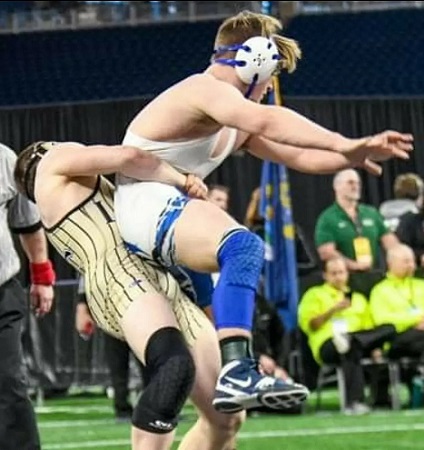 “Personally, I was just happy to have a season,” he said. “We started two or three months late – we started in February when the postseason would normally be – so I tried not to take any meet or anything for granted. I felt like I had a chance of not being able to compete at all.”
Not taking things for granted is something Brooks has carried into this winter. His work ethic has always been exemplary, Curtis said, but there is an added focus as Brooks prepares for his final wrestling season.
“Right from the first practice of the season, he stays after every practice – he gets guys to stay after and work with him,” Curtis said. “He goes through our whole practice, then he stays after another half hour with whoever he can get.”
Wrestling isn’t the only thing Brooks excels at, as he also was a standout running back and linebacker for the Bullock Creek football team. He said he’s keeping his options open in terms of playing at the next level, as he hasn’t decided which sport he will continue. Playing both, though, has been a benefit.
“I think they both helped me in both sports,” said Brooks, who also is a sprinter on the track team. “I think wrestling has helped me more with football. It’s made me a better athlete with my work ethic, athleticism, balance, speed and footwork. It’s really made me a better player.”
With his focus on football through the fall, there is the challenge of getting down to weight for Brooks. He plays at about 180 pounds on the gridiron but plans to wrestle at 160 for the majority of this season. A drop to 152 also isn’t out of the question.
“He’s one that I never have to worry about his weight,” Curtis said. “He knows what he needs to do, and he doesn’t starve himself. He does it the right way. He works out on his own at home. His work ethic is phenomenal.”
No matter the weight Brooks comes in at, he figures to be among the favorites to win an individual title. If he’s able to pull it off, he admitted the combination of it being his senior year and the events of a year ago would make it that much more special.
His coach agreed.
“I think it would be amazing,” Curtis said. “He doesn’t normally show a lot of emotion, but I think that would get to him, because he’s worked so hard.
“He should have had it last year. I don’t know if he feels like he was robbed, but he knows he should have won it last year. That’s going to give that extra drive this year to get it done.”
 Paul Costanzo served as a sportswriter at The Port Huron Times Herald from 2006-15, including three years as lead sportswriter, and prior to that as sports editor at the Hillsdale Daily News from 2005-06. He can be reached at [email protected] with story ideas for Genesee, Lapeer, St. Clair, Sanilac, Huron, Tuscola, Saginaw, Bay, Arenac, Midland and Gladwin counties.
PHOTOS (Top) Midland Bullock Creek’s Peyton Brooks, far right, raises his hand signifying a win last winter. (Middle) Brooks attempts to bring down an opponent during the 2020 Individual Finals. (Photos provided by the Bullock Creek wrestling program.)