


Classes Still Create Hoosier Hysteria
July 27, 2017
By Rob Kaminski
MHSAA benchmarks editor
This is the fourth part in a series on MHSAA tournament classification, past and present, that will be published over the next two weeks. This series originally ran in this spring's edition of MHSAA benchmarks.
Twenty years ago, Bloomington North High School won the Indiana High School Athletic Association boys basketball championship, defeating Delta 75-54 at the RCA Dome in Indianapolis.
The date, March 22, 1997, is at the same time revered and disdained by traditionalists in the state who saw it as the last schoolboy championship game the state would ever host.
That’s how devout the game of basketball, particularly interscholastic basketball, had become in the Hoosier state during the 87 years a state champion – one state champion, to be precise – was crowned.
Following that 1997 season, the IHSAA moved to a four-class system for its roundball tournaments, like so many of its state association counterparts had done years earlier.
It would be shocking to find more than a small percentage of current high school basketball players around the country unfamiliar with the iconic movie Hoosiers, even though the film is now more than 30 years old.
And, the storyline for that blockbuster unfolded more than 30 years prior to its release, when small-town, undermanned Milan High School defeated Muncie Central High School 32-30 in the 1954 IHSAA title game.
Perhaps it’s because of the David vs Goliath notion, or the fame of the movie that replaced Milan with the fictional Hickory and real-life star Bobby Plump with Hollywood hero Jimmy Chitwood, or the simple fact that Indiana had something other states didn’t.
Whatever the reason, plenty of opposition remains to this day to basketball classification in the state.
The fact is, the small rural schools were regularly being beaten handily by the much larger suburban and city schools as the tournament progressed each season.
Small schools also were closing at a rapid rate following the state’s School Reorganization Act in 1959, as students converged on larger, centralized county schools. From 1960 to 2000, the number of schools entering the tournament dropped from 694 to 381, and in 1997 a total of 382 schools and 4,584 athletes began competition at the Sectional level (the first level of the IHSAA Basketball Tournament).
It was at the entry level of the tournament where school administrators felt the pain of the new class system, but not necessarily for the same nostalgic reasons as the fans who either attended or boycotted the tournament.
At the Sectional round of the tournament, the IHSAA was culling just 2 percent of the revenue, with the participating schools splitting the balance. So, when Sectional attendance dropped by 14 percent in that first year of class basketball, many schools realized a financial loss. It was money they had grown to count on in prior years to help fund various aspects of the department.
Schools cumulatively received more than $900,000 from Sectional competition in 1998, but that total was down from more than $1 million in the last year of the single-class tournament.
Yet, the current format provides a great deal more opportunity and realistic chances at championship runs for schools of all enrollments.
To date, 60 additional teams have championship or runner-up trophies on display in school trophy cases around Indiana.
That was the mission in front of then-IHSAA commissioner Bob Gardner (now National Federation executive director) once the board made its decision: to give thousands more student-athletes the opportunity for once-in-a-lifetime experiences.
As any statistician knows, figures can be manipulated to tell any side of a story. Declining attendance in year one of class basketball is such a number.
The truth is tournament attendance had been on a steady downward spiral since its peak of just over 1.5 million in 1962. By the last single-class event in 1997, the total attendance was half that.
The challenge then and today, as it is for all state associations, is to find that delicate balance for those holding onto tradition, those holding onto trophies, and the number of trophies to hand out.
Editor’s Note: Stories from the Fort Wayne Journal Gazette in 1998 and from a 2007 issue of Indianapolis Monthly provided facts in this article.
Belleville Finds Championship Formula, Completes 1st Finals Run
By
Scott DeCamp
Special for MHSAA.com
November 27, 2021
DETROIT – Belleville’s football team found Ford Field after a series of near-misses in recent seasons. The Tigers found it much to their liking, too.
Belleville put its speed, athleticism and depth of talent on full display in a 55-33 runaway victory over Rochester Adams in the MHSAA Division 1 title game Saturday. The fast track and climate-controlled environment were ideal for the Tigers in their first-ever Finals appearance.
Freshman quarterback Bryce Underwood passed for 284 yards and five touchdowns with no interceptions, three of the scores to senior Jeremiah Caldwell as the Tigers (13-1) came within a point of tying a record for most scored in a Finals game.
“You get a bunch of athletes on a fast track and without the elements, you know, it was going to be some opportunities for Bryce …,” said Belleville coach Jermain Crowell, the former Detroit Cass Tech assistant, who is now 72-10 in seven years with the Tigers program.
The 6-foot-2, 180-pound Underwood, who is only 14 years old, finished 12-of-21 passing. He capped Belleville’s scoring with a 30-yard run in the fourth quarter when he delivered a forceful stiff-arm in the backfield to a would-be tackler.
The 6-3, 175-pound Caldwell was on the receiving end of only four passes, but the playmaker converted them into a whopping 204 yards. Underwood connected with the lanky, speedy senior on scoring strikes of 56, 64 and 72 yards, all in the first half, as Belleville entered the locker room with a 21-20 edge.
“I would say I wasn’t that nervous, I just knew that I had to come out and execute our plan and finish the football game,” Underwood said.
Belleville took control in the third quarter, when the Tigers converted two Adams turnovers into touchdowns – one on a blocked punt and the other on a fumble recovery. They led 35-20 entering the fourth quarter, and that margin never dipped below 14 points the rest of the way.
Six different players scored TDs for Belleville, illustrating Crowell’s point in the postgame press conference that it was a team effort. The Tigers had no turnovers.
“It was the team. I mean, to be honest with you, it was the team,” said Crowell, whose squads lost semifinal heartbreakers to eventual 2020 state champ West Bloomfield (35-34 in double-overtime) and Brighton in 2019 (22-19). The Tigers also lost in the 2018 semifinals to eventual state champ Clinton Township Chippewa Valley.
“All the other years, it was always about this individual guy, that individual guy, that individual guy, and it’s not high school football. That’s not how it’s supposed to be. It’s not supposed to be that way.”
 Even though Belleville’s defense surrendered 33 points, the Tigers made enough plays on that side of the ball and they did it with several players contributing.
Seniors Cameron Dyson and JaShawn Greene led Belleville’s defense with eight tackles apiece. Greene also had a forced fumble and sack, while Caldwell picked off a pass.
As much as Crowell stressed “team,” it was hard to ignore the individual talents of Underwood and Caldwell.
“I feel like it’s amazing because he’s so young,” Caldwell said about Underwood. “Once he gets to my age as a senior, it’s going to be, like, ‘Wow!’ Like, he’s doing this as a freshman now, so when he becomes a senior, it’s going to be mind-boggling.”
Said Adams coach Tony Patritto about Underwood: “His resume was pretty strong before he even got to Belleville. He can really sling it and, you know, his receivers made some big plays and a lot of yards after the catch. A lot of that’s on us.”
Adams (13-1), which went unscathed through the rugged Oakland Activities Association as well as a challenging playoff road, made some plays on Saturday, too.
Senior QB Parker Picot completed 8 of 21 passes for three TDs, four of his completions going to 6-6, 215-pound sophomore Brady Prieskorn for 117 yards and two scores.
Like Underwood, Picot was recognized at a young age for his athletic talents. He committed to University of Alabama for baseball as a freshman, but he also poured everything he had into this football season.
“Well, when it’s football season, it’s football season and this year we definitely had something special,” Picot said. “All of us players were all, you know, some of the best friends. At the start, every day (of) summer workouts, we knew we had something special and it was going to be really fun this year and I think we really held onto (it).”
Adams was seeking its first state title since 2003, which was Patritto’s first season at the helm, when the Highlanders captured the Division 2 championship.
On Saturday, it was Belleville’s time.
“I mean, it means a lot, especially to the community of Belleville,” said Caldwell, whose receiving TDs and receiving yards ties him for second in both categories in Finals history.
“It’s a new Belleville this year, so everything that happened in the past years was not happening this year. We all came together and made a change as a whole.”
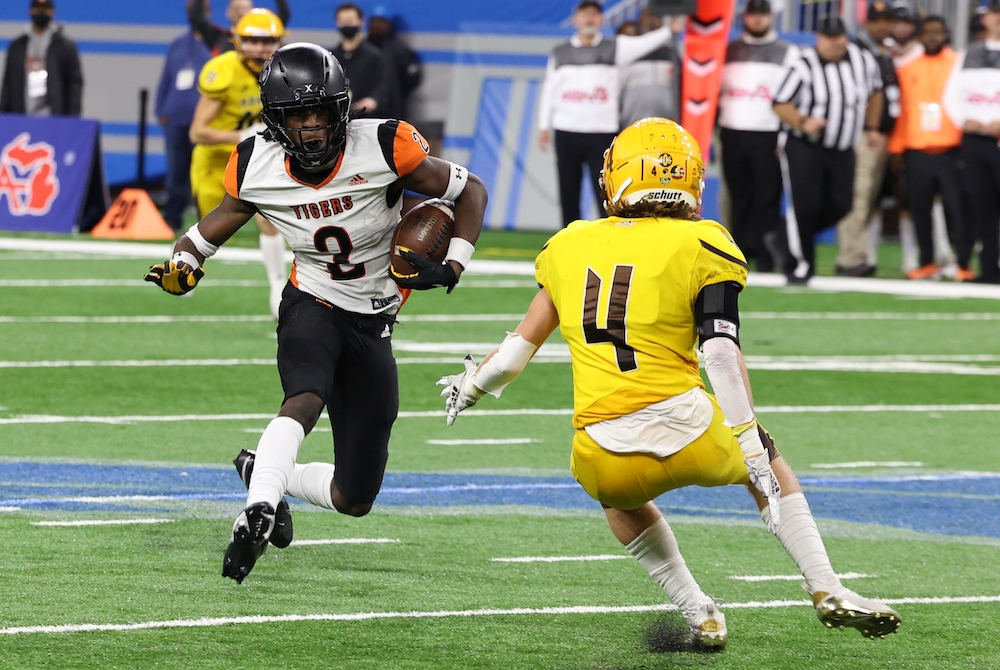
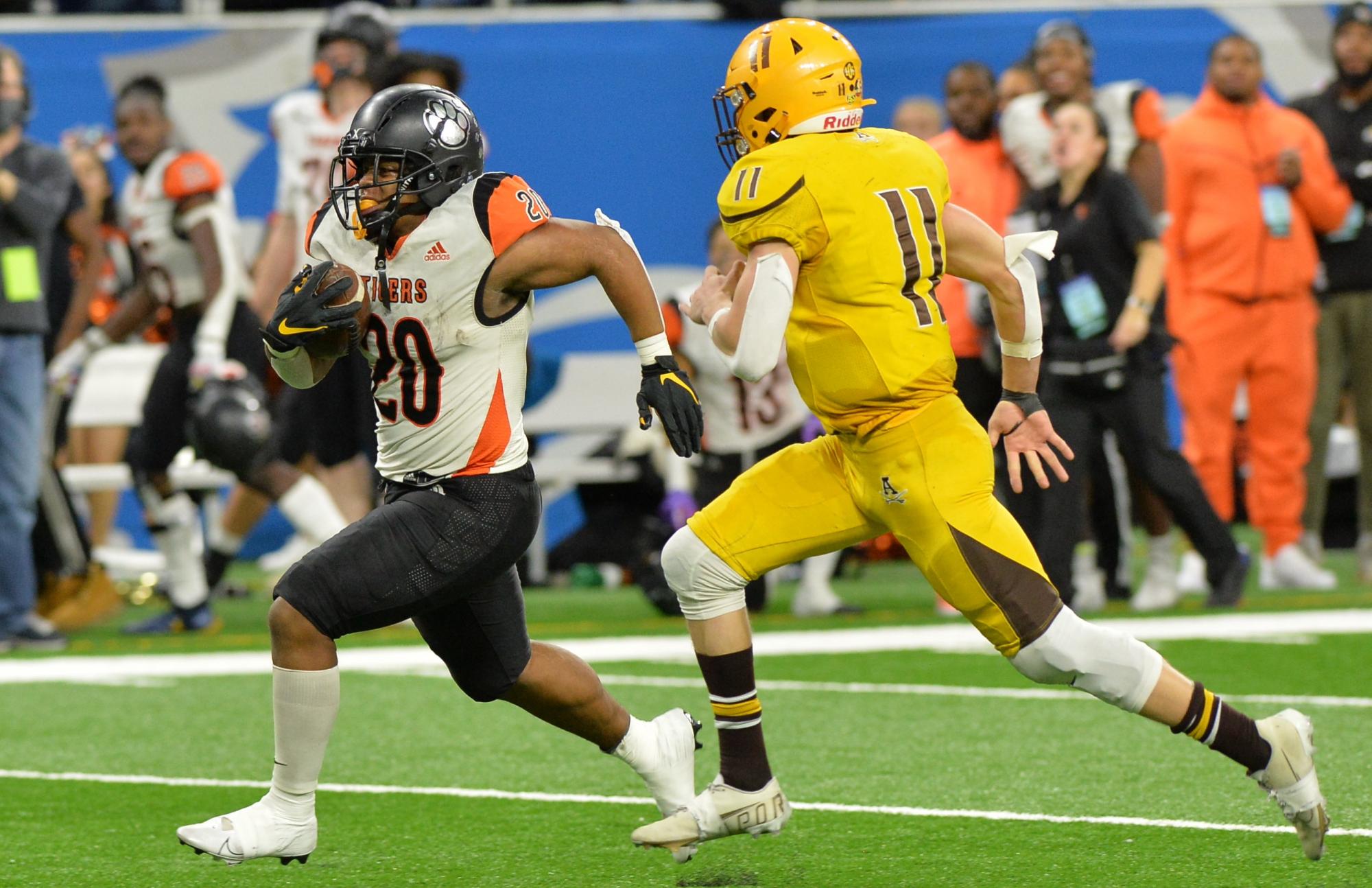
PHOTOS (Top) Belleville’s Jeremiah Caldwell (2) prepares to make his move as Rochester Adams’ Marco Dicresce (4) looks to make a stop. (Middle) The Tigers’ Davieon Pitchford (20) attempts to run past Adams’ Parker Picot (11). (Photos by Hockey Weekly Action Photos.)