


Classes Still Create Hoosier Hysteria
July 27, 2017
By Rob Kaminski
MHSAA benchmarks editor
This is the fourth part in a series on MHSAA tournament classification, past and present, that will be published over the next two weeks. This series originally ran in this spring's edition of MHSAA benchmarks.
Twenty years ago, Bloomington North High School won the Indiana High School Athletic Association boys basketball championship, defeating Delta 75-54 at the RCA Dome in Indianapolis.
The date, March 22, 1997, is at the same time revered and disdained by traditionalists in the state who saw it as the last schoolboy championship game the state would ever host.
That’s how devout the game of basketball, particularly interscholastic basketball, had become in the Hoosier state during the 87 years a state champion – one state champion, to be precise – was crowned.
Following that 1997 season, the IHSAA moved to a four-class system for its roundball tournaments, like so many of its state association counterparts had done years earlier.
It would be shocking to find more than a small percentage of current high school basketball players around the country unfamiliar with the iconic movie Hoosiers, even though the film is now more than 30 years old.
And, the storyline for that blockbuster unfolded more than 30 years prior to its release, when small-town, undermanned Milan High School defeated Muncie Central High School 32-30 in the 1954 IHSAA title game.
Perhaps it’s because of the David vs Goliath notion, or the fame of the movie that replaced Milan with the fictional Hickory and real-life star Bobby Plump with Hollywood hero Jimmy Chitwood, or the simple fact that Indiana had something other states didn’t.
Whatever the reason, plenty of opposition remains to this day to basketball classification in the state.
The fact is, the small rural schools were regularly being beaten handily by the much larger suburban and city schools as the tournament progressed each season.
Small schools also were closing at a rapid rate following the state’s School Reorganization Act in 1959, as students converged on larger, centralized county schools. From 1960 to 2000, the number of schools entering the tournament dropped from 694 to 381, and in 1997 a total of 382 schools and 4,584 athletes began competition at the Sectional level (the first level of the IHSAA Basketball Tournament).
It was at the entry level of the tournament where school administrators felt the pain of the new class system, but not necessarily for the same nostalgic reasons as the fans who either attended or boycotted the tournament.
At the Sectional round of the tournament, the IHSAA was culling just 2 percent of the revenue, with the participating schools splitting the balance. So, when Sectional attendance dropped by 14 percent in that first year of class basketball, many schools realized a financial loss. It was money they had grown to count on in prior years to help fund various aspects of the department.
Schools cumulatively received more than $900,000 from Sectional competition in 1998, but that total was down from more than $1 million in the last year of the single-class tournament.
Yet, the current format provides a great deal more opportunity and realistic chances at championship runs for schools of all enrollments.
To date, 60 additional teams have championship or runner-up trophies on display in school trophy cases around Indiana.
That was the mission in front of then-IHSAA commissioner Bob Gardner (now National Federation executive director) once the board made its decision: to give thousands more student-athletes the opportunity for once-in-a-lifetime experiences.
As any statistician knows, figures can be manipulated to tell any side of a story. Declining attendance in year one of class basketball is such a number.
The truth is tournament attendance had been on a steady downward spiral since its peak of just over 1.5 million in 1962. By the last single-class event in 1997, the total attendance was half that.
The challenge then and today, as it is for all state associations, is to find that delicate balance for those holding onto tradition, those holding onto trophies, and the number of trophies to hand out.
Editor’s Note: Stories from the Fort Wayne Journal Gazette in 1998 and from a 2007 issue of Indianapolis Monthly provided facts in this article.
Title IX at 50: Pioneer's Joyce Legendary in Michigan, National Swim History
By
Geoff Kimmerly
MHSAA.com senior editor
November 9, 2021
Michigan has had no shortage of achievers in the swimming pool over a half-century of girls swimming & diving sponsorship by the MHSAA. But nearly two decades after her last high school race, Ann Arbor Pioneer’s Kara Lynn Joyce's achievements remain among the highest of standards.
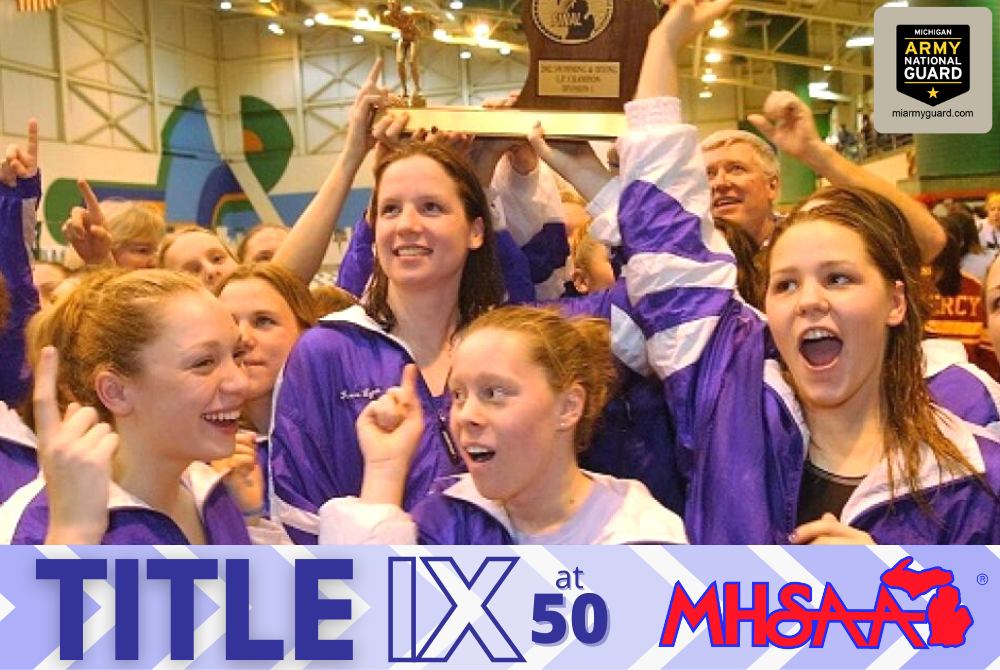
Joyce starred on the 2001 and 2002 teams that were the second and third, respectively, of Pioneer’s nine straight champions in Lower Peninsula Class A and then Division 1 (with that reclassification in 2002). She was part of four race champions both years – in the 100-yard freestyle and as part of the 400 freestyle relay at both Finals, while as a junior in the 50 and as part of the 200 medley relay and as a senior in 200 freestyle and 200 free relay.
Her name remains an incredible 16 times in the MHSAA girls swimming & diving record book, including seven times on the all-Finals lists (for performances from all Classes and Divisions combined). Her 50 (22.04 seconds – leading off a relay) and 100 (48.59) freestyles in 2002 remain all-Finals record, as does the 200 freestyle relay (1:32.77) she swam with Margaret Kelly, Leigh Cole and Jennifer Merte that season. Her winning 1:46.34 in the 200 as a senior is second all-time at the Finals only to another future Olympian, Canton’s Allison Schmitt, who finished nine hundredths of a second faster five years later.
Joyce’s 50 remains fifth all-time in the national record book, and her 100 ranks 13th on that list. Pioneer’s 2002 200 freestyle relay ranks sixth nationally.
Joyce went on to swim at University of Georgia and then during the 2004, 2008 and 2012 Olympics. She won four silver medals, two each as part of 400-meter freestyle and 400-meter medley relays.
That 2002 Pioneer team is still considered arguably the most dominant in MHSAA history. The Pioneers claimed that first LP Division 1 title with 476 points, by 275 over the rest of the field. No LP Division 1 team has broken 400 points at a Final since.
Joyce has become a strong voice in leadership training for teenage girls in athletics. In 2017, she founded Lead Sports Co., which serves as a “home base for teenage girl athletes, parents and coaches with comprehensive online courses in Leadership, Confidence, Sports Psychology, and more.”
Second Half's weekly Title IX Celebration posts are sponsored by Michigan Army National Guard.
Previous Title IX at 50 Spotlights
Nov. 2: Royal Oak's Finch Leading Way on Football Field - Read
Oct. 26: Coach Clegg Sets Championship Standard at Grand Blanc - Read
Oct. 19: Rockford Girls Set Pace, Hundreds After Have Continued to Chase - Read
Oct. 12: Bedford Volleyball Pioneer Continues Blazing Record-Setting Trail - Read
Oct. 5: Warner Paved Way to Legend Status with Record Rounds - Read
Sept. 28: Taylor Kennedy Gymnasts Earn Fame as 1st Champions - Read
Sept. 21: Portage Northern Star Byington Becomes Play-by-Play Pioneer - Read
Sept. 14: Guerra/Groat Legacy Continues to Serve St. Philip Well - Read
Sept. 7: Best-Ever Conversation Must Include Leland's Glass - Read
Aug. 31: We Will Celebrate Many Who Paved the Way - Read
PHOTOS Ann Arbor Pioneer celebrates the Lower Peninsula Division 1 championship; Olympian Kara Lynn Joyce stands middle, just below the trophy. (MHSAA File Photos.)