


Classes Still Create Hoosier Hysteria
July 27, 2017
By Rob Kaminski
MHSAA benchmarks editor
This is the fourth part in a series on MHSAA tournament classification, past and present, that will be published over the next two weeks. This series originally ran in this spring's edition of MHSAA benchmarks.
Twenty years ago, Bloomington North High School won the Indiana High School Athletic Association boys basketball championship, defeating Delta 75-54 at the RCA Dome in Indianapolis.
The date, March 22, 1997, is at the same time revered and disdained by traditionalists in the state who saw it as the last schoolboy championship game the state would ever host.
That’s how devout the game of basketball, particularly interscholastic basketball, had become in the Hoosier state during the 87 years a state champion – one state champion, to be precise – was crowned.
Following that 1997 season, the IHSAA moved to a four-class system for its roundball tournaments, like so many of its state association counterparts had done years earlier.
It would be shocking to find more than a small percentage of current high school basketball players around the country unfamiliar with the iconic movie Hoosiers, even though the film is now more than 30 years old.
And, the storyline for that blockbuster unfolded more than 30 years prior to its release, when small-town, undermanned Milan High School defeated Muncie Central High School 32-30 in the 1954 IHSAA title game.
Perhaps it’s because of the David vs Goliath notion, or the fame of the movie that replaced Milan with the fictional Hickory and real-life star Bobby Plump with Hollywood hero Jimmy Chitwood, or the simple fact that Indiana had something other states didn’t.
Whatever the reason, plenty of opposition remains to this day to basketball classification in the state.
The fact is, the small rural schools were regularly being beaten handily by the much larger suburban and city schools as the tournament progressed each season.
Small schools also were closing at a rapid rate following the state’s School Reorganization Act in 1959, as students converged on larger, centralized county schools. From 1960 to 2000, the number of schools entering the tournament dropped from 694 to 381, and in 1997 a total of 382 schools and 4,584 athletes began competition at the Sectional level (the first level of the IHSAA Basketball Tournament).
It was at the entry level of the tournament where school administrators felt the pain of the new class system, but not necessarily for the same nostalgic reasons as the fans who either attended or boycotted the tournament.
At the Sectional round of the tournament, the IHSAA was culling just 2 percent of the revenue, with the participating schools splitting the balance. So, when Sectional attendance dropped by 14 percent in that first year of class basketball, many schools realized a financial loss. It was money they had grown to count on in prior years to help fund various aspects of the department.
Schools cumulatively received more than $900,000 from Sectional competition in 1998, but that total was down from more than $1 million in the last year of the single-class tournament.
Yet, the current format provides a great deal more opportunity and realistic chances at championship runs for schools of all enrollments.
To date, 60 additional teams have championship or runner-up trophies on display in school trophy cases around Indiana.
That was the mission in front of then-IHSAA commissioner Bob Gardner (now National Federation executive director) once the board made its decision: to give thousands more student-athletes the opportunity for once-in-a-lifetime experiences.
As any statistician knows, figures can be manipulated to tell any side of a story. Declining attendance in year one of class basketball is such a number.
The truth is tournament attendance had been on a steady downward spiral since its peak of just over 1.5 million in 1962. By the last single-class event in 1997, the total attendance was half that.
The challenge then and today, as it is for all state associations, is to find that delicate balance for those holding onto tradition, those holding onto trophies, and the number of trophies to hand out.
Editor’s Note: Stories from the Fort Wayne Journal Gazette in 1998 and from a 2007 issue of Indianapolis Monthly provided facts in this article.
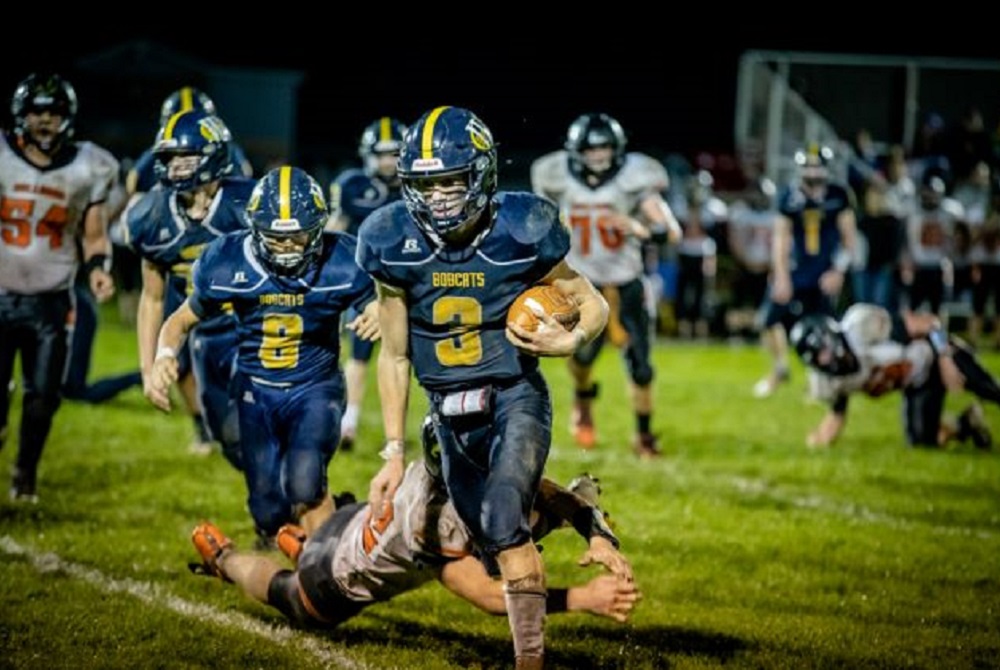
After Growing Up in Program, Giesige Earns Place Among Whiteford Greats
By
Doug Donnelly
Special for MHSAA.com
October 26, 2021
Cole Giesige had a big smile on his face when he went into the Ottawa Lake Whiteford huddle during the fourth quarter of Friday night’s win at Erie Mason.
 Giesige normally is a running back for the Bobcats, but he is also the backup quarterback for the team. When Whiteford built a big lead Friday to clinch the outright Tri-County Conference championship, Whiteford head coach Jason Mensing inserted Giesige at quarterback.
On the first play, Mensing called Giesige’s number. He then put his arm around the 6-foot-1 senior and called the play.
“He said, ‘You are two yards away from 1,000. Do you want to get it on this play?’ Giesige recalled. “I said, ‘Yeah.’ I was smiling when I went into the huddle.”
Giesige kept the ball and sliced his way through the Erie Mason defensive line for a six-yard gain. Goal accomplished. It was his final carry of the game, but it was a big one. It gave him 1,004 yards for the season.
“The line said, ‘All right, we’re going to get this for you’ and they did,” Giesige said. “I knew I had 909 coming into the game, but I didn’t know where I was at that point. When coach told me, I just started to smile.”
Reaching 1,000 yards has been a goal for Giesige since he was summoned to the varsity his sophomore season.
“That was one thing I set out to do,” Giesige said. “When I was a sophomore and I knew I was going to be on the varsity, I put goals on my walls, and one of them was 1,000 yards in a season. I’m glad I was finally able to accomplish that.”
Mensing said that after a big JV season as a freshman, Giesige was destined to be a big part of the Whiteford football team for the next three seasons.
“He’s a great kid,” Mensing said. “We knew when he was a sophomore and we brought him up that we were going to be relying on him to make big plays. He’s done a nice job.”
On Friday, Whiteford finished the regular season with an 8-1 record and No. 2 in playoff points in Division 8. The Bobcats are among favorites to make a deep run in the playoffs.
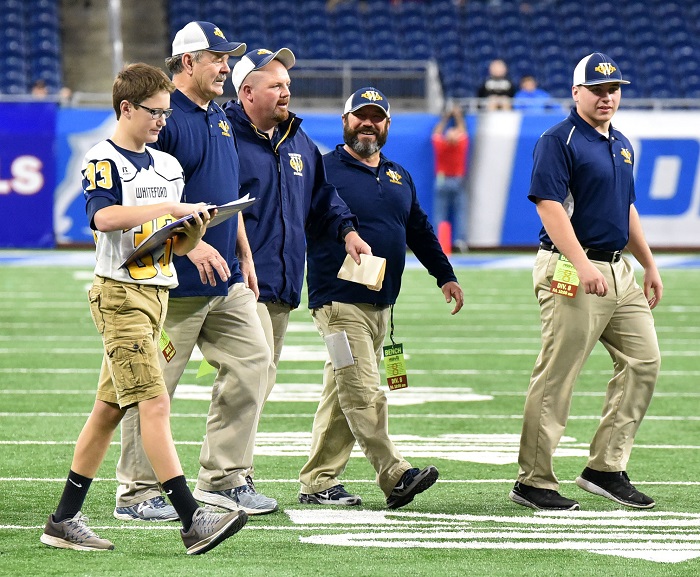 Giesige was in eighth grade when the Bobcats made its best-ever playoff run – winning the 2017 Division 8 championship. Giesige played middle school football for the Bobcats that season, but served a role for the varsity as well – he was on the Whiteford sideline for the Final at Ford Field, charting defensive plays for the coaching staff.
“He’s been a part of the program for a long time,” Mensing said.
The son of Troy and Kim Giesige is also an accomplished baseball and basketball player at Whiteford. He was an all-state pitcher last year for the Bobcats baseball team that reached the Quarterfinals, and he is fielding offers to play the sport after high school. He led the Whiteford basketball team in scoring last winter.
“He is a competitor that has a passion to improve at his craft daily,” Mensing said. “He has high expectations for himself and those around him.”
It’s been an outstanding football season for Giesige. He has done a little bit of everything for the Bobcats.
Heading into Friday’s playoff opener, he has scored 25 touchdowns and converted nine two-point conversions for 168 points. He’s rushed for 18 touchdowns, caught four touchdown passes, returned two kickoffs for scores, and went 100 yards on an interception return in Week 8 against Petersburg Summerfield.
He now holds the record for longest kickoff return (95 yards) and longest interception return (100 yards) in school history. He’s moving up the charts in season and career touchdowns. He averages 9.3 yards per carry and nearly 23 yards per reception. His kickoff return average is 40 yards per attempt.
Mensing said scoring touchdowns isn’t all that he does.
“He is a solid blocker, a good ball catcher and obviously a back with good vision and ability to cut,” the 10th-year Whiteford coach said.
Whiteford has been on a roll of late. The Bobcats enter the postseason on a five-game winning streak and are averaging 52 points per game. During the win streak, they have scored 58, 54, 76, 46 and 62 points.
Giesige is one of just five seniors on the team, but they all play important roles. Two-way tackle Noah Bauman is a two-time all-stater and makes an impact on both sides of the ball. Jack Andrews was a center as a sophomore but was converted to tight end and he has caught four touchdowns this season. Ty Ruddy is a team leader and two-way starter, and linebacker Levi Hillard is among the team’s top tacklers.
Thanks to that core group, the Bobcats are primed and ready to make noise in the playoffs.
“I’m not really certain how it compares to years past as each team and journey is so unique,” Mensing said. “I do know we have a great group of guys that I think want to keep competing together a little longer.”
 Doug Donnelly has served as a sports and news reporter and city editor over 25 years, writing for the Daily Chief-Union in Upper Sandusky, Ohio from 1992-1995, the Monroe Evening News from 1995-2012 and the Adrian Daily Telegram since 2013. He's also written a book on high school basketball in Monroe County and compiles record books for various schools in southeast Michigan. E-mail him at [email protected] with story ideas for Jackson, Washtenaw, Hillsdale, Lenawee and Monroe counties.
PHOTOS (Top) Ottawa Lake Whiteford’s Cole Giesige runs the ball during a win over Petersburg Summerfield this season. (Middle) Giesige (far left) walks with the coaching staff during halftime of Whiteford’s 2017 Division 8 Final at Ford Field. (Top photo by Natalie McCormack; middle photo by Cari Hayes.)