


Classes Still Create Hoosier Hysteria
July 27, 2017
By Rob Kaminski
MHSAA benchmarks editor
This is the fourth part in a series on MHSAA tournament classification, past and present, that will be published over the next two weeks. This series originally ran in this spring's edition of MHSAA benchmarks.
Twenty years ago, Bloomington North High School won the Indiana High School Athletic Association boys basketball championship, defeating Delta 75-54 at the RCA Dome in Indianapolis.
The date, March 22, 1997, is at the same time revered and disdained by traditionalists in the state who saw it as the last schoolboy championship game the state would ever host.
That’s how devout the game of basketball, particularly interscholastic basketball, had become in the Hoosier state during the 87 years a state champion – one state champion, to be precise – was crowned.
Following that 1997 season, the IHSAA moved to a four-class system for its roundball tournaments, like so many of its state association counterparts had done years earlier.
It would be shocking to find more than a small percentage of current high school basketball players around the country unfamiliar with the iconic movie Hoosiers, even though the film is now more than 30 years old.
And, the storyline for that blockbuster unfolded more than 30 years prior to its release, when small-town, undermanned Milan High School defeated Muncie Central High School 32-30 in the 1954 IHSAA title game.
Perhaps it’s because of the David vs Goliath notion, or the fame of the movie that replaced Milan with the fictional Hickory and real-life star Bobby Plump with Hollywood hero Jimmy Chitwood, or the simple fact that Indiana had something other states didn’t.
Whatever the reason, plenty of opposition remains to this day to basketball classification in the state.
The fact is, the small rural schools were regularly being beaten handily by the much larger suburban and city schools as the tournament progressed each season.
Small schools also were closing at a rapid rate following the state’s School Reorganization Act in 1959, as students converged on larger, centralized county schools. From 1960 to 2000, the number of schools entering the tournament dropped from 694 to 381, and in 1997 a total of 382 schools and 4,584 athletes began competition at the Sectional level (the first level of the IHSAA Basketball Tournament).
It was at the entry level of the tournament where school administrators felt the pain of the new class system, but not necessarily for the same nostalgic reasons as the fans who either attended or boycotted the tournament.
At the Sectional round of the tournament, the IHSAA was culling just 2 percent of the revenue, with the participating schools splitting the balance. So, when Sectional attendance dropped by 14 percent in that first year of class basketball, many schools realized a financial loss. It was money they had grown to count on in prior years to help fund various aspects of the department.
Schools cumulatively received more than $900,000 from Sectional competition in 1998, but that total was down from more than $1 million in the last year of the single-class tournament.
Yet, the current format provides a great deal more opportunity and realistic chances at championship runs for schools of all enrollments.
To date, 60 additional teams have championship or runner-up trophies on display in school trophy cases around Indiana.
That was the mission in front of then-IHSAA commissioner Bob Gardner (now National Federation executive director) once the board made its decision: to give thousands more student-athletes the opportunity for once-in-a-lifetime experiences.
As any statistician knows, figures can be manipulated to tell any side of a story. Declining attendance in year one of class basketball is such a number.
The truth is tournament attendance had been on a steady downward spiral since its peak of just over 1.5 million in 1962. By the last single-class event in 1997, the total attendance was half that.
The challenge then and today, as it is for all state associations, is to find that delicate balance for those holding onto tradition, those holding onto trophies, and the number of trophies to hand out.
Editor’s Note: Stories from the Fort Wayne Journal Gazette in 1998 and from a 2007 issue of Indianapolis Monthly provided facts in this article.
Preview: Next Challengers Set to Take Championship Strides
By
Geoff Kimmerly
MHSAA.com senior editor
October 22, 2021
A total of 17 top-10 individual finishers from last season’s Upper Peninsula Boys Cross Country Finals graduated this spring – resulting in a possible new look to at least one championship race Saturday at Gentz’s Homestead Golf Course in Marquette.
While Marquette remains an annual favorite in Division 1 and Dollar Bay looks like the team to chase again in Division 3, Division 2 might be a little less predictable for the first time in a while as always-speedy Ishpeming is among those bringing a mostly-new crew. Similarly, only one 2020 individual champion will return this weekend, and from a Division 3 also welcoming a number of new contenders.
Saturday’s races begin with the Division 1 girls at 11 a.m. and conclude with the Division 3 boys at 1:30 p.m. Check back Saturday evening for coverage, and see below for more teams and individuals to watch. (Click for race information and competitors.)
Division 1
Reigning champion: Marquette
2020 runner-up: Sault Ste. Marie
Top-ranked: 1. Marquette, 2. Houghton, 3. Calumet.
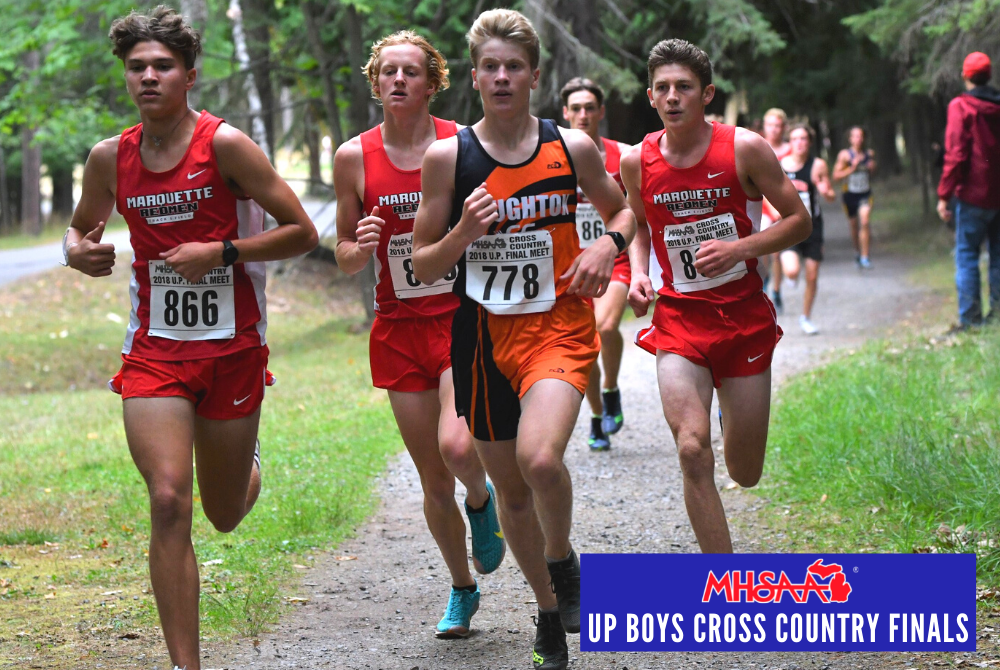
Marquette is seeking its third-straight Division 1 title after edging Sault Ste. Marie by nine points last season and six in 2019. Five of last season’s top seven runners will race again this weekend, including juniors Carson and Colin Vanderschaaf (who placed third and fifth, respectively, in 2020) and senior Luke Janofski (sixth) as all five Marquette returnees finished among the top 19 individuals overall. Senior Eric Weiss was the individual runner-up last season to lead Houghton’s third-place team finish, and he’s one of three back from that lineup. Sault Ste. Marie should figure in significantly again with four runners back from last season’s lineup (including three who placed among the top 19 overall), led by junior Cody Aldridge (eighth) and senior Riley Eavou (ninth).
Individuals: Total, 10 from last season’s top 20 will be back this weekend. Gladstone junior Drew Hughes is another to watch after finishing 12th a year ago and fifth as a freshman.
Division 2
Reigning champion: Ishpeming
2020 runner-up: Painesdale Jeffers
Top ranked: 1. Painesdale Jeffers, 2. Ironwood, 3. St. Ignace.
Ishpeming has won the last three Division 2 titles and six of the last seven, but graduated its top five runners from last season’s team and returns this weekend with five sophomores and a freshman. Painesdale Jeffers graduated four of its five runners from last season’s runner-up team, with junior Tavin Larson hoping to lead the next five to the front after taking fourth individually in 2020. Ironwood returns four runners from its fourth-place team finish, led by junior Tyler Smith (14th).
Individuals: Half of last season’s top 20 individual finishers graduated, and total seven runners will return this weekend from that remaining group. Larson is the highest-returning placer, followed by West Iron County sophomore John Swenski (eighth) and Ishpeming sophomore Parker Gauthier (10th).
Division 3
Reigning champion: Dollar Bay
2020 runner-up: Rudyard
Top ranked: 1. Dollar Bay, 2. Brimley, 3. Brimley Ojibwe Charter.
Dollar Bay went from runner-up in 2019 to winning its first championship in 2020, and four of its top six from last year will run this weekend with junior Cooper Stout returning after finishing sixth individually. Big things are expected from Brimley with four of its top five back after finishing fifth last season, and Ojibwe Charter brings back two of three individual qualifiers from a year ago as it seeks a high team finish. Stephenson is an interesting possibility with its top six runners back from last year’s team that finished fourth, including junior Griffin Brown (ninth individually) and senior Corey Buckley (11th).
Individuals: Half of the Division 3 top 20 from last season also graduated, but nine of the remaining 10 will be back Saturday. Ewen-Trout Creek senior Jonah Nordine is the reigning champ after clearing the field last season by nearly 25 seconds. Engadine junior Conrad Spieles also returns from the top 10 after placing ninth last fall.
PHOTO Marquette's Luke Janofski (866) and Colin Vanderschaaf (870), Houghton's Eric Weiss (778), and Marquette's Brady Ketzenberger (867) run at the Queen City Invitational this season. (Photo by Cara Kamps.)