


Classes Still Create Hoosier Hysteria
July 27, 2017
By Rob Kaminski
MHSAA benchmarks editor
This is the fourth part in a series on MHSAA tournament classification, past and present, that will be published over the next two weeks. This series originally ran in this spring's edition of MHSAA benchmarks.
Twenty years ago, Bloomington North High School won the Indiana High School Athletic Association boys basketball championship, defeating Delta 75-54 at the RCA Dome in Indianapolis.
The date, March 22, 1997, is at the same time revered and disdained by traditionalists in the state who saw it as the last schoolboy championship game the state would ever host.
That’s how devout the game of basketball, particularly interscholastic basketball, had become in the Hoosier state during the 87 years a state champion – one state champion, to be precise – was crowned.
Following that 1997 season, the IHSAA moved to a four-class system for its roundball tournaments, like so many of its state association counterparts had done years earlier.
It would be shocking to find more than a small percentage of current high school basketball players around the country unfamiliar with the iconic movie Hoosiers, even though the film is now more than 30 years old.
And, the storyline for that blockbuster unfolded more than 30 years prior to its release, when small-town, undermanned Milan High School defeated Muncie Central High School 32-30 in the 1954 IHSAA title game.
Perhaps it’s because of the David vs Goliath notion, or the fame of the movie that replaced Milan with the fictional Hickory and real-life star Bobby Plump with Hollywood hero Jimmy Chitwood, or the simple fact that Indiana had something other states didn’t.
Whatever the reason, plenty of opposition remains to this day to basketball classification in the state.
The fact is, the small rural schools were regularly being beaten handily by the much larger suburban and city schools as the tournament progressed each season.
Small schools also were closing at a rapid rate following the state’s School Reorganization Act in 1959, as students converged on larger, centralized county schools. From 1960 to 2000, the number of schools entering the tournament dropped from 694 to 381, and in 1997 a total of 382 schools and 4,584 athletes began competition at the Sectional level (the first level of the IHSAA Basketball Tournament).
It was at the entry level of the tournament where school administrators felt the pain of the new class system, but not necessarily for the same nostalgic reasons as the fans who either attended or boycotted the tournament.
At the Sectional round of the tournament, the IHSAA was culling just 2 percent of the revenue, with the participating schools splitting the balance. So, when Sectional attendance dropped by 14 percent in that first year of class basketball, many schools realized a financial loss. It was money they had grown to count on in prior years to help fund various aspects of the department.
Schools cumulatively received more than $900,000 from Sectional competition in 1998, but that total was down from more than $1 million in the last year of the single-class tournament.
Yet, the current format provides a great deal more opportunity and realistic chances at championship runs for schools of all enrollments.
To date, 60 additional teams have championship or runner-up trophies on display in school trophy cases around Indiana.
That was the mission in front of then-IHSAA commissioner Bob Gardner (now National Federation executive director) once the board made its decision: to give thousands more student-athletes the opportunity for once-in-a-lifetime experiences.
As any statistician knows, figures can be manipulated to tell any side of a story. Declining attendance in year one of class basketball is such a number.
The truth is tournament attendance had been on a steady downward spiral since its peak of just over 1.5 million in 1962. By the last single-class event in 1997, the total attendance was half that.
The challenge then and today, as it is for all state associations, is to find that delicate balance for those holding onto tradition, those holding onto trophies, and the number of trophies to hand out.
Editor’s Note: Stories from the Fort Wayne Journal Gazette in 1998 and from a 2007 issue of Indianapolis Monthly provided facts in this article.
No Just-Miss This Time: Groves Breaks Through with 1st Finals Win
By
Greg Chrapek
Special for Second Half
October 16, 2021
HOLLAND – This year’s Lower Peninsula Division 2 Boys Tennis Finals had a new look.
Along with the return to their traditional format after last year’s COVID-driven changes, the tournament featured a new champion, several new competing schools and some brand new names to the Division 2 tennis scene.
Birmingham Groves, a five-time Finals runner-up, broke through and claimed the first boys tennis team title in school history. Groves finished the two-day tournament Saturday with 27 points to edge a familiar name, two-time reigning Division 2 champion Grand Rapids Forest Hills Northern, by one point. Last year’s Division 1 champion, Okemos, had moved into Division 2 this season and tied for third place with Midland Dow as both teams totaled 20 points.
For Groves and coach Dave Farmer, the title meant the end of a chase lasting a decade.
“I’ve been coaching here since 2010 and we’ve had several second and third-place finishes,” Farmer said. “This one is very special because it’s the first high school title I’ve ever won. I won three titles at Eastern Michigan University, but this is my first in 12 years of coaching high school tennis.
“We have a veteran team this year, and that is a big reason why we won it. We had great senior leadership and a lot of good juniors as well.”
Groves came into the tournament with nine seniors on the team and seven in the starting lineup. The Falcons were paced by their singles lineup but received big efforts from doubles down the stretch.
“We have a good group of singles players that carried us for the bulk of the year,” Farmer said. “Our doubles teams really picked it up in the tournament and really helped solidify the team.”
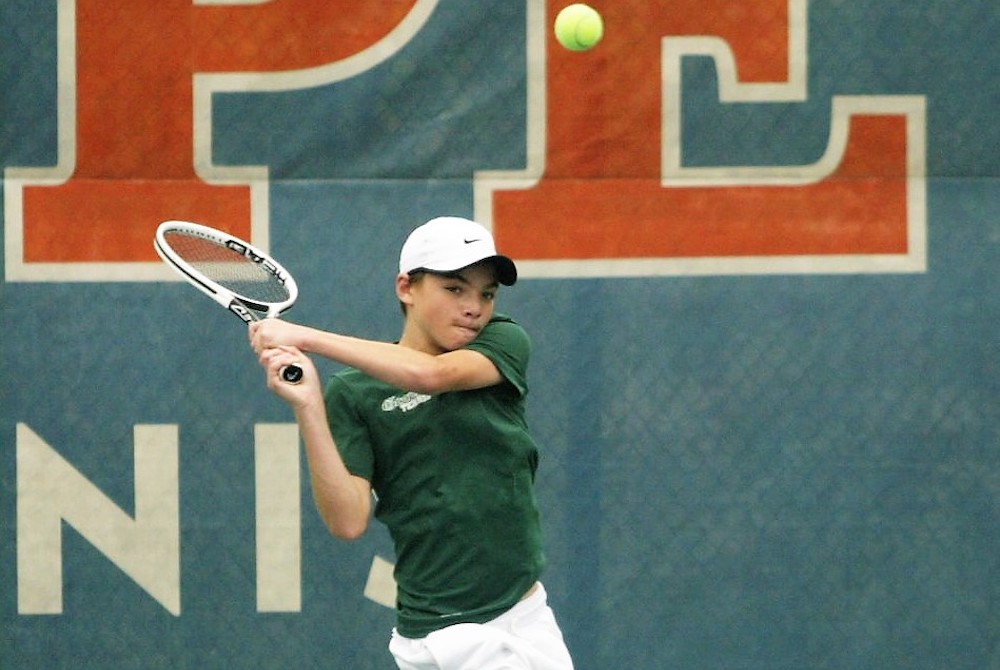
The Falcons also had a talented freshman in the singles lineup, and he made his high school Finals debut in a big way. Groves freshman Michael Liss won the No. 3 singles title as he defeated Will Seymour of Detroit U-D Jesuit 6-4, 6-3.
“It feels absolutely amazing,” Liss said. “I just tried to stay calm and not get upset at anything at all. I feel that as a team we were a cohesive unit, and we all pushed each other to get better. I’m just a freshman, but I know we’ve been really close to winning it as a team. We’ve finished second and third a lot so we really wanted to win it this year.”
Liss was not the only freshman to win an individual flight championship. Okemos freshman Suchir Nagisetty arrived on the Finals stage in a big way as well as he defeated Andrew Williams of Mattawan 7-5, 6-1, to clinch at No. 4 singles.
The win was especially meaningful for Nagisetty as he followed in the footsteps of his older brother Sid who won an individual flight title during his freshman season at Okemos in 2017. Sid was in attendance cheering and supporting his brother and has played his own role in Suchir’s development as a player.
 “My brother coached me and trained me this summer,” Suchir said. “I wanted to follow in his footsteps and win a state title in my freshman year. It is something I’ve thought about for a long time. There is some pressure, but once you start playing the match your love of tennis takes over and you just concentrate on playing the game. Winning the title feels great, and it’s nice to have something in common I can share with my brother.”
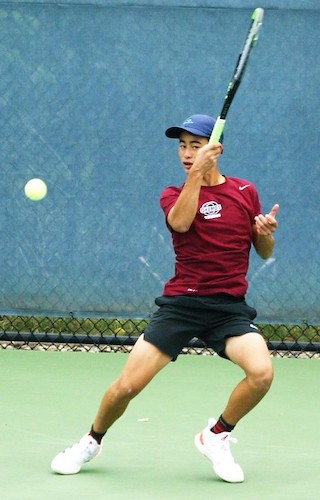
A new name to Division 2 tennis but a familiar face on the state scene, Okemos sophomore Ethan Portnoy, came away with the No. 1 singles championship. Portnoy, who played doubles last season, moved up to No. 1 singles and defeated Connor Stafford of Grosse Pointe South 6-3, 6-4.
Like Nagisetty, Portnoy had a good example of what it takes to win an individual championship under his own roof as his older brother Josh Portnoy was a two-time Finals flight champion during his high school career at Okemos.
“It’s really cool to follow in my older brother’s footsteps,” Portnoy said. “I had a lot of confidence that I could do it. I played a lot of USTA (United States Tennis Association) tournaments in the summer and had a lot of tough matches, and I knew I could bring that experience to high school tennis.”
At No. 2 singles, senior Owen Goodrich of Forest Hills Northern wrapped up his career in a memorable way by outlasting Okemos senior George Fan in a grueling, three-set struggle 6-2, 3-6, 6-4.
“I just took it one point at a time,” Goodrich said. “I’ve played him before, and I knew it was going to be a tough match. I knew he’s a great player, but he’s not invincible.”
Winning his final match as a senior was a fitting way to go out for Goodrich, who lost in the final at No. 4 singles as a freshman.
“I lost in the state finals to a player from Okemos as a freshman,” Goodrich said. “Now I win my final match in the state finals against a player from Okemos. I couldn’t ask for a better way to finish my senior year. It’s amazing.”
In doubles competition, winners came from four schools.
Grosse Pointe South, in Division 2 for the first time after having played in Division 1 for years, finished in a tie for sixth place and was led by seniors Blake Discher and Alex Prather. Discher and Prather teamed up to stop Thomas Ladwein and Aaron Li of Midland Dow 6-4, 6-3, at No. 1 doubles.
“We played really good,” Prather said. “It was one of our best days ever. This is the second year that we’ve played as partners, and we do a great job of supporting each other.”
The duo was determined to bring home a title for South, and even though they believed they could win, there was an element of awe when it was over.
“I thought we could take it with how much we put into it,” Discher said, “but in the end we were kind of shocked that we actually did it.”
The Jesuit No. 4 doubles team of Sam Owens and Stephen Cibulas won a tough struggle against Andrew Weitzman and Gabe Klein of Groves 7-5, 7-6 (2). The win was made even harder considering the duo had just spent plenty of energy getting past a tough Forest Hills Northern team in the semifinal round.
“We had a real tough match with Forest Hills Northern, and it drained a lot of our energy,” Owens said. “We had to be more mentally tough in this match. They were up 4-1 in the second half so we had to come back to win it.”
“We just played with more energy,” Cibulas added. “It was all about the energy. We also support each other really well.”
At No. 2 doubles, the Forest Hills Northern duo of Aaryan Singh and Anderson Halland were pushed to the limit before claiming a 3-6, 6-1, 6-3, victory against Dylan Wolf and Alexandras Abarius of Groves.
Birmingham Seaholm, which tied for sixth with Grosse Pointe South, was paced by its No. 3 doubles team of Alex George and Alex Lewis. The Seaholm duo won the No. 3 doubles title by stopping Kyle Wang and Joey Lamberg of Forest Hills Northern 6-3, 6-3.
PHOTOS (Top) Birmingham Groves' Michael Liss returns a volley Saturday during his run to the No. 3 singles championship. (Middle) Okemos' Ethan Portnoy drives a shot during a No. 1 singles match. (Click for more from High School Sports Scene.)