


Classes Still Create Hoosier Hysteria
July 27, 2017
By Rob Kaminski
MHSAA benchmarks editor
This is the fourth part in a series on MHSAA tournament classification, past and present, that will be published over the next two weeks. This series originally ran in this spring's edition of MHSAA benchmarks.
Twenty years ago, Bloomington North High School won the Indiana High School Athletic Association boys basketball championship, defeating Delta 75-54 at the RCA Dome in Indianapolis.
The date, March 22, 1997, is at the same time revered and disdained by traditionalists in the state who saw it as the last schoolboy championship game the state would ever host.
That’s how devout the game of basketball, particularly interscholastic basketball, had become in the Hoosier state during the 87 years a state champion – one state champion, to be precise – was crowned.
Following that 1997 season, the IHSAA moved to a four-class system for its roundball tournaments, like so many of its state association counterparts had done years earlier.
It would be shocking to find more than a small percentage of current high school basketball players around the country unfamiliar with the iconic movie Hoosiers, even though the film is now more than 30 years old.
And, the storyline for that blockbuster unfolded more than 30 years prior to its release, when small-town, undermanned Milan High School defeated Muncie Central High School 32-30 in the 1954 IHSAA title game.
Perhaps it’s because of the David vs Goliath notion, or the fame of the movie that replaced Milan with the fictional Hickory and real-life star Bobby Plump with Hollywood hero Jimmy Chitwood, or the simple fact that Indiana had something other states didn’t.
Whatever the reason, plenty of opposition remains to this day to basketball classification in the state.
The fact is, the small rural schools were regularly being beaten handily by the much larger suburban and city schools as the tournament progressed each season.
Small schools also were closing at a rapid rate following the state’s School Reorganization Act in 1959, as students converged on larger, centralized county schools. From 1960 to 2000, the number of schools entering the tournament dropped from 694 to 381, and in 1997 a total of 382 schools and 4,584 athletes began competition at the Sectional level (the first level of the IHSAA Basketball Tournament).
It was at the entry level of the tournament where school administrators felt the pain of the new class system, but not necessarily for the same nostalgic reasons as the fans who either attended or boycotted the tournament.
At the Sectional round of the tournament, the IHSAA was culling just 2 percent of the revenue, with the participating schools splitting the balance. So, when Sectional attendance dropped by 14 percent in that first year of class basketball, many schools realized a financial loss. It was money they had grown to count on in prior years to help fund various aspects of the department.
Schools cumulatively received more than $900,000 from Sectional competition in 1998, but that total was down from more than $1 million in the last year of the single-class tournament.
Yet, the current format provides a great deal more opportunity and realistic chances at championship runs for schools of all enrollments.
To date, 60 additional teams have championship or runner-up trophies on display in school trophy cases around Indiana.
That was the mission in front of then-IHSAA commissioner Bob Gardner (now National Federation executive director) once the board made its decision: to give thousands more student-athletes the opportunity for once-in-a-lifetime experiences.
As any statistician knows, figures can be manipulated to tell any side of a story. Declining attendance in year one of class basketball is such a number.
The truth is tournament attendance had been on a steady downward spiral since its peak of just over 1.5 million in 1962. By the last single-class event in 1997, the total attendance was half that.
The challenge then and today, as it is for all state associations, is to find that delicate balance for those holding onto tradition, those holding onto trophies, and the number of trophies to hand out.
Editor’s Note: Stories from the Fort Wayne Journal Gazette in 1998 and from a 2007 issue of Indianapolis Monthly provided facts in this article.

Central Lake/Ellsworth Remains Model of Football Cooperation
By
Tom Spencer
Special for MHSAA.com
September 24, 2021
The year was 1989, and Dutch Essenberg was a freshman at Ellsworth High School. Playing football simply was not an option.
 His Lancers hadn’t fielded a team in years.
Little did he know that he would get the opportunity to play football his junior and senior years thanks to the vision of Hugh Campbell and Denny YoungeDyke.
Campbell, a renowned community member of Ellsworth, and YoungeDyke, then the football coach at Central Lake, started discussing a co-operative agreement between the two schools – located just seven miles apart – about the time Essenberg was entering high school.
Also at that time, Jack Roberts became the MHSAA’s executive director, a post he held for 32 years. If you ask Campbell, Roberts got there just in time. Roberts is credited with developing plans for smaller schools to sponsor cooperative teams, and his legacy also includes being a champion of 8-player football.
The co-op produced great results immediately. The Trojans went undefeated the first year and suffered only two losses the second.
Today, without a co-op and the 8-player format, student-athletes at Ellsworth and Central Lake would not be playing high school football.
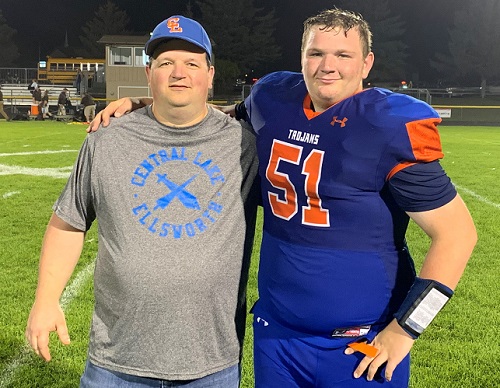
 That’s something of which Daryl Purdy is extremely aware. He was a senior lineman at Central Lake when the schools started playing football together in 1991. Today his son Garrett is a senior at Central Lake playing for the Central Lake/Ellsworth Trojans. And, Daryl serves as assistant coach for the team.
The Trojans share the honor of the longest-running football co-op in Michigan history with Manistee Catholic Central/Mason County Eastern, which also participates in 8-player. Central Lake/Ellsworth moved to 8-player in 2017, and immediate captured the Division 1 championship.
The Trojans are hosting Homecoming and Bellaire, a big rival, tonight on the gridiron.
“Without the co-op today, we would not have football in Central Lake - period,” Daryl Purdy pointed out. “Even with the two schools combined, we have to go 8-man to be competitive.
“As much as it meant to me to play football, it means even more to me to watch my son play and be able to help assistant coach … and be there with him and share the experience with him — it is just mind-blowing to me.”
The co-op is extra special for Garrett, knowing his Dad played on the first team and competed against the Lancers in other sports right after.
“It is special, that’s for sure,” the senior center and nose guard said. “I am pretty good friends with everyone from Ellsworth.
“We all have a bond that lasts after football season too,” he continued. “We are still a family after football.”
Purdy, the coach, agrees.
“That’s what amazes me the most … the kids even then and today,” he said. “We are a family and friends during football season.
“And then we go turn back to warriors again during basketball and baseball season,” he added. “It also makes it more special and even more competitive.”
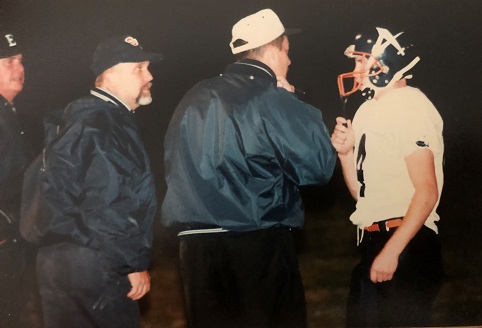
 YoungeDyke, now retired, coached 17 years total at Central Lake. He was assisted in the successful co-op launch by Campbell, then the Lancers’ basketball coach and now president of the Ellsworth village council.
YoungeDyke cites Campbell as the key to all of the co-op’s success today. As a basketball coach, Campbell welcomed the additional training the boys could get in the fall.
“He’s kind of Mr. Ellsworth,” YoungeDyke said. “His whole life has been dedicated to kids of Ellsworth.”
YoungeDyke insisted Campbell come on board for the first season to help the community buy-in process.
“(Campbell) goes, ‘Ah, I am not a football coach,’” YoungeDyke recalled. “I said, ‘You know what Hugh, you’re a coach. A coach is a coach. It’s the only way it’s going to work.’”
Campbell, who remained the assistant coach for nearly a decade, credits Roberts with making the co-op a reality.
“Denny (YoungeDyke) and I and some others in Central Lake had been talking about (a co-op) for a while,” Campbell said. “We didn’t get anywhere until the new MHSAA director (Roberts) came from Wisconsin, and he liked co-ops. It’s really helped a lot of kids.”
The blessing of the co-op by the MHSAA led to a new helmet melding the Ellsworth Lancers and the Central Lake Trojans featuring a Trojan sword crossing an Ellsworth lance. It was designed by the co-op’s first manager, 11-year old Drew YoungeDyke, the coach’s son.
Drew went to play quarterback in the fall of 1996 and 1997 for the Trojans, alongside Nick Hopp, the Trojans’ current athletic director.
The younger YoungeDyke recalls his father wanting to make sure the Ellsworth players felt welcomed in the co-op and thought a new helmet design would extend the welcome mat.
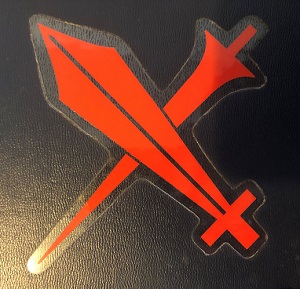 “The two mascots — the Lancers and the Trojans — just made it real simple,” Drew said. “I just took a lance and I took a Trojan’s broadsword, and I just crossed them.
“I was 11, and it wasn’t like I was a design expert then,” he continued. “I remember sketching it out in my little like Trapper Keeper. It’s pretty cool to see that years later.”
Many like Drew believe football in the two communities would have ended within five years had the co-op not been created.
Central Lake/Ellsworth is 1-3 this fall after a 44-40 loss to Pellston last week, but also will be added to the MHSAA record book when this season is done after combining with Indian River Inland Lakes for the highest-scoring 8-player game in state history. The teams combined for 152 points Sept. 11 in Inland Lakes’ 86-66 win.
Today’s coach, Chase Hibbard, is thrilled to have nine Ellsworth student-athletes on the 23-player roster.
“If it wasn’t for Ellsworth, we would not have a team,” Hibbard indicated. “Every year the pool from Ellsworth is growing.”
Essenberg, who played receiver, quarterback and running back, liked the idea of playing for the Trojans even if only to get him in better shape for his junior basketball season with the Lancers.
Now Essenberg hopes the co-op will provide his son Nolan with a chance to play high school football. Nolan is 11.
“We were all kind of nervous because you know it was a rival town,” Essenberg said. “I remember coach YoungeDyke saying ‘if you don’t like it, you can leave.’
“Nobody left.”
 Tom Spencer is a longtime MHSAA-registered basketball and soccer official, and former softball and baseball official, and he also has coached in the northern Lower Peninsula area. He previously has written for the Saginaw News, Bay County Sports Page and Midland Daily News. He can be reached at [email protected] with story ideas for Manistee, Wexford, Missaukee, Roscommon, Ogemaw, Iosco, Alcona, Oscoda, Crawford, Kalkaska, Grand Traverse, Benzie, Leelanau, Antrim, Otsego, Montmorency, Alpena, Presque Isle, Cheboygan, Charlevoix and Emmet counties.
PHOTOS: (Top) Central Lake/Ellsworth’s receivers line up during a Week 4 game against Pellston. (2) Coaches (from left) Hugh Campbell, Denny YoungeDyke and Matt Peters talk things over with quarterback Drew YoungeDyke during the 1997 season. (3) Daryl, left, and Garrett Purdy. (4) Drew YoungeDyke’s helmet logo design remains a symbol of the community’s football cooperation 25 seasons later. (Photos courtesy of the Central Lake/Ellsworth football program.)